Powered By Blogger
Showing posts with label Frank Gorshin. Show all posts

Wednesday, April 3, 2013

Batman (TV Series): Why It's Friggin' Awesome, despite what comic book purists would have you believe.


I think for most people from my generation (and my parents) their first exposure to Batman was the campy 1960s television show starring Adam West. It was a show that I watched religiously when I was a kid, to the point that when it was taken off syndication I was absolutely devastated. I sat in my room for days and sulked about it. How could I live without my daily dose of The Dynamic Duo? It also meant that I would deprived of the greatest TV theme song in history.

The highlight of each episode was the fight scenes, whenever Batman and Robin would punch villain, words like, POW, BAM, BOOF, would appear on the screen. It was away to emphasize the very comic book nature of the television show.
The Batman in the TV show was an upstanding citizen who apparently had no vices, he didn't drink, didn't smoke and was able to keep his sexual urges in check, despite the fact that beautiful women were constantly throwing themselves at him. He was a goody two shoes who packed a mean wallop.

As a kid, Adam West was the DEFINITIVE Batman, until 1989, when the Tim Burton/Michael Keaton movie was released. The Tim Burton film went back to Batman's roots and made him a dark, brooding character haunted by the death of his parents, as opposed to the rather whimsical, benevolent authority figure of the old Adam West series. It was the DEFINITIVE Batman movie, until 2005 when Batman Begins was released to the cinemas.  Christopher Nolan's version was more grittier and less stylized than Burton's interpretation, and more importantly, Bruce Wayne was the central figure in the story, rather than a supporting player. Tim Burton's films, Batman and Batman Returns, were more interested in the plight of the villains and often pushed Batman/Bruce Wayne to the sidelines. Last year, Nolan finally completed his trilogy with The Dark Knight Rises, so it's only inevitable that in a few years time another reboot of the Batman franchise will be commissioned. Whether or not it will replace Nolan's Dark Knight trilogy as the DEFINITIVE Batman remains to be see.

I have done a complete 360 on the 1960s television series: I loved it as a kid, was embarrassed by it as a teen (especially after seeing the "serious" Burton films), and now love it as an adult. The television series may be a complete bastardization the original character, but it makes for some rather enjoyable (and funny) television. Of course, it's often overlooked that throughout the 1950s and most of the 1960s (the Silver Age) the Batman comic books themselves had devolved into rather silly children's stories. The villains weren't so much evil geniuses as they were merry pranksters with too much time on their hands. A typical story line from this era might involve the Joker trying to rob a pie factory in Gotham so he could stage the biggest pie fight in history. These comic books were aimed solely at kids and the TV show, for the most part, followed suit. It was also the campy TV show that brought Batman back into the spotlight after years of dwindling comic book sales.

What makes the TV show entertaining is Adam West's ability to deliver his lines in a straight manner, regardless as to how ridiculous they might sound. Oddly enough, when I was a kid, the campy humor went above my head, and I took the show absolutely seriously. When I watch the 1966 feature length film, I couldn't comprehend why my dad was laughing hysterically during the scene where Batman is punching a rubber shark that latched on his leg. This scene features the immortal line, "Hand me down the shark repellent bat spray." It is a moment that makes serious comic book fans cringe, but it is absolutely hilarious, especially with West's dry delivery.

I never liked character of Robin, even in the comic books and cartoons, and Burt Ward's take on the character can be extremely grating at times; to the point where one wishes Batman would give the Boy Wonder a nice crack in the jaw after his latest outburst of "HOLY______, Batman!"  Robin in the TV series main function was to get caught so Batman would have an excuse to fight the villains. Every once in a blue moon the writers would give him something useful to do, but otherwise he was a complete hindrance to the Caped Crusader's war on crime.  Robin in the TV series was essentially a boy scout in tights. 

Then there was the rogues gallery of villains, some of the most colorful characters in television (and comic book) history:
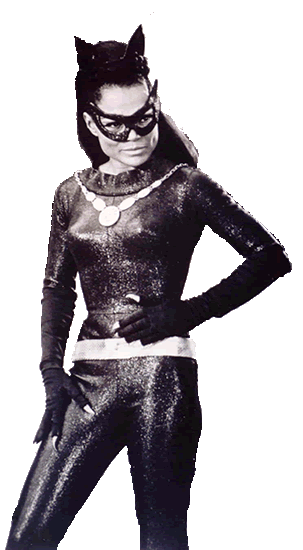
Catwoman: Three actresses played Catwoman during the show's run (well, two played the role on the television, one played the character in the movie), Julie Newmar, Eartha Kitt, and Lee Meriwether. 
Julie Newmar's interpretation is probably the most famous and best loved out of three, partly due to the fact that she had a wonderful chemistry with Adam West, but mostly because she was.....extremely... hot. 


Newmar's Catwoman was flirtatious with Batman and had a soft spot for him, to the point where she even contemplated giving up crime to be with him. In one of my favorite exchanges from the TV series, Catwoman offers turn a new leaf:

Batman: I'll do everything I can to rehabilitate you.
Catwoman:  Marry me!
Batman: Everything, except that! A wife, no matter how beauteous or affectionate, would severely impair my crime fighting.
Catwoman: But I can help you with your work. As a former criminal, I would be invaluable. I can reform. Honestly I can! 
Batman: What about Robin?
Catwoman: Robin?! Oh, I've got it. We'll kill him!

As a kid (and still as an adult) I was absolutely irate that Batman turned down her offer. Sure, killing Robin is excessive, but Catwoman would certainly be a more apt crime fighting partner than Robin, the Boy Blunder. She even tells him as much, but Batman turns her down. IDIOT! For my money, Newmar's portrayal is still the best (and yes that includes Michelle Pfeiffer and Anne Hathaway). 

Lee Meriwether (Miss America 1955) take on the character was much different, she had an icy cold exterior and didn't get all starry eyed when she encountered Batman. She took her role as a criminal very seriously and used her pretty looks (and sexuality) to lure Bruce Wayne into a trap. 

Catwoman and her cohorts (The Joker, Penguin, The Riddler), came up with an elaborate scheme to kidnap Bruce Wayne, so they could trap Batman when he came to rescue the famous millionaire. They wanted to lure Batman into a giant spring that would send him soaring into the arms of the Joker's exploding octopus. Needless to say, it didn't go according to plan. 


Meriwether was the first Catwoman I ever saw, so I will always I have a soft spot for her portrayal. 

When Earth Kitt inherited the role in the show's final season, the sexual tension between Batman and Catwoman was nonexistent, instead she purred her way through the scenery. Earth Kitt was by no means a bad Catwoman, but the dynamic between the two characters was far less interesting; she lacked Newmar's sex appeal and didn't quite possess Meriwether's cold hearted villainy, either. Though, Kitt's distinctive voice was a lot of fun to listen to.  
The Joker (Cesar Romero): It's common to disparage Caesar Romero's portrayal of the Joker, especially when compared to the much darker interpretations that Jack Nicholson (an multiple Oscar Winner) and Heath Ledger (the role he won the Oscar for) gave to the character.  Romero's Joker is a jovial prankster whose main goal in life is to embarrass Batman on a national stage. His schemes are completely impractical and, as a result, there is often no collateral damage involved when his plan is inevitably foiled. The Joker doesn't wish anyone (except for Batman) harm, he's mainly a criminal for his own amusement. 


While the Nicholson/Ledger incarnations are more truer to the comics, they would be completely out of place in the television series. The TV show was meant to be fun for the family, so the sight of the Joker smashing a guy's skull into a pencil would probably not go over well with parents.  Nor would him hand buzzing a gangster to death. Romero brought a lot of energy to the role, so even though his Joker may not be remotely like the one in the comics, he was still a lot of fun to watch. 

The Riddler (Frank Gorshin): Frank Gorshin's manic portrayal of the Riddler is vastly superior to any of the actors that followed in his footsteps; Jim Carrey's take on the character in Batman Forever is a piss poor imitation of Gorshin. The Riddler absolutely enjoyed toying with the Caped Crusader, his main down fall was his over confidence. He was so certain that he would succeed that he would give Batman and Robin clues to those crimes in the form of riddles, thinking that they wouldn't be able to figure them out, or that he and his cronies would be ready for the dynamic duo when they showed their faces. He always failed, but it never dissuaded him (then again, that applies to all the Batman villains).  The less I say about John Astin's brief stint as the Riddler, the better. 


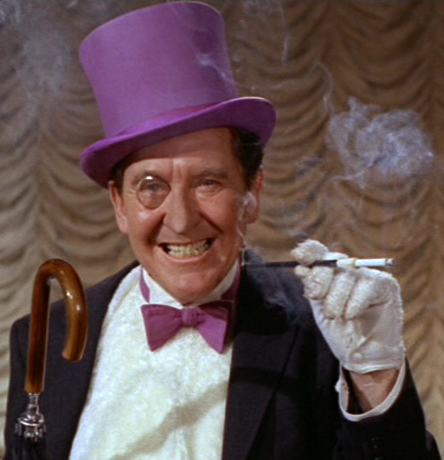
The Penguin (Burgess Meredith): The Penguin was always a silly character, not even a gritty reboot would be able to disguise just what a ridiculous villain he truly was. He walked like a penguin, had an extremely long nose, wore a monocle, and always had a cigarette holder protruding from his mouth. While he is extremely out of place in the dark, gritty Batman comics, he is a perfect fit for the campy TV show. 
The Penguin's crimes were always bird related and always chose extremely transparent bird themed aliases to throw the law off his track. In Batman: The Movie, he buys a pre-atomic submarine under the pseudonym P. N. Guin.  He labeled himself as being a SUPER GENIUS criminal mastermind, but was always bested by Batman. Whenever the Penguin disapproved of something he would let out a "Quack" sound. 

There were other colorful villains in the shows run as well: Egghead, King Tut, The Book Worm, False Face,The Minstrel, Mr. Freeze, but it's the four highlighted above that were, and still are, the most popular.

In the show's final season the character of Barbara Gordon/Batgirl was introduced. She was portrayed by beach movie regular (and frequent Elvis co-star) Yvonne Craig. Her character served dual purposes, it offered the girls a positive role model and it gave the boys more eye candy to look at. 
Batgirl's identity was a completely mystery to Batman and Robin, and she would often slip away before the Dynamic Duo had a chance to ask her any questions. She was a certainly more competent hero than Robin (and all the Gotham police force, but that goes without saying). Her alter ego, Barbara Gordon, was an extremely intelligent woman and could often figure out the criminals schemes/ where abouts before Batman and without the aid of a computer. She was also fairly adept at handling herself in fights, often holding her own with Batman and Robin (well, maybe not Batman, but she often bested Robin in terms of knock outs). Unfortunately, for all her toughness, she also had a tendency to get herself captured by the villains, then Batman would come along to save the day. Still, she was infinitely better than Robin. Yvonne Craig is leagues better than Alicia Silverstone, who stuttered her way through the role in 1997's Batman & Robin


As I mentioned before, Batman purists absolutely loathe the 60s TV show, because in their minds it makes a complete mockery out of the character. It wouldn't be until the 1989 Tim Burton film that the character would be a given a more serious minded treatment and since then the dark, troubled Batman of the Burton/Nolan films have supplanted the warm, whimsical Batman of the 60s. When Joel Schumacher went back to the camp format in Batman & Robin the movie going public rejected it, to the point where it's regarded as one of the worst movies ever made. In all fairness, it is a fairly dreadful film. It successfully killed the first Batman movie series but made way for the Christopher Nolan reboot. It's easy to rag on the Batman show for its camp aesthetics, but let's not forget that the comic book itself was extremely silly at the time. The 1960s Batman TV show is just one of the many faces the Caped Crusader has donned over the last eighty plus years, rather than being disgusted by it, Batman fans should embrace it. There's more than enough for room for two different interpretations of the same character (and in the comic book's case there's been 
more than that), so LIGHTEN UP PEOPLE! 
Besides, nothing in the Nolan films can top the sight of Batman running through this streets with a bomb over his head, looking for a place to dispose of it. (NOTE: This clip has been replaced with music from Benny Hill, as I could't find a decent clip with the original score.) 


Sunday, July 8, 2012

Invasion of the Saucer Men (1957)


If I had to choose my favorite decade overall for filmmaking, it would be the 1950s. Now, don’t get me wrong, I’m not saying the films of the 50s were vastly superior to those of any other decade, it’s mainly due to the fact it was quite possibly the most eclectic time for cinema.  It was a decade in which the genres ranged from the big budget musicals to low budget science fiction films. It was a decade in which, out of panic, the studios devised all sorts of gimmicks to steal back their audience from the ever growing threat of television. If you want to know how filmmakers viewed television, watch any film from the 1950s and it’s never portrayed in a positive light. It was the first time that studios (primarily American International Pictures) started making films that pandered to a teenage audience; the mid 50s saw a boom of teenaged theme movies with titles like I Was a Teenage Werewolf and Teenage Caveman. What’s interesting is that despite their ridiculous titles, some of these films (Teenage Werewolf) are actually quite good; certainly a lot better than they have any right to be.  My favorite out of the bunch is the 1957 Invasion of the Saucer Men, because despite its silly title monsters and teenage sensibilities, it’s actually a far more interesting film than the filmmakers ever intended.
Invasion of the Saucer Men is the type of movie that gets absolutely destroyed by the film critics, because it usually gets lumped in with all the bad science fiction films of the 50s. For instance, Leonard Maltin in his video guide book gives the film one and a half stars, but never really explains why. After all, it’s a silly science fiction film, therefore no explaining is necessary. While Invasion of the Saucer Men is no classic, it’s certainly not as bad as most movie critics would have you believe, in fact it holds up fairly well to most sci-fi “classics” of the decade like The Day the Earth Stood Still and Forbidden Planet.  Both films are horribly overrated by the critics solely for the fact that they were made by prestigious studios (FOX and MGM), where as The Invasion of the Saucer Men was released by AIP, which specialized in schlock (entertaining schlock). 
Invasion of the Saucer Men has an interesting subplot that details the cover up of a UFO that the Air Force accidentally blew up. In the film, the Saucer Men land in a heavily wooded area and start scouting the area. The Air Force gets wind of it and drive down to investigate the saucer.  The men try to communicate with the saucer verbally, but when they get no reply, they come to the conclusion that it is empty and decide to enter by force.  Air Force engineers cut through the hull of craft, but in the process set off a fuse that causes the saucer to explode.   The local authorities hear the explosion and send a policeman to investigate. He is greeted by Lt. Wilkins, who tells the officer that one of their jets crashed and everything is under control.  The police officer accepts Wilkins story and drives away. The most interesting part of this subplot is that it is implied that this is not the first time that the Air Force has covered up a UFO crash. In the end, with the cover up a success, Lt. Wilkins and Col. Ambrose have the following exchange:
Ambrose: Makes you proud, doesn’t it?
Wilkins: What does colonel?
Ambrose: Being part of a show like this; protecting our country from alien invaders. Just think about it, only this special unit and the president of the United States will know what happened here tonight.
Wilkins: You mean you think we know what’s happened!
Ambrose: Well, of course we do!
Wilkins: Colonel! This top secret service is like scratching; once you get started it’s hard to stop.
Ambrose: What are you getting at lieutenant? SPIT IT OUT!
Wilkins: Well, did it ever occur to you colonel that there might be other units just like ours covering up other things?


This may seem like a standard science fiction plot, but it was basically unheard of the 1950s to portray the military in such an unflattering light; Colonel Ambrose is a pompous boob who elicits nothing but disgust from Lt. Wilkins.  Ambrose takes pride in defending the country from alien invaders, when in reality  all he did was botch a major operation (explode a flying saucer), while the real protagonists of the film, teenagers Johnny and Joan, are defeating the Saucer Men in another area of the woods.  
In a nice twist, it’s not only the Air Force that is covering up the Saucer Men’s existence, but the Saucer Men as well. While driving back from the local make out spot, teenagers Johnny and Joan accidentally hit a Saucer Man.  Johnny is afraid that he ran over a kid and gets out of his car to investigate, only to find the corpse of bulbous extra terrestrial lying underneath his fender.  Before Johnny has a chance to look at the Saucer Man, one of its hands detaches itself from its wrist, crawls over to a tire on Johnny’s car “Elvis,” sprouts needles from its fingertips and proceeds to stab the tire, causing it to deflate.  With his car out of commission, Johnny decides the best thing to do is call the police from a nearby telephone. While Johnny and Joan are away, the other Saucer Men come to collect the body of their compatriot and replace it with the body of would be conman, Joe Gruen, who has met an untimely end at the hands of the Saucer Men.  The police arrive at the scene before Johnny and believe that Joe is the victim of a hit and run accident. When Johnny arrives at the police station, he is unaware that they have found Joe’s body in place of the Saucer Man and is duped into signing a confession.  When he tries to persuade the police that he hit an extraterrestrial, they just ignore his pleas and chalk it up to him being a “mixed up teenager”.  
Johnny and Joan escape from the police department in hopes that they can find evidence to back up their story; they track down Joe’s roommate Art and hope to persuade him that they are telling the truth. Art is skeptical, but agrees to go along with them and is attacked by the Saucer Men for his effort.  When Johnny and Joan call the police for help  the police once again ignore them and tell them that the  hit and run charges have been dropped, because the autopsy revealed that Joe died of alcohol poisoning hours before the alleged accident.  It turns out that the Saucer Men’s main defense is injecting alcohol into their victims, Joe was already wasted when he ran into them, hence the alcohol poisoning, while Art survives the ordeal slightly tipsy.


The Saucer Men are probably the only screen villains (extraterrestrial that is) not hell bent on taking over the world, rather are part of a scouting mission that goes horribly awry. It’s not revealed what their mission is, but it is made apparent that they do not want their presence known; to extent that they are willing to frame a young couple who have seen too much.  They will do anything to ensure secrecy, include murdering the scheming Joe Gruen, who was planning to make millions off the dead Saucer Men before biting the dust himself.  The Saucer Men, however, have only vital weakness….THEY HATE LIGHT!  The meet their demise when Johnny and Joan gather up all their teenage friends and have them turn their headlights on the slowly advancing Saucer Men. The Saucer Men evaporate into thin air and the make out point is saved.
Invasion of the Saucer Men is one of the first (if not the first) science fiction films to have teenagers as its lead protagonists, prior to this most science fiction heroes were scientists, military men, or men in higher positions in life.  There was usually a science vs. military subplot prevalent throughout these films; the scientists wanted to understand and, if possible, communicate with the creature, whereas the military only wanted to destroy the damn thing.  The military usually came out on top in the end, when it was revealed that the creature had no desire to communicate and was bent on taking over the world/or destroying large cities. Invasion of the Saucer Men discards this subplot altogether, focusing more on Johnny and Joan’s attempts at getting the local authorities to believe their story about the Saucer Men, and when failing to do so, taking the matter into their own hands. This is a trope that would dominant science fiction/horror films for the next 50 years, but it’s interesting to see it first hand in a fairly obscure 50s sci-fi thriller.  Johnny and Joan are determined to fight these monsters, while the adults just stand around and sneer at them.  The police and Joan’s father perceive Johnny as a hoodlum, who is destined to wind up in prison, while crotchety old farmer Larkin threatens to blast them full of rock salt for trespassing on his property and getting his cows drunk. It could be argued that the real antagonists are the adults, because in the end, the Saucer Men really aren’t much of a threat and are defeated rather easily, whereas farmer Larkin is still out and about, ready to blast the next teenager that trespasses on his property.


I know what you must be thinking at this point:
This movie sounds absolutely ridiculous! Extra-terrestrial invaders that inject alcohol into their victims and are allergic to light! That sounds lame!
It would be lame, if the film was a straight horror film, but the filmmakers approach it in a very tongue in cheek manner.  It is rumored that it was initially supposed to be a straight out horror film, but when director Edward L. Cahn saw the Saucer Men costumes he decided it would be best to play for laughs. However, it must be said that Cahn (with the exception of the climax) does an excellent job of handling the creatures, often showing them in shadows or in close ups, but never allowing the viewer to get a good look at them. The scene in which Johnny hits the Saucer Men is especially effective, because the Saucer Man is briefly glimpsed in silhouette, giving the scene an appropriately eerie edge.  The humor is largely supplied by Joe , Art, and old man Larkin. The opening shot is of Larkin’s dilapidated house, punctuated by a flash of lightning, just then Art’s voiceover (he’s the narrator of the film) intones, “Spooky, huh?”  He then informs us that, “a plain, old farmer lives in this house, an easy going sort of guy.” Just then a car drives by and out comes old man Larkin brandishing a shot gun, grumbling, “I’ll get the law after them.”  We are then introduced to Joe and Art sitting in a diner; Joe, in a drunken stupor, asks a pretty waitress, “I wonder if you can tell me how to…..get to first base with you tonight.” The waitress walks away offended, Art gives Joe a dirty look, and Joe defends his actions with, “At least I tried!” It’s not pivotal to the plot, but it’s a scene that sets up the characters and their relationship with one another: Joe is always looking for an angle, while Art is fairly indifferent to everything. Joe is played by Frank Gorshin, who would later find fame as The Riddler on TV's Batman.


Even the relationship between Col. Ambrose and Lt. Wilkins is played for laughs. Ambrose is a pompous, humorless windbag who is suspicious of everyone, while Lt. Wilkins does his best to keep a straight face when listening to Ambrose ramble on and on. It’s pretty fitting that at the film’s end Wilkins can no longer keep himself in check and deflates Ambrose’s ego by hinting that there are other units out there covering up similar things.  The humor certainly helps gloss over the film’s shortcomings.
The most pleasant surprise about Invasion of the Saucer Men is its two leads Steve Terrell and Gloria Castillo; both are extremely likable and are believable as a young couple. It certainly helps that their characters Johnny and Joan are fairly intelligent people, as opposed to the personality free mannequins that usually dominate these types of films.  It’s to the film’s credit that these two characters often behave in a rational and believable manner, when Johnny runs over the Saucer Men, he calls the police.  When the police don’t believe him, he seeks out someone who might (Art). When Art is attacked by the Saucer Men, Johnny phones the police again and when they refuse to send help, he seeks out the aid of his friends. I especially like the character of Joan, because she actually plays a role in bringing down the Saucer Men, as opposed to being just a lovely decoration for the male audience to gawk at. Joan stands by Johnny’s side throughout the entire film and is as determined put an end to the Saucer Men as he is. The film could have easily followed the tired storyline of Joan being kidnapped and Johnny having to come to her rescue, but instead it’s Art that gets kidnapped, and Joan and Johnny come to his aid.  When Johnny goes to rustle up some friends, Joan is right there with him, getting the attention of the teenagers by running from car to car and explaining the situation in a calm, but urgent manner.


It’s interesting to note the role of women in low budget, 50’s science fiction, because they were often depicted as being brave, intelligent, and completely self sufficient.  While their A-movie counterparts were often given nothing to do, the women in these films often played a pivotal role in defeating the title monster, or in the case of Beverly Garland in It Conquered the World went out with a bang.  All one has to do is compare Alta from Forbidden Planet to Joan from Invasion of the Saucer Men.  In Forbidden Planet, a big budgeted MGM film, Alta’s (Anne Francis) sole function is to add sex appeal to the proceedings, otherwise her character is fairly useless, while in Invasion of the Saucer Men, Joan is willing to step into danger with Johnny, because she finds it preferable than waiting at home. She may not be the ass kicking heroine of today, but she’s certainly not the brainless sex kitten that became prevalent throughout the 60s, 70s, and 80s. 
Invasion of the Saucer Men was remade in 1965 as The Eye Creatures by hack filmmaker Larry Buchanan, whose other noteworthy credits include: The Trial of Lee Harvey Oswald, Mars Needs Women, It’s Alive, and other AIP remakes.  The title creatures consist of actors wearing black leotards covered with plastic eyeballs, with a rubber eyeball mask to boot.  The Eye Creatures is so cheap and completely inept, that it makes the original look like a Steven Spielberg production by comparison. The star is Beach Movie hunk John Ashley, who unlike Steve Terrell, is completely bland in the lead role.  If The Eye Creatures is remembered at all, it’s for the fact that it became fodder for the boys at Mystery Science Theater 3000.


Credits:
Cast: Steve Terrell (Johnny Carter), Gloria Castillo (Joan Hayden), Frank Gorshin (Joe Gruen), Lynn Osborne (Art Burns), Raymond Hatton (Larkin), Russ Bender (Doctor), Douglas Henderson (Lt. Wilkins), Sam Buffington (Col. Ambrose).
Director: Edward L. Cahn.
Screenplay: Al Martin
based on the short story "The Cosmic Frame Up" By Paul W. Fairman.
69 min.

House of Spirits (2016)

A theme that has eluded Hollywood for the last decade is forgiveness. Hollywood prefers the strawman approach to villainy – they will ofte...