Powered By Blogger
Showing posts with label Richard Donner. Show all posts

Tuesday, January 20, 2026

Wanted: Dead or Alive (1958-1961)/ The Rebel (1959-1961)


It has been months since I posted on this blog. The main reason for the lack of activity is pure laziness on my part: I moved into a new apartment in August, and I am now living on my own – this disadvantage of living by yourself is that you’re not as motivated to do things as you are when you have other people pressuring you. I have been writing an epic post about Korean Soap Operas – I have watched half a dozen of them in the last few months, but I am currently suffering from writer’s block when it comes to this entry, so I thought I would do short post about two old school westerns that I recently began watching – Wanted: Dead or Alive (starring Steve McQueen) and The Rebel (starring Nick Adams).  These are two shows that I began watching at dialysis (I go in at five in the morning and the only thing worth watching at this time is old westerns and Perry Mason). Since I have seen almost every episode of Perry Mason, I decided to give these two westerns a watch. Both of them immediately drew me in that I started watching them on Tubi and YouTube. I also own the first season of Wanted: Dead or Alive – my dad gave me his copy after he bought the entire series on DVD. 

Wanted: Dead or Alive helped springboard Steve McQueen into superstardom – it was his role as bounty hunter, Josh Randall, that got him cast in the 1960 western (and Seven Samurai remake) The Magnificent Seven. It should also be noted that Wanted: Dead or Alive premiered four days (September 6, 1958) before the cult classic The Blob (September 10, 1958) opened in movie theaters – meaning that McQueen may have been the first Hollywood actor to have a hit TV show and hit movie in theaters showing at the same time.  Yes, The Blob was a hit movie. Josh Randall was a departure from the tall, square jawed males that populated westerns at the time (John Wayne, Randolph Scott, Joel McCrea, to name a few). Josh Randall was an early example of the anti-hero – he was a bounty hunter, who was motivated by money instead of individual responsibility, though there are episodes where you see his softer side (like when a little boy pays him eight cents to find Santa Claus). He was also a man who loved his vices – gambling, alcohol, and women. He wasn’t the first western anti-hero – James Stewart in The Naked Spur (where he also plays a bounty hunter) and John Wayne in The Searchers (as the racist, Ethan Edwards) are two earlier examples of anti-heroes, but it was the role that helped McQueen craft his “King of Cool” persona. The other iconic aspect of Wanted: Dead or Alive was Josh Randall’s gun, “Mare’s Leg” – a sawed off .44-40 caliber Winchester 92.


Wanted: Dead or Alive was a spin-off of the western, Trackdown (starring Robert Culp). The character of Texas Ranger, Hoby Gilman, was more in line with the western heroes of time – tall, handsome, and a morally upstanding individual. He would fit right in with the cast of Rio Bravo, while Josh Randall would probably be comfortable hanging around Will Kane in High Noon. For the record, I regard both films as two of the best westerns ever made.  Just like Wanted: Dead or Alive catapulted McQueen to superstardom, Trackdown launched the long career of Robert Culp (who exudes charisma in his portrayal of Hoby Gilman). I have only seen a few episodes of Trackdown, but it deserves a brief mention in this review. 


The show often followed “The Villain of the Week” format – Josh Randall would be hunting down a “baddie” and would often rely on help from a local to capture the villain. In some episodes, the villain might be a third party who is also interested in collecting the bounty on Randall’s prisoner. There was the occasional episode that would stray away from the formula; in season three, there is a charming episode called “The Voice of Silence” where Josh is hired to look after a deaf-mute girl while her father is a way on business. There is very little dialogue in the episode, but McQueen and the actress, Carolyn Kearney, have great chemistry and able to convey so much emotion with the small of gestures. It is one of the few times that Randall contemplates settling down with a woman. There is part of me that would like to think Randall returned to the girl (he promises to do so at the end) and married her. The episode was also directed by future blockbuster filmmaker, Richard Donner.


While Wanted: Dead or Alive marked the beginning of Steve McQueen’s career, The Rebel was the peak of Nick Adams’ career – he is probably best known for his role as Astronaut Glenn in the Japanese Monsterfest, Invasion of Astro-Monster (or Godzilla vs. Monster Zero as it commonly known as). Interestingly, McQueen and him would co-star in the war movie, Hell is for Heroes. Prior to The Rebel, Nick Adams was a star on the rise – he was a close friend of James Dean and appeared in Rebel Without a Cause in a supporting role (he played a Chick, a member of the gang that harasses Dean’s character throughout the movie). He appeared in various movies and television credits (including the pilot episode of Wanted: Dead or Alive, where he, along with the pre-fame Michael Landon, played the villains of the week) before landing the role of Johnny Yuma (a character he co-created) in The Rebel. If The Rebel is remembered, it is mainly due to theme song that was sung by Johnny Cash (“Johnny Yuma was a rebel.....")


The Rebel was one of the first existential westerns – the show revolves around Johnny Yuma, an ex-Confederate soldier, roaming the west to find inner peace, and often finds himself getting involved with a local dispute. He also keeps a journal of his travels and sends pages to a newspaper editor from his hometown. Johnny Yuma anticipates anti-heroes like Billy and Wyatt in Easy Rider, and John Rambo in First Blood (before the character turned into a G.I. Joe action figure come to life) – disillusioned individuals who wander aimlessly across the country looking for a place to call home.


Even though, The Rebel and Wanted: Dead or Alive have similar premises, their two leading men are worlds apart- McQueen brings an easy-going charm to his portrayal of Josh Randall, who always finds away to get the upper hand. On the other hand, there is a lot of anger in Adams’ portrayal of Johnny Yuma – he is the kind of character who can explode at any moment. He was a soldier for the losing side of the Civil War (probably suffering from PTSD) and now is an aimless drifter trying to find his place in the world. He works the occasional job to help pay for his lifestyle but there is no place he can call home. He doesn’t seek trouble, but rather trouble seems to find him. The phrase “No good deed goes unpunished” applies to Johnny Yuma – he often has the best intentions, but the locals misunderstand him and believe he has ulterior motives. In School Days, Yuma agrees to be a temporary schoolteacher, but one of the locals, Troy Armbuster (Warren Oates) believes that Johnny is making a move on his girl, Peggy O’ Shea. Though, this is a rare episode that has a happy ending – Troy finally confesses his love to Peggy, the two get married, and Troy buries his grudge against Johnny. Plus, Warren Oates rules!


A name associated with The Rebel that Star Wars might recognize is Irvin Kershner – he directed a huge bulk of the series and would later helm The Empire Strikes Back. The Rebel was a good training ground was Kershner to hone his skills for later projects. Wanted: Dead or Alive and The Rebel were starting point for many future stars (both in front of behind the camera): Richard Donner (director of The Omen, Superman, The Goonies and Lethal Weapon, to name a few) helmed six episodes of Wanted: Dead Alive. Verna Fields (who later won on Oscar for her editing on Jaws) was the sound editor on Wanted: Dead or Alive. Warren Oates was a guest star on both shows. Wanted: Dead or Alive had a more impressive eye for spotting future talent: Michael Landon, James Coburn, James Best (Sheriff Roscoe), Richard Anderson (A face you recognize even if you don’t know the name), Martin Landau, Dyan Cannon, Mary Tyler Moore, and others popped up in guest roles.


Wanted: Dead or Alive and The Rebel often highlight the advantages of episodic television. Most modern television shows are serialized – there is an overarching storyline that runs through the entire series. Most of these television shows are built on a Mystery Box – the show opens on a mystery and then slowly unravels it as the series progresses. Each episode ends on a cliff hanger to set up the next episode – if the show is executed well, this well leave the viewers wanting to watch more and can result in endless hours of binge watching. The one fatal flaw to the serialize format is that often one bad episode (or a weak finale) can derail the entire series. The most recent example is the final episode of Stranger Things, which left a lot of plot threads hanging. This is the moment that series has been building up for the last decade and it ends on a wet fart.  The advantage of the episodic format is that each episode is its own self-contained story (beginning-middle-end) and a few bad episodes is not going to ruin your overall enjoyment of the series. The episodic format also allows for a greater flexibility for story telling – since the show is not beholden to telling one storyline, it allows the showrunners to do different genres: one episode might be somber piece about the social issues of the day, while the next could be a  more light hearted affair (like Josh Randall being hired to find Santa Claus). There is a famous episode of Bonanza where the Cartwrights encounter Leprechauns – it would be out of place in a serialized television show, but in an episodic series like Bonanza, you’re response would likely be, “Well, that was a weird episode,” then you would shrug your shoulders and tune in next week to watch the further adventures of the Cartwrights.  If Leprechauns randomly showed up in Strangers Things or Game of Thrones, you would scratch your head and wonder how it is relevant to the main storyline. It might even dissuade from watching the rest of the series.

Monday, April 29, 2013

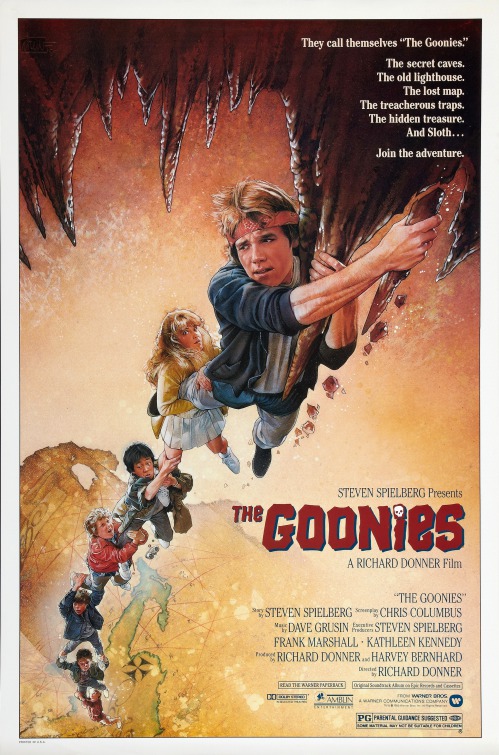
The Goonies (1985)


The blockbusters of the 1980s are fairly restrained when compared to the blockbusters of today. Computer technology has made it so that practically everything is possible, hence filmmakers have a tendency to go a bit overboard at times. The special effects of the 1980s were realized  by using more traditional and practical means, so that filmmakers often had go back to the drawing board if a particular effect didn't work. In The Goonies, there was initially supposed to be a scene in which the kids are attacked by an octopus, but much to the horror of the filmmakers it looked terrible, something right out of an Edward D. Wood, Jr picture, and they wisely discarded it (though a clip of it can still be seen in the second part of the Cyndi Lauper video for "The Goonies R Good Enough." )


If The Goonies were made today, no doubt the octopus would have been CG and it would have remained in the film, even though the scene is rather superfluous to the overall narrative. This is not meant as an attack on the films of today, but rather to defend The Goonies from the charge that it is a "loud, soulless Hollywood product." Sure, The Goonies is a loud film at times and it was, indeed, a Hollywood product, but soulless?! Absolutely not! The film has a lot of heart and it's clear that it was a labor of love for director Richard Donner and executive producer Steven Spielberg.

The Goonies was a huge staple in my (and probably most of my generation's) childhood. I first saw it at the Starlight Drive In Theater at the age of six and was elated when I found a VHS copy of it at the (then) recently opened Wal-Mart. I watched it over and over again to the point where I had the entire film memorized. I could relate to the character of Mikey, because I was a bit of an outsider in school and had fairly oddball friends. Not to mention, it was produced by Steven Spielberg and I was, and still am, a huge Spielberg fan boy. Even though Richard Donner was the director on the film, Spielberg's finger prints are all over it. The Goonies is unashamedly an old fashioned movie, it's a throwback to the adventure films of Hollywood's Golden Era with  preteens as its protagonists. It is the kind of film that would make Terry Gilliam heave and cause cynical movie goers to roll their eyes every five minutes. And I love absolutely every minute of it. It is one of the my personal favorite films. Sure, I maybe blinded by nostalgia, but I'd rather watch a movie that features likable characters succeeding in the end, then have some angry filmmaker preach to me about the injustices in the world.

There's a tendency among film scholars to frown down upon "popcorn" films, because they have nothing important to say. The irony is that the "popcorn" films tend to survive the test of time, while the topical "message" films become horribly dated. Just look at Guess Who's Coming To Dinner, it took an important topic, interracial marriage, and served up a heavy handed message at the film's end about how everyone should be nice to one another. It got great notices in 1967, but is nearly unwatchable by today's standards. Practically everyone remembers The Goonies, but  few remember the  "socially relevant" films of 1985.

The characters in The Goonies are all archetypes, they are reminiscent of the kind of friends we had during our childhood.

Brand: He's the jock of the group. In his spare time he lifts weights, works oddjobs to feed his bike hobby, and is smitten by the cheerleader Andy. He is the more practical one out of the group, while everyone is wanting to go on an adventure, he proceeds with caution. He is also the butt of many jokes, because he failed his driver's test.

Mikey: He is the complete opposite of his older brother Brand. Mike is an awkward teenager who wears braces and has asthma. While Brand is the more physically gifted of the two, Mikey is the intellectual one. He has a great knowledge of history and his enthusiasm for an adventures wears off on his friends.

Mouth: He is the wiseass of the group. Mouth is constantly cracking jokes, much to the annoyance of his friends. He talks a lot, but often has very little to say.

Chunk: The fat friend. Chunk devotes a good portion of his time to hanging out in arcades and eating lots of junk food. He is also a horrible liar, often telling incredible stories about famous people he meet or amazing events that he witnessed. He is the boy who cried wolf and that eventually costs him later in the film.

Date: The smart Asian stereotype. Data specialty is inventing gadgets that serve no real function and rarely work. He often stumbles over his English and gets extremely upset when people correct him.

Andy: She is popular cheerleader who Brand is smitten with. Andy is somewhat flakey, but extremely sweet girl who returns Brand's affections. She is initially at odds with the Goonies as she is comes from an upper class background, but by film's end has ingratiated herself with them.

Stef:  She is the slightly nerdy female of the group. She is Andy's close friend and is fairly antagonistic towards Mouth. She is extremely opinionated and vocal, often the voice of reason, especially when it comes towards her friend Andy. At one point Andy starts freaking out and Stef does her best to calm her nerves.

The movie's title refers to the fact that the characters live in "The Goon Docks" neighborhood of Astoria, Oregon. This threatens to be "The Goonies" last weekend together as their houses are being foreclosed on and they are moving to different parts of the country, barring an absolute miracle. That miracle comes in the form of old pirate treasure map that is stored in the Walshes' attic; Mikey and Brand's dad is the curator of the town museum. They read old newspaper clippings about the treasure of pirate One Eyed Willy, supposedly hidden somewhere in the area and Mikey is convinced that this is their ticket out of this mess. The other Goonies are hesitant at first, but Mikey is able to persuade them when he reveals that their houses will be torn down to make way for a new golf course. Brand, however, will have none of this. The Goonies usurp his authority by tying him up while he is working out. To add insult to injury, Mouth lets the air out of the new tires on Brand's bicycle, needless to say this makes Brand extremely mad. After Brand is released by his mom, he sees that his bicycle tires are flat and commanders  a little girl's bike so he can chase after Mikey and his friends. There are two obstacles standing in the way of One Eyed Willie's treasure: booby traps the pirate has scattered throughout the underground tunnel and the Fratellis, a family of criminals, led by their surly and ugly mom. The two brothers, Jake and Francis, are constantly at each other's throats and Mama Fratelli often has to (literally) slap some sense into their thick skulls.  They run into the Fratelli's by sheer happenstance, the entrance to the underground tunnel is located in the basement of a run down restaurant, where the Fratellis happened to be holed up. Chunk naturally gets hungry and opens the kitchen freezer to see if there's any ice cream, only to find much to his (and everyone else's) horror a dead body with a bullet hole in it's head. The Fratelli's come back at that moment and Chunk hides in the freezer with the corpse, while the rest of the gang enters the tunnel. When the Fratellis have exited, Brand and Mikey implore Chunk to call the police. Chunk goes out the window and tries to call the police, but the deputy doesn't believe him. Chunk then waves down a van, explaining to the driver what is going on, only to find that the driver is Jake Fratelli. Jake's brother Francis grabs Chunk and throws him in the back of the van, reuniting Chunk with the corpse from the freezer.


The Goonies has often been criticized for being an extremely loud and relentless film. And certainly there is a lot of truth to this criticism. The film does have a roller coaster feel to it, and too often there are close ups of characters screaming at the top of their lungs. It can wear the viewer down from time to time. On the other hand, it does a great job of establishing the relationships between the characters and can be extremely moving at times.  The most complex relationship in the film is between Brand and Mikey. The two of them are siblings, Brand is the oldest of the two and is often antagonistic towards Mikey. They are polar opposites in  both a physical and intellectual sense; Brand constantly works out and is in great shape, he is the brawn out of the two. Mikey, on the other hand, is the more scholarly type and has a fairly puny physique. Yet, despite constantly being at odds with one another, there is a mutual love between the two characters. Early in the film, after contractors have dropped off papers from their father to sign, everyone goes inside except for Mikey. He stands on the front patio staring into distance, contemplating what the future has in store for him and is on the verge of tears. Just then Brand walks into frame from the side door, Mikey runs toward him and the two of them hug. Brand may get annoyed with Mikey at times, but he does genuinely care about his younger brother.

The heart of the film is the relationship between Chunk and Sloth. Sloth is the black sheep of the Fratelli family; his face is deformed and he is extremely tall. They keep him chained up in the basement of the abandoned restaurant, so he will be out of their way. After the Fratellis have captured Chunk, they tie him up and put him in the same room as Sloth. Chunk is frightened at first, but breaks the ice by offering Sloth a Baby Ruth candy bar. Chunk throws the candy bar Sloth's way, but his aim is off and it hits Sloth in the forehead, landing a few feet away from Sloth's reach. Sloth begins to freak out and in the process breaks the chains that have been holding him. He picks up the Baby Ruth bar and feeds half of it to Chunk. The two of them form an inseparable bond and Sloth helps save the day at the film's end. Chunk offering his Baby Ruth bar is probably the first act of kindness Sloth has ever encountered in his entire life and he doesn't forget it.


It's also interesting how The Goonies will often slow down the action to give its characters breathing room. The most memorable moment is the interlude inside the wishing well. Mikey and company stumble upon a cavern that is glittering with coins. Stef points out that it is the old wishing well and Andy comments about how she used to believe that it actually granted people's wishes. Mikey and Data start gathering up coins, but Stef tells them they can't do that, because "These are other people's wishes. They are other people's dreams." Mouth then counters by telling a story about how he once made a wish and it didn't come true. He then adds, "I'm taking it back. I'm taking them all back."

It looks like The Goonies adventure is going to be short lived, when resident douchebag Troy and his friends are standing at the top of the well. Troy's main goal in life is too make it with Andy and he is naturally elated when he finds out that she is at the bottom of the well. They implore Troy to lower down the bucket, so he can pull them up one by one. Andy, naturally, is the first to go, so not only does it look like The Goonies adventures will be short lived, but Troy might make it with Andy as well. Uh-oh!

Mikey, however, persuades them to carry on with a long monologue about how "it's their time, down here." Meaning, this might be their last chance to go on a genuine adventure and it will come to a screeching halt when they go up "Troy's bucket." Sure, it might be a safer route, but they might regret their decision later. Mikey's words touches ever one, including the upper crust Andy, and they all carry on. Andy, who is wearing Troy's letterman jacket, for some reason, wraps it around the bucket. This naturally infuriates the horny Troy and he shouts, "ANDY! YOU GOOOOOOOOOONIE!"

Troy is quite possibly the biggest douchebag ever to grace the silver screen, he is the son of the contractor who hopes to build a new golf course over where The Goonies houses are currently stand. He is spoiled brat that has always gotten everything he wanted and has no concern for the feelings of others. In the beginning of the film, Troy is cruising in his car with Andy and Stef, when they spot Brand riding the little girl's bike. Troy pulls over and Andy asks Brand if he would like a ride. Brand declines, but Troy, being the dipshit that he is, grabs a hold of Brands hand (that is resting on the car door) and begins to drive a fast speed. Andy and Stef implore Troy to stop, but he won't listen. The car goes so fast that the training wheels fly off the little girl's bike. Troy releases his grip and Brand goes sailing off into the woods. Troy never really gets the come uppence he deserves; the worst that happens to him is when he flies through the air when the toilet he is sitting on explodes, but that's not exactly on even trade off, given the fact that he endangered Brand's life. Troy is completely one dimensional character that audiences love to hate, every time he's onscreen everyone boos. He's even more despicable than the Fratellis, who at least are amusing in their nonstop bickering.

There are other memorable moments in The Goonies as well:

Andy decides she wants to have a little make out session with Brand, so she calls for him to come to her. Brand, in the middle of taking a leak, sends Mikey to see what she wants. Mikey walks down a darken tunnel and Andy, mistaking him for Brand, gives him a long, passionate kiss on the lips. Stef, who happens to be holding a lantern, witnesses the entire thing and starts to laugh. Mikey completely dazed by the experience stumbles his way out of the tunnel. Andy, still oblivious that she just made out with a preteen, asks Stef is Brand wears braces. Stef starts laughing and Andy chides her for it and adds that she thinks it cute. Later on, Brand and Andy kiss and she asks, "What happened to your braces?"

The Fratellis capture Chunk and tell him to "spill everything." Chunk starts to confess all the horrible deeds that he has done throughout his short life, the most memorable being how he brought fake vomit into a movie theater, made some heaving sounds, and then threw it over the balcony and onto the audience below, which in turn caused the person it landed on to barf. Then the person sitting next to that person barfed and so on.


The special effects, the stunt work, and the sets (especially the life sized Pirate ship at the film's climax) are extremely impressive, but The Goonies is at its absolute best when the characters are given the reigns. The reason The Goonies has resonated with audiences is that there's at least one character they can relate to, be it Brand, Mikey, Chunk, Mouth, Data, Andy, and even Stef. If the audience likes the characters, they tend to the forgive flaws that are inherent in the film's production. The Goonies is a far from perfect film, but it's cast of colorful characters make it a treat to watch, nonetheless.  Of course, if you can't stand child actors, then this is definitely not the film for you.

Cast: Sean Astin (Mikey), Josh Brolin (Brand), Jeff Cohen (Chunk), Corey Feldman (Mouth), Kerri Green (Andy), Martha Plimpton (Stef), Jonathan Ke Quan (Data), John Matuszak (Sloth), Anne Ramsey (Mama Fratelli), Robert Davi (Jake), Joe Pantolianio (Francis), Steven Antin (Troy), Mary Ellen Trainor (Mrs. Walsh).

Director: Richard Donner
Screenplay: Chris Columbus. Steven Spielberg (story)
Running Time: 114


House of Spirits (2016)

A theme that has eluded Hollywood for the last decade is forgiveness. Hollywood prefers the strawman approach to villainy – they will ofte...