Powered By Blogger
Showing posts with label Batman. Show all posts

Thursday, July 10, 2025

Dick Tracy (1990)


In the summer of 1990, Dick Tracy was everywhere – the market was saturated with Dick Tracy merchandise (the soundtrack to the movie, posters, action figures, etc.);  a Making Of special aired a few weeks before the movie was released; Dick Tracy comic strips were reprinted in comic book form and being sold in bookstores across the country (I purchased a few issues – there are two I distinctly remember – Dick Tracy vs. the Influence and Dicky vs. Mrs. Pruneface), and the local station (Super 18) re-aired old episodes of the Dick Tracy cartoon from the 1960s. All of these were an attempt by Disney to manufacture excitement for their upcoming Dick Tracy adaptation.


Dick Tracy was Disney’s answer to Batman, which was a huge hit for Warner Brothers. They took a few of their cues from Batman – an well respected (and Oscar nominated) actor was cast as the lead villain (Jack Nicholson in Batman, Al Pacino in Dick Tracy); Danny Elfman was commissioned to write the score (just like he did for Batman); a popular pop artist was hired to perform original songs on the soundtrack (Prince in Batman and Madonna in Dick Tracy). Both movies are highly stylized productions – Gotham City is a stylized version of New York, while Dick Tracy resides in a stylized version of Chicago.

It seemed like Disney was going to have a huge hit on their hands – it all got off to a great start with a 22 million dollar opening weekend (which was huge in 1990), but Dick Tracy quickly
fizzled out at the box office. It grossed over 160 million dollars worldwide, not a bad sum for 1990, but it also cost Disney over a 100 million dollars to produce and market the movie. It did less than half the business of Batman (which grossed over 400 million worldwide) and, to add insult to injury, it got beat by Teenage Mutant Ninja Turtles, which was made for about a quarter of the budget and released by an independent studio, New Line Cinemas. It is also interesting to note that Teenage Mutant Ninja Turtles, despite being geared towards children, is also the darkest of the three movies. It pays to remember the context of 1990 – comic book adaptations were a rarity in cinema, so the fact that three of them were released over the course of one year was truly amazing. In the 1990s, movies were still driven by star power – which is why signing big names like Jack Nicholson and Al Pacino was such a big deal. Now, it is all about the intellectual properties and the actors have become interchangeable (though, ironically, so have all the IPs. There is almost no difference between Marvel, DC, Star Wars, and Star Trek).

Why did Batman and Teenage Mutant Ninja Turtles rake in the money while Dick Tracy floundered? The answer is simple – name recognition. In 1990, younger audiences were more familiar with Batman and Ninja Turtles than they were with Dick Tracy. The Batman comics, and reruns of the Adam West show, were still in heavy rotation throughout the 1980s. Not to mention, there were the various Saturday Morning cartoons that featured Batman. The Teenage Mutant Ninja Turtles cartoon came out in 1987 (the comic book began in 1984) and was extremely popular among children (as were the TMNT action figures).  In fact, I remember after seeing Teenage Mutant Ninjas Turtles in theatre, my two younger cousins were disappointed that it was more faithful to comic book than the animated series (most notably, Splinter’s origin).  However, by 1990, audiences had pretty much forgotten about Dick Tracy – the character was popular among the silent generation and the baby boomers, while Gen Xers and millennials might, at best, vaguely recognize the squared jawed detective. As for Gen Z, well, they weren’t born yet.


The other problem is that the character of Dick Tracy isn’t that interesting. He doesn’t have a cool back story like the Ninja Turtles nor is he a troubled soul like Batman – he is a total square. The highlight of the comic strips was the grotesque villains Dick Tracy faced off against. The comic book wasn’t exactly subtle when it came to its villains – their names were a too on the nose (Pruneface, Flattop, Itchy, The Brow, to name a few) and most of the time they were petty criminals. The Dick Tracy comic strip first appeared in 1931, during Prohibition, so it’s not surprising that Dick Tracy would be squaring off against bootleggers, racketeers, and gangsters. It was very much a product of its time. It would also be difficult to update Dick Tracy without stirring controversy.  Hell, the 1960s cartoon is now a subject of controversy because of its use of ethnic stereotypes (Dick Tracy would often call upon minorities to do the footwork for him – there was the Japanese detective, Joe Jitsu; the Mexican officer, Go Go Gomez (he is basically a human Speedy Gonzalez); and the Irish police officer, Heap O’ Calorie).  Even in his own cartoon show, Dick Tracy was the least interesting character.


There had been previous attempts at adapting Dick Tracy to the big screen – there were four serials made between 1937 to 1941 that starred Ralph Byrd as the detective (Dick Tracy, Dick Tracy Returns, Dick Tracy’s G-Men, and Dick Tracy vs. Crime, Inc). In 1946 and 1947, RKO studios produced four Dick Tracy movies (Dick Tracy, Dick Tracy vs. Cueball, Dick Tracy’s Dilemma, and Dick Tracy Meets Gruesome), the first two starred Morgan Conway as the title character, and then Ralph Byrd reprised the role in the latter two. These were low budget movies that were produced to make a quick buck and, interestingly, none of them feature a villain from the comic strip.  Dick Tracy Meets Gruesome gets a huge boost by having Boris Karloff as the title villain, but it is still forgettable fare.  Ralph Byrd was perfectly cast as the strait-laced detective, while Morgan Conway is an extremely bland leading man (he is a poor man’s Humphrey Bogart). It is not surprising RKO brought back Byrd for the latter movies.  There is the occasional stylish moment in the series – in Dick Tracy vs. Cueball, there is a scene where the title villain strangles a double-crossing woman, and it is shot from his point of view – anticipating the slasher genre by a good thirty years.  Dick Tracy vs. Cueball was also included in the Harry/Michael Medved book, Fifty Worst Films of All Time (And How They Got That Way). The book is an interesting read, but it also has a few questionable entries. Dick Tracy vs. Cueball is no classic, but it is not that bad! The four Dick Tracy movies RKO produced are mildly entertaining – there are certainly worse ways to waste sixty minutes.   Fun fact: Mike Mazurki, who played the villain, Splitface, in the 1946 Dick Tracy has a cameo in the 1990 version as “Old Man at Hotel.” It was his final screen appearance.  It is a nice tip of the hat by Beatty to Old Hollywood.


I first saw
Dick Tracy at second run theatre (the Rivoli in Cedarburg) and enjoyed it immensely. My eleven-year-old self didn’t like the scenes with Breathless Mahoney and Dick Tracy, but I liked the colorful villains and, hell, I even liked the Kid.  Thirty-five years later, I still have a soft spot for Dick Tracy, though my opinion of the Breathless Mahoney scenes hasn’t changed (I do, however, like the musical numbers that Madonna performs throughout the movie). It is no surprise that Madonna excels in the musical number scenes but struggles in the more dramatic moments. Movie stardom is something that has eluded Madonna – her most successful movies were also ones where she was a supporting role (Dick Tracy, A League of Their Own). The only exception to the rule was Evita, which has based off a popular stage musical by Andrew Lloyd Webber and Tim Rice. Prior to Dick Tracy, her two starring features, Who's That Girl and A Shanghai Surprise were box office duds. Her later starring vehicles like Swept Away and The Next Best Thing didn't fare so well, either.  However, in the context of 1990 it made perfect sense to cast Madonna in a femme fatale role – she was the current IT girl and a controversial figure. She was also coming off one of her most successful years as an artist – in 1989, she released the album, Like a Prayer, which featured the hit singles Like a Prayer, Express Yourself, and Cherish.  The album sold over 15 million copies and was a turning point in Madonna’s career. In 1990, months before the release of Dick Tracy, she kicked off the Blonde Ambition tour. She was all over the place. She was also dating Warren Beatty, her Dick Tracy co-star and director. This is an example of corporate synergy at work – Disney, and Beatty, were hoping to cash in on Madonna’s notoriety and cast her in the role of the nightclub singer/femme fatale, Breathless Mahoney. There was also a Dick Tracy soundtrack that featured Madonna performing original songs by Stephen Sondheim. 


The interesting thing is that even though Madonna and Warren Beatty were having a torrid love affair in real life, it didn't translate to the silver screen. The movie’s idea of seduction is to have Breathless Mahoney wear revealing outfits and utter a few double entendres at Dick Tracy. I always found the scene in Breathless Mahoney’s dressing room to be more cartoonish than sexy (“Don’t you want to frisk me?”). It is also reminiscent of a similar scene in Who Framed Roger Rabbit, where the animated femme fatale, Jessica Rabbit, visits the cynical detective, Eddie Valiant, at his office. Yet even though this scene is played for laughs, it some how is filled with more sexual tension that any of the scenes with Dick Tracy and Breathless Mahoney.

There is also no way that a square like Dick Tracy would fall for a woman like Breathless Mahoney – he is too in love with Tess Trueheart to even consider another woman. Warren Beatty, definitely! Dick Tracy, hell no! There also significantly better chemistry between Dick Tracy and Tess Trueheart, largely because Glenne Headly is a superior actress. Tess Trueheart is the type of role actresses dread to play – she is the long suffering but loyal girlfriend. There really isn’t much depth to the character, but Headly gives an endearing performance and even manages to inject humor into her characterization – when the Kid tells Tess, “I don’t like dames.” She responds, “Good! Neither do I!” and then gives him the stink eye.


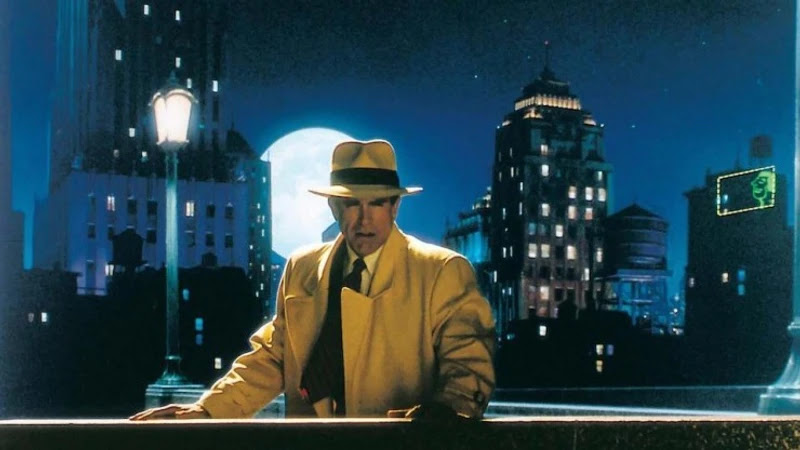
There are even aspects of Beatty’s performance that I like. He doesn’t look anything like the character from the comic strip, but his performance is spot on. Beatty’s Dick Tracy is a man who likes the status quo – Tess and him eat at the same diner and engage in comedic banter with the owner, Mike. Even though he loves Tess, he still can’t bring himself to pop the big question, because it would change their current relationship. He is at home in Mike's diner, but he sticks out like a sore thumb, with his yellow fedora and overcoat, at the nightclub that Breathless works at (and that “Big Boy” Caprice stole from “Lips” Manlis). He is awkward and stiff whenever he is in the same room as Breathless Mahoney – she puts the moves on him, but he shoots her down and tells her that he wants her to testify against “Big Boy” Caprice.

Beatty and his screenwriters deserve credit for trying to give Dick Tracy some depth – this a truly Herculean feat given how one dimensional the source material was. He is a devoted, and honest, detective but it comes at the expense of his relationship with Tess. The two of them rarely enjoy a quiet moment together – Dick and Tess are watching an opera when he gets a call over his wrist radio and is forced to leave to check out a murder scene. Later, when Tess tells Dick Tracy that she is leaving town (and moving in with her mother), their conversation is interrupted by a call over Tracy’s wrist radio – he wants to talk her out of moving away, but duty calls and Tess urges him to go. Dick Tracy's work interrupting his private life was often a running gag in early film adaptations and each time this happened it would end with an exasperated Tess shouting, "OH DICK!"  In the 1990 movie, it eventually takes its toll on their relationship. 

While Dick Tracy is hesitant to take risks in his private life, he is willing to take a role of the dice when it comes to his job. While investigating the scene of “Lips” Manlis, Tracy comes across a bunch of smashed walnut shells and suspects “Big Boy” Caprice because of his fondness for walnuts. He takes a roll of the dice and has “Big Boy” Caprice arrested, despite the flimsy evidence. When the forensic department fails to find fingerprints on the walnuts, he has no choice but to release the gangster. “Big Boy” uses this as an opportunity to complain to the press about police corruption. Tracy later brings in “Mumbles” for questioning and tries to sweat a confession out of Big Boy’s incoherent lackey – he sits Mumbles under a heat lamp and asks the same question over again, “Who killed Lips Manlis?” He taunts Mumbles by drinking a cold glass of water, which causes the perspiring henchmen to break down and incoherently babble. Later on, when Tracy plays back the recording to Mumbles and slows it down, he clearly says “Big Boy did it!”


The heart of the movie is Dick Tracy’s relationship with the Kid (who later chooses the name Dick Tracy, Jr.) The movie is at best when it focuses on Dick Tracy slowly embracing the role of fatherhood. The Kid is first introducing running out Mike’s diner – he has stolen the wallet of a patron. Dick Tracy chases after him and finds him living under the tyrannical rule of a hobo, who forces the Kid to commit petty crimes in exchange for food and shelter. Tracy saves the Kid from the abusive hobo, but then he is left with the question on what do the Kid.  He initially wants to hand the Kid over to orphanage, but he grows fond of the boy and keeps putting it off. More importantly, he proves to be a positive role model for the Kid – it is implied that had the Kid not met Dick Tracy, he might have easily fallen into the clutches of Al “Big Boy” Caprice, or some other gangster. A common tactic used by crime bosses was to groom wayward boys into a life of crime – they would often pay children good money to run errands for them (get the paper, shine their shoes, etc.) and when they grew up, they would be chosen to do shadier activities. This is an interesting plot point in the James Cagney classic, The Public Enemy.

Beatty also avoids making the Kid overly cute and precocious (especially when you compare The Kid to “Junior” in the 1940s Dick Tracy movies– like most preteen boys, he is kind of a shithead. He scarfs down his food and always asks, “When do we eat?” When Tess wants to buy him a new set of clothes, he makes a huge fuss out of it. He also rides on the backboards of cars, despite the objections of Tracy. However, once Tracy has gained the Kid’s trust, he proves to be a loyal and valuable ally. He even manages to save the detective's life on two occasions. When Dick Tracy is framed for the murder of the corrupt D.A, the Kid stands by him and goes to the police chief to express his belief in his mentor's innocence.


The most memorable aspect of Dick Tracy is its galley of grotesque villains – the make-up artists certainly earned their paychecks on this movie. Al Pacino chews the scenery with his portrayal of the flamboyant gangster, Al “Big Boy” Caprice. I always enjoyed Pacino’s over the top performance, because it perfectly suits this film. The comic strip had a larger-than-life quality, and a more naturalistic performance would be out of place. “Big Boy” wants to run the city – he eliminates the first obstacle in his path, “Lips” Manlis and then arranges a meeting where he tries to persuade the other crime bosses to unite with him. The only hold out – “Spud” Spaldoni (James Caan under heavy makeup) – gets blown up for his refusal. This also leads to one of my gripes about the movie – most of the memorable villains from the comic strip are relegated to being Caprice’s henchmen. For instance, the character of The Influence is practically a background extra – in the comic strip he wore a special set of contacts that gave him the ability to hypnotize his victims. In the movie, he has a few lines of a dialogue, fades into the background, and then gets killed in the final shootout.  


There are a few standout performances: Dustin Hoffman is a riot as “Mumbles.” A running gag throughout the movie is how Dick Tracy will bring in “Mumbles” for questioning and be bombarded with incoherent babble.  William Forsythe and Ed O’ Ross are appropriately creepy as Big Boy’s henchmen, Flattop and Itchy. Both characterizations are accurate to comic strip – they were usually depicted as killers for hire (in the cartoon, Itchy was Pruneface’s lackey). 

The plot has always been criticized for being “threadbare” but that was also the case with the comic strip. Dick Tracy is a rather simple premise – the comic strip (and cartoon) all followed “the villain of the week” format – a villain would go on a crime spree and Dick Tracy would have to stop them. The villain was usually disposed of in a rather gruesome manner. The movie tries to liven up the proceedings by introducing a mystery to the plot – a gangster known as “The Blank” (because their face is devoid of features) uses 88 Keys (the piano player at Big Boy’s club) to frame Dick Tracy for the murder of D.A. John Fletcher.  The Blank later frames Big Boy Caprice for the kidnapping of Tess Trueheart. With the Blank’s two rivals out of the way, they will control the city.  The audience is supposed to keep guessing who this criminal mastermind is, but it’s pretty obvious from the get-go. There is only one character who has a clear motive for wanting to get rid of them both, and who inhabits both of their worlds. However, in this one instance, I will not spoil for the people who like to figure it out for themselves.


While one might find the storyline lacking, there is no doubt movie the movie is triumph of production design. The movie looks like the Dick Tracy comic strip come to life – rather than shoot on location, Beatty shot entirely in the studio and relied heavily on matte paintings to expand the city and bring it to life. As a result, each shot in the movie looks like the panel of a comic strip – Beatty will often keep the camera stationary as characters walk in and out of frame. When we are first introduced to Dick Tracy, he is framed though the window of his apartment building, grabbing his yellow hat and jacket. The also has a limited color palette – primarily red, green, blue, and yellow, each of the exact same shade. This further adds to the comic book look of the movie.  It is also fitting that the Beatty uses film techniques that were popular in the 1930s – the use of matte painting is most obvious, but his use of montage editing (when Dick Tracy is arresting Big Boy’s lackeys) looks like something out of a Warner Brothers gangster movie from that period.  


Dick Tracy is definitely curio – it was an attempt at old fashioned filmmaking before CGI took over the industry. Out of the main comic book adaptations that was released in 1989/1990, it is the odd man out. It is also interesting to watch a comic book that wasn’t made with the intent of starting a movie franchise – both Batman and Teenage Mutant Ninja Turtles were given the sequel treatment, but Dick Tracy is a self-contained movie. There is nowhere Beatty could go with a sequel, considering that he killed off all of the main villains from the comic book. It is almost Beatty knew this would be his only shot at making a Dick Tracy movie and decided to include as many villains as possible. Warren Beatty has sat on the rights to Dick Tracy for the last thirty plus years and, with the exception of two specials, has done nothing with the character – probably because he knows it would be tough for this character to compete with all the CGI spectacles that dominate theatres.


Cast: Warren Beatty (Dick Tracy), Al Pacino (Al “Big Boy” Caprice), Madonna (Breathless Mahoney), Glenne Headly (Tess Trueheart), Charlie Korsmo (Kid), William Forsythe (Flattop), Ed O’ Ross (Itchy), Mandy Patinkin (88 Keys), Dustin Hoffman (Mumbles), Dick Van Dyke (D.A. Fletcher), Seymour Cassel (Sam Catchem), James Keane (Pat Patton), Charles Durning (Chief Brandon), Michael J. Pollard (Bug Bailey), James Tolkan (Numbers), R.G. Armstrong (Pruneface), Henry Silva (Influence), Paul Sorvino (“Lips” Manlis), Tom Signorelli (Mike), James Caan (“Spud” Spaldoni), Frank Campanella (Judge Harper), Kathy Bates (Mrs. Green), Catherine O’ Hara (“Texie” Garcia), Estelle Parsons (Mrs. Trueheart), Allen Garfield (Reporter), Charles Fleischer (Reporter), Mike Mazurki (Old Man at Hotel), Ian Wolfe (Munger).

Director: Warren Beatty
Writers: Jim Cash, Jack Epps, Jr. Based off the comic strip by Chester Gould.
Running Time: 105 minutes.

Sunday, November 20, 2016

Batman (1989)


There is a tendency in the comic book community to retroactively hate on earlier film adaptations of their superheroes, while anointing the new version as “the best adaptation ever.” This was the fate that befell the Tim Burton Batman movies when Christopher Nolan’s “The Dark Knight” trilogy hit theatre screens (the same fate also befell Richard Donner’s Superman movies after the release of Man of Steel). This is predicated on the logic that the Nolan movies are a far more faithful recreation of the Batman comic books than Tim Burton’s more gothic approach. The flaw with this argument is that there have been various incarnations of Batman throughout the decades, therefore the argument that the Nolan films are the most “faithful” is based entirely on what version of Batman you grew up with: Everyone talks about how the early Batman comics were dark and gritty, but they quickly took a more fantastical turn; as early as 1939, Batman was fighting vampires. By the time World War II rolled along, Batman went from being a dark vigilante to being a full-blooded patriot who devoted his time to fighting Nazis and the Japanese. In the 1950, he was a warm and fuzzy father figure who easily thwarted his incredibly inept enemies. 

I like the Christopher Nolan movies, but they didn’t nearly have the cultural impact that the Tim Burton movie had back in 1989. It is really hard to describe to younger audiences just how big Batman was in the summer of 1989; it wasn’t merely a movie; it was an event!  Super Hero movies have become a fixture in modern day cinema (Marvel has three movies slated for release in 2017, while DC has two), but they were a complete scarcity in the 1980s; the Superman series hit an all-time low with the 1987 Superman: The Quest for Peace. Before the Tim Burton, if you were to bring up Batman in a conversation, the Adam West television show would undoubtedly spring to mind. Sure, the comic book had already adopted a darker tone in the 1970s, but West’s tongue in cheek approach had cast a long shadow. It was the Tim Burton movie that helped shift the public perception of the character; he was no longer goofy Boy Scout but a dark, brooding vigilante that would resort to whatever means necessary to capture his guy. There have been complaints over the fact that Burton’s Batman kills, but this isn’t far removed from the early Batman comic books in which The Dark Knight often racked up a body count. 

I prefer the style of Burton’s movies to Nolan’s more “realistic approach.”  There is a timeless look to the Burton’s Batman movies; the characters dress in different fashions that it is really hard to pinpoint what time period it takes place in. The only thing that really dates the first movie to the 1980s are the songs by Prince. In my opinion, Tim Burton's Batman has the best opening of any comic book movie: two scuzzy muggers hold up a family in an alley way and are dividing the take on top of a building, when Batman swoops in and kicks their asses.  The reveal of Batman is extremely clever – the two muggers are stationed in the foreground when the Batman descends into frame in the background, while the two thieves remain oblivious to his presence. This effectively builds suspense, when will Batman strike? 


The main mugger shoots Batman multiple times and he falls to the ground, only to rise up again and take out the two bad men; bullets seemingly have no effect on Batman.  Batman then grabs the main mugger and holds him over the edge of the building, and then commands, “I want to you tell all your friends about me.”  Batman throws the man aside and jumps off the building. The mugger is scared shitless! It’s an incredibly exciting way to open a movie and definitely preferable to the disjointedness of Batman Begins. It is not only a visually exciting opening, but it sets up the psychological warfare Batman wages on crime – what makes Batman frightening is the idea that he could be watching you any place and any time, so you better be on your best behavior.  A mythic stature has already been bestowed upon Batman – the two muggers arguing over his existence before he punches them into next week. The interesting thing about Burton’s movie is that it avoids the structure of most Super Hero movies – the first half is devoted to the origin story, the second half has the hero fighting the villain – Batman has already begun his crime fighting campaign and has become a newsworthy topic. The police deny his existence, while secretly viewing him as a threat to the public.  
 
The main criticism of Tim Burton’s adaptation is that it is more of a Joker movie than an actual Batman film; this isn’t entirely false.  It is the Joker that is given a lengthy back story, while Bruce Wayne’s is told in a brief flashback.  Jack Nicholson certainly dominates the proceedings with his wonderfully over the top performance as the Joker.  However, even this isn’t too far removed from the comic books – Batman’s foes were often far more colorful (and interesting) than he was.  Tim Burton’s interpretation of the character is that he is a man that keeps to the shadows and has a very low key personality; Bruce Wayne goes through the motions of being a millionaire – he holds fundraisers, he attends business meetings, and he dates attractive women.  The only time he comes to life is when he dons the bat suit and fights criminals. This is not the flamboyant character from the Batman TV series. He is so obsessed with his work that he foregoes a social life and is willing to sacrifice a potential romance with Vicki Vale. I always felt that Michael Keaton was miscast in the role of the Caped Crusader, but he is good enough of an actor that it isn’t too big of an issue. I also prefer his interpretation of The Dark Knight to Christian Bales nonstop grunting. 


I like the fact that Burton and company don’t go to the default ending of most modern Super Hero movies – the leveling of an entire city. It ends on a rather small, personal note: Batman faces off against the Joker in a church bell tower.  It’s a completely unique sequence and certainly trumps the massive amounts of destruction seen in most modern day Super Hero movies; it’s really hard to distinguish one from the other.  Batman certainly has its share of flaws; I never bought Alfred showing Vicki Vale into the Batcave behind his master’s back.  Alfred over steps his bounds and would probably feel the wrath of Batman in some form or other. Also, Bruce Wayne has only known Vicki Vale for a couple of days; therefore it’s a bid odd that he would want to reveal his true identity to her.  In Batman Returns, it is revealed that their relationship didn’t work out. Way to go, Alfred.  Plus, the reveal that it was the Joker that murdered Bruce Wayne’s parents is a bit too convenient. It’s an unnecessary addition to the script that doesn’t really serve any purpose. If Batman is solely drive by revenge, then killing the Joker should be enough for him to move on. 


I know I’m in a minority when I say that I prefer the Burton movies to Christopher Nolan’s trilogy, and I’m willing to admit that there is a nostalgic bias at work. The Tim Burton movie came at the right time in my life (I was ten) and is what got me hooked on the Batman comic books. It was the first time I, and most fans, had seen a more serious adaptation of the comic books.  The Christopher Nolan movies are terrific movies, but I’ve notice they are much easier to nitpick because of Nolan’s “realistic” approach.  It is easier to accept the flaws in the Burton movie, because it never makes an attempt at realism and is much more fantastical in its approach.  However, the Nolan films deserve credit for willing to take risks, when most Super Hero movies play it safe. However, it must be said that if it wasn’t for the success of Tim Burton’s 1989 movie, there is a good chance that the Nolan movies would have never been made. 

Credits
Cast: Jack Nicholson (Jack Napier/The Joker), Michael Keaton (Bruce Wayne/Batman), Kim Basinger (Vicki Vale), Robert Wuhl (Alexander Knox), Michael Gough (Alfred), Pat Hingle (Commissioner James Gordon), Billy Wee Williams(Harvey Dent), Jack Palance (Carl Grissom), Jerry Hall (Alicia), Tracey Walter (Bob the Goon), William Hootkins (Lt. Eckhardt), Lee Wallace (The Mayor).
Director: Tim Burton
Screenplay: Sam Hamm, Warren Skaaren.
Running Time: 126 min.

Saturday, March 22, 2014

Batman (1943)


What is Ming the Merciless doing in a Batman movie? Playing a gun toting miner, of course. This is one of many surprises that pop up in the 1943 movie serial Batman.  Ming was played by the great character actor, Charles Middleton, and it’s rather amusing to see him in a rather incidental role as opposed to the main villain (which was his specialty). He turns up just long enough to be blown up in a mine explosion.                

Batman was the first screen adaptation of the comic book and, as a result, it’s a rather raw take on the character; he is not the dark, brooding vigilante that we know today, but rather a fairly jovial and extremely fallible super hero.  In the Christopher Nolan adaptations, Batman is able take out the villain’s henchmen without breaking a sweat, but in this serial he is constantly getting his ass handed to him. The biggest flaw of this Batman is that he is pure impulse; he almost never takes the time to scope out the area and strategize a plan for capturing the villains. Instead, he just rushes head first into a room and naturally assumes that he can handle the situation on his own. It would certainly be beneficial for him to know how many men are in a room, or where the villains have hidden Linda Page, his supposed fiancée.  He is completely oblivious to the dangers that are in store for him and is too reliant on Robin to bail him out. This is a typical scene: Batman and Robin spot one of Daka’s lackeys walking into the building. Batman runs in after him and gets knocked out for his efforts. The lackeys leave Batman to his grisly fate, Robin arrives just in the nick of time to save him. It is amazing in a serial titled Batman that Robin is the one who ends up saving the day. 


That’s right; Batman isn't allowed to be the hero in his first screen appearance. It is a rather baffling decision on the part of writers and the director. Who wants to watch a movie where Robin triumphs at the end? The answer: NO ONE. Of course, I can only speak for myself, as a kid I absolutely loathed the character of Robin and hated how he compromised the sheer awesomeness of Batman. Why is The Dark Knight hanging around with this annoying little bastard? Granted, Robin in this serial (as portrayed by Douglas Croft) is not nearly as abrasive as Burt Ward’s interpretation in the sixties television series, but still, he does grow a bit tiresome as the story progresses.  

It should also be noted that Batman’s code of not killing is nowhere to be found in this film. In fact, the film has a fairly high body count; Daka loses almost half of his henchmen due to Batman’s interference. Though, most of the deaths are an indirect consequence of Batman's actions. There is, however, a scene in which Batman knocks out two men in the back of an armored car and makes no attempt to save them as it goes careening off a cliff. Though, this was fairly common place in the Batman comic books at the time, as well. There’s actually one story, “Dr. Hugo Strange and the Mutant Monsters,” where Batman hangs one of Strange’s creations at the climax. 


Lewis Wilson was the first actor (and still the youngest) to play Batman on the big screen and his casting is a double edged sword; he makes for a terrific Bruce Wayne. He looks uncannily like the Bruce Wayne in the comic books at the time.  There is also a fun section in the serial in which he disguises himself as a hoodlum, Chuck White, so he can infiltrate Daka’s criminal underworld. Wilson is absolutely a joy to watch in these moments; his Bruce Wayne is a rather lazy and foppish fellow, and is largely played for laughs.


Unfortunately, once he dons the cape and cowl, our suspension of disbelief evaporates right in front of our eyes. Wilson was a handsome actor, but a model for physical fitness he was not. It doesn’t help that he’s laden with a chintzy costume that accentuates his flabby physique. This is one case where adding fake muscles to the costume would have greatly benefited the actor. Though, it does help explain why Batman is constantly getting owned by puny henchmen…well, except for at the serial’s climax when he has no problem handling a group of them. 

 Wilson would retire from acting at a fairly young age and, reportedly, was complete embarrassment by his involvement in this serial. It is too bad as he gives, despite his paunch belly, a rather lively performance.  He may lack the intensity (and the ripped physique) of Christian Bale, but he’s a lot more fun to watch.

J. Carrol Naish hams it up as the sadistic villain, Prince Daka. This serial was made during the height of World War II, so it’s not too surprising that its main villain is mad Japanese doctor out to control the world. It is a fairly xenophobic piece of work and it’s filled with all kinds of racial slurs; in the serial’s opening the narrator refers to Japanese people as being “shifty eyed” and when Linda Page meets Daka for the first time, she exclaims in sheer terror, “A Jap!”  These scenes are fairly uncomfortable for modern day viewers, though they are so ridiculously over the top that it’s hard to take them seriously.  Daka has developed a machine that can transform people into super strong zombies that obey only his commands, yet he only uses it on two elderly gentlemen and Linda Page. He is about to brainwash Batman, but Robin intervenes.  His main goal is to get his hands on a supply of radium that he needs to power his super ray gun. He also has a colorful way of disposing of his enemies; dropping them into a pit of alligators.  Hmmmm…I wonder if that is somehow going to play a part in his demise?  Also, in a fairly clever touch, Daka’s layer is hidden inside a House of Horrors.


Shirley Patterson is a beautiful actress and does what the script asks of her, which isn’t very much. The character of Linda Page is a fairly useless and forgettable; her main function is to get captured so Batman can rescue her.  In fact, her engagement to Bruce Wayne comes off as an afterthought; it isn’t until Chapter 13 that it is revealed she is his fiancée.  Up until this revelation, it is never made clear what their relationship is to one another. How does she know Bruce?  Half of the time, Linda seems to have the utmost contempt for Bruce Wayne and his “leisurely” lifestyle. Why the hell would she agree to marry such a guy? When her character isn't stumbling into trouble, she is nowhere to be seen.  The whole fiancée subplot is totally contrived and doesn't feel natural to the overall story line; Linda and Bruce are engaged because the script demands it.  Interestingly enough, Patterson, using the name of Shawn Smith, would experience her greatest success in the fifties, starring in the Universal thriller, The Land Unknown, and the cult classic, It! The Terror From Beyond Space.


Douglas Croft is probably the best realized screen Robin; it helps that he is actually the right age. Robin is an irritating character, but Croft makes the most of the material he is given. It is to his credit that you don’t roll your eyes ever time Robin utters a line.  Hell, at least he is of actual use to Batman as opposed to other incarnations of Robin, whom mainly just got in the way.  Croft, sadly, passed away at the young age of 37. 


Batman is far from being a great piece of cinema and, especially when compared to the action films of today, it is often extremely corny and dated. Yet, part of its charm is that it offers the modern day a viewer a glimpse into the world (and mindset) of 1943. It may not overwhelm you, but it moves along at a fairly fast pace (thanks to Lambert Hillyer’s efficient direction) and is actually more tightly plotted that most movie serials from the time period. It is definitely worth a look as a piece of nostalgia. Also, it is more beneficial to watch it over the course of a couple of days, instead in one sitting; it will seem far less redundant.


Credits
Cast: Lewis Wilson (Bruce Wayne/Chuck White/Batman), Douglas Croft (Dick Grayson/Robin), J. Carrol Naish (Prince Daka), Shirley Patterson (Linda Page), William Austin (Alfred), Charles Middleton (Ken Colton), Charles C. Wilson (Police Captain Arnold).

Director: Lambert Hillyer
Screenplay: Victor McLeod, Leslie Swabacker, Harry L. Fraser. Based off the comic book character by Bob Kane. 

Running Time: 260 min [15 episodes]

Wednesday, April 3, 2013

Batman (TV Series): Why It's Friggin' Awesome, despite what comic book purists would have you believe.


I think for most people from my generation (and my parents) their first exposure to Batman was the campy 1960s television show starring Adam West. It was a show that I watched religiously when I was a kid, to the point that when it was taken off syndication I was absolutely devastated. I sat in my room for days and sulked about it. How could I live without my daily dose of The Dynamic Duo? It also meant that I would deprived of the greatest TV theme song in history.

The highlight of each episode was the fight scenes, whenever Batman and Robin would punch villain, words like, POW, BAM, BOOF, would appear on the screen. It was away to emphasize the very comic book nature of the television show.
The Batman in the TV show was an upstanding citizen who apparently had no vices, he didn't drink, didn't smoke and was able to keep his sexual urges in check, despite the fact that beautiful women were constantly throwing themselves at him. He was a goody two shoes who packed a mean wallop.

As a kid, Adam West was the DEFINITIVE Batman, until 1989, when the Tim Burton/Michael Keaton movie was released. The Tim Burton film went back to Batman's roots and made him a dark, brooding character haunted by the death of his parents, as opposed to the rather whimsical, benevolent authority figure of the old Adam West series. It was the DEFINITIVE Batman movie, until 2005 when Batman Begins was released to the cinemas.  Christopher Nolan's version was more grittier and less stylized than Burton's interpretation, and more importantly, Bruce Wayne was the central figure in the story, rather than a supporting player. Tim Burton's films, Batman and Batman Returns, were more interested in the plight of the villains and often pushed Batman/Bruce Wayne to the sidelines. Last year, Nolan finally completed his trilogy with The Dark Knight Rises, so it's only inevitable that in a few years time another reboot of the Batman franchise will be commissioned. Whether or not it will replace Nolan's Dark Knight trilogy as the DEFINITIVE Batman remains to be see.

I have done a complete 360 on the 1960s television series: I loved it as a kid, was embarrassed by it as a teen (especially after seeing the "serious" Burton films), and now love it as an adult. The television series may be a complete bastardization the original character, but it makes for some rather enjoyable (and funny) television. Of course, it's often overlooked that throughout the 1950s and most of the 1960s (the Silver Age) the Batman comic books themselves had devolved into rather silly children's stories. The villains weren't so much evil geniuses as they were merry pranksters with too much time on their hands. A typical story line from this era might involve the Joker trying to rob a pie factory in Gotham so he could stage the biggest pie fight in history. These comic books were aimed solely at kids and the TV show, for the most part, followed suit. It was also the campy TV show that brought Batman back into the spotlight after years of dwindling comic book sales.

What makes the TV show entertaining is Adam West's ability to deliver his lines in a straight manner, regardless as to how ridiculous they might sound. Oddly enough, when I was a kid, the campy humor went above my head, and I took the show absolutely seriously. When I watch the 1966 feature length film, I couldn't comprehend why my dad was laughing hysterically during the scene where Batman is punching a rubber shark that latched on his leg. This scene features the immortal line, "Hand me down the shark repellent bat spray." It is a moment that makes serious comic book fans cringe, but it is absolutely hilarious, especially with West's dry delivery.

I never liked character of Robin, even in the comic books and cartoons, and Burt Ward's take on the character can be extremely grating at times; to the point where one wishes Batman would give the Boy Wonder a nice crack in the jaw after his latest outburst of "HOLY______, Batman!"  Robin in the TV series main function was to get caught so Batman would have an excuse to fight the villains. Every once in a blue moon the writers would give him something useful to do, but otherwise he was a complete hindrance to the Caped Crusader's war on crime.  Robin in the TV series was essentially a boy scout in tights. 

Then there was the rogues gallery of villains, some of the most colorful characters in television (and comic book) history:
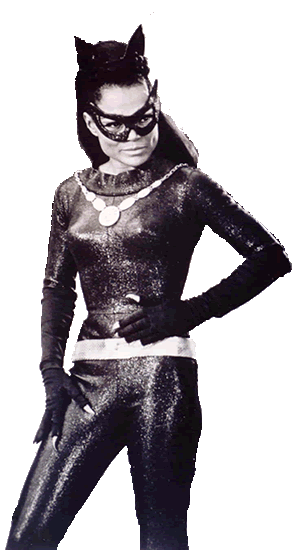
Catwoman: Three actresses played Catwoman during the show's run (well, two played the role on the television, one played the character in the movie), Julie Newmar, Eartha Kitt, and Lee Meriwether. 
Julie Newmar's interpretation is probably the most famous and best loved out of three, partly due to the fact that she had a wonderful chemistry with Adam West, but mostly because she was.....extremely... hot. 


Newmar's Catwoman was flirtatious with Batman and had a soft spot for him, to the point where she even contemplated giving up crime to be with him. In one of my favorite exchanges from the TV series, Catwoman offers turn a new leaf:

Batman: I'll do everything I can to rehabilitate you.
Catwoman:  Marry me!
Batman: Everything, except that! A wife, no matter how beauteous or affectionate, would severely impair my crime fighting.
Catwoman: But I can help you with your work. As a former criminal, I would be invaluable. I can reform. Honestly I can! 
Batman: What about Robin?
Catwoman: Robin?! Oh, I've got it. We'll kill him!

As a kid (and still as an adult) I was absolutely irate that Batman turned down her offer. Sure, killing Robin is excessive, but Catwoman would certainly be a more apt crime fighting partner than Robin, the Boy Blunder. She even tells him as much, but Batman turns her down. IDIOT! For my money, Newmar's portrayal is still the best (and yes that includes Michelle Pfeiffer and Anne Hathaway). 

Lee Meriwether (Miss America 1955) take on the character was much different, she had an icy cold exterior and didn't get all starry eyed when she encountered Batman. She took her role as a criminal very seriously and used her pretty looks (and sexuality) to lure Bruce Wayne into a trap. 

Catwoman and her cohorts (The Joker, Penguin, The Riddler), came up with an elaborate scheme to kidnap Bruce Wayne, so they could trap Batman when he came to rescue the famous millionaire. They wanted to lure Batman into a giant spring that would send him soaring into the arms of the Joker's exploding octopus. Needless to say, it didn't go according to plan. 


Meriwether was the first Catwoman I ever saw, so I will always I have a soft spot for her portrayal. 

When Earth Kitt inherited the role in the show's final season, the sexual tension between Batman and Catwoman was nonexistent, instead she purred her way through the scenery. Earth Kitt was by no means a bad Catwoman, but the dynamic between the two characters was far less interesting; she lacked Newmar's sex appeal and didn't quite possess Meriwether's cold hearted villainy, either. Though, Kitt's distinctive voice was a lot of fun to listen to.  

The Joker (Cesar Romero): It's common to disparage Caesar Romero's portrayal of the Joker, especially when compared to the much darker interpretations that Jack Nicholson (an multiple Oscar Winner) and Heath Ledger (the role he won the Oscar for) gave to the character.  Romero's Joker is a jovial prankster whose main goal in life is to embarrass Batman on a national stage. His schemes are completely impractical and, as a result, there is often no collateral damage involved when his plan is inevitably foiled. The Joker doesn't wish anyone (except for Batman) harm, he's mainly a criminal for his own amusement. 


While the Nicholson/Ledger incarnations are more truer to the comics, they would be completely out of place in the television series. The TV show was meant to be fun for the family, so the sight of the Joker smashing a guy's skull into a pencil would probably not go over well with parents.  Nor would him hand buzzing a gangster to death. Romero brought a lot of energy to the role, so even though his Joker may not be remotely like the one in the comics, he was still a lot of fun to watch. 

The Riddler (Frank Gorshin): Frank Gorshin's manic portrayal of the Riddler is vastly superior to any of the actors that followed in his footsteps; Jim Carrey's take on the character in Batman Forever is a piss poor imitation of Gorshin. The Riddler absolutely enjoyed toying with the Caped Crusader, his main down fall was his over confidence. He was so certain that he would succeed that he would give Batman and Robin clues to those crimes in the form of riddles, thinking that they wouldn't be able to figure them out, or that he and his cronies would be ready for the dynamic duo when they showed their faces. He always failed, but it never dissuaded him (then again, that applies to all the Batman villains).  The less I say about John Astin's brief stint as the Riddler, the better. 


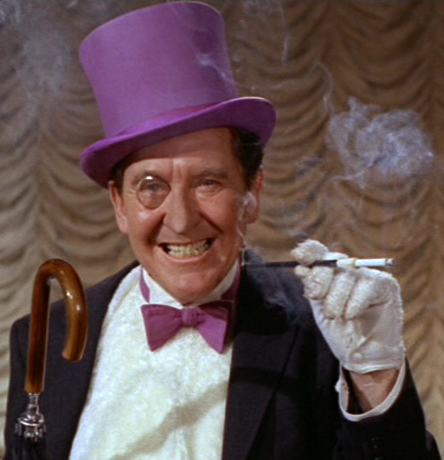
The Penguin (Burgess Meredith): The Penguin was always a silly character, not even a gritty reboot would be able to disguise just what a ridiculous villain he truly was. He walked like a penguin, had an extremely long nose, wore a monocle, and always had a cigarette holder protruding from his mouth. While he is extremely out of place in the dark, gritty Batman comics, he is a perfect fit for the campy TV show. 
The Penguin's crimes were always bird related and always chose extremely transparent bird themed aliases to throw the law off his track. In Batman: The Movie, he buys a pre-atomic submarine under the pseudonym P. N. Guin.  He labeled himself as being a SUPER GENIUS criminal mastermind, but was always bested by Batman. Whenever the Penguin disapproved of something he would let out a "Quack" sound. 


There were other colorful villains in the shows run as well: Egghead, King Tut, The Book Worm, False Face,The Minstrel, Mr. Freeze, but it's the four highlighted above that were, and still are, the most popular.

In the show's final season the character of Barbara Gordon/Batgirl was introduced. She was portrayed by beach movie regular (and frequent Elvis co-star) Yvonne Craig. Her character served dual purposes, it offered the girls a positive role model and it gave the boys more eye candy to look at. 
Batgirl's identity was a completely mystery to Batman and Robin, and she would often slip away before the Dynamic Duo had a chance to ask her any questions. She was a certainly more competent hero than Robin (and all the Gotham police force, but that goes without saying). Her alter ego, Barbara Gordon, was an extremely intelligent woman and could often figure out the criminals schemes/ where abouts before Batman and without the aid of a computer. She was also fairly adept at handling herself in fights, often holding her own with Batman and Robin (well, maybe not Batman, but she often bested Robin in terms of knock outs). Unfortunately, for all her toughness, she also had a tendency to get herself captured by the villains, then Batman would come along to save the day. Still, she was infinitely better than Robin. Yvonne Craig is leagues better than Alicia Silverstone, who stuttered her way through the role in 1997's Batman & Robin


As I mentioned before, Batman purists absolutely loathe the 60s TV show, because in their minds it makes a complete mockery out of the character. It wouldn't be until the 1989 Tim Burton film that the character would be a given a more serious minded treatment and since then the dark, troubled Batman of the Burton/Nolan films have supplanted the warm, whimsical Batman of the 60s. When Joel Schumacher went back to the camp format in Batman & Robin the movie going public rejected it, to the point where it's regarded as one of the worst movies ever made. In all fairness, it is a fairly dreadful film. It successfully killed the first Batman movie series but made way for the Christopher Nolan reboot. It's easy to rag on the Batman show for its camp aesthetics, but let's not forget that the comic book itself was extremely silly at the time. The 1960s Batman TV show is just one of the many faces the Caped Crusader has donned over the last eighty plus years, rather than being disgusted by it, Batman fans should embrace it. There's more than enough for room for two different interpretations of the same character (and in the comic book's case there's been 
more than that), so LIGHTEN UP PEOPLE! 
Besides, nothing in the Nolan films can top the sight of Batman running through this streets with a bomb over his head, looking for a place to dispose of it. (NOTE: This clip has been replaced with music from Benny Hill, as I could't find a decent clip with the original score.) 


Snow White's Revenge/Scandal (2024)

  It is difficult to write about Snow White’s Revenge without bringing up the ending, so readers beware, this review will contain spoilers...