Powered By Blogger
Showing posts with label Bela Lugosi. Show all posts

Thursday, October 31, 2019

The Raven (1935)


In the 1930s, Universal Studios was primarily known for its monster movies; the box office successes of Dracula and Frankenstein would kick start a new era of horror movies that lasted until 1936. Universal’s monster movies have left such an indelible mark on pop culture that it is easy to over look that other horror movies the studio produced in the era; most notably the three movies based off the works of Edgar Allan Poe (The Murders in the Rue Morgue, The Black Cat, and The Raven) - with Bela Lugosi appearing in each one.  The three movies may not be up to par with the likes of Bride of Frankenstein but they are fairly enjoyable and feature some of Lugosi’s best work.  In fact, The Raven may feature my favorite Bela Lugosi performance of all time.  It is far better showcase for Lugosi’s acting abilities than his most famous role, Count Dracula. If you have read the blog before, then you know that I am not a big fan of the 1931 Dracula.  It has its share of brilliant moments but, for the most part, it is a fairly dull movie. While Lugosi is genuinely creepy as Dracula, his performance is fairy one dimensional – though, I blame this more on script, which gives Bela very little to work with. 

In The Raven, Lugosi stars as the world famous surgeon, Dr. Vollin, who has a fairly eccentric hobby – he builds the torture devices that appear in the works of Edgar Allan Poe.  Vollin always seems to have Edgar Allan Poe on the brain, regardless of the situation.  When a young ballerina, Jean Thatcher (Irene Ware), is injured in a car accident, Dr. Vollin is asked to perform a surgery on her (the movie emphasizes that he is only man qualified for this job).   After the surgery is a success, Vollin and Jean form a bond, and the doctor becomes smitten with the much younger woman – much to the chagrin of her father.  After Judge Thatcher makes his objections known, and orders the doctor to stay away from his daughter, Vollin completely loses his mind and, with the help of a disfigured convict (Boris Karloff), he plots his revenge.


 There are a few interesting touches to The Raven that separate it from most horror movies from that era:
1.       It is heavily implied that, had it not been for the meddling of her father, Dr. Vollin and Jean would have ended up together.  While Dr. Vollin does have his eccentricities, he can turn on the charm when the situation calls for it and it’s not too surprising that Jean would be attracted to his personality.  When Jean, in a show of gratitude, does a dance interpretation of “The Raven” on the stage, Dr. Vollin is genuinely moved by the gesture.  It is also clear that Jean is one of the few souls that Dr. Vollin can actually open up to; there is a sense that she could have brought some normality to his life but, unfortunately, fate dealt Dr. Vollin a rotten hand. After Judge Thatcher confronts Dr. Vollin, you can feel his entire world come crashing down.  He is a broken man.  That doesn’t justify attempted murder on his part but it’s hard not to feel some sympathy towards him.  Lugosi takes what could have been a one dimensional character and makes him a tragic figure – at the end of the day he only wanted to be loved.   


2.       The Creepy Assistant was a staple in 1930s horror movies; the most famous example is probably the hunchbacked Fritz in James Whale’s Frankenstein.  These characters were either deformed and/or mute, and generally lacked any sort of empathy – they obeyed their masters without question.  Naturally, The Raven takes this trope and turns it on its head by making the creepy assistant, Edmond Bateman, the most sympathetic character in the movie.  Bateman is an escaped convict and wants to disguise his identity by having Dr. Vollin perform plastic surgery on his face. Vollin does perform the surgery, but disfigures Bateman’s face.  Vollin promises to fix it, but only if Bateman helps him with his revenge.  Bateman reluctantly agrees.  While Karloff does play second fiddle to Lugosi in this movie, he does manage to give Bateman a spark of humanity (even the bad make up job can’t hide this fact).  Bateman, despite his criminal past, has a moral conscience but is stuck between a rock and a hard place – he wants to help Jean but he also wants his face restored back to normal.  He does attempt to warn Jean about Vollin but she either won’t listen him (out of fear), or he gets thwarted by Dr. Vollin. 


3.       The heroine in 1930s horror movies was usually a naïve innocent, or a fairly good natured sort who made the best out of a bad situation.  Therefore, it is actually surprising just how callous Jean is towards Dr. Vollin and Edmond Bateman.  After Judge Thatcher orders Dr. Vollin to stay away from his daughter, Jean doesn’t put up any resistance and immediately runs into the arms of Dr. Jerry Holden, who is a complete dullard (which is on par for this type of movie). It should also be noted that actress Irene Ware has much better screen chemistry with Lugosi than she does with Lester Matthews; which leads one to believe that she is only with Holden to please her father.  Jean completely discards Vollin and doesn’t stop to think how her actions might affect him. When Dr. Vollin invites her to his house for the weekend (along with a few other guests) she takes Jerry with her and even jokes about how Vollin is “in love with her.”  It doesn’t even occur to her to reject Vollin’s invitation; which would make more sense given the circumstance.  Judge Thatcher speaks for the audience when he wonders why Jean would accept the invite. The answer being: If she didn’t there wouldn’t be a movie.  When she first lays eyes on Bateman, she lets out a scream.  It is interesting to see this type of insensitive behavior from a 1930s heroine; though, I’m not sure if this was intentional. The filmmakers probably assumed we would side with Jean and, therefore, find all her reactions completely reasonable.  


The Raven moves at an incredibly fast pace. It is incredibly efficient in its storytelling and doesn’t waste a lot of time – the opening scene is Jean getting into a car accident, followed by Dr. Holden claiming that only Dr. Vollin can perform the necessary surgery.  It doesn’t bore you with needless subplots and there is no cringe inducing love scene between the two juvenile leads; instead it shines the spotlight on two its two legendary stars, Bela Lugosi and Boris Karloff. 

Credits
Cast: Bela Lugosi (Dr. Vollin), Boris Karloff (Edmond Bateman), Irene Ware (Jean Thatcher), Lester Matthews (Dr. Jerry Holden), Samuel S. Hinds (Judge Thatcher), Spencer Charters (Col. Bertram Grant), Inez Courtney (Mary Burns), Ian Wolfe (Geoffrey ‘Pinky’), Maidel Turner( Harriet).
Director:  Lew Landers
Writer: David Boehm (based off the poem by Edgar Allan Poe).  
Running Time:  61 min

Thursday, June 13, 2019

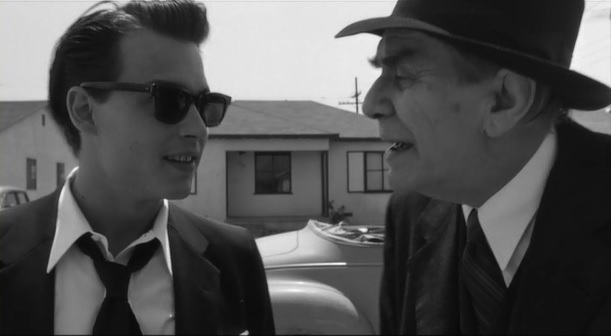
Ed Wood (1994)


Edward D. Wood, Jr. is often regarded as the worst director in cinema history. He might have been destined for obscurity if it wasn’t for the 1980 book “The Golden Turkey Awards” by Harry and Michael Medved.  In their book, Wood was voted the “worst director of all time” and his magnum opus Plan 9 from Outer Space was voted “the worst movie of all time.” This brought Wood new found fame among bad movies aficionados, who eagerly sought out his body of work.  Wood was a fairly interesting character, not only was a bad movie auteur but also – a World War II vet (he survived one of the bloodiest battles in the South Pacific); a writer of lurid pulp novels; a pornographer (after his failed career in Hollywood he relegated himself into making hardcore porn); and a transvestite.  His pseudo-documentary Glen or Glenda is (rightfully) ridiculed for its sheer ineptitude, but it’s also one of the most personal movies ever committed to celluloid – it’s based on Wood’s own struggles to come to terms with his cross dressing.   His movies are genuinely unique, even if they are terrible. He was a true auteur!  It is no wonder that Tim Burton was compelled to tell Ed Wood’s story – he is the ultimate misfit. 


It is important to note that Ed Wood is not your typical Hollywood biopic. It only focuses on a small portion of Wood’s life (1953 – 1959) and completely plays around with the facts – it glosses over Wood’s alcoholism and omits his brief marriage to Norma McCarty. It recreates the behind the scenes of three Wood movies – Glen or Glenda, Bride of the Monster, and Plan 9 from Outer Space – but skips over the making of Jail Bait (which was shot on the same sets as Glen or Glenda).  While most of Wood’s stock company is portrayed in the movie, Lyle Talbot is noticeably absent (even though he appeared in three of Wood’s movies).  

There are also a lot of liberties taken in the storytelling (mostly for comedic effect); in the movie, while making Bride of the Monster, Ed talks Bela Lugosi into wrestling with a rubber octopus in a pond, when in reality it was a stunt double (this is even more obvious in the cleaned up DVD of Bride of the Monster).  There has been a dispute as to how Loretta King was cast in Bride of the Monster – in the movie, Ed mistakenly believes that Loretta has the money to finance the entire production (after she lends him two hundred dollars) and he cast her in the lead out of obligation, while Loretta King claims that she was contacted by Wood, via her agent, and that money was never a factor.  I tend to be believe King’s account of the story, because while filming Bride of the Monster Wood ran out of money and had to briefly shutdown production until he could get financing – so,  if King was cast under false pretenses, then wouldn’t Wood just recast the role once production started up again?  It should be noted that it was Dolores Fuller, Ed Wood’s ex-girlfriend and one time lead actress, who kept pushing this story about Loretta King. Initially, Fuller was supposed to play the heroine in Bride of Monster but Wood eventually cast King in the role.  There is a theory that Wood lied to Fuller about the circumstance of King’s casting in a desperate attempt to let his girlfriend down gently.  “I desperately wanted to cast you in the lead role, baby, but she has all the money.  I need to placate her whims.”  Either way, Fuller’s account of Loretta King is second hand, at best, and is fairly biased towards Ed Wood.   Also, despite what the movie claims, Loretta King was not allergic to water.  


The movie is less of a biography of Wood and more a retelling of his life through a fairy tale lens.  Wood, as played by Johnny Depp, is an enthusiastic, good natured young man who is looking for the big break. He desperately wants to make movies but just can’t seem to get his foot into the door.  He finally gets a chance when he learns that sleazy producer, George Weiss, is making a biography of Christine Jorgenson and Wood manages to convince Weiss he is the man for the job because of his cross dressing history.  Weiss grudgingly hands Wood the assignment and then is dismayed (albeit briefly) that Wood’s script has nothing to do with Christine Jorgenson, but he really doesn’t care too much about the content as long as Wood delivers the movie on time and it makes a profit.  The running gag throughout the movie is that Wood often has to swindle his way into making movies; he’ll do anything because the ends justify the means.  When his landlord tells him that his church is interested in making a series of movies on the apostles, Wood tells him that they should invest their money into a proven genre (science fiction) and then they can use the profits from that film to finance their apostle movies.  He then persuades the church to fund Plan 9 From Outer Space (they later regret the decision after seeing Wood’s absent minded approach to filmmaking).  When they point out all errors in a scene, Wood barks back, “movies are not about the small details, they are about the big picture.”  What is incredible about this scene is that, despite the legitimate criticism of his backers, we find ourselves siding with Wood. The movie does such an excellent job of portraying Wood as an underdog figure that we naturally root for him, despite his lack of talent. 

The heart of the movie is the relationship between Ed Wood and Bela Lugosi (wonderfully played by Martin Landau).  There is an interesting dynamic between the two men - Wood is a fairly young man struggling to get into the movie business while Lugosi is washed up movie star who has been forgotten by the industry.  The two of them are kindred spirits despite their age gap.  Wood’s relationship with women is pretty much secondary:  His girlfriend, Dolores Fuller, leaves him midway through the movie and his courtship of Kathy (his second wife) is extremely rushed.  The two of them meet while Bela is in rehab and then Ed Wood woos her at a carnival. 


 Burton really isn’t interesting in this aspect of Wood’s life (probably because it is too conventional for his sensibilities).  The most moving scene in the movie is not when Ed wins over Kathy, but rather when he persuades Bela, hopped up on pain killers, to check into rehab. Up until this scene, the movie was been fairly light hearted, but this scene is extremely nightmarish.  Everything is a state of disarray– Bela’s household is a complete mess and he his babbling incoherently. At one point he pulls out a gun and insists that Ed and him should kill themselves. Ed defuses the situation by calmly talking Bela down and then driving his friend to rehab.  Both of the actors are spot on in their performances – Landau is so good that  you can genuinely feel  Bela’s pain and confusion, and Depp rather effectively underplays the scene - instead of trying to compete with Landau, he basically stands back and gives Landau room to perform. It is a nice give and take between the two talented actors.  This is the rare instance where Ed is the voice of reason. He is clueless most of time, but when it comes to his friendship with Bela he is absolutely committed.  


There is the criticism that Wood exploited Bela Lugosi’s name to further his own career – this view is largely expressed by Bela Lugosi, Jr. in the documentary The Haunted World of Ed Wood.  Lugosi, Jr. views his father’s work with Wood as being the absolute “bottom of the barrel” and a total disgrace to his father’s memory.  In all fairness to Junior, he isn’t wrong – his father’s appearances in Glen or Glenda and Bride of the Monster are huge step down from Dracula, The Black Cat, and, hell, Abbott & Costello Meet Frankenstein. However, what Lugosi, Jr. conveniently overlooks is that his father’s career had already reached the bottom of the barrel long before his association with Ed Wood. The year before Lugosi appeared in Glen or Glenda he starred in a truly execrable comedy called Bela Lugosi Meets a Brooklyn Gorilla  (which featured the second rate comedy duo  Sammy Petrillo and Duke Mitchell – a Martin & Lewis knockoff).  Truth to be told, if you take the time to look at Lugosi’s filmography, you will find that the bad movies greatly outnumber the good ones. While it’s true the Wood movies are bottom of the barrel, it’s a bit disingenuous of Junior to blame Wood for his father’s downfall.

 Did Wood exploit the Lugosi name? Definitely.  Was it sole reason he cast Lugosi in his movies? Definitely not.   While a few curious filmmakers might have been drawn into by Lugosi’s billing on the movie poster, the fact is he wasn’t exactly a major star at this point in his career.  In the 1950s he was pretty much forgotten – it wouldn’t be until the sixties that he would become a cult figure. I believe Wood genuinely cared about Lugosi and did whatever he could to get his friend work – like writing a nonsensical role in the pseudo-documentary Glen or Glenda. I’ m sure having Lugosi as his “star” persuaded investors to fund his movie, but the fact is these roles seem tailor made for Bela (especially the made scientist in Bride of the Monster).  To be honest, other than the Wood pictures, the movies Lugosi made in the 1950s are pretty forgettable.  


There is an interesting parallel between Ed Woods friendship with Bela Lugosi and Tim Burton’s friendship with Vincent Price – they were both fairly young filmmakers who befriended aging horror icons.  Vincent Price did the narration for Burton’s animated short, Vincent, and then later appeared in Edward Scissorhands, while Lugosi spent his final years making movies for Ed Wood.  However, unlike Wood before him, Burton managed to find mainstream success fairly early in his career (his third feature length movie was Batman) and Price never quite reached the bottom of the barrel that Lugosi did.  Lugosi spent most of his career living in the shadow of Dracula, while Price managed to adapt with the times (most people from my generation know him for the rap he did on Michael Jackson’s “Thriller.”) 


Is Edward D. Wood, Jr. truly the worst director of all time? Is Plan 9 from Outer Space the worst movie of all time? My answer is a staunch…..NO!!!!  Granted, it’s this title that made Wood a posthumous celebrity but it’s simply not true.  Sure, Ed Wood’s movies are bad, but they are also fairly watchable.  There is also a nice sincerity about Wood’s movies – he genuinely loved the medium of filmmaking and wanted to tell compelling stories.  Unfortunately, his movies are interesting for all the wrong reasons but at least the passion there.  In all honesty, Wood often displayed some flashes of competence – the nightmare sequence in Glen or Glenda is genuinely creepy and disorienting;  Bela Lugosi is genuinely good in Bride of the Monster; and there a few atmospheric shots of Tor Johnson and Vampira wandering through the cemetery in Plan 9 From Outer Space.  I can think of a few filmmakers that are more deserving of the worst director of all time:  Coleman Francis, Larry Buchanan, Dwain Esper, to name a few.  These filmmakers were in the movie industry for monetary gain and would gladly have given up the craft if they could find an easier way to make money.  There also plenty of movies that are infinitely worse than Plan 9 from Outer Space, I will gladly name a few:  The Creeping Terror, The Beast of Yucca Flats, Manos: The Hands of Fate, Child Bride, Mesa of Lost Women, They Saved Hitler’s Brain, and Larry Buchanan’s entire filmography. Compared to these movies, Plan 9 from Outer Space is a veritable masterpiece.  

 While Ed Wood was a critical success, it was a complete dud at the box office. This isn't too surprising given that the vast majority of movie goers probably have never heard of Ed Wood - his movies appeal to a fairly niche audience. Ed Wood is not only Burton's most personal film, but it also signified the end of his "Golden Era."  Beginning with Pee-Wee's Big Adventure in 1985 and ending with Ed Wood in 1994, Tim Burton had nearly a decade of solid film making under his belt. He was truly a unique movie director - but after the financial failure of Ed Wood his movies became increasingly more inconsistent and, worst of all, forgettable.   He has basically relegated himself to big budget remakes of classic movies and TV shows- with the occasional "personal" film thrown in for good measure.  His newer movies feel less like a personal statement and more like a corporate product meant for mass consumption.  I'm not going to begrudge Tim Burton his success (he absolutely earned it) but it's shame to see a once unique and extremely original filmmaker get swallowed up by the Hollywood system.


Credits
Cast: Johnny Depp (Ed Wood), Martin Landau (Bela Lugosi), Sarah Jessica Parker (Dolores Fuller), Patricia Arquette (Kathy O’ Hara), Bill Murray (Bunny Breckinridge), Jeffrey Jones (Criswell), Lisa Marie (Vampira), George “The Animal” Steele (Tor Johnson), Juliet Landau (Loretta King), Mike Starr (George Weiss), Max Casella (Paul Marco), Brett Hinkley (Conrad Brooks), Clive Rosengren (Ed Reynolds), G.D. Spradlin (Reverend Lemon), Vincent D’ Onofrio (Orson Welles), Ned Bellamy (Dr. Tom Mason), Rance Howard (Old Man McCoy).
Director: Tim Burton
Writers: Scott Alexander, Larry Karaszewski.
Running  time: 126 min.

Wednesday, October 12, 2016

Dracula (1931)


When I finally caved in and bought a DVD player, one of the first DVD sets I purchased was “The Monster Legacy DVD Gift Set,” which included fourteen movies, and small busts of Dracula, the Frankenstein Monster, and the Wolf Man; all for the reasonable price of fifty six dollars! It was money well spent as I was concerned.  As a kid growing up in the 80s, the local station used to play these movies every Saturday night (and a few Hammer movies thrown in for a good measure).  There were books in the school library devoted to the classic monsters and I frequently checked them out.  Therefore, it pains to me say that I find the original Dracula, starring Bela Lugosi, to be incredibly dull. It is the one film in the collection that is an absolute challenge to watch; House of Dracula may be a terrible movie, but at least it is entertaining.

The first twenty minutes, set in Transylvania, are superb and heavy on the atmosphere: Terrified villagers warn Renfield not to go up to Castle Dracula; the eerie scene of Dracula’s brides rising up from their coffins; the wonderful tracking shot of Dracula staring directly into the camera; and  Dracula slowly descending down a stairway that is covered in spider webs. These are all spine-chilling scenes and it is easy to understand why audiences in the 1930s were terrified by them.  The movie takes a turn for the worst when it switches locations to London and turns into a photographed stage play.  


This criticism isn’t anything new, in his 1967 book, “An Illustrated History of the Horror Movie,” Carlos Clarens writes,"The sequence of Renfield at the castle has a pleasant Gothic flavor, but, as soon as the action moves to London, the picture betrays its origins 'on the boards,' becoming talky, pedestrian, and uncinematic. We are told, when we should be shown, about the “red mist” that heralds the arrival of the vampire and about the werewolf seen running across Dr. Seward’s lawn.”

This is absolutely correct! Of course, one might argue that the movie is scarier because it doesn’t show us these things and allows us to use our imagination instead. That argument doesn't apply to this movie; the lack of visual effects is due to necessity rather than artistic expression. This was a fairly low budget movie, after all.  The “werewolf running across the lawn” bit is great example; if this was accompanied by a creepy sound effect, or score, then it might be a chilling  moment, instead all we are given is David Manners’ half hearted line delivery.  A wolf running across your lawn isn’t something you see every day, but Jonathan Harker doesn’t seem all too concerned about it.  Manners wasn’t particularly happy to be cast in Dracula and it shows; much to his chagrin, he would  be cast as the juvenile lead in two more Universal Horror movies, The Mummy and The Black Cat. The limitations of Manners’ acting are even more apparent when you compare his performance to that of his leading lady, Helen Chandler, who is a more interesting, and livelier, performer.  Chandler’s performance is uneven, but she is very good later on in the movie when Mina, after having been bitten by the Count, tries to fight her more basic instincts. The scene where she flirts with Jonathan and then stares his neck, waiting to make her move, is a wonderful moment and Chandler is quite scary with her wide eyed stare.  It is the only real noteworthy moment in the final twenty minutes. 


It doesn’t help that most of the second half is set in Dr. Seward’s parlour; most of the time, the camera remains stationary as actors walk into frame, say their lines, and then exit. This portion of the movie drags on and often feels like a proud parent recording their children in a high school production (sans the nonstop zooms). This is a dull group of actors: Edward Van Sloan plods through the scenery while delivering endless exposition while everyone else scratches their heads in confusion.  Bela Lugosi and Dwight Frye (as Renfield) will occasionally show up to breathe some life into the proceedings, but otherwise it is completely aimless. There is never any sense of urgency among the protagonists and, as a result, it doesn’t feel like the movie is building towards anything:  Jonathan repeatedly objects to Van Helsing’s methods; Mina keeps acting strange; Van Helsing ticks off Dracula; and Renfield tries to warn Mina about “the master.”


After a half hour of this nonsense, the movie finally switches locations to Carfex Abbey, Dracula’s new “home.” Hey, maybe we’ll be treated to an exciting one on one face off between Dracula and Van Helsing.  Dracula views the professor as a worthy adversary, so maybe the two of them…..NOPE (spoilers for an 85 year-old movie)……the famed count is killed off screen (his death is signified by a barely audible groan). This ending doesn’t hold a candle to the one in Frankenstein (also released in 1931): Victor Frankenstein finally takes responsibility for his actions and faces off with his creation inside a wind mill. This is a genuinely exciting scene sparked by Boris Karloff’s terrific turn as the Monster.  

Dracula is remembered today for Bela Lugosi’s iconic performance as the Count; his stilted line delivery and theatrical mannerism, which would be a debit to most actors, helps add an air of mystery to Dracula. There are historians that claim the Spanish – language version (shot at night time on the same sets as the Browning production) is a superior movie and from a technical stand point they are correct. Unfortunately, Carlos Villiarias, as Dracula, lacks Lugosi’s screen presence; he often makes funny faces to express his anger.  While Dracula is Lugosi’s most famous performance, it is by no means his best:  I prefer his turn as the demented, broken necked shepherd, Ygor, in Son of Frankenstein.  The more over the top Lugosi is, the more enjoyable his performances are.  It is really Dwight Frye that steals the movie with his creepy performance as the tragic Renfield; the likable real estate agent that is driven into madness by Dracula. The shot of him standing at the bottom of a ship’s stairway, staring into the camera with a mad look in his eyes and a huge grin plastered on his face, is one of the most unnerving moments in movie history.


Dracula is a mixed bag – an exciting twenty minutes, followed by nearly an hour of boredom (with a few bright spots thrown in).  If it is every on television, or streaming online, I recommend you watch the opening twenty minutes and then promptly find something else to watch.

Cast: Bela Lugosi (Count Dracula), Helen Chandler (Mina), David Manners (Jonathan Harker), Dwight Frye (Renfield), Edward Van Sloan (Van Helsing), Herbert Bunson (Dr. Seward), Frances Dade (Lucy), Joan Standing (Maid), Charles Gerrard (Martin).
Director: Tod Browning
Screenplay:  Garrett Fort (adapted from the 1924 stage play by Hamilton Deane and John L. Balderston).
Based on the novel by Bram Stoker.
Running Time: 75 min.

Snow White's Revenge/Scandal (2024)

  It is difficult to write about Snow White’s Revenge without bringing up the ending, so readers beware, this review will contain spoilers...