Powered By Blogger
Showing posts with label Nancy Sinatra. Show all posts

Friday, November 13, 2020

The Wild Angels (1966)


When The Wild Angels came out in 1966 it was a huge box office hit and inspired a whole new subgenre of outlaw biker movies.  It was also a source of inspiration for Easy Rider (which also starred Peter Fonda). It was fairly controversial when it came out, but in hindsight it comes off as rather silly.  While watching the movie, I couldn’t help but to think of the Beach Party series (also produced by American International Pictures) in the mid 60s.  The main antagonists in the Beach Party movies (with the exception of Muscle Beach Party) were a biker’s gang, The Rat Pack, led by the dopey Eric Von Zipper. 


Zipper often came up with ridiculous schemes to “get those no good surfers” off of his beach, which always ended in total failure.  In The Wild Angels, the outlaw biker gang, The Angels, are led by Heavenly Blues (Peter Fonda), who, despite his “too cool for school demeanor” manages to be an even more incompetent leader than Eric Von Zipper.  Sure, Zipper’s schemes always failed, but at least he didn’t get any of his gang members killed.

The Wild Angels has a fairly simple plot:  Joe ‘Loser’ Kerns motorcycle has been stolen.  The Angels ride out to Mecca, California in hopes of finding it, which leads them to a garage run by a Mexican gang. The two groups brawl but, before it can be settled, the police show up.  Loser is separated from the rest of the Angels and steals a policeman’s motorcycle.  He gets shot for his effort and ends up in the hospital. Heavenly Blues finds out about this and leads a small group of Angels to sneak Loser out of the hospital; with his girlfriend Mike ‘Monkey’ acting as a Trojan Horse.  She pretends to be Loser’s sister and asks if she can see him, the policeman on duty reluctantly agree.   She whips up a few tears and, when the policeman gets distracted, unlocks the glass door.  The Angels get Loser out of the hospital but Heavenly is identified by a nurse on duty (who one of the gang members attempted to rape).  The Angels arrange for a funeral to be held in Loser’s hometown. They hold a service in a small church and even go the trouble of hiring a preacher to preside over the service. However, Heavenly is not satisfied with the preacher’s eulogy and decides that the Angels will honor Loser’s memory by having the party. The Angels tie up the preacher, tear up the church, and proceed to have an orgy. Finally, after the mayhem has ended, they go to bury Loser’s body in the local cemetery.  One of the townsfolk throws a rock at them, which leads to a brawl.  However, once they hear police sirens heading their way, the Angels bolt, leaving Heavenly alone to bury the Loser.  

The question I initially asked was:  Is The Wild Angels a parody of the A.I.P. Beach Party movies. It plays like a demented version of those. It’s easy to imagine Heavenly Blues being the leader of a surfer gang, with Mike being his best girl (the same year The Wild Angels came out, Nancy Sinatra appeared in the final Beach Party movie, The Ghost in the Invisible Bikini).
At the end of the movie, Heavenly Blues makes a famous speech:

We wanna be free! We wannabe free to do whatever we wanna do! We wanna be free to ride!
We wanna be free to ride our machines without being hassled by the MAN! And we wanna get loaded! And we wanna have a good time! And that is what we’re gonna do! We are gonna have a good time! We gonna have a party!

No doubt this speech resonated with the 1960s counterculture, yet is exactly the same type of speech Frankie Avalon would give in a similar situation. The only difference is that he would want to be “free to surf without being hassled by the Man.” I make this point, because by 1966 the Beach Party movies were considered old hat by the counterculture, yet this so-called “anti-establishment” movie seems content on plagiarizing them.  


Did the 1966 youth take this movie seriously?  I initially thought my theory of The Wild Angels being a Beach Party parody was correct, when I saw that Charles B. Griffith wrote the screenplay.  Griffith wrote a few scripts for Roger Corman; most notably Bucket of Blood and the original The Little Shop of Horrors.  Most of his scripts contain an element of dark humor; that includes his more “serious” scripts like The Undead and The Attack of the Crab Monsters. So, clearly The Wild Angels is a dark comedy.  Not so fast!  While Griffith is the credited writer, the script was largely rewritten by future director, and Orson Welles lackey, Peter Bogdanovich.  Corman found Griffith’s script to be unacceptable, so he brought in Bogdanovich to “fix it.” I have to wonder if Griffith’s script had more humor in it, which is why Corman found it unacceptable. Who knows?  All I know is that the finished script is a mess and completely devoid of any humor.

The movie helped establish Peter Fonda as a counter culture icon (Easy Rider would further cement this status). I must admit, I am completely baffled as to why that is.  Sure, Peter Fonda looks cool riding on his motorcycle, but he is completely devoid of any real personality. I would even argue that Fonda gives the weakest performance in the entire movie. It’s hard to believe a biker gang would follow this guy’s lead.  Fonda faired slightly better in Easy Rider, and that is largely because his character is devoid of any real agency. He just goes where the road takes him.  I also find the character to be somewhat problematic. I don’t think it was Corman’s intention to glorify the behavior of The Angels; they are, after all, white supremacists. Yet, Heavenly Blue’s speech at the end probably did resonate with many young people in the audience (especially since it was directed at a preacher – a symbol of the Establishment if there ever was one).  His treatment towards Mike is especially appalling; he dismisses her concerns and, out of pure spite and right in front of her, screws another woman in the church.  When Mike returns the affection of another biker, Heavenly punches the guy and gives her a dirty look.


Heavenly Blues fits well into Roger Corman’s galley of existential losers.  He could easily be descended from such characters like: Walter Paisley (Bucket of Blood), Seymour Krelboin (The Little Shop of Horrors), Quintus Ratcliff (The Undead), Roderick Usher (House of Usher), and Prince Prospero (The Masque of the Red Death). These are characters that have a skewed morality; “the ends justify the means” applies to them.  They avoid taking any responsibility for the actions, and that inevitably leads to their downfall.   There are multiple times throughout The Wild Angels where Heavenly could potentially right the ship, but he chooses to double down on his actions. It is fitting that movie ends with him all alone, burying the corpse of his best friend.  Movie critics and film historians like to slap the tag of auteur onto many filmmakers; but if you were to apply that to Roger Corman, most of them would probably laugh.  Yet, with the exception of The Raven, there is a fairly cynical, almost nihilistic world view that pervades most of Corman’s movies.  Not to mention that Corman had his own stock company of writers and actors who worked on many of his movies; in the Wild Angels, Corman regulars Dick Miller and Barboura Morris appear in small roles.

While 1967 is regarded as “The Summer of Love,” there was a significant shift in pop culture in 1966.
The Beach Boys released their album, Pet Sounds, which essentially signified an end to their surfing songs. The Beatles released, Revolver, which offered up more introspective songs (often fueled by drugs) and helped shed The Beatle’s “clean cut image.” They also announced they were done touring, which meant the only way fans could hear them was by purchasing their albums.  It should be noted that Walt Disney, the man who essentially symbolized the old studio system, passed away in late 1966.  Without Walt at the helm, Disney studios would flounder for the next couple of decades before achieving a renaissance in the 1990s. Whether that is a good or bad thing is entirely to up to you.

While The Beach Boys and The Beatles got all the attention in 1966, another significant song that charted the year was “These Boots Are Made For Walking,” sung by Nancy Sinatra.  It is interesting to contrast Nancy Sinatra’s character of Mike with her chart topping hit.  The song is about a woman who has had enough of her man’s shit and threatens to leave if he doesn’t straighten up.  Mike is the complete antithesis of this song – she is loyal to a fault.  Heavenly Blues is exactly the type of man that “Boots” is talking about.  He is completely dismissive towards Mike, often puts her in dangerous situations, and treats her like complete garbage.  When Mike asks Heavenly if he still loves her, he responds with “I don’t know.”  Interestingly enough, Sinatra played a similar role in The Ghost in the Invisible Bikini – where the man she pines for is fairly oblivious to her existence.  The only difference is that Bobby, her object of affection in The Ghost in the Invisible Bikini, is a good natured idiot. Heavenly is a first rate asshole - to the point where, just to spite Mike, he has sex with another woman on a church altar.  When she, hesitantly, responds to another biker’s advances, Heavenly gets jealous and punches the guy in the face; and the shoots Mike the evil eye.  

1966 - The Three Faces of Nancy Sinatra. 

The problem I have with Mike is that she is completely devoid of an agency. She constantly sides with Heavenly no matter how idiotic his schemes are.  While Heavenly and Mike could be seen as a sick parody of Frankie and Annette, the main thing that separates these two female characters is that at least Annette Funicello’s character, DeeDee, was constantly calling Frankie out on his bullshit.  If this were a beach party movie, when Frankie gives his speech about wanting to “be free,” this would be accompanied with a close up of Annette rolling her eyes at his juvenile mindset.  Mike is content with going along on the ride even though there is no real destination.   This is not the fault of Nancy Sinatra, who manages gives Mike an air of vulnerability, but the writers.  The fundamental flaw of many counter culture movies is their inability to write compelling female characters.  Don’t believe me!!!! In Easy Rider, the women solely exist to pleasure the main characters, Wyatt and Billy. They hook up with two women at a hippie commune and later on hook up with two prostitutes in New Orleans.  These women are barely in the movie and don’t have much in terms of personalities (despite being played by capable actresses).  In The Graduate, Mrs. Robinson is an interesting character, but she is the villain of the piece, while her daughter Elaine is kind of a flake. I often hear about how these movies “spoke to a generation.” Did they speak to women, as well? While watching The Wild Angels, I kept hoping Mike would follow the advice offered in “These Boots Are Made For Walking.” Kick the no good bum, Heavenly Blues, to the curb! Move on with your life! 

The also brings me to the movie’s most egregious moment – the rape of Gaysh (Diane Ladd) by the bikers Frankenstein and Dear John.  In fact, it could be argued that Frankenstein’s arc is that he successfully rapes a woman, after two failed attempts earlier on in the movie; he attempts to rape Gaysh at party and then a nurse while the other angels are sneaking Loser out of the hospital, both times he thwarted by Heavenly. However, at the end, while Heavenly is busy screwing the older Momma Monahan, Frankenstein persuades Dear John into helping him rape Gaysh (Loser’s grieving widow).  What I find so repulsive about this scene is how the filmmakers completely shrug it off. It has no relevance to the plot, and Frankenstein and Dear John are never held accountable for their actions. After having been raped, Gaysh walks up to Loser’s corpse and asks him for forgiveness. Why?
Even more troubling is that this trope would often pop up in many movies Corman produced for New World Studios – the only difference being that those rape scenes are far more graphic than the one in The Wild Angels (it happens offscreen).  There was an odd logic in many exploitation movies of the 1970s and 80s that there is no such thing as bad female nudity, hence they would often include a rape scene just to meet their quota of female nudity. Like The Wild Angel’s, these movies would rarely explore what effect the rape had on the victim; instead it was merely a plot device to motivate the heroes into action.
It’s also odd how sex in many counterculture movies is rarely depicted as a healthy or pleasurable act -
sex is either depicted as unhealthy (rape) or completely sterile (Benjamin sleeping with the older Mrs.
Robinson simply for the hell of it). Also, the question needs to be asked:  Wouldn’t Heavenly expel Frankenstein from the gang?  He’s not only a threat to members of the Angels, but it is his attempted rape of the nurse that leads to her identifying Heavenly to the police.  He is a total detriment to the Angels, yet Heavenly allows him to remain in the gang.  Hell, even the incompetent Eric Von Zipper would have had the common sense to boot this guy out.


The Wild Angels is interesting more as a curio than it is an actual movie.  It was a movie that marked a shift in the popular culture and anticipated more famous movies like The Graduate, Easy Rider, Five Easy Pieces, and Billy Jack.  Like those movies (with the exception of the superior Five Easy Pieces), it has aged fairly poorly.  What was once extremely controversial is now kind of laughable. Its screenplay is extremely haphazard in places and the more “titillating” scenes drag on endlessly.  It is essentially a half hour short film stretched out in a full length feature.  It is not the worst of its kind, but it’s not a classic, either. 


Credits
Cast:  Peter Fonda (Heavenly Blues), Nancy Sinatra (Mike ‘Monkey’), Bruce Dern (Joe ‘Loser’ Kerns), Diane Ladd(Gaysh), Buck Taylor (Dear John), Norman Alden (Medic),  Michael J. Pollard (Pigmy), Lou Procopio (Joint), Joan Shawlee (Momma Monahan), Marc Cavell (Frankenstein), Coby Denton (Bill Puckey), Frank Maxwell  (Preacher), Gayle Hunnicutt (Suzie), Kim Hamilton (Nurse), Frank Gerstle (Hospital Policeman), Dick Miller (Rigger), Barboura Morris (Mother).

Director: Roger Corman
Writers:  Charles B. Griffith, Peter Bogdanovich (uncredited)
Running  Time:  93 min.

Saturday, February 8, 2014

The Ghost in the Invisible Bikini (1966)


The Ghost in the Invisible Bikini is an amazing movie! It's amazing that producers Samuel Z. Arkoff and James H. Nicholson could pull together so much talent and make such a bad movie. American International Pictures (A.I.P) is often credited for being the launching pad for many prominent actors and directors (Jack Nicholson and Francis Ford Coppola, to name a few), but it was also where many actors finished their careers as well (Karloff, Rathbone, Peter Lorre, and Buster Keaton).  Therefore, it is a real curio to see Boris Karloff and  Basil Rathbone sharing the screen with former Disney star Tommy Kirk, Nancy Sinatra, Aron Kincaid, and would be starlet Susan Hart (future wife of producer Nicholson).  Karloff at least seems to be having fun in his extended cameo, while Rathbone can never shake off his embarrassment.  The Ghost in the Invisible Bikini is a disaster of movie, but like most disasters you are compelled watch, despite your better judgement.


The Ghost in the Invisible Bikini is often considered to be the last of the A.I.P Beach movies, but I think a more accurate description would be that it was a failed attempt at trying to reinvent the formula. The beach setting had out lived its usefulness, so the most logical thing was to take the party on the road. In Ski Party, our gang of lovable beach bums relocated to the slopes of Denver. In Ghost in the Invisible Bikini, the party is moved to a......haunted house. This was not the first attempt by A.I.P to meld the beach movie and horror genres; in 1965 they released Dr. Goldfoot and the Bikini Machine, which had Vincent Price co-starring with beach movie regulars Frankie Avalon and Dwayne Hickman.  It's interesting to note that Karloff, Price, and Peter Lorre all had cameos in the first three beach movies; Priced played a beatnik poet (Beach Party), Lorre, the owner of a gym(Muscle Beach Party) and Karloff, an art critic (Bikini Beach).

Not only is there a change a scenery, but a change in the cast as well. It is apparent that A.I.P was hoping that a different cast of characters would breathe life into the tired formula; the only returning character is Harvey Lembeck's dimwitted motorcyclist, Eric Von Zipper. Tommy Kirk and Deborah Walley are given the Frankie and Annette roles, while Aron Kincaid is given the role of the dopey party goer; a role usually reserved for Jody McCrea. The problem is that there really isn't a central character that the audience can relate to. Who is the main character in The Ghost in the Invisible Bikini?  In theory, Chuck (Tommy Kirk) should be the main character, but he is off screen for significant portions of the film and often takes a backseat to  Bobby's (Aron Kincaid) histrionics. The previous films centered around Frankie and Annette's often turbulent relationship; you may not necessarily like the characters, but at least there was a solid framework to hang the story on. The budding romance between Chuck and Lili (Deborah Walley) seems like an afterthought on the part of the filmmakers. When Lili first meets Chuck she is a bit apprehensive towards him, but changes her tune at the flip of a switch. Chuck and Lili's romance should be the heart of the film, but the film makers abandon it to make way for nonstop rock n' roll numbers and "hilarious" slapstick comedy. Walley isn't really given much to do, except play the damsel in distress at the film's climax.


The same flaw applies towards the Bobby/ Vicki story line. Vicki (Nancy Sinatra), for some inexplicable reason, hopes to spark a romance with Bobby, but he has wandering eyes. This nearly costs Bobby his life as the woman he keeps drooling over, Sinistra, is a would be a murderer. Luckily for him, her eye sight is extremely poor and instead of offing him, she ends up destroying a knight's armor and a bust of Julius Caesar.  This subplot takes up the entire midsection the film, only to be forgotten in the last half hour. This is a recurring theme in  The Ghost in the Invisible Bikini, a character or story line will be introduced, only to be discarded later on. It is an extremely overcrowded film. Other than continuity, why bring back Eric Von Zipper? He doesn't really add anything to the proceedings. In the previous films he was the main villain, or at least tried to be, in this film he is a helpless bystander.

If IMDB and Wikipedia are correct, then the scenes with Karloff and Susan Hart were added after principle photography had finished, thus adding more unnecessary characters into the mix. Boris Karloff plays a Hiram Stokely, a recently deceased carnival man who has 24 hours to do one good deed if he wants to enter heaven. The catch is that he must do it from the confines of his crypt, so he sends down Cecily (the title character) to make sure his heirs (Chuck, Lili, and the eccentric Myrtle Forbush) get their rightful share of his fortune. His shady lawyer, Reginald Ripper (Basil Rathbone), hopes to scare away Hiram's beneficiaries, so he can keep the inheritance for himself. This is the movie's plot, but again, the film doesn't treat this story line with any real sense of urgency. Even worse is the fact that Cecily, despite being a ghost and being able to go unobserved, is pretty useless for the most part. She, on occasion, will play practical jokes on Ripper, but she rarely lifts a finger to help the protagonists; at least for the first 75 minutes of the movie. Cecily will often pop into frame (she is tinted blue for a ghostly effect), mug it up for a few seconds, and then promptly disappear.

At the film's climax, when Lili is in danger of being cut in half by a buzz saw (while tied to a log), Cecily stands in the corner and screams at Chuck to save her. Why doesn't Cecily stop the buzz saw herself?  She does dispose of Reginald Ripper by jamming his gun with her finger, but that could have easily been avoided had she acted a lot sooner.  The filmmakers try to imply that she is influencing the movement of the characters by having her whisper stuff in their ears; at one point she pops into frame and tells Vicki to wear a bikini, because it will get Bobby's attention. This idea never comes off as well as it should, mainly due to the poor execution of the gag;  a character will often be in mid sentence when the film suddenly freezes, just then Cecily materializes into frame and whispers something into his/her ear. After having dispensed her advice, Cecily abruptly disappears, the film resumes, and the character will repeat what Cecily just said. It happens a couple of times throughout the film, but it's only real function is to make Susan Hart's role seem bigger than it actually is.

The Ghost in the Invisible Bikini is a complete mess of a film, but it's a beautiful mess; the cinematography by Stanley Cortez is extremely first rate. It's a shame that his talents were wasted on an extremely silly film like this.  He creates a genuinely spooky atmosphere, especially during Sinistra's musical number in which she seemingly melts into the shadows. The musical numbers themselves are pretty forgettable, though I do have a soft spot for the song "Geronimo," performed by Nancy Sinatra. It's not a great song, but it is rather catchy. Plus, forgettable rock n' roll songs were a staple in the beach movies, so why should The Ghost in the Invisible Bikini prove to be the exception?


Other things I like about The Ghost in the Invisible Bikini:

1) The double act of Tommy Kirk and Aron Kincaid is fairly funny at times; Kirk is such a bland actor that he perfectly balances out Kincaid's over zealous performance. The problem is that the film only pairs them together for a few scenes, thus wasting a potentially funny comedy team. Their scenes together play like a mini-remake of the wax museum scene in Abbott & Costello Meet Frankenstein; Kincaid is the scaredy cat, while Kirk tries to be the voice of reason. However, just Lou Costello in the earlier film, Kincaid's fears are justified. I rather like Aron Kincaid, he's a fairly energetic and fun performer to watch. He also later voiced Killer Croc on Batman: The Animated Series; that alone makes him awesome.

2) The opening scene with Hiram and Cecily is fairly amusing and often funny, especially when she drops the bomb that he is dead. Karloff is pretty adept at comedy, so is Susan Hart for that matter (she is genuinely funny in Dr. Goldfoot and the Bikini Machine as the bikini clad fembot). There's great interplay between the two actors that it's a shame that it amounts to very little as this scene is pretty disconnected from rest of the movie.

Interesting piece of trivia: the opening shot of the film (of Cecily in a red hood walking through a cemetery) was lifted from the Vincent  Price/ Roger Corman thriller The Haunted Palace. A.I.P was known for it's an extreme cheapness and would often lift footage from their previous films to pad out the running time of their latest release.

3) Nancy Sinatra is by no means a good actress, but she has a likable screen presence. You almost  care about the plight of Vicki....I say almost, because the character completely vanishes in the movie's second half. Though, she is in the final shot of the film; her and Bobby are dancing and having a groovy time, when all of a sudden Cecily materializes into frame. Bobby goes in for a kiss, but Cecily disappears. Bobby and Vicki shrug if off and resume their dancing. Fade to black. The end.

4) The Ghost in the Invisible Bikini maybe one of the earliest postmodern films in that the characters are constantly acknowledging the fact that they are in a movie. In one scene, Eric Von Zipper and his gang spot Reginald Ripper entering a secret passage and Zipper remarks that he looks like "Sherlock Holmes." The movie film will often cut back to Karloff commenting on the action as if he is a member of the audience; he's watching events unfold from a crystal ball inside his crypt.

There a plenty of amusing moments in the movie, but for every good idea there are, at least, two bad ones. It's an extremely disjointed picture that could have been easily improved in the editing room, or if they had taken the time to rewrite the script. Instead of adding more characters, they should have written a few out of the script. Buster Keaton was originally slated to played Chief Chicken Father, but, sadly, passed away before filming began. The filmmakers, rather than write out the character, decided to recast the role with
Benny Rubin and let's just say he doesn't hold a candle to the Great Stone Face.

Credits
Cast:  Boris Karloff (Hiram Stokely - The Corpse), Susan Hart (Cecily - The Ghost), Tommy Kirk (Chuck Phillips), Aron Kincaid (Bobby), Basil Rathbone (Reginald Ripper), Deborah Walley (Lili Morton), Nancy Sinatra (Vicki), Patsy Kelly (Myrtle Forbush), Harvey Lembeck (Eric Von Zipper), Jesse White (J. Sinister Hulk), Quinn O' Hara (Sinistra), Bobbi Shaw (Princess Yolanda), Benny Rubin (Chicken Feather), Francis X. Bushman (Malcolm), Piccola Pupa (Herself), Andy Romano (J.D.), Albert Nelson (Puss), Myrna Ross (Boots), The Bobby Fuller Four (themselves).

Director: Don Weis
Screenplay: Louis M. Heyward, Elwood Ullman.
Running Time: 83 min.

Monday, February 11, 2013

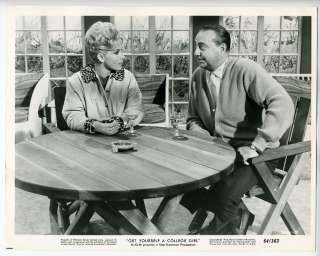
Get Yourself a College Girl (1964)


One of the disadvantages about having Turner Classic Movies is that they play so many movies I want to watch that I constantly find myself firing up the VCR, as a consequence I have a huge back log of movies that I have to watch. After nearly two years, I finally got around to watching Get Yourself a College Girl and thought it would serve as an interesting companion piece to my A Hard Day's Night/ Girl Happy review.

Get Yourself a College Girl was made in 1964 and as a result it often gets lumped in with the Beach Party genre that was popular during the period. While the similarities are there, the truth is, it has more in common with films like Rock Around the Clock (1956), and its semi-sequel Don't Knock the Rock (1956), than it does with the Frankie and Annette films that were popular at time. This isn't too surprising considering that not only does Get Yourself a College Girl have the same producer as those two films (Sam Katzman), but the same screenwriter as well (Robert E. Kent). Katzman was a legendary producer of low budget films and most famously brought not one, but two DC comic book heroes to the screen, Batman and Superman, in serial form. Rock Around the Clock and Don't Knock the Rock both would serve as templates for rock n' roll films of the future, including Get Yourself a College Girl.

Rock Around the Clock is officially the first Rock N' Roll film ever produced and it follows band manager, Steve Hollis (Johnny Johnston), as he attempts to bring Bill Haley and the Comets to the mainstream. One day, while driving across country with his musician friend, Steve stumbles upon Bill Haley and the Comets playing a dance in a small town located in the middle of nowhere. Steve his amazed at the amount of excitement Bill Haley and his band are generating among the locals; at point Steve's friend taps a dancing girl on the shoulder and asks, "What do you call that exercise you're getting?" She replies with, "It's rock n' roll, brother. And we're rocking tonight!"


Steve is convinced rock n' roll is the wave of the future and sets about getting Bill Haley national exposure. The only thing standing in his way is a manipulative, domineering music agent named Corinne Talbot (Alix Talton), who also has her heart set on marrying Steve, despite his lack of interest. When she finds Steve has become smitten with the female half of a brother/sister dancing act that accompanies the Comets, she sets about trying to sabotage Steve's chances. First, she books the Comets to play at a high school prom, thinking that the Comets "wild music" will get them booed offstage, but is utterly shocked when the youth respond in a wildly enthusiastic manner. After her first plan has failed, she attempts to have Steve and the Comets blackballed from the music industry by calling up her friends at other agencies. Steve circumvents her by calling upon popular DJ, Alan Freed, who owes Steve a favor. Finally, Corinne concedes defeat and offers the Comets are huge three year contract. A few other contrivances follow, but it ends on a happy note, with the Comets and other rock n' roll acts getting national exposure on a televised musical jamboree.

Two thoughts about Rock Around the Clock:
1) As a movie it is relatively worthless; the characters and acting (with the exception of Talton) are fairly bland. Bill Haley, despite his top billing, is relegated to the sidelines for the most of the film. But as time capsule for the period (mid 1950s) it is absolutely invaluable; it gives modern day viewers an opportunity to see rock n' roll acts of that time in their absolute prime. (Bill Haley, The Platters, The Bellboys, etc). 


2) The character of Corinne; she's a highly successfully, intelligent career woman, yet the filmmakers imply that she can never be happy unless she's married to a man. Throughout the film, she tries hard to break down Steve's will, so he will come crawling back to her, begging her to marry him. At the end, when she has failed, she seems content on settling for the next best thing (her assistant, Mike Dobbs). This theme of the highly successfully but lonely woman gets revived in Get Yourself a College Girl. 

Don't Knock the Rock, the semi-sequel to Rock Around the Clock, takes a defensive stance towards rock n' roll music; in it a successfully rock singer, Arnie Haines, returns to his hometown to find that he has fallen out of the favor with the elders. Their concern is that rock n' roll leads to juvenile delinquency, so he takes it upon himself (with help from Bill Haley and the Comets and other music acts) to put their fears to rest. After a couple of mishaps, he eventually wins over the elders and everything is peachy keen at film's end.

Flash forward to 1964, and the focus gets shifted from successful male rock star to successful female songwriter, Terry Taylor, who is still attending college at Wyndham. It is revealed that Wyndham is a fairly conservative musical college that looks down upon rock n' roll; to keep herself from being expelled, Terry has her songs published under a pseudonym. However, the cat is let out of the bag when her publisher, Gary Underwood, calls the college in regard to ideas he has for promoting her album. This naturally infuriates the Board of Directors, which consists mostly of old men, who demand that Terry be expelled. The student body marches in on the proceedings and objects to Terry's possible suspension, stating that she's been like a "Joan of Arc" to them with her progressive attitude towards women. However, the Dean, being a woman, is sympathetic towards Terry and asks that the Board wait until after Christmas Break to make their final decision.  One of the board members is Senator Hubert Morrison, who is up for reelection and whose grandmother founded the college. He is, at first, appalled by Terry's music, but the Dean tells him he's old fashioned and should try to get to know the girl before he passes judgment on her. Morrison takes this advice to heart and, by sheer coincidence, happens to be vacationing at the same ski resort as Terry and her friends. All sorts of hilarity ensue!


As I mentioned before Robert E. Kent was a screenwriter on all three films and I suspect a good majority of his screenplays contained the phrase, "Insert musical number here." These films are a more or less an excuse to showcase the musical talent of the day while the "story" mainly functions to bridge the musical numbers together. The actual story for Get Yourself a College Girl doesn't begin until nearly twenty minutes into the movie; the beginning has a few bits of exposition (Terry being a songwriter), but the majority of it is musical acts (The Dave Clark Five, The Animals) accompanied with shots of various college students dancing. One of the musical acts is Terry singing her new song, "Get Yourself a College Girl."


What I find interesting about this sequence (and the end as well) is that the two headlining bands (The Animals, The Dave Clark Five) were part of the British invasion. Get Yourself a College Girl maybe the first American film to openly embrace the British invasion, whereas most Beach Party films were either condescending toward it (Bikini Beach, The Girls on the Beach), or didn't bother to acknowledge its existence. Like A Hard Day's Night, I'm sure getting these bands was an attempt by Sam Katzman to cash in on their fame before it waned, but nonetheless, it is interesting that Katzman willingly jumped on this trend, while Samuel Z. Arkoff and other producers thumbed their nose at it. In fact, despite being labeled a "Beach Party Movie," there is absolutely no surf rock to be found in Get Yourself a College Girl. It is also interesting to note that many of the rock n' roll scenes often take a Direct Cinema approach to film making; often there will be shots of college students dancing done with handheld cameras to give it a more immediate look. This was obviously influenced by shots of the screaming audience at the end of A Hard's Day Night. 


Mary Ann Mobley is a far more engaging lead than the two stiffs (Johnny Johnston, Alan Dale) who sleepwalked through Rock Around the Clock and Don't Knock the Rock. Her character, Terry Taylor, is a woman who is trying to get ahead on her terms and takes offense when a man, Gary Underwood (Chad Everett), tries to run her life for her.  When Gary shows up at the ski resort, she is infuriated and threatens to sue him for breaching her contract; it was stipulated that the music publisher would never telephone Terry at Wyndham College. Gary's idea for promoting her new single is a painting of her holding an acoustic guitar and wearing a revealing nightgown; he then plans to have it plastered on billboards across the country. He has brought an artist along with him, Armand, to capture her likeness. Terry naturally takes offense to this and kicks Gary out of her room. Gary isn't defeated yet, he connives to use the body of another woman while painting Terry's face on top. He approaches various shapely woman at the ski resort, tells them his idea, and is met with a slap in the face. However, before the face slapping commences the audience is treated to an "Insert musical number here" moment with Astrud Gilberto singing "Girl From Ipanema."


While Get Yourself a College Girl features a relatively strong, independent woman in the lead, it's feminism is shaky at best. In the beginning, Terry stresses that a woman should be able to chose her path in life, without the interference of men; be it a career or romance. In the Frankie/Annette Beach Party films of the sixties, the main tension between the two of them was in regards to matrimony; Annette wanted to settle down and have a family, while Frankie wanted to have fun and avoid responsibility at all costs. In Get Yourself a College Girl, Terry's education and singing career come first, while a steady relationship is the last thing on her mind; she plays the field (as the lyrics to her songs suggest), but she's not quite ready to fall for any man. Of course, that all changes when Terry meets Gary. It's true that Terry initially resents Gary, but the audience knows that it's only a matter of time before the two fall in love. The romance is handled in an incredibly clumsy and lazy manner; Terry and Gary happen to be skiing on the same slope and Terry gives him the cold shoulder. She skis down the slope with Gary following her, she looks back to see where he is, and crashes into a snowbank. Her arms are stuck inside the snowbank and Gary takes advantage of the situation to kiss Terry on the lips. Rather than protest the situation, Terry gives in and after they are done kissing she comments that his kiss has melted the snow. She then frees her arms from the snow bank and embraces him.

There is a similar moment in Rock Around the Clock in which the band manager Steve Hollis is met with initial resistance by Lisa Johns (Lisa Gaye), the female half of the brother/sister dance act that performs with Bill Haley and the Comets. When Steve offers to manage that band he proposes a 60/40 split, meaning he'll get 40% of the earning. Lisa, acting as the spokes person for the band, insists that he should be only given 10% and tells him to call back later when he's changed his mind. Steve decides he will seduce Lisa into seeing his way. Later, the two of them are on the beach in bathing suits and Steve is about to make his move, but Lisa completely takes him off guard by kissing him first. The two kiss for a few minutes; Lisa tries to use her womanly charms to persuade Steve into taking 10%, while Steve uses his manly swagger into keeping the entire 40%, eventually they settle on 25%.  By the scene's end, they are hopelessly in love with one another. With the whole romantic subplot settled, the film can now focus on Steve's attempt to land the Bill Haley and The Comets a gig.

The most inexplicable moment that happens in Get Yourself a College Girl is when the character of Sue Ann (Chris Noel), the sexpot out of the group, starts to dance around in the girl's hotel room, clad in a bikini. It's real a head scratching moment...hell even Teresa and their friend Madge (Joan O' Brien) are confused by what is going on. This is a moment that is ripped from the many Beach Party films of the decade, except that it takes place at a ski resort in the WINTER! Which leads me to believe that the screenwriter, after having watched a marathon of earlier Beach movies, decided there needed to be at least one scene in which a busty blonde shakes her booty for all the world to see, regardless as to whether or not it made any sense. Granted, Chris Noel looks great in a bikini.


The best thing about Get Yourself a College Girl is the subplot involving Senator Hubert Morrison (Willard Waterman). At the beginning of the film, the Senator is fairly prudish in regards to the younger generation and finds Terry's songs offensive but, after the Dean of Wyndham tells him he's "old fashioned" in his view points and needs to be more open minded, he actually soaks in what she has to say and takes her advice. When he arrives at the ski resort, he makes it a point to introduce himself to Terry, so he can get to know her better. As the film progresses, his attitude begins to soften towards Terry and the younger generation, and they, in turn, begin to warm up towards him, to the point that they are willing to back him in his upcoming election. It's even implied that the Senator and the girl's beautiful dance teacher, Madge (Joan O' Brien), develop romantic feelings toward one another.
The older vs. younger generation is the staple of most rock n' roll pictures, and usually it's resolved in a fairly unconvincing manner (or in the case of A Hard Day's Night, not at all). In most rock n' roll pictures, the older generation remain firm on their preconceived idea that rock n' roll music is bad for society, and then, through some absolute miracle, have a change of heart at the film's end.  Yet, in Get Yourself a College Girl, because the Senator discards his presuppositions about the younger generation, it makes his conversion at the end all the more believable. The Senator is quite possibly the most likable character in the film; this is largely due to Willard Waterman's funny and engaging performance. 

Finally! In an interesting bit of trivia, all four leading actresses (Mary Ann Mobley, Joan O' Brien, Nancy Sinatra, Chris Noel) all co-starred with Elvis Presley at some point in their career.  Mobley would co-star with Elvis in Girl Happy and Harum Scarum. Joan O' Brien was his leading lady in the fairly well done It Happened At the World's Fair. Sinatra wouldn't be so fortunate, as her leading lady gig was in Speedway. And Noel played one of Shelley Fabares spring break friends in Girl Happy. Joan O' Brien was easily the best actress out of the bunch and had a fairly interesting career, co-starring with Cary Grant in Operation Petticoat and John Wayne in The Alamo, but after this film her career came to a complete halt. 

Cast: Mary Ann Mobley (Teresa "Terry" Taylor), Joan O' Brien (Marge Endicott), Chad Everett (Gary Underwood), Willard Waterman (Senator Hubert Morrison), Nancy Sinatra (Lynne), Chris Noel (Sue Ann),
Fabrizio Mioni (Armand), Dorothy Neumann (Martha Stone, Dean of Wyndham College), Astrud Gilberto (Herself), The Dave Clark Five, The Animals, The Standells, The Bell Boys.

Director: Sidney Miller
Screenplay: Robert E. Kent, Robert G. Stone.
Running Time: 86 min.

Snow White's Revenge/Scandal (2024)

  It is difficult to write about Snow White’s Revenge without bringing up the ending, so readers beware, this review will contain spoilers...