
I recently watched two K-dramas, My Sassy Girl and
The Heirs, and rather than writing separate long-winded reviews for each
drama, I decided to kill two birds with one stone by writing about both in a
single post. There is an even a thematic similarity between the two – the
protagonist in each show (Gyeon Woo in My Sassy Girl and Cha Eun-sang in
The Heirs) come from humble origins and end up falling in love with a social
elite (Princess Hye-myung in My Sassy Girl and Kim Tan in The Heirs).
They must overcome nonstop hurdles (misunderstandings, pre-arranged
marriages, disapproving parents and friends, etc.) in order to be together but,
in the end, love conquers all.
My Sassy Girl

The biggest hurdle that My Sassy Girl has to
overcome is, unfortunately, the title character, Princess Hye-myung. We’re
supposed to find her to be endearing but she is really annoying in the early
going – she constantly yells at people and even resorts to physical violence
when she doesn’t get her way. She never thinks about the consequences of her
actions. – she sneaks out of the palace at night and often gets drunk. It is
often her eunuch and bodyguard who are made to suffer for her disobedience –
they are blamed by the queen for neglecting the princess and even get caned for
not keeping a better eye on her. She usually thinks the worst of people and
rarely gives them the benefit of a doubt – due to a misunderstanding she believes Gyeon Woo attempted to rape her and isn’t willing to hear him out. Earlier,
in her state of drunkenness she vomited all over him and herself and then lost
consciousness. Gyeon Woo takes her to an
inn and, while she is asleep, he washes the vomit from his robe. When he notices vomit on the goreum of the princess's hanbok, he decides to wash it and, is in
the process of untying it, when the princess wakes up and believes he is
attempting to rape her. She cusses him out and then get physically violent with
him before passing out again.
Through the next few episodes, the princess bumps into
Gyeon Woo and publicly smears him as a rapist. She also managed to misplace a
ring that was given to her by her deposed mother and assumes that Gyeon Woo
stole it. In one scene, Gyeon Woo is
having lunch with Jung Da-yeon, a potential love interest, and the princess
approaches him and starts hurling all sorts of accusations at him, intentionally
embarrassing him in front of Da-yeon. The problem with this subplot is that the
show never properly resolves it – Gyeon Woo has a bunch of eyewitnesses who
could back his story, but he never uses them. The princess continues to believe
he is a pervert…until she doesn’t. If she genuinely believes that he is a
rapist, it is very unlikely that she would fall in love with him, despite the
multiple times he bails her out of dangerous situations. There at least needed
to be a scene where she remembers vomiting all of Gyeon Woo and the assistance
he offered her. It is a huge flaw in the scripting and an odd way for the two
main characters to meet. It doesn’t help that Oh Yeon-seo’s acting is all over
the place – in the early episodes, she consistently mugs for the camera by
making odd faces, bugging out her eyes, and shouting at the top of her lungs.
Though, this also a cultural difference – I rarely find Korean comedy funny,
but that is largely due to the fact that I have to rely on subtitles to
understand the joke. There is a huge difference between hearing a joke and
reading a joke. To Oh Yeon-seo’s credit, she does significantly better in the
series dramatic moments, because her performance is more restrained. The show
itself is tonally all over the place – it ranges from slapstick comedy to
political thriller – the first half of the series is more comedic in tone while
the second half is more dramatic.

The bright spot of the series is Joo Won as the
unflappable Gyeon Woo. The phrase “no good deed goes unpunished” greatly
applies to the character of Gyeon Woo – he is a well-meaning individual whose
actions are misunderstood and end up costing him dearly. When a bunch of men are
accosting the drunk princess, he sticks up for her and scares them away. His
reward – she vomits all over his robes and then later accuses him of rape. When he helps the princess look for her lost
ring – it leads them to a den of loan sharks. The princess steals a book that
contains the names of the people who owe them money. Later on, they come after
the princess and Gyeon Woo ends up getting stabbed while defending her. Gyeon
Woo is a well-respected scholar – he spent three years in Qing, China learning
their language and culture. When he comes back to Korea, he is somewhat of a
celebrity – he is greeted by a whole group of female admirers. He is also
appointed to be the young prince’s (Hye-myung’s kid brother) teacher. When
Hye-myung finds out that Gyeon Woo is teaching her younger brother, she
threatens to tell her father (the king) that he is a pervert.
When it is
decided to marry off the princess to the Qing prince, Gyeon Woo is, naturally,
chosen to be the interpreter. It is to the show’s credit that the Qing prince
is actually a decent person – he makes a genuine effort to win over Hye-myung’s
family, especially her younger brother, who disapproves of their union. The
princess fails to understand the predicament Gyeon Woo is in (he is not any
position to refuse a request from the king) and, once again, hurls insults at
him. At this point, their relationship has been volatile, yet she believes
Gyeon Woo has betrayed her for acting as an interpreter. It was at this point
where I wished Gyeon Woo would have taken his own advice and stayed away from
the princess. In fact, as snobby as Da-yeon can be, there is a sense that if
Gyeon Woo had accepted her proposal, he could have brought out her better side.
The only reason for her bratty demeanor is that she has been spoiled her entire
life by her father, the Minister of the Left. When you have been given everything
your entire life and never been humbled, it is difficult to sympathize with the
plight of the less fortunate.
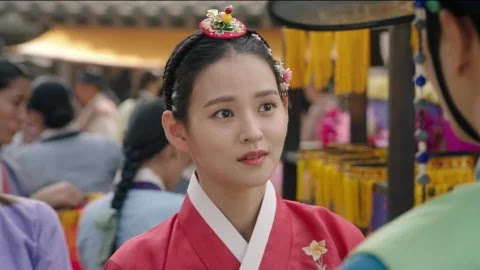
I also sensed that the writers were kind of winging it
in the second half of the series, Gyeon Woo begins to have dreams that involve
his ten-year-old self and the deposed queen. It turns out that he is recovering
forgotten memories. There is no hint of this in the first half of the series,
all of a sudden, he is beginning to remember an event from his past that he had
completely forgotten about. This is when the series becomes increasingly more
convoluted – when he was ten years old, he stumbled upon a murder scene at the
ink house. Before he passed away, the master of the house handed Gyeon Woo an
ink brush and begged him to expose the truth. While going through documents, he
came across a letter that seemed to implicate the queen – it was a love letter
to her supposed lover. In Gyeon Woo’s
eyes, it seemed like the queen had ordered the hit to cover up her infidelity. He wrote a scathing letter about the queen and
then posted it on the public bulletin board. The Minister of the Left stumbled
across the letter and used it for his own political purposes – he had been
wanting to depose the queen for a long time, and he made copies of Gyeon Woo’s
letter to stir up the masses. Later, Gyeon Woo found a letter hidden inside the
ink brush that proved the queen’s innocence and immediately set out to correct
his mistake – he initially tried to deliver it to his father, who was an
advisor to the king, but was denied entry into the palace by the guards. He
then decided he would find the queen and give it to her – the only problem was
that she had been exiled, and her convoy was currently marching through the
forest. While running after the queen,
he stumbled across a younger version of Hye-myung sneaking out of the palace.
The two of them decided to look for the queen together. They came across the remains of her convoy
(they had all been slaughtered) but could find no trace of the queen. They then
got lost in the forest and when Gyeon Woo went get some help, he lost his
footing, tumbled down a hillside, crashed into a tree, and lost his memories of
this incident. The most perplexing thing
about this subplot is: How come the princess doesn’t remember meeting Gyeon Woo
ten years earlier? There is no
indication that she suffers from amnesia – in fact, she still recalls chasing
after mother, but she apparently has forgotten the boy she met on the way. A
boy, who like Gyeon Woo, was a scholar. It wouldn’t be that hard to put the two
together, yet there is no scene where the princess recognizes Gyeon Woo as the
boy she met ten years ago.
I also can’t help but notice the double standard when it comes to princess and Gyeon Woo – she spends the first half of the series publicly smearing Gyeon Woo and never apologizes for it, but Gyeon Woo forgives her any ways. When Gyeon Woo regains his memory of the writing the scathing letter about the queen, he decides to atone for his mistake by showing the king the letter that proved her innocence – he knows that this will taint his relationship with the king and princess, but he it is important to him that the truth comes out. His mistake is not telling the princess herself about the letter, and she ends up finding out from Da-yeon (who in turn found out from Gyeon Woo’s nosy younger sister). When she confronts him with this, he cannot deny it and she vows that she will never forgive him.

I actually checked out the comments section YouTube
and there were many people who agreed with princess “What he did was
unforgivable!” But apparently her
smearing him in public is totally forgivable. They also conveniently ignored a
few facts: Gyeon Woo was ten years old when he wrote that letter. Secondly, he
stumbled upon a murder scene (which would traumatize anyone) and found evidence
that implicated the queen in the slaughter of a family. Third, when he found
evidence that exonerated the queen, he immediately tried to fix his mistake. If
it wasn’t for him getting into an accident and losing his memory, this could
have been cleared up years ago. Finally, when he regained his memory, he
contacted the king and showed him the letter that proved the queen’s innocence,
knowing fully it would tarnish his relationship with the king. He also atones
for his mistake by not only thwarting the Minister of the Left’s attempt to
usurp the throne, and reuniting Hye-myong with her mother, but by exiling
himself to an island that is far away. He pays more than his dues. The princess realizes she still loves him and
stops him before he can get on the boat, but I was actually hoping she would be
too late and could only watch teary eyed as he sailed away.
I’m going to be
perfectly blunt: the princess doesn’t deserve Gyeon Woo. It’s one of the most one-sided
relationships I have seen in television history – Gyeon puts his life on the
line multiple times to save the royal family, while the princess has everything
handed to her. The only reason she is preferable to Da-yeon is because the
script says so – even though Da-yeon puts forth an actual effort to be with
Gyeon Woo. She has a higher social standing them him but is willing to ingratiate
herself with his family and humble herself before him. She is another casualty
of the script – in the first few episodes, she is more likable than the
princess. It feels like the writers feared that the audience might prefer her
over the princess and decided to rewrite her as a cold-hearted bitch. “We can’t have the audience shipping Gyeon
Woo and Da-yeon. Quick, write a scene where she treats her servants poorly.”
The other thing that bugs me is that Gyeon Woo’s
younger sister, Gyeon Hee, is never given an actual character arc. She is
Da-yeon’s lacky and is a total gossip – she cannot keep secrets, no matter how
damaging they might be to her family. She is, justifiably, skeptical of the
princess and desperately wants her older brother to hook up Da-yeon. I was
waiting for that one scene where she redeems herself – like, I don’t know, a
scene where she divulges useful information to her older brother. Anything. It
feels like the writers are setting her up for a character arc, but it never
arrives. It’s only after Da-yeon lashes out against her and her mother that she
realizes that she was backing the wrong side, but I would have preferred she
come to this realization herself. It's a
shame because the actress, Jung Da-bin, is likable enough but the writers
don’t know what to do with her character.

Wow! I spent more time writing about My Sassy Girl than
I originally intended, but it does perfectly sum how frustrating this series
was. There are a lot of things to like about My Sassy Girl (the lead
actor, the supporting cast, and a few clever plot twists) but it never gels as
a whole. It’s about two rewrites away from being a first-rate show, instead of
being just watchable.
The Heirs

One of the most influential television shows in South
Korean history was Boys Over Flowers – it was based off a Japanese manga
and was one of the most watched shows in Southeast Asia. It not only set the
template for future K-dramas, but many of its cast members went onto successful
careers in South Korea. In Boys Over
Flowers, Geum Jan-di is a girl who comes from a working-class family (her
family runs a dry-cleaning business) and, after preventing a student from
committing suicide a prestigious high school (Shinwa High School) is given a
scholarship to attend the high school (mainly to appease public outrage). She
manages to fall into the cross hairs of the F4 (the four most popular boys at
the school who come from the wealthiest families in the country). Gu Jun-pyo, the ringleader of the group,
initially is antagonistic towards Jan-di, but after she sticks up for herself,
he finds himself falling for her. The
rest of the series chronicles the ups and downs of their turbulent
relationship. The cast is uniformly excellent, but it was Lee Min-ho’s
performance as the volatile Jun-pyo that really stood out – he took a
detestable character and made him sympathetic. The following year, Playful
Kiss came out and it sported a similar plot – Oh Ha Ni is a well-meaning
but ditzy female who is in love with the most popular student on campus, Baek
Seung-jo (played by Kim Hyun-joong who also made a splash on Boys Over
Flowers) who rejects her feelings. Through a series of
contrivances, Oh Ha Ni and her family end up moving in with Seung-jo’s family. Just
like Boys Over Flowers, the show chronicles the ups and downs of their
turbulent relationship and ends with Seung-jo marrying Oh Ha Ni. I actually
prefer it to Boys Over Flowers – it is more efficiently paced and better
written. My main issue with Boys Over Flowers is that is incredibly
drawn out (25 episodes) and inconsistent in its writing – there is very little
regard for character continuity. It is still a highly entertaining show thanks
to its likable cast, but it could have used a rewrite to fix these flaws.
This leads me to the subject of this review, The
Heirs. It not only has a similar plot to Boys over Flowers, but it
also stars Lee Min-ho as Kim Tan, the heir of the Jeguk Group, and the
illegitimate son of the CEO, Kim Nam-yoon. He also has an older half-brother,
Kim Won, who views Kim Tan as a potential rival. The other common factor the three shows have
in common is they feature a terrific lead actress (Koo Hye-sun in Boys Over
Flowers, Jung So-min in Playful Kiss, and Park Shin-hye in The
Heirs) who are required to do much of the heavy lifting – all three series
are told from the perspective of their female protagonist, all of whom come
from working class families. In The Heirs, Park Shin-hye is Che
Eun-sang, a girl whose mother is a mute and works as in-house maid for the Kim
clan. To help her mother pay the bills,
Eun-sang works multiple part-time jobs and becomes increasingly more frustrated
with her life – she lives paycheck to paycheck and there is no foreseeable
future in her sights. While most girls her age often have ambitious dreams, she
would be content with working an office job and making roughly $2,000 a month. Her outlook on life is very bleak. What makes
is even worse is that her older sister, Cha Eun-suk, is apparently living it up
in Los Angeles – she is engaged and attending a university.

When their mother wants to wire money to Eun-suk money
for her wedding, Eun-sang insists on delivering it in person. In truth, she
hopes to bail on their money, move in with her older sister, and hopefully find
a good paying career in Los Angeles. However, her trip turns into a disaster –
her older sister isn’t engaged (she is in relationship with a two-timing
boyfriend) and she isn’t attending college but working part-time as a waitress. Eun-sang gets into a public argument with her
older sister, and it ends with Eun-suk taking the money and running away. Coincidentally, their entire argument is
witnessed by none other than Kim Tan. She
is stranded in Los Angeles without money and a phone. Kim Tan learns of her
predicament and offers her shelter in his home.
She is skeptical of his generosity, but given her predicament, she
doesn’t really have much of a choice.
I always enjoy how small of a place the world is in
K-dramas – Los Angeles has a population of about 3.8 million people and yet, on
her first day in foreign country, Eun-sang not only runs into Kim Tan – who also
happens to be youngest son of the Tan clan, the same family her mother works
for. Not only does she run into Kim Tan,
but his bitchy fiancée, Rachel, at the airport. If there is a flaw with The
Heirs is that the entire series is built on a very flimsy foundation. The LA scenes are the weakest part of the
drama – I’m not too bothered by the multiple coincidences that get stacked up
in the first four episodes because it plays into the theme that Kim Tan and
Eun-sang are destined to be together. Despite all the hurdles that get tossed
in their direction, they overcome all of them and these obstacles only
strengthen their bond. The biggest issue I have with the LA scenes is the
atrocious acting by the American actors. In LA, Kim Tan’s best friend is a
stereotypical stoner dude – to the point where he mistakes the bean powder
Eun-sang is carrying around in her suitcase (meant for her older sister) for drugs,
steals the bag, ingests a handful, has an allergic reaction, and ends up in the
hospital. His cartoonish performance is jarring when compared to the more
restrained performances of Park Shin-hye and Lee Min-ho. I also get annoyed
when I see American actors popping up in K-dramas – the appeal of them is that
they offer another country’s take on popular genres. The Heirs is a soap opera told from
the South Korean perspective, and I find the American actors to be intrusive
(mainly because they tend to be bad actors).
I’m not interested in Kim Tan’s stoner friend, especially when his
strained relationship with his older brother is more interesting.

When Eun-sang returns to South Korea, she finds that
her mother has moved out of their apartment and into the Tan residence – she is
now an in-house maid. Eun-sang has no choice but to move into the servant’s
quarters with her mother. It just so
happens that Kim Tan also returns to South Korea (after spending three years in
the states) and it is only inevitable that the two of them run into each
other. While Eun-sang is attracted to
Kim Tan, she is also reluctant to get involved with because of their social
standings – he is the son of a CEO, while she is the daughter of mute
maid. While Kim Tan doesn’t see class, it is all
Eun-sang can think about – with good reason, because their relationship is
opposed by different factions. It also
doesn’t help that he is engaged to Rachel. The marriage has been arranged by
their parents – Rachel’s mother, Esther Lee, is a successful businesswoman and a
shareholder in the Jeguk Group. In three K-dramas I have mentioned, marriage
among the elites is more of a business merger and love rarely factors into the
equation. It is even more extreme in the case of Kim Tan and Rachel; they have
been engaged since they were seventeen.
Like the previous two dramas, there is the female lead
is part of a love triangle – in the case, it is between Eun-sang, Kim Tan, and
his bitter rival, Choi Young-do (whose father is engaged to Rachel’s
mother). Kim Tan and Young-do used to be
best friends but had a falling out. Young-do
is the school bully and initially sets his sights on Eun-sang but eventually
falls for her. After Kim Tan’s father
learns of his son’s relationship with Eun-sang, he gives her a scholarship so
she can attend Jeguk High School. However, we learn that his motive his less
than altruistic – he is hoping that, by attending Jeguk High School, Eun-sang
will learn her place and realize that it would be futile to pursue a
relationship with Kim Tan.

However, Eun-sang has an advantage, her best friend, Yoon
Chan-young and his girlfriend, Lee Bo-na, both attend Jeguk High School and
give her pointers as to how to survive the hostile environment. Chan-young points out the strict caste system
at Jeguk High School – there are four tiers of students:
The first tier is the Business Heir Group – that would include Kim Tan,
Young-do, and Rachel, whose parents own successful businesses.
The second tier is the Stock Heir Group. That includes Bo-na and a few other
females. They will not inherit their parents’ business, but they are major
shareholders.
The third tier is Honorable Heir Group. They are offsprings of politicians,
judges, etc. Or they are from families who recently acquired wealth.
At the bottom is the Social Welfare Group.
People like Eun-sang who got in because of scholarships and grants. They
are the outcasts of the school and are often picked on by those at the top
tier. Chan-young advises Eun-sang to lie about her social status and say that
she is from the third tier. Of course,
this proves to be difficult as Eun-sang works multiple part-time jobs and is
even seen by Young-do delivering food. Not to mention, her relationship with
Kim Tan makes their classmates curious and they start to dig up information on Eun-sang.
The most curious of them all is Rachel, who is baffled by what her fiancé sees
in Eun-sang. Even worse is that Kim Tan’s opponents will often target Eun-sang
as a way of getting to him. It’s
actually impressive that Eun-sang can keep up the façade for as long as she
does, considering how the deck is stacked against her.
There are also a couple of things that end up working
in Eun-sang’s favor – the most notable thing is when Kim Tan’s mother poses as
Eun-sang’s mother at the PTA meeting. Kim Tan’s mother Han Ki-ae is his
father’s mistress and, so as not to tarnish the family, she is not allowed to
make public appearances. However, she desperately wants to attend a PTA meeting
and when Eun-sang’s mother opts not go, Ki-ae goes in her place. It should be noted that Tan and Won’s
stepmother, Jung Ji-suk, is the chairwoman of Jeguk High School and when Ki-ae
pops up at the PTA, she is speechless. Ki-ae manages to impress the other
members of the board by offering to pay for the food at an upcoming event.
This information trickles down to the student body and they are convinced that
Eun-sang comes from a wealthy family.
The relationship between Han Ki-ae and Eun-sang’s mother, Park Hee-nam, is one of the most interesting aspects of The Heirs. At first, there is a mutual understanding between the two of them – Hee-nam is depends on Ki-ae for employment while Ki-ae often confides all of her insecurities to Hee-nam. In fact, the reason Ki-ae permits Eun-sang to move into servants’ quarters with her mother is because all of the dirt Hee-nam has on her. The two of them eventually become close friends – after Ki-ae leaves Nam-yoon she visits Hee-nam and they both admit they missed one another. \
They both think of themselves as being burdens to their children - Hee-nam feels guilty about how her mute
condition limits her career opportunities and Ki-ae, being a mistress to Tan’s
father, believes that publicly showing her son affection will tarnish his name
– everyone believes that his stepmom is his biological mom. She wants what is best for her son and fears
that she will only hinder his career. Kim Tan feels differently and is appalled
by how poorly his mother is treated by his father and stepmother. They both
love their children unconditionally but feel bad that they can’t do more for
them. After Kim Tan announces that Ki-ae is his biological mother, this creates
all sorts of shock waves in the Jeguk Group, but it also gives Ki-ae the
confidence to leave Kim Nam-yoon. No matter what, Tan will always have her back
and proclaims to his father that he would rather be Ki-ae’s son than an heir to
the Kim Empire. It is the ultimate show
of love. Ki-ae initially opposes Tan and Eun-sang seeing each other but it’s
nothing personal, she genuinely believes that it is more beneficial for her son
to marry Rachel. She is worried that his
father might disinherit Tan if he chooses Rachel.

The other interesting relationship is between Tan and
his older half-brother, Kim Won. It’s a very one-sided relationship on the
surface – Tan looks up to his older brother while Won acts very coldly to his
younger brother. He thinks of Tan as less of a sibling and more of a rival – it
was Won who exiled Tan to the Los Angeles.
However, there is a sense that Won’s coldness is an act, that this is
actually a case of tough love – in order for Tan to survive the business world,
he needs to be strong and has to be willing to turn off his emotions. After
Eun-sang and her mother move out of the Kim household and to unknown location,
Tan has a complete breakdown and hits rock bottom – he frequents the bars and
gets into fist fights with other patrons. It is Won who comes to his brother’s
rescue and helps him get back together with Eun-sang. Won, like his younger
brother, is also romantically involved with a woman of a lower class, Jeon
Hyun-joo, who initially works as tutor and them becomes a teacher at Jeguk High
School. Won is also given a similar choice as Tan – the family business or true
love? His father wants him to marry the
daughter of a prominent businessman, but he can’t get over his feelings for
Hyun-joo.

There is also a nice character arc with Lee Bo-na. She
is the girlfriend of Yoon Chan-young, Eun-sang’s best friend, and she doesn’t
like how close her boyfriend is with Eun-sang. Yet, despite her constantly
proclaiming her dislike for Eun-sang, she always has Eun-sang’s back. She knows
the truth about Eun-sang (that she is from the Social Welfare Group) but keeps
this information to herself. She also takes Eun-sang under her wing and
protects her from the spiteful Rachel. She is a good example of “actions speak
louder than words” – she claims to dislike Eun-sang but her actions prove the
opposite. It is interesting to see so
much thought given to a supporting character.

The show, rather unsuccessfully, tries to set up a
love triangle between Eun-sang, Kim Tan, and Choi Young-do. It is amusing to
see Kim Woo-bin play the role that Lee Min-ho played in Boys Over Flowers – the
bad boy who initially bullies the female protagonist but ends up fall in
loving with her. In Young-do’s case, it
is a case of unrequited love. Eun-sang resents him for most of the series and
then pities him towards the end, but there is never a sense that she considers
him potential dating material. He is also at a huge disadvantage – they don’t
actually meet each other until episode five. It doesn’t help that her first
impression of Young-do is a negative one – she is appalled by his nonstop
bullying of a lower classman. Her initial resistance to Kim Tan is not because
she dislikes him (in fact, she likes him quite a lot) but because of their
class differences. Boys Over Flowers, for all its flaws, had more
believable love triangle between Geum Jan-di, Gu Jun-pyo, and Yoo Ji-hoo. In
the first few episodes, Jan-di is much closer to (and has a crush on) Ji-hoo
and views Jun-pyo with suspicion (with good reason, as he was her tormenter in
the first two episodes). What Jun-pyo finds impressive about Jan-di is her
ability to stick up for herself and others – she is the first person who has
given him push back. His initial respect turns into love, and she eventually
reciprocates his feelings.
Both Boys Over Flowers and The Heirs feature one of my least favorite tropes in K-dramas – THE NOBLE SACRIFICE. This is when the lead protagonist concludes that their love interest would be better off without them and pushes love interest away by giving him/her the cold treatment. Boys Over Flowers takes this trope to most extreme level – most of the second half is devoted to Jun-pyo giving Jan-di the cold treatment, because his parents are pressuring him to marry Ha Jae-kyung. This subplot consumes so much screentime that you wish Jan-di would just move on. In The Heirs, Nam-yoon forces Eun-sang and her mother to leave his estate. They move to a small town near the ocean. Kim Tan and Young-do put aside their differences and pool their resources to find her. Kim Tan finds her first but does not initially make contact – he blames himself for her current situation. However, he desperately needs to see her and visits her at the bookstore he works at, and she gives him the cold treatment. However, he is persistent, and she can’t resist his charms. This trope is used more effectively in The Heirs than it is in Boys Over Flowers, because it is set up better. There is always a cloud of uncertainty that hangs over Tan and Eun-sang’s relationship, despite their attraction to one another, so when the shit hits the fan, it is believable that Eun-sang would push Tan away so he can move on with his life. However, most of the time “the noble sacrifice” trope feels like filler – the writers are obligated to write a certain number of episodes, and they need to find a reason to separate the lead romantic couple. They spend days pace around the room until a light bulb goes in of their heads, “I KNOW! THE NOBLE SACRIFICE!” It is also interesting to note that this trope isn’t limited to K-dramas – the Harold Lloyd silent comedy, Girl Shy, also features the "noble sacifice."
I’m only scratching the surface of The Heirs – however, for brevity’s sake, I only touched on the main plot points. If I were to go into all the subplots, supporting characters, and themes, this review would be well over 100 pages. The same applies to My Sassy Girl, there are a lot of subplots I didn’t touch upon. So, if you have the time and are willing to sit through subtitles, I recommend you check out both shows. The Heirs is significantly better, but My Sassy Girl has a certain charm about it.
Credits
MY SASSY GIRL (2017)
Cast: Joo Won (Gyeon Woo), Oh Yeon-seo (Princess Hye-myung), Lee Jung-shin (Kang Joon-young),
Kim Yoon-hye (Jung Da-yeon), Jung Da-bin (Gyeon Hee, Woo's sister), Son Chang-min (King Hwijong), Yoon Se-ah (Queen Park), Yoon So-jung (Dowager Queen Jihye), Choi Ro-woon (the Heir Presumptive), Ryu Dam (Young-shin, eunuch to the princess), Tae Mi (Byeol-i, the bodyguard to the princess), Lee Kyung-hwa (the Deposed Queen Han), Jo Hee-bong (Gyeon Pil-hyung, Woo's father), Jang Young-nam (Lady Heo, Woo's mother), Jung Woong-in (Jung Ki-joon, Left Minster and Da-yeon's father), Shim Hyung-tak (Choon-poong/ Prince Eunseong), Kwak Hee-sung (Park Chang-whi), Lee Si-eon (Bang Se-ho), Seol Jung-hwan (Maeng Kwang-soo), Park Young-soo (Hwang-ga), Seo Eun-ah (Mal-geum, Da-yeon's servant), Kris Sun (Prince Darhan of Qing), Kim Min-jun (Prince Choosung).
Director: Oh Jin-seok
Writer: Yoon Hyo-je
16 episodes ~ 60 minutes
THE HEIRS (2013)
Cast: Lee Min-ho (Kim Tan), Park Shin-hye (Cha Eun-sang), Kim Woo-bin (Choi Young-do), Kim Ji-won (Yoo Rachel), Kang Min-hyuk (Yoon Chan-young), Krystal Jung (Lee Bo-na), Choi Jin-hyuk (Kim Won), Kim Sung-ryung (Han Ki-ae, Tan's mother), Kim Mi-kyung (Park Hee-nam, Eun-sang's mother), Jung Dong-hwan (Kim Nam-yoon, father of Tan and Won), Park Joon-geum (Jung Ji-suk, Tan and Won's stepmother), Choi Won-young (Yoon Jae-ho), Kang Ha-neul (Lee Hyo-shin), Park Hyung-sik (Jo Myung-soo), Jeon Soo-jin (Kang Ye-sol), Cho Yoon-woo (Moon Joon-young), Choi Jin-ho (Choi Dong-wook), Yoon So-ha (Esthe Lee), Lim Ju-eun (Jeon Hyun-joo), Baek Seung-hyeon (Secretary Jung), Choi Ji-na (Yonng-do's mother), Yoon Jin-seo (Cha Eun-sak, Eun-sang's sister), Wang Ji-won (Kim Won's blind date).
Directors: Kang Shin-hyo, Boo Sung-chul
Writer: Kim Eun-sook
20 episodes ~ 60 minutes


