Powered By Blogger
Showing posts with label Charlie Korsmo. Show all posts

Thursday, July 10, 2025

Dick Tracy (1990)


In the summer of 1990, Dick Tracy was everywhere – the market was saturated with Dick Tracy merchandise (the soundtrack to the movie, posters, action figures, etc.);  a Making Of special aired a few weeks before the movie was released; Dick Tracy comic strips were reprinted in comic book form and being sold in bookstores across the country (I purchased a few issues – there are two I distinctly remember – Dick Tracy vs. the Influence and Dicky vs. Mrs. Pruneface), and the local station (Super 18) re-aired old episodes of the Dick Tracy cartoon from the 1960s. All of these were an attempt by Disney to manufacture excitement for their upcoming Dick Tracy adaptation.


Dick Tracy was Disney’s answer to Batman, which was a huge hit for Warner Brothers. They took a few of their cues from Batman – an well respected (and Oscar nominated) actor was cast as the lead villain (Jack Nicholson in Batman, Al Pacino in Dick Tracy); Danny Elfman was commissioned to write the score (just like he did for Batman); a popular pop artist was hired to perform original songs on the soundtrack (Prince in Batman and Madonna in Dick Tracy). Both movies are highly stylized productions – Gotham City is a stylized version of New York, while Dick Tracy resides in a stylized version of Chicago.

It seemed like Disney was going to have a huge hit on their hands – it all got off to a great start with a 22 million dollar opening weekend (which was huge in 1990), but Dick Tracy quickly
fizzled out at the box office. It grossed over 160 million dollars worldwide, not a bad sum for 1990, but it also cost Disney over a 100 million dollars to produce and market the movie. It did less than half the business of Batman (which grossed over 400 million worldwide) and, to add insult to injury, it got beat by Teenage Mutant Ninja Turtles, which was made for about a quarter of the budget and released by an independent studio, New Line Cinemas. It is also interesting to note that Teenage Mutant Ninja Turtles, despite being geared towards children, is also the darkest of the three movies. It pays to remember the context of 1990 – comic book adaptations were a rarity in cinema, so the fact that three of them were released over the course of one year was truly amazing. In the 1990s, movies were still driven by star power – which is why signing big names like Jack Nicholson and Al Pacino was such a big deal. Now, it is all about the intellectual properties and the actors have become interchangeable (though, ironically, so have all the IPs. There is almost no difference between Marvel, DC, Star Wars, and Star Trek).

Why did Batman and Teenage Mutant Ninja Turtles rake in the money while Dick Tracy floundered? The answer is simple – name recognition. In 1990, younger audiences were more familiar with Batman and Ninja Turtles than they were with Dick Tracy. The Batman comics, and reruns of the Adam West show, were still in heavy rotation throughout the 1980s. Not to mention, there were the various Saturday Morning cartoons that featured Batman. The Teenage Mutant Ninja Turtles cartoon came out in 1987 (the comic book began in 1984) and was extremely popular among children (as were the TMNT action figures).  In fact, I remember after seeing Teenage Mutant Ninjas Turtles in theatre, my two younger cousins were disappointed that it was more faithful to comic book than the animated series (most notably, Splinter’s origin).  However, by 1990, audiences had pretty much forgotten about Dick Tracy – the character was popular among the silent generation and the baby boomers, while Gen Xers and millennials might, at best, vaguely recognize the squared jawed detective. As for Gen Z, well, they weren’t born yet.
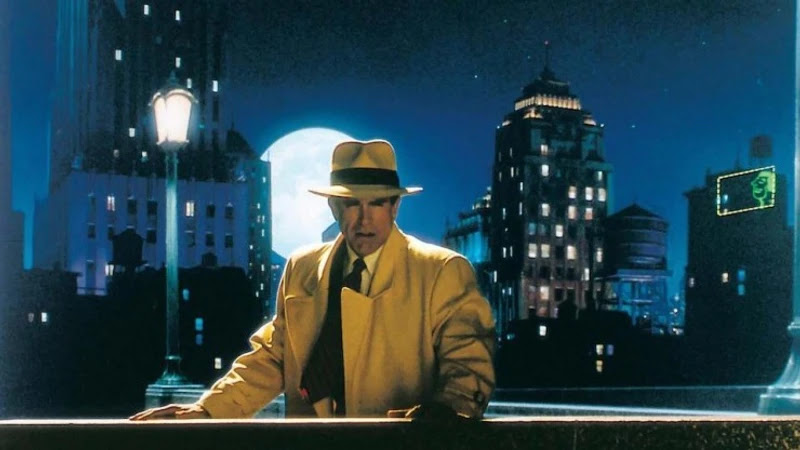


The other problem is that the character of Dick Tracy isn’t that interesting. He doesn’t have a cool back story like the Ninja Turtles nor is he a troubled soul like Batman – he is a total square. The highlight of the comic strips was the grotesque villains Dick Tracy faced off against. The comic book wasn’t exactly subtle when it came to its villains – their names were a too on the nose (Pruneface, Flattop, Itchy, The Brow, to name a few) and most of the time they were petty criminals. The Dick Tracy comic strip first appeared in 1931, during Prohibition, so it’s not surprising that Dick Tracy would be squaring off against bootleggers, racketeers, and gangsters. It was very much a product of its time. It would also be difficult to update Dick Tracy without stirring controversy.  Hell, the 1960s cartoon is now a subject of controversy because of its use of ethnic stereotypes (Dick Tracy would often call upon minorities to do the footwork for him – there was the Japanese detective, Joe Jitsu; the Mexican officer, Go Go Gomez (he is basically a human Speedy Gonzalez); and the Irish police officer, Heap O’ Calorie).  Even in his own cartoon show, Dick Tracy was the least interesting character.


There had been previous attempts at adapting Dick Tracy to the big screen – there were four serials made between 1937 to 1941 that starred Ralph Byrd as the detective (Dick Tracy, Dick Tracy Returns, Dick Tracy’s G-Men, and Dick Tracy vs. Crime, Inc). In 1946 and 1947, RKO studios produced four Dick Tracy movies (Dick Tracy, Dick Tracy vs. Cueball, Dick Tracy’s Dilemma, and Dick Tracy Meets Gruesome), the first two starred Morgan Conway as the title character, and then Ralph Byrd reprised the role in the latter two. These were low budget movies that were produced to make a quick buck and, interestingly, none of them feature a villain from the comic strip.  Dick Tracy Meets Gruesome gets a huge boost by having Boris Karloff as the title villain, but it is still forgettable fare.  Ralph Byrd was perfectly cast as the strait-laced detective, while Morgan Conway is an extremely bland leading man (he is a poor man’s Humphrey Bogart). It is not surprising RKO brought back Byrd for the latter movies.  There is the occasional stylish moment in the series – in Dick Tracy vs. Cueball, there is a scene where the title villain strangles a double-crossing woman, and it is shot from his point of view – anticipating the slasher genre by a good thirty years.  Dick Tracy vs. Cueball was also included in the Harry/Michael Medved book, Fifty Worst Films of All Time (And How They Got That Way). The book is an interesting read, but it also has a few questionable entries. Dick Tracy vs. Cueball is no classic, but it is not that bad! The four Dick Tracy movies RKO produced are mildly entertaining – there are certainly worse ways to waste sixty minutes.   Fun fact: Mike Mazurki, who played the villain, Splitface, in the 1946 Dick Tracy has a cameo in the 1990 version as “Old Man at Hotel.” It was his final screen appearance.  It is a nice tip of the hat by Beatty to Old Hollywood.


I first saw
Dick Tracy at second run theatre (the Rivoli in Cedarburg) and enjoyed it immensely. My eleven-year-old self didn’t like the scenes with Breathless Mahoney and Dick Tracy, but I liked the colorful villains and, hell, I even liked the Kid.  Thirty-five years later, I still have a soft spot for Dick Tracy, though my opinion of the Breathless Mahoney scenes hasn’t changed (I do, however, like the musical numbers that Madonna performs throughout the movie). It is no surprise that Madonna excels in the musical number scenes but struggles in the more dramatic moments. Movie stardom is something that has eluded Madonna – her most successful movies were also ones where she was a supporting role (Dick Tracy, A League of Their Own). The only exception to the rule was Evita, which has based off a popular stage musical by Andrew Lloyd Webber and Tim Rice. Prior to Dick Tracy, her two starring features, Who's That Girl and A Shanghai Surprise were box office duds. Her later starring vehicles like Swept Away and The Next Best Thing didn't fare so well, either.  However, in the context of 1990 it made perfect sense to cast Madonna in a femme fatale role – she was the current IT girl and a controversial figure. She was also coming off one of her most successful years as an artist – in 1989, she released the album, Like a Prayer, which featured the hit singles Like a Prayer, Express Yourself, and Cherish.  The album sold over 15 million copies and was a turning point in Madonna’s career. In 1990, months before the release of Dick Tracy, she kicked off the Blonde Ambition tour. She was all over the place. She was also dating Warren Beatty, her Dick Tracy co-star and director. This is an example of corporate synergy at work – Disney, and Beatty, were hoping to cash in on Madonna’s notoriety and cast her in the role of the nightclub singer/femme fatale, Breathless Mahoney. There was also a Dick Tracy soundtrack that featured Madonna performing original songs by Stephen Sondheim. 


The interesting thing is that even though Madonna and Warren Beatty were having a torrid love affair in real life, it didn't translate to the silver screen. The movie’s idea of seduction is to have Breathless Mahoney wear revealing outfits and utter a few double entendres at Dick Tracy. I always found the scene in Breathless Mahoney’s dressing room to be more cartoonish than sexy (“Don’t you want to frisk me?”). It is also reminiscent of a similar scene in Who Framed Roger Rabbit, where the animated femme fatale, Jessica Rabbit, visits the cynical detective, Eddie Valiant, at his office. Yet even though this scene is played for laughs, it some how is filled with more sexual tension that any of the scenes with Dick Tracy and Breathless Mahoney.

There is also no way that a square like Dick Tracy would fall for a woman like Breathless Mahoney – he is too in love with Tess Trueheart to even consider another woman. Warren Beatty, definitely! Dick Tracy, hell no! There also significantly better chemistry between Dick Tracy and Tess Trueheart, largely because Glenne Headly is a superior actress. Tess Trueheart is the type of role actresses dread to play – she is the long suffering but loyal girlfriend. There really isn’t much depth to the character, but Headly gives an endearing performance and even manages to inject humor into her characterization – when the Kid tells Tess, “I don’t like dames.” She responds, “Good! Neither do I!” and then gives him the stink eye.


There are even aspects of Beatty’s performance that I like. He doesn’t look anything like the character from the comic strip, but his performance is spot on. Beatty’s Dick Tracy is a man who likes the status quo – Tess and him eat at the same diner and engage in comedic banter with the owner, Mike. Even though he loves Tess, he still can’t bring himself to pop the big question, because it would change their current relationship. He is at home in Mike's diner, but he sticks out like a sore thumb, with his yellow fedora and overcoat, at the nightclub that Breathless works at (and that “Big Boy” Caprice stole from “Lips” Manlis). He is awkward and stiff whenever he is in the same room as Breathless Mahoney – she puts the moves on him, but he shoots her down and tells her that he wants her to testify against “Big Boy” Caprice.

Beatty and his screenwriters deserve credit for trying to give Dick Tracy some depth – this a truly Herculean feat given how one dimensional the source material was. He is a devoted, and honest, detective but it comes at the expense of his relationship with Tess. The two of them rarely enjoy a quiet moment together – Dick and Tess are watching an opera when he gets a call over his wrist radio and is forced to leave to check out a murder scene. Later, when Tess tells Dick Tracy that she is leaving town (and moving in with her mother), their conversation is interrupted by a call over Tracy’s wrist radio – he wants to talk her out of moving away, but duty calls and Tess urges him to go. Dick Tracy's work interrupting his private life was often a running gag in early film adaptations and each time this happened it would end with an exasperated Tess shouting, "OH DICK!"  In the 1990 movie, it eventually takes its toll on their relationship. 

While Dick Tracy is hesitant to take risks in his private life, he is willing to take a role of the dice when it comes to his job. While investigating the scene of “Lips” Manlis, Tracy comes across a bunch of smashed walnut shells and suspects “Big Boy” Caprice because of his fondness for walnuts. He takes a roll of the dice and has “Big Boy” Caprice arrested, despite the flimsy evidence. When the forensic department fails to find fingerprints on the walnuts, he has no choice but to release the gangster. “Big Boy” uses this as an opportunity to complain to the press about police corruption. Tracy later brings in “Mumbles” for questioning and tries to sweat a confession out of Big Boy’s incoherent lackey – he sits Mumbles under a heat lamp and asks the same question over again, “Who killed Lips Manlis?” He taunts Mumbles by drinking a cold glass of water, which causes the perspiring henchmen to break down and incoherently babble. Later on, when Tracy plays back the recording to Mumbles and slows it down, he clearly says “Big Boy did it!”


The heart of the movie is Dick Tracy’s relationship with the Kid (who later chooses the name Dick Tracy, Jr.) The movie is at best when it focuses on Dick Tracy slowly embracing the role of fatherhood. The Kid is first introducing running out Mike’s diner – he has stolen the wallet of a patron. Dick Tracy chases after him and finds him living under the tyrannical rule of a hobo, who forces the Kid to commit petty crimes in exchange for food and shelter. Tracy saves the Kid from the abusive hobo, but then he is left with the question on what do the Kid.  He initially wants to hand the Kid over to orphanage, but he grows fond of the boy and keeps putting it off. More importantly, he proves to be a positive role model for the Kid – it is implied that had the Kid not met Dick Tracy, he might have easily fallen into the clutches of Al “Big Boy” Caprice, or some other gangster. A common tactic used by crime bosses was to groom wayward boys into a life of crime – they would often pay children good money to run errands for them (get the paper, shine their shoes, etc.) and when they grew up, they would be chosen to do shadier activities. This is an interesting plot point in the James Cagney classic, The Public Enemy.

Beatty also avoids making the Kid overly cute and precocious (especially when you compare The Kid to “Junior” in the 1940s Dick Tracy movies– like most preteen boys, he is kind of a shithead. He scarfs down his food and always asks, “When do we eat?” When Tess wants to buy him a new set of clothes, he makes a huge fuss out of it. He also rides on the backboards of cars, despite the objections of Tracy. However, once Tracy has gained the Kid’s trust, he proves to be a loyal and valuable ally. He even manages to save the detective's life on two occasions. When Dick Tracy is framed for the murder of the corrupt D.A, the Kid stands by him and goes to the police chief to express his belief in his mentor's innocence.


The most memorable aspect of Dick Tracy is its galley of grotesque villains – the make-up artists certainly earned their paychecks on this movie. Al Pacino chews the scenery with his portrayal of the flamboyant gangster, Al “Big Boy” Caprice. I always enjoyed Pacino’s over the top performance, because it perfectly suits this film. The comic strip had a larger-than-life quality, and a more naturalistic performance would be out of place. “Big Boy” wants to run the city – he eliminates the first obstacle in his path, “Lips” Manlis and then arranges a meeting where he tries to persuade the other crime bosses to unite with him. The only hold out – “Spud” Spaldoni (James Caan under heavy makeup) – gets blown up for his refusal. This also leads to one of my gripes about the movie – most of the memorable villains from the comic strip are relegated to being Caprice’s henchmen. For instance, the character of The Influence is practically a background extra – in the comic strip he wore a special set of contacts that gave him the ability to hypnotize his victims. In the movie, he has a few lines of a dialogue, fades into the background, and then gets killed in the final shootout.  


There are a few standout performances: Dustin Hoffman is a riot as “Mumbles.” A running gag throughout the movie is how Dick Tracy will bring in “Mumbles” for questioning and be bombarded with incoherent babble.  William Forsythe and Ed O’ Ross are appropriately creepy as Big Boy’s henchmen, Flattop and Itchy. Both characterizations are accurate to comic strip – they were usually depicted as killers for hire (in the cartoon, Itchy was Pruneface’s lackey). 

The plot has always been criticized for being “threadbare” but that was also the case with the comic strip. Dick Tracy is a rather simple premise – the comic strip (and cartoon) all followed “the villain of the week” format – a villain would go on a crime spree and Dick Tracy would have to stop them. The villain was usually disposed of in a rather gruesome manner. The movie tries to liven up the proceedings by introducing a mystery to the plot – a gangster known as “The Blank” (because their face is devoid of features) uses 88 Keys (the piano player at Big Boy’s club) to frame Dick Tracy for the murder of D.A. John Fletcher.  The Blank later frames Big Boy Caprice for the kidnapping of Tess Trueheart. With the Blank’s two rivals out of the way, they will control the city.  The audience is supposed to keep guessing who this criminal mastermind is, but it’s pretty obvious from the get-go. There is only one character who has a clear motive for wanting to get rid of them both, and who inhabits both of their worlds. However, in this one instance, I will not spoil for the people who like to figure it out for themselves.


While one might find the storyline lacking, there is no doubt movie the movie is triumph of production design. The movie looks like the Dick Tracy comic strip come to life – rather than shoot on location, Beatty shot entirely in the studio and relied heavily on matte paintings to expand the city and bring it to life. As a result, each shot in the movie looks like the panel of a comic strip – Beatty will often keep the camera stationary as characters walk in and out of frame. When we are first introduced to Dick Tracy, he is framed though the window of his apartment building, grabbing his yellow hat and jacket. The also has a limited color palette – primarily red, green, blue, and yellow, each of the exact same shade. This further adds to the comic book look of the movie.  It is also fitting that the Beatty uses film techniques that were popular in the 1930s – the use of matte painting is most obvious, but his use of montage editing (when Dick Tracy is arresting Big Boy’s lackeys) looks like something out of a Warner Brothers gangster movie from that period.  


Dick Tracy is definitely curio – it was an attempt at old fashioned filmmaking before CGI took over the industry. Out of the main comic book adaptations that was released in 1989/1990, it is the odd man out. It is also interesting to watch a comic book that wasn’t made with the intent of starting a movie franchise – both Batman and Teenage Mutant Ninja Turtles were given the sequel treatment, but Dick Tracy is a self-contained movie. There is nowhere Beatty could go with a sequel, considering that he killed off all of the main villains from the comic book. It is almost Beatty knew this would be his only shot at making a Dick Tracy movie and decided to include as many villains as possible. Warren Beatty has sat on the rights to Dick Tracy for the last thirty plus years and, with the exception of two specials, has done nothing with the character – probably because he knows it would be tough for this character to compete with all the CGI spectacles that dominate theatres.


Cast: Warren Beatty (Dick Tracy), Al Pacino (Al “Big Boy” Caprice), Madonna (Breathless Mahoney), Glenne Headly (Tess Trueheart), Charlie Korsmo (Kid), William Forsythe (Flattop), Ed O’ Ross (Itchy), Mandy Patinkin (88 Keys), Dustin Hoffman (Mumbles), Dick Van Dyke (D.A. Fletcher), Seymour Cassel (Sam Catchem), James Keane (Pat Patton), Charles Durning (Chief Brandon), Michael J. Pollard (Bug Bailey), James Tolkan (Numbers), R.G. Armstrong (Pruneface), Henry Silva (Influence), Paul Sorvino (“Lips” Manlis), Tom Signorelli (Mike), James Caan (“Spud” Spaldoni), Frank Campanella (Judge Harper), Kathy Bates (Mrs. Green), Catherine O’ Hara (“Texie” Garcia), Estelle Parsons (Mrs. Trueheart), Allen Garfield (Reporter), Charles Fleischer (Reporter), Mike Mazurki (Old Man at Hotel), Ian Wolfe (Munger).

Director: Warren Beatty
Writers: Jim Cash, Jack Epps, Jr. Based off the comic strip by Chester Gould.
Running Time: 105 minutes.

Thursday, August 31, 2017

Hook (1991)


In Steven Spielberg’s long career he has had very few misfires. While Hook may not be his most maligned movie, it was greeted with fairly negative reviews when it first came out. These reviews were fairly justified – it is overlong, overcrowded, cloyingly sentimental at times, and is nearly undone by a fatal piece of miscasting (more on that later). It is easily one of Spielberg’s weakest movies. Yet, I must confess that I have a soft spot for Hook.  If you have read this blog before, then you know that I am a hopeless Spielberg apologist and tend to find value in most of his movies (the only exception being The Lost World: Jurassic Park, which is just dreadful). Hook is not a great movie, but it makes for a passable entertainment.

The first half hour of Hook is fairly efficient filmmaking.  Peter Pan has grown up to become a lawyer and father. Unfortunately, he is a fairly distant parent – he takes a business call during his daughter, Maggie’s school play (which happens to be Peter Pan) and misses his son Jack’s championship baseball game. He has also completely forgotten about his time in Never Land and dismisses Granny Wendy’s claims as those of a crazy old lady. The workaholic father is a fairly old cliché, but Spielberg is able to get a lot of mileage out of it thanks to Robin Williams first rate performance.  There is a hint of resentment in Williams’ performance – Peter often views his children as a burden rather than a source of joy. He would rather spend time talking business on his cell phone than play with his kids. This sense of resentment is fully realized when Jack blows up at his children because they are being noisy and interrupting an important phone call. Peter Banning is the rare instance of an unlikable protagonist in Spielberg’s filmography – he is total wet blanket and lacks any humor. His attempts at “bonding” with Jack are even more pathetic – he makes promises he doesn’t intend to keep and then gives Jack a watch (which is a family heirloom).  


The children are a mixed bag. Charlie Korsmo (coming off Warren Beatty’s Dick Tracy) gives a fairly naturalistic performance, while Amber Scott is more of your typical movie child; she is overly cute and could easily be the star of a McDonald’s commercial. She is not terrible, but she can be a bit grating at times (especially when she sings musical number “When You’re Alone”).  


 Caroline Goodall is fine as Moira, but she is given very little to do.  The character of Granny Wendy is a bit problematic; when Peter is reunited with her it is supposed to evoke a sense of nostalgia, yet this only works if you are familiar with the story of Peter Pan. If you have never read the book, nor seen any previous screen adaptations, the reunion with Peter and her falls flat. Later in the movie, we get a brief recap of their long history together, but it covers less than a minute of screen time. Still, Maggie Smith is very good and brings a much needed warmth to the proceedings. 
 

Hook speeds along efficiently for the first thirty minutes and then it hits its first road block in the form of Julia Roberts’ Tinkerbell.  There is one word that perfectly sums up Robert’s performance: AWFUL! She seems less like a magical fairy and more like a vacuous cheerleader; one going through the motions because she has other things on her mind. In defense of Julia Roberts, she was going through a turbulent time in her life (Keifer Sutherland had broken off their engagement) and she filmed the majority of her scenes in front of a green screen, separate from the cast.  However, it’s clear that this was just a pay day for Roberts and her casting was just a cynical move by the studio to generate bigger box office (she was coming off her star making performance in Pretty Woman).  It is one of those rare cases, where the movie might have been better served by a special effect than an actual performer. In the stage version of Peter Pan, Tinkerbell is depicted as a ball of light and this simple effect is  far more interesting than Robert’s performance (and less costly). 


It is also a shame that given the movie’s big budget (70 million, a sizable sum for 1991) that Neverland looks more like a theme park than a magical place of adventure. The introduction of the Lost Boys' Hideout plays less like a scene from a movie and more like a commercial for THE SUPER AWESOME LOST BOYS PLAY SET.  The Lost Boys are another obstacle that the movie has to overcome, because other than Rufio and Thud Butt, they are completely devoid of personality and are fairly interchangeable. The only thing that distinguishes Thud Butt from the others (other than the fact that he is overweight) is his ability to turn into a human bowling ball and knock over various pirates.  Rufio is the leader of the Lost Boys and is antagonistic towards Peter, but eventually recognizes that Banning is the real “Pan.”

SPOILERS FOR A TWENTY SIX YEAR-OLD MOVIE: Rufio’s death at the hand of the Captain Hook is extremely odd and doesn’t ring true. His dying words are that he wishes he had a father like Peter. Why? Up until like five minutes ago Rufio viewed Peter as his inferior.  When exactly did he begin to view Peter as a father figure? They never have a genuine moment of bonding.  It is also amazing how quickly everyone forgets about Rufio’s untimely demise.  Less than a minute after Rufio kicks the bucket, Peter is cracking jokes at the expense of Captain Hook. It is an extremely odd decision. If the movie had a much darker tone, and Rufio was more likable, then his death would make sense.  Was the movie originally supposed to be darker? Nick Castle was originally slated to direct Hook (and even helped developed the screen story) but was replaced by Steven Spielberg.  After looking at Castle’s directorial credits (which include: The Last Starfighter, Dennis the Menace, and Major Payne), I’m not sure his version would have been any better.


Why exactly do I like this movie? The production design is terrible, Julia Roberts is awful, and the Lost Boys are fairly annoying. These are three key elements of the story and should render it an unwatchable mess. Thankfully, Dustin Hoffman and Bob Hoskins arrive in the nick of time to liven up the proceedings. In the 1953 Disney and Broadway musical of Peter Pan, Captain Hook is a comical character, so it is appropriate that Hoffman chews up the scenery with his flamboyant performance. It also makes him a perfect match for Williams’ Peter Pan. If Captain Hook were portrayed as a bigger, more intimidating figure it would be difficult to believe that Peter Pan could best him in a sword fight. 

Hoskins is fun as Smee, Captain Hook’s bumbling sidekick who is not nearly as stupid as he looks. It is Smee that comes up with the ultimate revenge plan:  Have Captain Hook win the love of Peter Pan’s children.  This is pretty clever idea and while Captain Hook doesn’t succeed with Maggie, he comes close to winning over Jack. This is much more interesting than just having Hook and Peter fight it out at the end, plus it actually raises the stakes. It gives the movie an element of time:  Maggie tells Jack that Neverland makes people forget, so the longer Peter is separated from his children, the better chance Hook has at successfully enacting his plan. Will Peter arrive in time? Will Jack forget his parents? Granted, the answer to both these questions is obvious, but it makes the final conflict between Peter and Hook far more personal. 


Hook is definitely one of Spielberg’s weakest efforts. He was simply the wrong director for this movie. However, it says a lot about Spielberg that even his worst movies (except The Lost World) are fairly watchable. Of course, I am also a hopeless Spielberg fan boy, so a good many of you will probably roll your eyes at that sentiment. 


Credits
Cast: Dustin Hoffman (Captain Hook), Robin Williams (Peter Banning/Pan), Julia Roberts (Tinkerbell), Bob Hoskins (Smee), Maggie Smith (Granny Wendy), Caroline Goodall (Moira), Charlie Korsmo (Jack), Amber Scott (Maggie), Dante Basco (Rufio), Raushan Hammond (Thud Butt), Arthur Malet (Toodles), Gwyneth Paltrow (Young Wendy), Ryan Francis (Young Peter Pan), Phil Collins (Inspector Good), Laurel Cronin (Liza), Alex Zuckerman (Latchboy), Thomas Tulak (Too Small), Jasen Fisher (Ace), Isaiah Robinson (Pockets), James Madio (Don’t Ask), Ahman Stoner (No Nap), Glenn Close (Gutless), David Crosby (Tickles).
Director: Steven Spielberg
Screenplay:  James V. Hart, Malia Scotch Marmo. Nick Castle (screen story.
Running Time: 142 min.

Tuesday, June 28, 2016

Can't Hardly Wait (1998)


“Just so you know, judging from my little experience, I kind of believe in fate. It just works in really fucked up ways sometimes.” – Denise Fleming, Can’t Hardly Wait.


The release of Can’t Hardly Wait coincided with a very important moment in my life – my high school graduation. Having just finished some of the best/worst moments of my life, I was able to relate to the characters in this movie (especially the nerd, William Lichter).  Can’t Hardly Wait takes a lot of cues from American Graffiti (one of my favorite movies); it has a multi-storyline structure that follows various characters on the last night of their high school lives.  The difference between the two movies is that American Graffiti has a cinéma vérité feeling to it, while Can’t Hardly Wait is highly stylized. 
In my opinion Can’t Hardly Wait is one of the better teenage comedies from the late 1990s/early 2000s, largely due to its likable cast and energetic direction by Harry Elfont and Deborah Kaplan.  
Can’t Hardly Wait has six primary characters and it’s important to discuss each one to help set up just exactly what Elfont/Kaplan were up to:

Preston Meyers (Ethan Embry)

Preston is an aspiring writer who has harbored a crush for Amanda Beckett since he was a freshman. After hearing that Mike Dexter has dumped Amanda , Preston is convinced that fate has given him an opportunity to tell Amanda how he truly feels (Ethan Embry, with his sad eyes and fidgety demeanor is well cast). Preston deduces that Amanda will be at the big graduation party (being held at the house of a nameless classmate), and thus this will give him a chance to deliver the love letter he has written her.  This letter has been in his possession for years and has gone through multiple drafts.  This is a great example of movie logic vs. real life logic. In the movie, Preston’s obsession over Amanda, to the point of endlessly revising a simply love letter, is ROMANTIC (swoon), in real life, however, it would be viewed as creepy.  Ladies, picture a man you have never spoken to, walking up to you in the street and with demented grin on his face, handing you a love letter that he has kept in his possession for many years…yeah, pretty damn creepy.  Therefore, it is completely understandable when, later on, Preston (sans the letter) confesses his feelings towards Amanda and she (oblivious to the fact that he wrote the love letter) writes him off as a complete creep.  Seconds later, she looks up Preston’s picture in the yearbook (Preston’s name is on the love letter, but she has no idea who he is) and is appalled at her behavior towards her semi-secret admirer. 

Amanda Beckett(Jennifer Love Hewitt)


Jennifer Love Hewitt was the IT girl when Can’t Hardly Wait went into production and is perfectly cast as Amanda as Amanda Beckett – the most popular girl in high school.  She also has probably the most thankless role in the entire cast; Amanda is sanest character out of the group, hence the least interesting.  Her main conflict is trying to adapt to post Mike Dexter/high school life.  Her identity in high school was simply “Mike’s Girlfriend” and it’s a role that she willing to play, because the alternative (being alone) scared her.  Preston’s love letter, which magically falls into her hands, gives her the confidence to move on with her life. Though, it’s a bit problematic that Amanda’s idea of moving on is to jump directly into another relationship (with Preston) after having just been dumped by Mike.  Of course, this is a trope that pervades most teen comedies, so it’s hard to really fault Can’t Hardly Wait for sticking to the formula. 


The filmmakers slowly build to Amanda's first appearance, thus give Jennifer Love Hewitt her "star" moment. It is not until about twenty minutes into the movie that we get a good look at Amanda Beckett. The party goers (and the movie) comes to a complete stop when she makes her appearance at the party.  Before this moment everything we  learn about her comes from high school gossip and Preston’s flashback, which cleverly  obscures her face.  She is a near mythic figure at Huntington High School; in Preston’s flashback her arrival is signaled by thunder and lightning.   The party is first time that many of her classmates, and the audience, are seeing her in a human light. Who is the real Amanda? What is she going to do?  As the movie progresses Amanda, despite her lofty position in the high school hierarchy, becomes a sympathetic figure.  The party is a catalyst for Amanda to move on with her life; she no longer cares what other people think of her.


Mike Dexter (Peter Facinelli)

Peter Facinelli gives  my favorite performance in the entire movie as the arrogant jock, Mike Dexter.  He is wonderfully obnoxious in his early scenes – when his friends express their disbelief that he broke up with THE Amanda Beckett, he responds with a belch.  He perfectly embodies the phrase “the man you love to hate.” Yet, when Mike’s world comes falling apart around him, Facinelli manages to make the character sympathetic. This was supposed to be a big night for Mike; instead it has turned into a descent into hell (an off screen, female voice calls him a “FAG” following his public humiliation at the hands of Amanda).  The only sympathetic ear at the party is William Fichter – the nerd who Mike has tormented for years.

William Lichter (Charlie Korsmo)

William Lichter’s character arc is interesting, because it is the exact opposite of Mike Dexter’s – he begins the night as a complete outsider (he was an anti-social nerd in high school) and ends up being the most popular guy at the party; his drunken rendition of Guns N' Roses "Paradise City" proves to be a big hit with his fellow party goers. William’s initial reason for going to the party is to get revenge of Mike Dexter, for the years of torment and public embarrassments, and has contrived a plan to humiliate Mike:
He will lure Mike and a jock friend behind the pool house, then two of his nerd friends will jump the jocks and knock them out with chloroform.  The two jocks will then be stripped of their clothes and posed in suggestive positions while William takes Polaroids of them.
However, William’s revenge plot gets put on hold  as he starts to intermingle with his classmates and gets absolutely wasted as the night progresses.  In an even more shocking twist, William and Mike actually share a bonding moment at the party, albeit a drunken one.  This leads to one of my favorite exchanges in the movie:
 Mike Dexter: You remember the time that you had to make that really stupid speech, and I kinda sorta tripped you, and everybody started laughing at you in school?
William Lichter: OK, yeah. Yeah.
Mike Dexter: I'm sorry.
William Lichter: Oh, man. Don't worry about it.
Mike Dexter: Hey, it's ancient history, right?
William Lichter: It's ancient history.
Mike Dexter: When was that, anyway?
William Lichter: That was this morning at graduation.
Mike Dexter: Oh, yeah.

Denise Fleming(Lauren Ambrose)

Denise is the misfit out of the group – she doesn’t belong in a specific group and is fairly anti-social. It is only due to Preston’s insistence that she attends the party.  Preston is her best and, possibly,  only friend, so when he goes off to find Amanda, she is left to her own devices and has a hard time fitting in; the only person that talks to her, a seemingly shy girl, does so on a bet.  In a more traditional teenage comedy, Denise and Preston would end up together, while Amanda is left standing on the curb. After all, the set up is there – Preston is infatuated with Amanda, completely oblivious to the fact that his best, female, friend is fairly cute in her own right. Though, at least Can’t Hardly Wait doesn’t make this mistake most teen comedies make by casting the more attractive women in the role of the “plain best friend.” Lauren Ambrose is cute, but she is not “beautiful”, in the traditional Hollywood sense. However, Elfont/Kaplan have a much different fate in store for Denise. She doesn’t end up with her current best friend Preston, but, rather, her best friend from childhood, Kenny Fisher. 

Kenny Fisher(Seth Green)

In the 90s, the term used to describe a guy like Kenny was “wigger.” This piece of slang was, understandably, put to pasture by the end of the decade (though, it is occasionally thrown around). Kenny is a white suburban boy who emulates “black culture,” much to the annoyance of everyone around him.  His sole reason for going to the party is to get laid, but, much to his surprise, it proves to be a lot more difficult that he expected (most of the women greet him with complete disdain).  Just when it looks like he might score with a girl looking for rebound sex, he gets himself locked in a bathroom with Denise. The two of them have been estranged since the sixth grade – Kenny stopped talking to her because he thought it might hurt his popularity.  Their time in the bathroom together allows for them to reconnect and Kenny drops the pretense.

The underlying theme of Can’t Hardly Wait is fate: does it exist, and if so, what purpose does it play in our life. It is clear that Elfont/Kaplan clearly believe in fate as it is setting their cinematic world in motion:  Mike Dexter breaks up with Amanda Beckett on Graduation Day, which allows Preston to express his true feeling towards her (via love letter); The house band gets into a petty argument and breaks up, setting the stage for social wallflower, William, to do a rowdy sing a long to “Paradise City,” which in turns makes him the life of the party; a broken door knob traps estranged friends, Denise Fleming and Kenny Fisher, in the bathroom together, which leads to romance; and through a series of contrivances, Preston’s love letters ends up in Amanda’s hands (after he has thrown it in the garbage). 

Can’t Hardly Wait was given mixed reviews by the critics and, rather bafflingly, has a lower rating than American Pie. Sure, Can’t Hardly Wait isn’t a perfect movie, but its theme is much better integrated into its story than the contrived message American Pie preaches (There is more to life than sex, kids!”)

Fate is not the only thing at work in Can’t Hardly Wait, as there are thee moments of divine intervention: Mike’s run in with Trip McNeely; the head banger that starts blaring Gun N Roses’ “Paradise City” on his boom box; and, rather blatantly, Preston’s encounter with a stripper dressed like an angel. These three minor characters, seemingly, appear out of nowhere and force the main characters into taking action.

Divine Intervention#1: Trip McNeely
 
Mike Dexter has broken up with Amanda; because he is “a college guy” now and his main interest in life is hooking up with college girls. He tries to convince his friends to break up with their girlfriends so they can spend the entire summer hanging out together before going to college. His friends are, at first, enthusiastic about the idea (“Girlfriends suck!”), but when they arrive at the party they have a complete change of heart.  Mike feels betrayed and, after getting rejected by two girls, sits on a porch swing to sulk. Then, quite unexpectedly, former high school great, Trip McNeely, sits down next to Mike and is completely wasted. Mike is absolutely elated – not only is Trip a legend for his on field accomplishments, but his off field as well (he was a sexual monster).  However, post-high school life has not been pretty for Trip; he broke up with his high school girlfriend (for the exact same reason Mike broke up with Amanda) only to find rejection in college (the women on campus don’t care about athletics). He even begged his high school girlfriend to take him back, but she had moved on. Trip, oblivious Mike has broken up with Amanda, advises Mike to stay with her and then walks off in a drunken stupor. This is a “Ghost of Christmas Future” moment for Mike – Trip is, essentially, a future version of himself if he doesn’t change his ways. However, Mike misinterprets the meaning of this encounter and, rather focusing on bettering himself, he decides it is pivotal that he gets back with Amanda. He publicly asks Amanda to take him back, but she rejects the offer, thus making him look like an asshole in the process.  

Divine Intervention#2: The Head Banger
 
The party has grown kind of stale, when suddenly a head banger jumps on the band stage and starts blaring “Paradise City” on his boom box. William is chilling with the stoners outside, when he hears “Paradise City” blaring from inside the house. He comments that he knows this song because a student he tutored used to play this song all the time. He then stumbles indoors, pushes aside the head banger with the boom box, and does a rowdy, drunken sing a long to “Paradise City.” The other party goers find it funny at first, but the rowdier William gets, the more they get into it – there is body surfing and a drunken girl flashes him. William becomes a rock star in his own right and  even acquires a few groupies, who are eager to make out with him. The party is a life changing experience for William as it changes him from being a socially awkward nerd to a laid back, popular fellow (he goes on to become one of the most popular students at Harvard). However, without the head banger spurring on William, there is a good chance he would have spent the rest of party hanging out with the stoners, spewing philosophical nonsense.  


Divine Intervention #3: The Angel Stripper
 
Preston leaves the party after he witnesses (and misinterprets) Ron making a pass at Amanda. He was certain that this was going to be his night, because he heard the Barry Manilow song “Mandy” playing on the radio and interpreted as a sign. Denise scoffs at this and tells him that the song was written about a dog. It turns out that the radio station he is listening to is having a Barry Manilow marathon, much to Preston’s chagrin. However, the station is conducting 
an interview with Barry Manilow, and their  listeners can call in and ask him a question. Preston decides to call in to find out whether or not “Mandy” was about a dog and pulls up to a pay phone (remember those?).  While he is on the pay phone, a woman dressed like an angel materializes out of nowhere and asks if she can use the pay phone – her car has died and she needs to call a taxi.  She hangs up the phone on Preston, after hearing his question for the DJ, and then commandeers the pay phone. Preston has a few choice words with her, until she points out the absurdity of him wanting call Barry Manilow at two in the morning.  Preston realizes she is right and begins to mope on a bench. She then sits down next to him and offers up some words of wisdom.  She tells him there is fate, but it can only take you so far and the rest is up to you.  The angel stripper tells Preston about an encounter she had with Scott Baio – she had a major crush on the actor and fate had dealt her favorable hand to tell him how she felt. However, at the last second she chickened out, leaving her to wonder “WHAT IF?” for the rest of her life.
 

 This revitalizes Preston and he is determined to tell Amanda his true feelings – he doesn’t want to have another “WHAT IF?” moment in his life.  This one of the best scenes in the movie and, interestingly, Ethan Embry has much better onscreen chemistry with Jenna Elfman than he does with Jennifer Love Hewitt.  Jenna Elfman’s delivery of the “Scott Baio” monologue borders on the comedic/tragic. It is simultaneously hilarious and heart breaking.  It is a small role, but Elfman nearly steals the movie.  I also like the touch of having her emerge from a fog bank – it gives the scene an ethereal quality to it. Is she really a stripper disguised as an angel? Or is she Preston’s guardian angel disguised as a stripper?

While the Amanda – Preston story line is settled in a traditional manner, the structure of Can’t Hardly Wait, itself, is fairly atypical.  The plot to your average teen comedy is “Boy meets girl – boy loses girl – boy wins girl back". However, the two “romantic leads” in Can’t Hardly Wait, Ethan Embry and Jennifer Love Hewitt, share very little screen time and only twice do they exchange dialogue (both scenes occur in the last half hour). It seems whenever Preston is ready to make his movie, fate steps in the way. Early in the party, he is sitting right next to Amanda on a couch, when suddenly a nostalgic classmate starts to tell an embarrassing story about Preston, while Amanda laughs in the foreground.


The closer Preston gets to Amanda the more difficult it becomes - it's on par with getting to the final boss in a video game. You work so hard to get to the final stage, when, out of nowhere, a stray bullet strikes the character and you have to start all over. It is always an uphill battle Preston. Maybe the party is fate's way of telling Preston that it is not meant to be. NAH!

William Lichter's revenge plot against Mike Dexter gets put on hold as he is too busy intermingling with his classmates and having the time of his life. It also proves to be unnecessary because Amanda's public take down of Mike is far more damaging to his ego than any revenge William could ever think of. It also backfires big time - when, after the police raid the party, Mike tries to lead his newfound friend, William, to safety behind the pool house and the two of them get jumped, and chloroformed, by William's two nerdy minions. The nerds snap pictures of Mike and William is obscene positions and only afterwards do they realize their mistake. The cops then arrive on the scene and haul Mike and William to jail.   

There are also a few minor subplots going on as the movie unfolds: A psychotically perky girl (Melissa Joan Hart) is determined to get everyone to sign her yearbook; the hostess of the party slowly loses her mind as it gets more out of control; the band, Love Burger, breaks up before playing a single note and then agree to get back together; and a kleptomaniac steals anything that is within his reach.  The one thing you can’t say about Can’t Hardly Wait is that it is boring, because there is so much going on.

However, there are certain scenes/elements of Can’t Hardly Wait that never really sat well with me and I often cringe whenever they come up; the first being the complete rejection – and undermining – Mike Dexter’s character arc.  The movie leads you to believe that Mike has turned over a new leaf when he takes the fall for William. Yet, when William thanks Mike at the diner the next morning, Mike denies knowing him and proceeds to mock William in front of his friends.  A title card then appears onscreen that informs us of Mike’s fate – he flunked out of college, gained forty pounds, and got fired from the car wash.  This irks me to no end. Granted, it fits in with Elfont and Kaplan’s cinematic world view: 
the party has been a humbling experience for Mike and fate has given him an opportunity to better himself, but he completely rejects it. I, personally, would rather see Mike be given a full redemption. The movie doesn’t necessarily have to end with William and him becoming BFFS, but at least have Mike and William give a slight nod of the head to each other. Sure, it is corny idea, but I find it preferable to the stereotype of “the dumb jock who amounts to nothing.” 

 
I’ve also never been sold on the idea that Denise would be so willing to sleep with Kenny, despite the bonding that goes on in the bathroom. This not the fault of the actors, but rather the writing – prior to them being locked in the bathroom together, it is never established that Kenny and Denise have a history together.  There is a brief moment where Denise makes fun of Kenny, but so does everyone else at the party.  The two of them hooking up always felt a bit contrived to me despite the sincerity of the performers.  

Finally, my least favorite scene in the movie: Cousin Ron making a move on Amanda!  
At the party Amanda runs into her second cousin (through marriage), Ron, and he offers up a sympathetic ear as she airs out her grievances. This, however, turns out to be a complete ruse on his part and, sensing that Amanda is vulnerable, he makes a pass at her.  Preston walks in, sees the two of them kissing, and assumes that this is consensual, and then leaves the party absolutely deflated. Seconds after he leaves, Amanda pushes Ron away, gives him a good scolding, and walks out of the room. Ron runs after her, pleading to her not to tell his mother.  The only reason Ron exists is to give Preston a crisis of faith. I hate it for two reasons:

1)      The filmmakers could have easily accomplished that same thing by having Preston walk in as Amanda and Ron share a friendly hug.  Or, have Amanda give Ron an affection kiss on the cheek. You don’t need Ron to be a complete lech in order for Preston to have a crisis of faith.
2)      It would be nice to meet one male who doesn’t have designs on Amanda. Practically every male she encounters at the party, other than Preston, is a horn dog that wants to shack up with Amanda. It would be a nice twist to have her meet a guy (her second cousin) who has zero interest in her. It wouldn’t be so redundant. 


There plenty of flaws with the script by Elfont and Kaplan, but they are extremely imaginative filmmakers.  My favorite part is how they link characters, in different locations, together throw creative editing and screen direction.  The movie opens on Preston and Denise at the graduation ceremony.  After Preston reveals his whole plan to Denise, they get in his car and drive off. The car drives out of the right side of the frame. 
CUT to. A long shot of Preston’s car, driving left to right in the frame, and then pan over to Mike and his friends at a fast food restaurant.  Mike convinces his cronies to dump their girlfriends and they get in his red pick up truck; the truck drives to the left and out of frame. 
CUT to. A long shot as a red, toy pick up truck rolls right to left into the frame. All of a sudden, a hand comes into frame and knocks the toy pick up truck over. The camera tilts up to reveal William Lichter.  He then explains his elaborate revenge plot to his two minions. The three of them walk upstairs as they appear on black and white surveillance monitor (that, for some reason, William has in his room).
CUT to. A long shot of a surveillance camera in an convenience store. The camera tilts down to reveal Kenny and his homeboys hanging out. 
This is a clever, and efficient, way to introduce each character. It keeps the movie going at a fast pace and, visually, gives us the information we need about each character.
 
Can’t Hardly Wait is not a great work of art, but it is great piece of entertainment. It helped kick off the teen comedy cycle that, for better or worse, would dominate the cinemas in the late 1990s/early 2000s; and would later be a parodied in Not Another Teen Movie. It is a much more imaginative movie than the later teen comedies, even though it wasn’t as big of a hit (She’s All That and Bring It On did better box office). It is also interesting to see familiar faces, before they hit stardom, in smaller roles: Selma Blair, Jason Segal, Clea DuVal, Marisol Nichols, Sara Rue, and Eric Balfour (to name a few).  It greatly helps that most of the main cast members were actual teenagers when the movie went into production (the only two exceptions being Peter Facinelli and Seth Green).  It's always a distraction when actors clearly in their mid-twenties to early-thirties play hip, young teenagers. 

Credits
Cast: Jennifer Love Hewitt (Amanda Beckett), Ethan Embry (Preston), Lauren Ambrose (Denise), Charlie Korsmo (William), Peter Facinelli (Mike Dexter), Seth Green (Kenny), Jenna Elfman (The Angel), Melissa Joan Hart (Yearbook Girl), Erik Pallandino (Cousin Ron),  Jerry O’ Connell (Trip McNeely), Channon Roe (Jock #1), Sean Patrick Thomas (Jock #2), Freddy Rodriguez (Jock #3),  Michelle Brockhurst (Girl Whose Party It is), Joey Michaely (X-Phile #1), Jay Paulson (X-Phile #2), Jaime Pressley (Girlfriend #1), Tamala Jones (Girlfriend #2), Jennifer Lyons (Girlfriend #3),  Branden Williams (Homeboy #1), Robert Jayne (Homeboy #2), Chris Owen (Klepto Kid), Marisol Nichols (Groupie), Monica McSwain (Groupie), Alexander Martin (Exchange Student), Clea DuVall (Jana), Jason Segal (Watermelon Guy),  Breckin Meyer (Lead Singer), Donald Faison (Drummer), Johnny Zander (Guitar Player), Alec Ledd (Bass Player),  Nicole Bilderback (Ready to Have Sex Girl), Leslie Grossman (Ready to Have Sex Girl’s Friend), Victor Togunde (Reminiscing Guy), Selma Blair (Girl Mike Hits on #1), Jennifer Praz (Girl Mike Hits on #2), Brian Klugman (Stoner), Meadow Sisto (Hippie Girl), Eric Balfour (Hippie Guy), Sara Rue (Earth Girl).

Directors: Harry Elfont, Deborah Kaplan
Screenplay: Harry Elfont, Deborah Kaplan
Running Time: 100 min.

Snow White's Revenge/Scandal (2024)

  It is difficult to write about Snow White’s Revenge without bringing up the ending, so readers beware, this review will contain spoilers...