Powered By Blogger

Tuesday, May 14, 2013

Doctor Who: The Chase (May 22, 1965 - June 26, 1965)


The world of Doctor Who has been and always will be a mixed bag, one story can amaze you with it's creativity and intelligent writing, the next can bore you to tears with it's laziness. There are undisputed masterpieces from both eras of Doctor Who, then there are the complete duds, ones that you would like to forget about. Then there are stories like The Chase which leaves you scratching your head, wondering what in the hell it is you are watching. The Chase is a six part serial from the second season of Doctor Who, it was also the season finale which saw the departure of longtime companions, Ian Chesterton and Barbara Wright. It's hard to describe The Chase, because while it isn't particularly good, it's also extremely hard to dislike, because it's an extremely ridiculous story, punctuated by bumbling Daleks, a pit stop on top of The Empire State Building, a misadventure inside a carnival horror house, and a robot duplicate of the Doctor. It's borderline surreal at times, the most memorable moment being a long shot of a Dalek slowly emerging from the sand on a desert planet (populated by reptilian like people).

The plot is fairly simple: The Daleks chase the Doctor and his companions throughout time and space. The Chase came early in the evolution of Doctor Who; at this point very little of the mythology had been set. It wouldn't be established until The Tenth Planet that the Doctor could regenerate and it wasn't until The War Games that it was revealed which alien civilization that Doctor hailed from; in The Chase the Daleks refer to him as being a human. The TARDIS is supposed to be Time Lord technology, but the Daleks time machine is exactly like the Doctor's, bigger on the inside. At one point the Doctor implies that he built the TARDIS, whereas in The War Games he tells Jamie and Zoe that he stole it.

However, other than the Doctor and the TARDIS, there was one point of the mythology that had been established, the leaving of the companions. In Dalek Invasion of the Earth, The Doctor's granddaughter Susan falls in love with a future resistance fighter and The Doctor leaves her behind, so she can pursue a life of happiness. Enter Vicki, who is an often overlooked companion, but a noteworthy one as she was the first of many change ups in the TARDIS line up. Vicki, in many ways, was exactly like the Doctor, in that she was a loner that had been separated from her family; she was in a space crash that claimed the life of her father. The Doctor and her hit off from the get go and she became a surrogate granddaughter to him. I rather like the relationship between the Doctor and Vicki, because it allowed the Doctor to show his more gentler side. Susan was his granddaughter, but Vicki was a complete stranger whom he took under his wing. Vicki was also a far more livelier companion than Susan; at one point in The Chase she begins to imitate the voice of a Mechonoid (a robot race that lives on the planet Mechanus), much to the annoyance of Barbara.

Ian and Barbara probably belong in the "TOP 5 COMPANIONS" list, because their relationship with the Doctor grew as the series progressed. Initially, there were unwanted travelers on the TARDIS and the Doctor had an antagonistic attitude towards them. Yet, eventually the Doctor's attitude began to mellow and eventually they wound up the best of friends. It's no wonder the Doctor is at first reluctant to help them when they ask him how to operate the Daleks' time machine to get back to their own time. The Doctor claims he doesn't want to "abet in suicide," but secretly he doesn't want to see his two best friends leave him. After Vicki pleads with, the Doctor acquiesces and shows them how to work the Dalek's time machine. The scenes with Ian and Barbara running amuk London are the best in the entire serial, this could be largely due to the fact that were directed by Douglas Camfield, one of Doctor Who's best directors. They pack an emotional wallop and are extremely bittersweet in their execution. Ian and Barbara are home, but there adventures in the TARDIS have come to an end. The Doctor confides to Vicki that he will miss them. It's a strong ending to a fairly contrived story.

The first episode of the saga ("The Executioners") sets the tone for the insanity that is about to ensue. The Doctor and company are aboard the TARDIS, Ian's reading book, Barbara's making a dress, and Vicki is getting in the way. The Doctor calls them over to have a look at his Time Space Visualiser, which is essentially a "Time Television."


The Doctor has each of the companions choose a historical event they want to watch; Ian chooses Abraham Lincoln giving the Gettysburg address, Barbara picks William Shakespeare visiting Queen Elizabeth, and Vicki delights over The Beatles singing "Ticket To Ride" on Top of the Pops. Barbara is surprised that Vicki, being from the distant future, knows of The Beatles. Vicki, in a bit of prophecy, responds that she's been to The Beatles Museum many times. She thinks they are fantastic, but didn't know their music was "classical." The perplexes Barbara, but Ian moves things forward by suggest music styles change over the years. This sequences up about rough ten minutes of screen time and has practically no narrative value. The Time Space Visualiser does comes into play later in the episode, but the rest of it is just filler.

Finally, the TARDIS has landed, on the desert planet Aridius, and the crew go on their merry way, forgetting to turn off  the Time Space Visualiser. Vicki wants to go off exploring and Ian goes along with her, while Barbara and the Doctor soak up some sun. Barbara, distracted by the humming coming from the Time Space Visualiser, goes inside the TARDIS to turn it off, only to stumble across a "broadcast" of the Daleks. She calls the Doctor and together they learn about the Daleks' plan to chase them throughout the Galaxy and exterminate them.  Yes, it's through sheer happenstance that the Doctor discovers the Daleks' diabolical plan. Granted, Doctor Who has always been contrived, but this is just too much to accept. The Doctor's survival is dependent upon a Time Television accidentally being left on. The Doctor deduces that since the Time Space Visualiser can only pick up events from the past that means the Daleks must have already landed on the planet Aridius. The two of them go to gather Vicki and Ian, only to get lost in a sandstorm. Aridius has two suns and the climate changes rapidly, the sandstorm lasts for only a few seconds, but in that time the TARDIS has been buried. For an episode that is set on an expansive desert planet, it's pretty claustrophobic; at one point Ian and Vicki cast shadows on the painted back drop. It's only too obvious this was shot in a studio, a small one at that. Of course, this was standard for many of old Doctor Who episodes.
Meanwhile, Vicki and Ian have come across a trap door which leads into a cavern beneath the sand. They go down to investigate and the door closes behind them. THEY ARE TRAPPED. Just when things can't get any worse, a tentacled beast starts crawling towards them. Is it the end of Vicki and Ian?
Cut to the Doctor and Barbara still wandering through the desert. The Doctor tells Barbara to get down and, to their complete horror, a Dalek slowly starts to emerge from the sand.

This bit is lifted from the serial Dalek Invasion of Earth, in which one of the cliffhangers consisted of a Dalek slowly emerging from the Thames river.  END OF PART ONE!

Episode Two ("The Death of Time") is the weakest part of The Chase, in large part due to the overall cheapness of the production. The classic Doctor Who always had fairly poor production values, but even by the low standards of 1960s BBC television, they are extremely bad in this episode. How bad are they? Well, I've seen high school plays with better production values.  The most problematic aspect of the episode is the Aridians, a reptilian like species that live underground. What's so bad about that, you ask? Well, just take a look at them:


Yup, they are indeed men in leotards with scales glued onto them and are wearing fin-like helmets. It's a complete credit to William Hartnell that he is able to deliver his lines in a completely straight and sincere manner, despite the silliness that is constantly staring him in the face. The Aridians mortal enemies are the Mire Beasts, which look like this:

The Aridians find the Doctor and Barbara in the desert and give them shelter and food. Meanwhile, Vicki and Ian have successfully eluded one of the Mire Beasts, but are still lost in the underground tunnels. The Aridians hope to contain the Mire Beasts by blowing up their underground strongholds, Vicki and Ian get caught in the blast, but manage to survive. Ian gets knocked unconscious by a rock and Vicki runs off to the find the Doctor. The Daleks force two Aridians to dig out the TARDIS from the sand and then execute them for their effort. The pleasantries between the Doctor, Barbara and the Aridians come to end, when they tell the Doctor they have been issued an ultimatum by the Daleks: Hand over the Doctor and his companion or be destroyed! They refused to allow the Doctor and Barbara to leave, fearing the repercussions bring on their race. Vicki manages to find the Doctor and tells him about Ian. However, their happy reunion is short  lived, when the Doctor gives Vicki the entire low down.  Just when things look bleak for our heroes, a Mire Beast comes crashing through a bricked up wall and attacks an Aridian that happens to be standing in its path. This proves to be enough of distraction that it allows for the Doctor and friends to sneak away. Ian has regained consciousness and manages to stumble upon the TARDIS, which is being guarded by Daleks.  Two of the Daleks have been called away, leaving just one Dalek guard on the TARDIS. Ian bumps into the Doctor and company and they devise a plan to lure the Dalek away from the TARDIS. Ian covers a hole with Barbara's sweater and the Doctor's jacket, and they get the Dalek's attention by shouting insults at it. The Dalek scuttles towards our heroes and falls into the hole. The Doctor and his companions get inside the TARDIS and not a second too soon, for at that very moment a platoon of Daleks fire at the TARDIS. The TARDIS dematerializes and the Doctor and friends are on their way to next week's episode ("Flight Through Eternity.")

I'm going to be completely biased here, part three of The Chase ("Flight From Eternity") is one of my favorite Doctor Who episodes, despite being a completely unnecessary one. Nothing in this episode advances the story in the least, it's just filler. Yet, it's so completely ridiculous that you can't but help to love it. What's so special about this episode, you ask? Well, essentially the TARDIS makes two pit shops; one atop of the Empire State Building, the other aboard on old sailing ship. The Empire State Building sequence is especially interesting, because it's seen entirely through the eyes of a secondary character, Alabama Hillbilly, Morton Dill.


Dill is part of tour group and while the rest of them leave, he stays behind, hoping to get a picture of the breath taking scenery. Just then the TARDIS materializes and naturally Dill is completely bewildered by the whole thing. His bewilderment is changed to complete delight when Vicki and Barbara exit from the TARDIS. Barbara asks him what year it is and he, in state of confusion, tells her it is 1966. When the Doctor and Ian exit the TARDIS as well, Dill is convinced that they are from Hollywood, that the TARDIS is a prop, the Doctor is a director, and the companions are actors. The Doctor humors him and they get inside the TARDIS. Dill wants to get their picture, but when he goes to grab his camera that TARDIS has dematerialized. Almost instantly, the Daleks' time machine materializes and once again, Morton Dill thinks they are a form of Hollywood trickery. The Daleks asks him a few questions and he tells them about the "Hollywood people" and how they left. The Daleks follow suit. And, once again, Dill goes for his camera, but before he can get a picture, the Daleks' time machine dematerializes. Dill is convinced that there is a trap door hidden on the observation deck of the Empire State Building and gets on his hands and knees to feel around for it. Just then the tour group returns and the tour guide tells one of them to get a policeman. Thus ends the misadventures of Morton Dill. I absolutely adore this bit, largely due to Peter Purves' wonderful comic performance. Purves seems to have taken his cue from Max Bear, Jr. (Jethro in the Beverly Hillbillies);  he talks in a cheesy southern accent, does lots of double takes, and is boundlessly energetic throughout.Though, Dill is not nearly as dense as Jethro.  I, for one, would love to see Morton Dill make a come back.
The second part of this episode finds the TARDIS crew aboard an old sailing ship. Barbara decides to have a look around, but gets accosted by a sailor who thinks she is a stowaway. Barbara protests, but to no avail. Vicki leaves the TARDIS and sees that Barbara is in distress. She sneaks up on the sailor and knocks him unconscious. The TARDIS is ready to go, so the Doctor sends Ian to gather the girls. Barbara and Vicki hear footsteps and hide. Ian walks into view and gets knocked on the head by Vicki, who mistakes him for a sailor. The girls put his arms around their shoulders and carry him back to the TARDIS. It dematerializes.  The sailor regains conscious and tells the rest of the crew about the female stowaway on board. They spread out to find her, just then the Daleks' time machine materializes on the ship. The crew, terrified by the sight of the Daleks, all abandon ship. The Daleks take off in their time machine. The name of the ship, the Mary Celeste. There is actually a pretty grim moment in what is otherwise a fairly light hearted episode; one of the people seen jumping the ship is a woman clutching a baby in her arms. It's an odd choice, tonally, but they are only onscreen for a brief second.
The Doctor reveals that they only have a eight minute lead on the Daleks and that gap keeps decreasing. END OF PART THREE.

Episode Four ("Journey Into Terror") amps up the absurdity that is The Chase by setting the entire episode in a futuristic theme park, "Frankenstein's House of Horrors" that features an animatronic Dracula and Frankenstein Monster. The major flaw of this episode is that it calls for the TARDIS crew to behave in an extremely dim manner. The animatronic Dracula and Frankenstein Monster go through the same motions over and over, yet the crew never figures out that they are mechanical in nature; at the end of the episode Vicki tries to warn the Dracula mock up about the Daleks, but to no avail. Barbara and Ian may not be familiar with animatronics, but certainly the Doctor and Vicki would know about them. Vicki, is from the future, and the Doctor has traveled throughout time and space, yet it never crosses either of their minds that what they are seeing is mechanical in nature. The Doctor's conclusion is that the TARDIS some how landed in the dark recesses of the human psyche. Vicki manages to get separated by the rest of the group, while trying to warn the clockwork Dracula about the Daleks, and is forced to hitch a ride aboard the Daleks' time machine.  Interestingly, this episode predates the opening of the Disney attraction, Pirates of the Caribbean, by two years. It should also be noted that mechanical monstrosities are immune to the Daleks' death rays.
In one of the most surreal moments in a Doctor Who episode, a Dalek blasts the Frankenstein Monster with its death ray and enrages the creature in the process. The animatronic creature comes to life, lifts up the Dalek, and smashes it into the ground. The Daleks run away in terror. Vicki, inside the Dalek time machine, tries to radio for help, but to no avail. The Daleks enter and Vicki hides. The audience (and Vicki) is then introduced to the next phase of Daleks' plan: a robotic duplicate of the Doctor. Vicki is horrified by what she sees. Meanwhile, back in the TARDIS, the Doctor and crew finally realize that they accidentally left Vicki behind. The strategize a way to get her back and decide the best option would be to seize the Dalek time machine, as it more reliable than the TARDIS. The Doctor then states the next place they land will be the sight of the final battle between them and the Daleks.  END OF PART FOUR!

Episode Five ("The Death of Doctor Who") features the least convincing double in television history. As mentioned above, the Daleks create a robotic duplicate of The Doctor and give it the following orders: Infiltrate, divide, and kill. The TARDIS has landed on the planet Mechanus, which is swarming with giant fungoid plants that attack everything that walks in their path, but are completely sensitive to bright light. Through out this excitement, the Doctor has managed to make a bomb to destroy the Daleks. Meanwhile, Vicki has managed to escape from the Dalek time machine and while wandering through the jungle, gets attacked by a fungoid plant. She lets out a scream that is heard by the Doctor and his companions.

 The Doctor and Ian run to the rescue, while Barbara remains the cave they have stumbled upon. The robot Doctor enters the cave and informs Barbara that Ian has been killed by a fungoid plant and that he needs her help in the jungle. The Doctor and Ian find Vicki and bring her back to the cave. She panics at first when she sees the Doctor, but soon realizes he is the real deal when she sees Ian standing next to him. She then informs the Doctor and Ian about the robot duplicate and the three then go searching for Barbara. Barbara is elated when she hears Ian calling her name, just then the robot Doctor lunges at her, knocks her to the ground, but before he can finish the job, Ian comes to save the day. The robot Doctor escapes.
This episode is particularly confusing, because in some instance the robot duplicate is played by William Hartnell (in close ups), but for the most part is portrayed by a double, Edmond Warwick, who vaguely resembles William Hartnell. At the end of the episode, the two Doctors confront each other and the TARDIS crew can't tell who is Who. (Ha!) On paper, this should be an extremely suspenseful scene; the problem, however, is that the director, Richard Martin, makes the mistake of showing the face of the double (in close up) and the audience is already clued as to who is the real Doctor and who is the fake. The TARDIS crew doesn't figure it out until the robot refers to Vicki as "Susan." The Doctor dispatches of his doppelganger by ripping out it's wiring. With the robot Doctor out of the way, the TARDIS crew can resume it's mission. Or so they think!
William Hartnell - The Doctor.
The Robot Doctor with Vicki and Barbara.

The Doctor and his companions get a good night's rest. Unbeknownst to them, a camera lowers from the roof of the cave and spies on them. When the wake up the next morning, they are surprised to see an entire city above the jungle. They didn't notice it before, because of the darkness.


 However, this serene setting is short lived when the Daleks come charging at them; they take shelter in the cave. Ian suggests that the Doctor impersonate his robot duplicate and try to fool the Daleks, but Vicki and Barbara disagree, stating that it is too dangerous. While the companions have a debate, the Doctor sneaks out and give this plan a try. It is a complete failure. The Doctor makes it back just by the skin of his teeth. Just when things look hopeless for our heroes, one of the walls in the cave opens up to reveal a large, circular mechanical creature, a Mechonoid. It orders them to enter and they reluctantly accept it's invitation.
END OF PART FIVE.

Episode six ("Planet of Decision") is the final chapter in The Chase saga. It introduces a new companion, Steven Taylor (Peter Purves again), while saying goodbye to Ian and Barbara. The Mechonoids are a fairly well realized creation, they move smoothly and are fairly menacing at times. It's amazing to think that this episode is part of the same serial that gave such atrocities like the Aridians and the Mire Beast. The Mechonoid takes the TARDIS crew to a room and they are introduced to Steven Taylor, an astronaut who crash landed on Mechanus two years earlier. The years of isolation has made Steven slightly off kilter; his only companion during that entire time was his mascot, Hi Fi, a small stuffed panda bear. He is completely overjoyed to be in the presence of humans again that he refuses to shut up, asking them endless questions. He reveals that they are all prisoners to the Mechonoids, who regard them all as specimens to study. The Mechonoids were originally devised by humans to clear the planet for colonization, but an interplanetary war put an end to that, since then they have been roaming the planet, doing maintenance on one another, and taking prisoner whatever life form stumbled in their direction.


Steven takes the Doctor and friends to the roof, the only place that is Mechonoid free. It just so happens that on the roof is a drum that is filled with cabling. The Doctor devises a plan of escape; they will lower the cabling over the side and climb down it. In fact, they really have no choice, for at that very moment the Daleks come crashing into the Mechonoid city. The Daleks and the Mechonoids start to battle one another, amidst the chaos, the Doctor sneaks into the room and plants his bomb. A Dalek runs into it, sets it off, and a fire erupts. The TARDIS crew is ready to go, when Vicki has a panic attack. The Doctor blind folds Vicki, while Ian ties cable around her waist. The slowly lower her down to safety. Steven notices the building is on fire, let's go of the cable, and runs to save his mascot, Hi Fi. The Doctor and companions manage to recover just in the nick of time, sparing Vicki the fate of becoming a human pancake. 

The rest of the crew climb down to safety, while the Daleks and the Mechonoids destroy one another. The Mechonoid  city goes up in a blaze; the fate of Steven is unknown to the Doctor and crew. Later, he is seen stumbling through the jungle, some how surviving the inferno. The TARDIS crew stumble upon the Dalek time machine, Ian has a little fun by impersonating a Dalek. The Doctor has won the day! The Doctor comments on what a remarkable piece of technology the Dalek time machine is and how it managed to stay on their heels throughout time and space. Ian and Barbara realize that they can use the time machine to get back home and plead their case to the Doctor. He is reluctant at first, but eventually gives into their wishes and shows them how to work the machine. They materialize in an abandoned garage in 1965. Ian activates the self destruct mechanism on the time machine, and he and Barbara run for cover. The two go sight seeing throughout London. This is a rather effective moment, achieved through the use of still photos. At one point they stumble upon a police box and are relieved to find out that it is a real one. They get on a city bus and try to come up with a story that will explain their two year absence. The Doctor and Vicki watch them on the Time Space Visualiser; Vicki is overjoyed that they landed safely, while the Doctor is saddened to see them gone. END OF THE CHASE.  What about Steven, you ask? Well, it is revealed in next week's episode that he stowed aboard the TARDIS.


The Chase is too muddled to be classified as a good Doctor Who serial, but it's never boring, either. Just when you think have you seen everything, it throws another surprise your way. It may not be good surprise, but it sure as hell won't put you to sleep. It's an extremely fun story if you catch it in the right frame of mind. It's certainly no worse than the atrocity that is The Last of the Time Lords. 

It also needs to be said that William Hartnell is vastly underrated as the Doctor. Hell, many fans of the new Doctor Who have probably never heard of William Hartnell. This is a great shame!  Tom Baker and David Tennant are the names that usually spring to mind when people talk about their favorite Doctor. I wouldn't say Hartnell is my favorite Doctor, but the more I see him the more I like him. Indeed, there is no Doctor Who without William Hartnell. Many of the eccentricities that fans associate with the Doctor originate in Hartnell's performance. His Doctor possessed great intelligence, but could be incredibly absented minded at time. He had a great whimsy about him, but also an extremely volatile temper. There was a great air of mystery surrounding the First Doctor, that seemed to lessen with each incarnation. You never knew what Hartnell's Doctor was capable of; each week he surprised you with something new. In An Unearthly Child, he is a sinister figure and, for the most part, the villain of the piece. At one point in the serial, he contemplates smashing in the head of a wounded caveman with a rock, because the man is a hindrance to the group; Ian intervenes before the Doctor can enact his plan. Yet, despite his seemingly sinister exterior, there was a glint of benevolence waiting to be stirred up. The audience sensed he was a good guy at heart, largely due to the strong bond he had with his granddaughter Susan. She was his soft spot that offered a glimpse into his "humanity." As the series progressed, the Doctor grew as a character, the good side emerged and he formed a tight bond with Ian and Barbara as well. Hartnell brought a lot of conviction to the role; there was never any hint that he was sending up the material.
There was also an air of vulnerability about Hartnell's Doctor (and Troughton's for the matter), he was a frail old man who could drop dead any minute. Every time he went up against a villain, it often felt like a mismatch in their favor, but some how the Doctor would persevere. Flash forward to Jon Pertwee as the Doctor, and the audience was 100% each time that the Doctor would win out, because Pertwee cut such an imposing figure. No monster stood a chance against him. It's this vulnerability that makes the Doctor such a unique hero, especially in the same decade that brought James Bond to the silver screen. He was not a dashing lady killer who beat his rivals senseless, but rather a cantankerous old man who used every ounce of his brain to outwit his opponents. William Hartnell was a wonderful Doctor and the fan base owes his a great deal of thanks for his memorable characterization.

Credits:

Cast: William Hartnell (The Doctor), William Russell (Ian Chesterton), Jacqueline Hill (Barbara Wright), Maureen O' Brien (Vicki), Peter Purves (Steven Taylor/Morton Dill).

Director: Richard Martin
Writer: Terry Nation

Tuesday, May 7, 2013

R.I.P. RAY HARRYHAUSEN (1920-2013)


Ray Harryhausen was a pivotal part of my childhood. My introduction to the world of Ray Harryhausen was Clash of the Titans at the age of five. The movie itself is mediocre, but it is loaded with memorable moments, courtesy Mr. Harryhausen.  The image that always remained with me a kid was when Kraken turns to stone after Perseus shows it  the severed head of Medusa. I've never forgotten it and never will. Harryhausen's stop motion effects had the ability to turn a potentially schlocky movie into an extremely enjoyable one. See: The Valley of Gwangi, Sinbad and the Eye of the Tiger, and One Million Years B.C. for examples. 
His greatest talent was the ability to interject personalities into his creations, to the point that they became genuine characters in the narrative, as opposed to just flashy objects for the audience to "ooohhh'' and "aaahhh" over. Quite often, they were the most interesting characters characters in the entire movie. The Ymir in 20 Million Miles To Earth is far more interesting that any of the human protagonists. It goes from being a curious, innocent animal to a completely vicious monster after the abuse it has suffered at the hand's of mankind. We root for the Ymir, because it is the most relatable character in the entire film. William Hopper, the protagonist, spends much of the film being a complete sour puss, constantly barking at the lovely  Joan Taylor that our sympathies naturally go the Ymir.  

Thanks for the memories, Ray! Your influence on cinematic landscape is an everlasting one. 

The best way to pay tribute to the man is by showing clips from his work. Here are just some of the  memorable cinematic moments that Harryhausen helped to create: 

The Allosaurus attack from One Million Years B.C.  This film is notable for two reasons: the sight of Raquel Welch in a fur bikini and Ray Harryhausen's excellent special effects work. This is an exceptionally exciting scene that perfectly showcases everything that was great about Ray Harryhausen.


The skeleton fight from Jason and the Argonauts. Arguably the greatest special effects sequence in movie history.


The Cyclops from The 7th Voyage of Sinbad. 


Medusa from Clash of the Titans. The stuff nightmares are made of. 


Tuesday, April 30, 2013

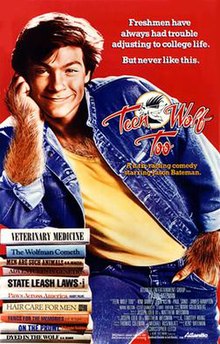
Teen Wolf Too (1987): Attack of the Bad Sequel


Teen Wolf Too! Ugh! When I first bought a DVD player, one of the first DVDs I purchased was Teen Wolf. The only downfall was that it was a double feature DVD, which meant I had to purchase Teen Wolf Too as well. Teen Wolf is not a great movie, but compared to Teen Wolf Too it is a masterpiece. No word is adequate enough to describe just how terrible Teen Wolf Too is; it's an atrocity against the human race. It's 95 minutes of sheer torture with a ridiculously overqualified cast doing their best not to look embarrassed. 

I've always theorized that Teen Wolf Too was originally supposed to be Teen Wolf 2, and further the adventures of Scott Howard (Michael J. Fox) as he took on college. However, when Michael J. Fox turned down the script (because it was friggin' awful), the filmmakers created a new character, Todd, and cast a Michael J. Fox-like actor in the role. It was during this time frame (1987) that Jason Bateman was starring in the dreadful sitcom The Hogan Family and  he was the real life brother of Michael J. Fox's Family Ties co-star, Justine Bateman. The filmmakers probably looked at these two factors and shouted, "EUREKA! We found the next Teen Wolf!" Bateman would later prove to be an enormously gifted comedic actor, but he's absolutely dreadful in this film. Of course, it doesn't help that he is burdened with one of the worst scripts in cinematic history. 

Todd Howard, the cousin of Scott (played by Michael J. Fox in the first film), is extremely nervous about starting his first day of college. The werewolf gene has seemingly skipped him, but his Uncle Harold (Scott's father) keeps reminding him that he could be late a bloomer. Why is Scott's father in Teen Wolf Too? Well, Todd's going to need someone to dispense some advice to him when shit hits the fan and Harold was obviously a logical choice. In theory, it's supposed to provide the audience with a nostalgic link to the first film. "Hey, look! It's Scott's dad!"  
Whenever Harold is onscreen we're supposed to have warm and fuzzy memories of the relationship he had with Scott. The problem is that Harold is hardly in the film and is fairly superfluous to the overall narrative. Harold isn't the only returning character from the first film, there are a few others as well. 

Todd has been accepted into Hamilton University on an athletic scholarship, despite the fact that he has never played a single sport in his entire life. "Why is this?" you yawn...er ask. Well, turns out the Hamilton's boxing coach  is none other than Coach Bobby Finstock, Scott's high basketball coach from the first film. He recommended the athletic scholarship for Todd on the assumption that Todd is a werewolf like his cousin. His high hope is that Todd's lycanthropic powers can turn around the struggling boxing team, the pride and joy of Hamilton University. Why would the college dean hire a high school basketball coach to turn around Hamilton's boxing team? The movie never really delves into this question, instead the audience is asked to take it at face value. The boxing team is the top priority on Dean Dunn's list, he believes that it will help bring back school spirit. He gives Finstock an ultimatum, either get the team back on track, or you're out of a job. Coach Finstock just shrugs away the dean's threats, because he is more focused on eating a sandwich. It also doesn't help that Coach Finstock is played by a different actor, Paul Sand, who seems merely content on aping Jay Tarses' performance from the first film. 

Todd arrives at his dorm room and finds that his two roommates are...SURPRISE...Scott's best friend, Stiles (played by a different actor, Stuart Fratkin), and Scott's former basketball teammate, Chubby (played by the same actor, Mark Holton). Todd is at a disadvantage as Stiles and Chubby seem to know everything about him, but he knows nothing about them. Like Finstock, Stiles is hoping to take advantage of Todd's lycanthropic prowess. In the first film, Stiles made a fortune selling Teen Wolf merchandise at basketball games, while Scott/ Teen Wolf  was lighting up the court. He hopes Todd will help him rake in more cash and score with some hot college girls, as well. Harold is naturally less than enthused to see that Stiles is Todd's roommate, but he puts on a brave face. Stiles offers up a peace offering by giving Harold a McDonald's cheeseburger (in a Styrofoam container). Harold glances at the Styrofoam container and then tosses it to passing college student. The college student is extremely happy about this and thanks Harold. Then he adds, "Got any fries?" This is funniest bit in the entire film and it takes about a second of screen time; and occurs within the first ten minutes of the film.....OH, MAN! This is going to be a LONG 95 minutes. 

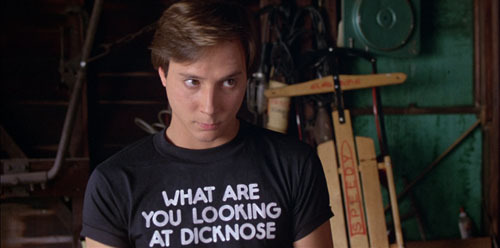
Stiles comes across as being a refugee from an early 1980s sex comedy. He is constantly scheming to get laid, but always fails. His latest scheme is to leech off Todd's new found fame and even that backfires on him. He is at first elated when Todd turns into The Wolf, but eventually he grows tired of the cocky persona that Todd acquires. 
BEFORE.  Stiles -  Teen Wolf

AFTER. Stiles - Teen Wolf Too


Todd isn't all that interested in athletics, his true passion is science and he wants to be a veterinarian. Todd needs to change his schedule after Stiles has mucked it all up by registering for him, one of the classes is Woman's Volleyball. Todd asks Professor Brooks if he can add her class and she most happily obliges him. He seems to have found a kindred spirit in Professor Brooks. It's also at this juncture in the movie that Todd meets his love interest, Nicki (Estee Chandler), the hot nerdy girl. In the real world, Nicki would probably turn heads where ever she went, but in parallel universe of Teen Wolf Too, only Todd seems to be aware of her existence. Nicki is, indeed, gorgeous, but she commits TWO unforgivable cinematic crimes:

1) She occasionally wears glasses. Nicki is spectacle free for most of the film, but she dons them enough for her to labeled as a "freak." If an attractive woman has just one tiny flaw in the movies, people will avoid her like the plague. See also: Rachael Leigh Cook in She's All That.

2) She dresses in a very conservative attire. Nicki wears fuzzy sweaters and poodle skirts. She looks like she walked straight out of the 1950s. Her appearance is more fitting for an episode of Leave It To Beaver than an 1980s teen comedy. 


All in all, Nicki is an extremely sweet and lovable girl, which means that the happiness her and Todd share is going to be shattered with the arrival of a cold hearted temptress. The temptress comes in the form of Lisa, a bitchy blonde with a southern accent. Todd's first transformation into the Wolf occurs while he is dancing with Lisa at a Meet and Greet for College Freshman. She is wearing a form fitting dress, which exposes ample cleavage, and Todd becomes aroused by this. Also in a tow is Lisa's slutty brunette friend, Emily. Initially, both women reject Todd, but once he becomes the big man (WOLF) on campus, they are both clinging to his arms. Todd (in wolf form) even engages in a menage 'a trois with the two woman, though this heard, rather than seen. Stiles arrives at his dorm room, only to find it is locked, he hears giggling coming from within and knocks on the door. Emily answers it, wearing nothing but her bra and panties, Stiles is elated. However, Todd tells Stiles to go away and Emily shuts the door on his face. However, even the bad girls grow tired of Todd's antics and go back to their boyfriend, Gustavson, who is...SURPRISE AGAIN...the star boxer on a rival boxing team. How much do you want to bet that him and Todd will face off in the movie's climax? 

Todd's second transformation happens during a boxing match. Todd is getting the crap beat out of him by his opponent and falls to the ground. All hopes seems lost, but then Todd's eyes start glowing red. Then he leaps  to his feet in full werewolf mode. He turns the tables on his stunned opponent and wins the day. After this great victory, he becomes a campus hero and a party is held in his honor. He then regales the crowd by singing The Contours classic, "Do You Love Me (Now That I Dance)."  It's five of the most agonizing minutes in cinema history. Everyone seems to be having a good time, except for the angelic Nicki.

 Man, I wish I lived in the parallel world of Teen Wolf Too, because maybe, just maybe I could get Nicki on the rebound. But alas, I'm stuck in horrible reality. The audience is then treated to endless montages of Todd's rise and fall as the Wolf. He goes from being a beloved icon to being a complete pain in the ass to the people close to him. 

I will say this for Teen Wolf Too, it does a better job of establishing the dichotomy between Todd (good) and The Wolf (bad) than it's predecessor.  In the first movie, Scott becomes a tad bit cocky when he's the Wolf, but he never develops into a full out asshole. Whereas in Teen Wolf Too, once Todd becomes the Wolf he turns into a complete douche bag; he completely disregards the safety of a bicyclist when he essentially runs the poor sucker off the road. To Todd it's an amusing prank, but to the bicyclist it's a moment of complete terror. In the the first film, Scott was smitten with Pamela and hoped to be in a long term relationship with her. After their first date is over, Scott comments about how angry Mick was and Pamela says you can't blame him, as he is her boyfriend. This completely blindsides Scott, who was convinced that this was the start of something beautiful. In Teen Wolf Too, Todd has no such ambitions when it comes to Lisa and Emily, it's purely a carnal thing. I'm probably putting more thought into this movie than the actual filmmakers did, I suggest I move along. 

After Lisa and Emily, and most of his friends have abandoned him, Todd calls Harold for some advice. James Hampton some how manages to sell the scene with his sincere performance, despite the horrible material he has to work with.  Todd then makes good with Nicki and Professor  Brooks, whose class he has been neglecting.  We are then treated to a montage of Todd, with Nicki's help, cramming for his finals, set to the Real Life song "Send Me An Angel." 


Naturally, Todd aces his finals, thanks to the power of love. He then faces Gustavson in the ring and decides to do it  as himself and not as the Wolf, despite the fact that Gustavson is twice his size. Todd takes quite a punishment, but refuses to give up. Eventually his persistence pays off as he beats Gustavson and pulls off the greatest upset in fictional sports history since a guy by the name of Rocky Balboa beat the dreaded Russian Ivan Drago. Like Rocky Balboa, Todd is like a "piece of iron" that doesn't know the meaning of the word quit. Sure, you may knock him senseless, but he'll come back for more, until he wears you down. Oh, and in another SURPRISE, it turns out that Professor Brooks is, in fact, a SHE-WOLF. She tells Dean Dunn to leave Todd alone, so he can be free to pursue his studies. This, of course, mirrors the scene in the first film in which Harold told Principal Thorne to leave his son alone, glowing red eyes and all. 

I'm sure just reading this review is giving you headache, well just imagine what it likes watching the actual movie. There was really absolutely no reason to make a sequel to Teen Wolf, the first film is a stand alone film. Scott discovers he's a werewolf, let's it get the better of him, then vows to never to become the wolf again and be content with just being himself. END OF STORY. However, there was a quick buck to made and the Atlantic Entertainment Group hastily put this film into production. Not surprisingly, the Atlantic Entertainment Group went belly up in 1989; they made too many films like this one. 

Teen Wolf Too is also living proof of just how much of great actor Michael J. Fox truly was. Teen Wolf has basically the same flaws as it's sequel, but gets a great boast by Fox's likable persona. He some how transformed an average script into something watchable. Jason Bateman was still too wet behind the ears to have that kind of impact and as a result his character of Todd often comes off as unlikable even before the  transformation; at one point he scolds Nicki in the library for taking the book he wants. His character lacks the warmth and humor that Fox possessed in the first film, as a result it's hard to care about his plight. Nicki is actually a more sympathetic character, but unfortunately, is often relegated to the background. Oddly enough, Bateman and Estee Chandler have a wonderful chemistry together, but unfortunately it gets lost amongst the crude humor, cheesy montages, goofy supporting characters, and an overall air of familiarity. The film almost follows the original beat for beat; the only difference being that Boof was Scott's childhood friend, while Nicki is Todd's newly found love interest.  

Kim Darby as Professor Brooks does her best with the little material she's given and comes out of this mess unscathed. John Astin (as Dean Dunn) leers for the camera and manages to get a few cheap laughs. That's about the best thing I can say about this film. Even when I was an undemanding nine year-old, I still hated this movie. Which is sad, because I thought the Teen Wolf cartoon on Saturday mornings was the absolute best. 


Credits:
Cast: Jason Bateman (Todd Howard), Kim Darby (Professor Brooks), John Astin (Dean Dunn), James Hampton (Uncle Howard), Paul Sand (Coach Finstock), Estee Chandler (Nicki), Stuart Fratkin (Stiles), Mark Holton (Chubby), Robert Neary (Gustavson), Beth Miller (Lisa), Rachel Sharp (Emily).

Director: Christopher Leitch
Screenplay: Tim Kring, Joseph Loeb (story), Matthew Weisman (story).

Running Time; 95 min.

Monday, April 29, 2013

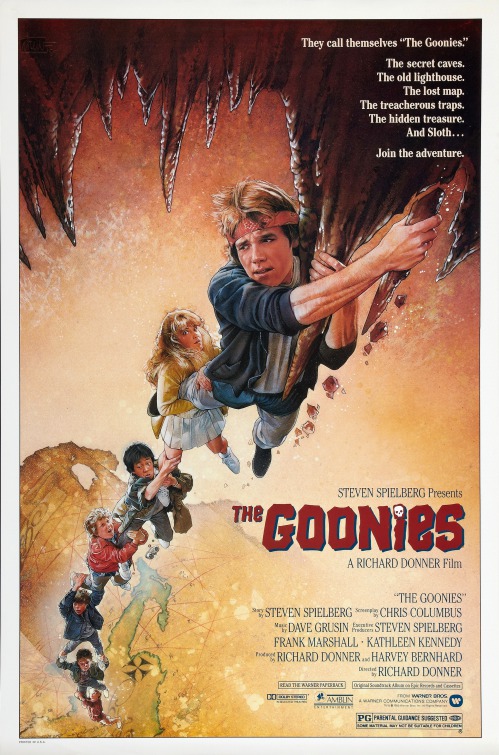
The Goonies (1985)


The blockbusters of the 1980s are fairly restrained when compared to the blockbusters of today. Computer technology has made it so that practically everything is possible, hence filmmakers have a tendency to go a bit overboard at times. The special effects of the 1980s were realized  by using more traditional and practical means, so that filmmakers often had go back to the drawing board if a particular effect didn't work. In The Goonies, there was initially supposed to be a scene in which the kids are attacked by an octopus, but much to the horror of the filmmakers it looked terrible, something right out of an Edward D. Wood, Jr picture, and they wisely discarded it (though a clip of it can still be seen in the second part of the Cyndi Lauper video for "The Goonies R Good Enough." )


If The Goonies were made today, no doubt the octopus would have been CG and it would have remained in the film, even though the scene is rather superfluous to the overall narrative. This is not meant as an attack on the films of today, but rather to defend The Goonies from the charge that it is a "loud, soulless Hollywood product." Sure, The Goonies is a loud film at times and it was, indeed, a Hollywood product, but soulless?! Absolutely not! The film has a lot of heart and it's clear that it was a labor of love for director Richard Donner and executive producer Steven Spielberg.

The Goonies was a huge staple in my (and probably most of my generation's) childhood. I first saw it at the Starlight Drive In Theater at the age of six and was elated when I found a VHS copy of it at the (then) recently opened Wal-Mart. I watched it over and over again to the point where I had the entire film memorized. I could relate to the character of Mikey, because I was a bit of an outsider in school and had fairly oddball friends. Not to mention, it was produced by Steven Spielberg and I was, and still am, a huge Spielberg fan boy. Even though Richard Donner was the director on the film, Spielberg's finger prints are all over it. The Goonies is unashamedly an old fashioned movie, it's a throwback to the adventure films of Hollywood's Golden Era with  preteens as its protagonists. It is the kind of film that would make Terry Gilliam heave and cause cynical movie goers to roll their eyes every five minutes. And I love absolutely every minute of it. It is one of the my personal favorite films. Sure, I maybe blinded by nostalgia, but I'd rather watch a movie that features likable characters succeeding in the end, then have some angry filmmaker preach to me about the injustices in the world.

There's a tendency among film scholars to frown down upon "popcorn" films, because they have nothing important to say. The irony is that the "popcorn" films tend to survive the test of time, while the topical "message" films become horribly dated. Just look at Guess Who's Coming To Dinner, it took an important topic, interracial marriage, and served up a heavy handed message at the film's end about how everyone should be nice to one another. It got great notices in 1967, but is nearly unwatchable by today's standards. Practically everyone remembers The Goonies, but  few remember the  "socially relevant" films of 1985.

The characters in The Goonies are all archetypes, they are reminiscent of the kind of friends we had during our childhood.

Brand: He's the jock of the group. In his spare time he lifts weights, works oddjobs to feed his bike hobby, and is smitten by the cheerleader Andy. He is the more practical one out of the group, while everyone is wanting to go on an adventure, he proceeds with caution. He is also the butt of many jokes, because he failed his driver's test.

Mikey: He is the complete opposite of his older brother Brand. Mike is an awkward teenager who wears braces and has asthma. While Brand is the more physically gifted of the two, Mikey is the intellectual one. He has a great knowledge of history and his enthusiasm for an adventures wears off on his friends.

Mouth: He is the wiseass of the group. Mouth is constantly cracking jokes, much to the annoyance of his friends. He talks a lot, but often has very little to say.

Chunk: The fat friend. Chunk devotes a good portion of his time to hanging out in arcades and eating lots of junk food. He is also a horrible liar, often telling incredible stories about famous people he meet or amazing events that he witnessed. He is the boy who cried wolf and that eventually costs him later in the film.

Date: The smart Asian stereotype. Data specialty is inventing gadgets that serve no real function and rarely work. He often stumbles over his English and gets extremely upset when people correct him.

Andy: She is popular cheerleader who Brand is smitten with. Andy is somewhat flakey, but extremely sweet girl who returns Brand's affections. She is initially at odds with the Goonies as she is comes from an upper class background, but by film's end has ingratiated herself with them.

Stef:  She is the slightly nerdy female of the group. She is Andy's close friend and is fairly antagonistic towards Mouth. She is extremely opinionated and vocal, often the voice of reason, especially when it comes towards her friend Andy. At one point Andy starts freaking out and Stef does her best to calm her nerves.

The movie's title refers to the fact that the characters live in "The Goon Docks" neighborhood of Astoria, Oregon. This threatens to be "The Goonies" last weekend together as their houses are being foreclosed on and they are moving to different parts of the country, barring an absolute miracle. That miracle comes in the form of old pirate treasure map that is stored in the Walshes' attic; Mikey and Brand's dad is the curator of the town museum. They read old newspaper clippings about the treasure of pirate One Eyed Willy, supposedly hidden somewhere in the area and Mikey is convinced that this is their ticket out of this mess. The other Goonies are hesitant at first, but Mikey is able to persuade them when he reveals that their houses will be torn down to make way for a new golf course. Brand, however, will have none of this. The Goonies usurp his authority by tying him up while he is working out. To add insult to injury, Mouth lets the air out of the new tires on Brand's bicycle, needless to say this makes Brand extremely mad. After Brand is released by his mom, he sees that his bicycle tires are flat and commanders  a little girl's bike so he can chase after Mikey and his friends. There are two obstacles standing in the way of One Eyed Willie's treasure: booby traps the pirate has scattered throughout the underground tunnel and the Fratellis, a family of criminals, led by their surly and ugly mom. The two brothers, Jake and Francis, are constantly at each other's throats and Mama Fratelli often has to (literally) slap some sense into their thick skulls.  They run into the Fratelli's by sheer happenstance, the entrance to the underground tunnel is located in the basement of a run down restaurant, where the Fratellis happened to be holed up. Chunk naturally gets hungry and opens the kitchen freezer to see if there's any ice cream, only to find much to his (and everyone else's) horror a dead body with a bullet hole in it's head. The Fratelli's come back at that moment and Chunk hides in the freezer with the corpse, while the rest of the gang enters the tunnel. When the Fratellis have exited, Brand and Mikey implore Chunk to call the police. Chunk goes out the window and tries to call the police, but the deputy doesn't believe him. Chunk then waves down a van, explaining to the driver what is going on, only to find that the driver is Jake Fratelli. Jake's brother Francis grabs Chunk and throws him in the back of the van, reuniting Chunk with the corpse from the freezer.


The Goonies has often been criticized for being an extremely loud and relentless film. And certainly there is a lot of truth to this criticism. The film does have a roller coaster feel to it, and too often there are close ups of characters screaming at the top of their lungs. It can wear the viewer down from time to time. On the other hand, it does a great job of establishing the relationships between the characters and can be extremely moving at times.  The most complex relationship in the film is between Brand and Mikey. The two of them are siblings, Brand is the oldest of the two and is often antagonistic towards Mikey. They are polar opposites in  both a physical and intellectual sense; Brand constantly works out and is in great shape, he is the brawn out of the two. Mikey, on the other hand, is the more scholarly type and has a fairly puny physique. Yet, despite constantly being at odds with one another, there is a mutual love between the two characters. Early in the film, after contractors have dropped off papers from their father to sign, everyone goes inside except for Mikey. He stands on the front patio staring into distance, contemplating what the future has in store for him and is on the verge of tears. Just then Brand walks into frame from the side door, Mikey runs toward him and the two of them hug. Brand may get annoyed with Mikey at times, but he does genuinely care about his younger brother.

The heart of the film is the relationship between Chunk and Sloth. Sloth is the black sheep of the Fratelli family; his face is deformed and he is extremely tall. They keep him chained up in the basement of the abandoned restaurant, so he will be out of their way. After the Fratellis have captured Chunk, they tie him up and put him in the same room as Sloth. Chunk is frightened at first, but breaks the ice by offering Sloth a Baby Ruth candy bar. Chunk throws the candy bar Sloth's way, but his aim is off and it hits Sloth in the forehead, landing a few feet away from Sloth's reach. Sloth begins to freak out and in the process breaks the chains that have been holding him. He picks up the Baby Ruth bar and feeds half of it to Chunk. The two of them form an inseparable bond and Sloth helps save the day at the film's end. Chunk offering his Baby Ruth bar is probably the first act of kindness Sloth has ever encountered in his entire life and he doesn't forget it.


It's also interesting how The Goonies will often slow down the action to give its characters breathing room. The most memorable moment is the interlude inside the wishing well. Mikey and company stumble upon a cavern that is glittering with coins. Stef points out that it is the old wishing well and Andy comments about how she used to believe that it actually granted people's wishes. Mikey and Data start gathering up coins, but Stef tells them they can't do that, because "These are other people's wishes. They are other people's dreams." Mouth then counters by telling a story about how he once made a wish and it didn't come true. He then adds, "I'm taking it back. I'm taking them all back."

It looks like The Goonies adventure is going to be short lived, when resident douchebag Troy and his friends are standing at the top of the well. Troy's main goal in life is too make it with Andy and he is naturally elated when he finds out that she is at the bottom of the well. They implore Troy to lower down the bucket, so he can pull them up one by one. Andy, naturally, is the first to go, so not only does it look like The Goonies adventures will be short lived, but Troy might make it with Andy as well. Uh-oh!

Mikey, however, persuades them to carry on with a long monologue about how "it's their time, down here." Meaning, this might be their last chance to go on a genuine adventure and it will come to a screeching halt when they go up "Troy's bucket." Sure, it might be a safer route, but they might regret their decision later. Mikey's words touches ever one, including the upper crust Andy, and they all carry on. Andy, who is wearing Troy's letterman jacket, for some reason, wraps it around the bucket. This naturally infuriates the horny Troy and he shouts, "ANDY! YOU GOOOOOOOOOONIE!"

Troy is quite possibly the biggest douchebag ever to grace the silver screen, he is the son of the contractor who hopes to build a new golf course over where The Goonies houses are currently stand. He is spoiled brat that has always gotten everything he wanted and has no concern for the feelings of others. In the beginning of the film, Troy is cruising in his car with Andy and Stef, when they spot Brand riding the little girl's bike. Troy pulls over and Andy asks Brand if he would like a ride. Brand declines, but Troy, being the dipshit that he is, grabs a hold of Brands hand (that is resting on the car door) and begins to drive a fast speed. Andy and Stef implore Troy to stop, but he won't listen. The car goes so fast that the training wheels fly off the little girl's bike. Troy releases his grip and Brand goes sailing off into the woods. Troy never really gets the come uppence he deserves; the worst that happens to him is when he flies through the air when the toilet he is sitting on explodes, but that's not exactly on even trade off, given the fact that he endangered Brand's life. Troy is completely one dimensional character that audiences love to hate, every time he's onscreen everyone boos. He's even more despicable than the Fratellis, who at least are amusing in their nonstop bickering.

There are other memorable moments in The Goonies as well:

Andy decides she wants to have a little make out session with Brand, so she calls for him to come to her. Brand, in the middle of taking a leak, sends Mikey to see what she wants. Mikey walks down a darken tunnel and Andy, mistaking him for Brand, gives him a long, passionate kiss on the lips. Stef, who happens to be holding a lantern, witnesses the entire thing and starts to laugh. Mikey completely dazed by the experience stumbles his way out of the tunnel. Andy, still oblivious that she just made out with a preteen, asks Stef is Brand wears braces. Stef starts laughing and Andy chides her for it and adds that she thinks it cute. Later on, Brand and Andy kiss and she asks, "What happened to your braces?"

The Fratellis capture Chunk and tell him to "spill everything." Chunk starts to confess all the horrible deeds that he has done throughout his short life, the most memorable being how he brought fake vomit into a movie theater, made some heaving sounds, and then threw it over the balcony and onto the audience below, which in turn caused the person it landed on to barf. Then the person sitting next to that person barfed and so on.


The special effects, the stunt work, and the sets (especially the life sized Pirate ship at the film's climax) are extremely impressive, but The Goonies is at its absolute best when the characters are given the reigns. The reason The Goonies has resonated with audiences is that there's at least one character they can relate to, be it Brand, Mikey, Chunk, Mouth, Data, Andy, and even Stef. If the audience likes the characters, they tend to the forgive flaws that are inherent in the film's production. The Goonies is a far from perfect film, but it's cast of colorful characters make it a treat to watch, nonetheless.  Of course, if you can't stand child actors, then this is definitely not the film for you.

Cast: Sean Astin (Mikey), Josh Brolin (Brand), Jeff Cohen (Chunk), Corey Feldman (Mouth), Kerri Green (Andy), Martha Plimpton (Stef), Jonathan Ke Quan (Data), John Matuszak (Sloth), Anne Ramsey (Mama Fratelli), Robert Davi (Jake), Joe Pantolianio (Francis), Steven Antin (Troy), Mary Ellen Trainor (Mrs. Walsh).

Director: Richard Donner
Screenplay: Chris Columbus. Steven Spielberg (story)
Running Time: 114


Wednesday, April 17, 2013

Blood On Satan's Claw (1971)


Blood On Satan's Claw is an extremely flawed, but fascinating horror movie. Initially, it was supposed to be anthology of three stories all linked together with "the Devil's skin" infecting individuals and turning them into evil, Satan worshiping thugs, but the filmmakers decided to condense the three story lines into one narrative, turning it into a disjointed, often plodding horror film. It's fairly common for characters to disappear from the narrative and never to be heard from again..... WITH NO EXPLANATION.

The story is about a farming community that is effected by demonic possession after a plow boy, Ralph (Barry Andrews), accidentally unearths the remains of a demonic creature with strange fur on it. Shortly afterwards, the children (more accurately young adults) of the community start getting infected with a strange patch of fur on their bodies and join a satanic cult. The leader of the cult is Angel Blake, who is determined to bring the Devil back in the flesh. Apparently, these strange patches of fur are the "Devil's skin" and she needs all of them to resurrect him from the netherworld. The cult aspect of the film is poorly handled, because it's never established when it actually begins. Angel Blake, for instance, goes from being a normal teenage girl to evil temptress in a blink of an eye, there's no transitional period. A half hour into the film, the cult is well underway, and more than half the children in the area have already joined, much to the chagrin of the local Reverend (Anthony Ainley). The first half hour of the film centers around the character of Peter and his fiancee Rosalind. Peter lives with his upper class, well to do aunt, who naturally disapproves of him marrying a peasant girl like Rosalind. Peter's aunt forces Rosalind to sleep in the attic of the house, after Peter has successfully campaigned to let her stay the night, and it's there that Rosalind is possessed by some demonic force. Screams ring through the household and Peter's aunt goes upstairs to check what all the commotion is about, only to have her face scratched to hell by the possessed Rosalind, who's right hand has been replaced by claws....Satan's claws.


The film is lacking in the protagonist department as well, there really is no strong central figure for the audience to get involved with. The Judge (Patrick Wymark) is, by default, the hero of the film as he vanquishes Satan at the film's climax, but he's not a particularly sympathetic character and is off screen for a good chunk of the narrative. He does have a character arc as he goes from being completely skeptical (and ignorant) of the supernatural to eventually accepting it and using his knowledge of it to stop the spread of evil.
The closest the film comes to having a protagonist we care about is Ralph. He is a sympathetic character, but is often on the periphery of events, rather than the center; he is a beat too late from saving his beloved Cathy from the satanic cult. At the film's climax, he contemplates giving into his more primal urges, until the Judge arrives just in the nick of time to save him. He does manage to save Margaret, member of the cult, from certain death by pulling her from the river, after an angry mob has attempted to drown her by tossing her in. Ralph is an idealist and hopes that he can save Margaret from the clutches of the satanic cult. He naturally gets frustrated when the only thing Margaret prattles on and on about is her devotion to the Dark Lord.

The ending of the film is fairly anti-climatic: The Judge and a mob of villagers descends upon the coven, while Ralph is being seduced by the "charms" of a curvaceous cult member. Angel sees the mob coming, panics, and promptly runs into a pitchfork that one of the villagers is wielding. The Judge impales Satan (who is not fully completed, still needing "Devil's skin" from Ralph's leg) with a sword and then throws Beelzebub into a fire. Freeze frame. Credits roll.  The Judge has little difficulty in disposing of the Prince of Darkness and everything is right with the world.

As sloppy and uninvolving as the film is at time, it's also hard to completely dismiss. There are some genuinely chilling moments throughout the film that remain ingrained in your memory.

1) The opening sequence in which Ralph unearths the one eyed skull of Satan. This starts out as a rather tranquil moment with Ralph waving to Cathy and then proceeding to go on with his plowing. Then, quite abruptly, the peace is shattered with the discovering of the deformed skull.


2) The murder of Mark Vespers. It is established early on the Mark has a crush on Angel Blake, so when two girls come to his doorway asking him if he wants to play and that ANGEL with be there, he naturally accepts the invitation. The scene starts out in a seemingly innocent manner as the kids frolic around the wood, but out of nowhere  hand emerges from the bushes and strangles Mark. The strangulation is implied, rather than actually shown, but once again it's rather jarring moment.

3) Angel's seduction of Reverend Fallowfield. Reverend Fallowfield is a stern taskmaster, who gets increasingly frustrated by the lack of focus his pupils have during his lessons. Naturally, when half of his class stops showing up this seriously pisses him off and he puts the blame on Angel Blake, as she is the ringleader of the group. Fallowfield is about ready to close up the church one night, when Angel comes in to have (what he assumes) a conversation him. However, Angel removes all her clothes and tries to seduce the Reverend into sleeping with her, he is tempted at first, but eventually rebukes her advances. The next day, Angel tells her father that the Reverend molested her and he takes this up with the town's squire. The squire has the Reverend arrested and this seemingly puts him out of the way. However, the Reverend is acquitted of all charges, when Ralph comes back carrying Cathy's corpse and telling the authorities that Angel is responsible for the murder. The Reverend, despite his acquittal, disappears from the proceeding altogether.

4) The rape and murder of Cathy Vespers. This is probably the most shocking scene in the picture, because it shows a rather sweet girl getting murdered in a rather brutal fashion. It's definitely hard to watch. Cathy is picking flowers in the woods, when two mischievous boys approach and ask her to play with them. They then tie a rope around her, in a seeming playful manner, and lead her to the middle of the woods where the rest of the coven is waiting. Angel emerges into the frame and starts to recite incantations, while Satan looks on in the background. Then the coven descends upon Cathy and tears off her clothes. One of the male members then step forward, slowly pulls down his pants, and rapes Cathy. After the rape is finished, Angel stabs Cathy in the back with a pair of sheers. Again, this is an extremely hard and painful scene to watch, but's effective in conveying the sheer terror of the moment. Our sympathies lie completely with Cathy and we are sickened by the abuse she is forced to endure. And, we can sympathizes with Ralph's pain when he finds the mangled body of his beloved lying in the woods. It's quite possibly one of the darkest scenes in cinema history. The rape itself is not graphic and rather short lived, but the build up to the moment makes it even more horrific. It's a rather long scene and disorienting one at that, the film cuts between shots of the coven, including a perverted old couple, and close ups of the frightened Cathy. Like her, we have no idea what is going to happen, so when the male starts to undress, our stomachs start to turn.

The 17th century witch movie ( or "folk horror" as Mark Gatiss termed it) was almost a subgenre in itself in the late 60s/early 70s with the release of films like The Witchfinder General, Cry of the Banshee, and Blood On Satan's Claw. In these films, violence is an epidemic that sweeps through the country side, only to come to abrupt end, but at an exceedingly high price. The Witchfinder General is the only one that doesn't have a supernatural element to the story line, but rather it's about a corrupt individual, Matthew Hopkins(Vincent Price), who sweeps through the countryside ridding the world of suspected witches, and people who are antagonistic towards him. It's a film that showcases humanity at it's worst and even the ending is a downer, despite the slewing of Hopkins, because it's implied that the protagonist of the piece, Richard Marshall (Ian Ogilvy) has been driven mad in his quest for revenge. Cry of the Banshee shades the same flaws as Blood On Satan's Claw, but in this case the coven is the wronged party, while their persecutors are part of the decadent upper class.

Another interesting aspect of Blood On Satan's Claw is that it features not one, but two Doctor Who regulars, Wendy Padbury (Cathy Vespers) and Anthony Ainley. Padbury was just coming off her stint as Zoe Heriot, companion to the Second Doctor portrayed by Patrick Troughton, when she made this movie.  Ainley would go onto play the recurring role of The Master throughout the 80s. They share a few scenes together as Cathy is a member of Reverend Fallowfield's parish. Hell, even Barry Andrews would later go on to do a guest starring role in one of Tom Baker's later serials, Nightmare of Eden. 


The film is well acted for the most part, and director Piers Haggard does have a great eye for detail and establishing menace, it's just too bad the script is so incoherent, because the film had potential to be a classic.

Cast: Patrick Wymark (The Judge), Barry Andrews (Ralph Gower), Linda Hayden (Angel Blake), Michele Dotrice (Margaret), Wendy Padbury (Cathy Vespers), Anthony Ainley (Reverend Fallowfield), Charlotte Mitchell (Ellen Vespers), Tamara Ustinov (Rosalind Burton), Simon Williams (Peter Edmonton).
Director: Piers Haggard.
Screenplay: Robert Wynne-Simmons, Piers Haggard
Running Time: 93 min.

Tuesday, April 9, 2013

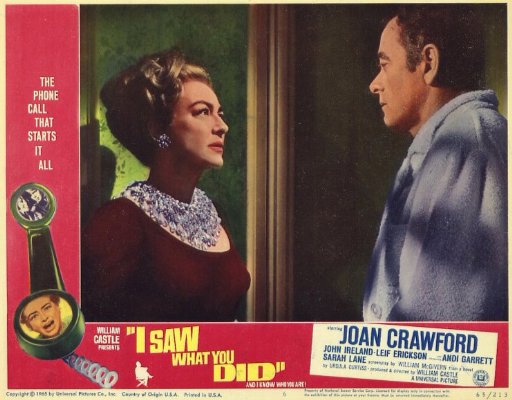
I Saw What You Did (1965)


It's common for film critics to bemoan the lack of originality in today's cinema, consistently grumbling over the latest horror remake or sequel that is due for release. Why things can't things be like the good old days? The problem with this attitude is two fold:

1) It completely romanticizes old Hollywood. Sure, a lot of great movies were made during the studio system, but for every great movie Hollywood churned out there were just as many clunkers. So, for every Gone With the Winds there were just as many Return of Dr. Xs.

2) It ignores the fact that the Hollywood of today is EXACTLY like the Hollywood of yesterday. Hollywood has always been about the profit. If one film is extremely successful, then it's only a matter of time before the other studios release a film exactly like it. When Easy Rider became an unexpected hit in 1969, the studios followed suit by making movies in a similar vain. In the 40s, two of Universals biggest money makers were the Monster films and Abbott and Costello series. MGM made a lot of great films in the 30s, but made countless Andy Hardy films as well. To quote Billy Joel, "the good old days weren't always good and tomorrow is not as bad as it seems."

In 1960 Alfred Hitchcock's Psycho hit the cinemas and proved to be a huge commercial hit. Hitchcock took a relatively obscure horror novel (by Robert Bloch) and, with a fairly low budget, turned it into a gold mine. It was only a matter of time before other filmmakers jumped on the bandwagon and produced their own Psycho, complete with relatively predictable twist endings. It is staggering just how many derivatives of Psycho were made throughout the 60s; Hammer studios would produce films like Paranoiac, Nightmare, and Scream of Fear, a young Francis Ford Coppola would direct Dementia 13 for his mentor Roger Corman, and William Castle got in the act by making THREE Psycho-like films.

William Castle is probably best known for the outrageous gimmicks he used to promote his horror films. His best known gimmick is probably Percepto-vision used for the movie The Tingler. Percepto consisted of attaching buzzers underneath select seats in the theater and setting them off during the film's climax (in which Vincent Price implores the audience to scream for their lives). Another gimmick was Emergo, which essentially was a plastic skeleton attached to a wire that floated over the heads of the audience during the climax of House on Haunted Hill. 

I Saw What You Did was William Castle's third attempt at mimicking Hitchcock, his two previous attempts were Homicidal and Strait Jacket, both of which hinge on a twist ending regarding the killer's REAL identity. Castle tries to pull a sleight of hand like Hitchcock did with Psycho, but ultimately fails, because the twist is fairly predictable in both films. I Saw What You Did is probably the most successful out of the three films, because it's the least gimmicky. The film follows two mischievous teenage girls, Libby and Kit, who amuse themselves by prank calling random numbers and whispering the phrase, "I know who you are and I saw what you did."  Unfortunately, one of their recipients, Steve Marak, has just murdered his wife. Libby mistakenly thinks that Steve is playing along with the prank and starts to grow curious as to what he actually looks like. The girls decide to drive by his home to have a look. Their plan is thwarted by Steve's next door neighbor (and would be lover), Amy, who thinks that Steve is having an affair with Libby. The girls beg Amy not to say anything, fearing that they will get in trouble with Libby's parents (who are at party) for leaving the house. Amy, out of spite, takes Libby's ID. The girls drive home dejected. Amy is aware that Steve has murdered his wife and plans to use this information to blackmail him into marrying her. Fat chance! Steve, not one to be caged, offs Amy and discovers Libby's ID. He then drives to Libby's house to confront her. Uh-oh!


I Saw What You Did "borrows" two distinct elements from Alfred Hitchcock's Psycho:

1. The killing of a star name fairly early in the proceedings: In Psycho, it was a genuinely shocking to see Janet Leigh killed off in the middle of the film. It was simply unheard of at the time to kill off a star name so early in the proceedings and naturally the audience had no idea how to react. William Castle takes a page from Hitchcock's book and bumps off Joan Crawford's character, Amy Nelson, with nearly a half hour remaining in the film. However, Crawford's death isn't nearly as shocking and disorienting as Janet Leigh's, because Amy is a supporting character and a fairly unsympathetic one at that. When she thinks Steve is having an affair with Libby, she becomes extremely jealous and possessive, to the point of blackmailing Steve into marrying her.

2. The shower scene: The shower scene is the most famous set piece in Psycho, so it's not surprising that Castle would ape it in his own movie, but with a twist. Steve is taking a shower when his wife starts to yell at him, he has had enough, pulls her in and stabs her to death. It is the Psycho shower scene done in reverse. The stabbing is shot in a similar fashion to the one in Psycho; shots of blood going down the drain, close ups of the woman's face, etc.

After Steve has murdered his wife, he attempts to cover up the crime by burying her in the woods. This is very similar to how Norman Bates tried to cover up Marion's murder, by dumping her car (with her body in the trunk) in the swamp. Castle milks these scenes to great effect, Steve is constantly on the verge of being discovered. At one point Steve hears a rustle in the woods and realizes a dog is coming his way. The gig is up, or so Steve thinks, but at the last possible second the dog's owner calls it back to the car.

I Saw What You Did is pretty jarring at times due to how tonally inconsistent it is. The scenes with the girls are done in a fairly light hearted manner with upbeat music playing on the soundtrack. These scenes would be more at home in a TV sitcom like Gidget than in a horror film. The scenes with Steve and Amy are extremely intense with your typical "spooky" horror/suspense music playing in the background. The fatal flaw of the film (other than plagiarizing Hitchcock) is that it hinges on characters behaving in the stupidest manner possible. Libby MUST know what Steve looks like, so she drives down to his house, gets caught snooping on his lawn by Amy, and in the process gives Steve the information he needs (her ID that Amy has taken) to track her down. Amy, out of fear of losing to Steve to much a younger woman, tries to blackmail him into marrying her, which, given the fact that he has just murdered his wife for her constant nagging, isn't exactly a bright idea. If Steve wasn't going to allow himself to be tied down to a constant nagger, then why would he allow himself to be held prisoner to a potential blackmailer. It's enough to make you smack your forehead in complete disbelief. On the other hand, at least the girls are played by actual teenagers (instead of the twenty something that often populate high school horror films) and behave as such. John Ireland makes for a compelling villain as well, he's absolutely cold and frigid to the world around him, and shows no remorse for the crimes he has committed. However, he only lashes out at the world when he feels he is being boxed in; his first murder was one of passion, the second was for self preservation. The confrontation between Steve and Libby (and Libby's younger sister Tess) at the end is extremely well done; at one point he tosses a knife as Tess when she screams out a warning to Libby. Castle really pumps up the atmospherics; the outside of the Mannering house is shrouded in fog, while Tess hides in the woods from her pursuer.
I Saw What You Did certainly pales in comparison to Psycho, but it's fairly entertaining in its own silly way.

Credits
Cast: Joan Crawford (Amy Nelson), John Ireland (Steve Marak), Andi Garrett (Libby Mannering), Sara Lane (Kit Austin), Sharyl Locke (Tess Mannering), Leif Erickson (Dave Mannering), Patricia Breslin (Ellie Mannering), John Archer (John Austin).

Director: William Castle
Screenplay: William P. McGivern
Running Time: 82 min.

Snow White's Revenge/Scandal (2024)

  It is difficult to write about Snow White’s Revenge without bringing up the ending, so readers beware, this review will contain spoilers...