Powered By Blogger
Showing posts with label Christopher Lee. Show all posts

Sunday, February 1, 2015

Dracula A.D. 1972 (1972)


If Peter Cushing had starred in more “prestige” movies, he would easily be regarded as one of the finest film actors to ever grace the silver screen. Unfortunately, he spent most of his career starring in horror movies; a genre that is greatly frowned down by most film critics and historians.  Look no further than Dracula A.D. 1972 for proof of Cushing’s greatness, because his presence alone elevates it from being absolute garbage to a passable thriller.  Indeed, whenever Cushing is not onscreen the movie is absolutely dreadful, even laughable at times – check out the scene in which Caroline Munro’s wide eyed hippie, Laura, begs to be sacrificed to Dracula.  In fact, its modern setting (1972) makes the movie far more dated than the previous Dracula movies, which were all set in the Victorian Era.  What is truly amazing is that, despite the silly script, Cushing gives it his all; there is no condescension in his performance nor does he ever resort to histrionics. He gives an air of credibility to the movie and is fairly affecting at times, especially in the scenes that involve Van Helsing’s granddaughter, Jessica (Stephanie Beacham).  Cushing tended to play different variations on the same role – the authority figure. Whereas his Baron Frankenstein was a cold man who became increasingly more cynical as the series progressed, his Lorrimer Van Helsing is a beacon of light in a dark age. When Lorrimer finds out that Jessica took part in the black mass that awakened Dracula, rather than screaming at her, he tells her, in a calm voice, that he wants to help and then hugs her. 


Jessica has gotten herself involved with a group of hedonistic hippies; their ringleader is Johnny Alucard, who comes from a long line of Dracula disciples.  Johnny persuades his friends to attend a black mass ceremony at an abandoned church, and they all agree, though Jessica is reluctant, because it is something different.  Of course, this is a ruse by Johnny to resurrect Dracula from the dead, and his friends are merely sacrificial lambs in his pursuit to achieve immortality.  After Johnny dumps a cauldron of blood all over Laura’s body (she volunteers to take part in the mass), Jessica and friends flee in horror, abandoning the hysterical Laura. Dracula is successfully brought back to life and wastes no time in disposing of Laura; he drains all the blood from her body.  Dracula spends the rest of the movie offing Jessica’s friends, until he is stopped by Lorrimer.

I like Stephanie Beacham as Jessica Van Helsing, despite her sporting one of the most unfortunate mullets in film history.  Jessica is a young girl just looking to get some kicks, oblivious to the danger that is lurking around the corner.  It is extremely unfortunate that Jessica is never given a full character arc, because it might have smoothed over the movie’s more glaring flaws.  In the previous Dracula films, most notably Dracula Has Risen from the Grave and Taste of the Blood of Dracula, the main protagonist is a young, carefree lad (named Paul in both films) who reluctantly finds himself going head to head with Dracula at the movie’s climax; at stake is the souls of their girlfriends (Maria in Risen, Alice in Taste). At first, it seems that Jessica is going to be given a similar type of arc – she is a carefree soul and is very dismissive towards her grandfather.  When he tells her that the study of the occult has been his life’s work, she snaps back, “It’s not one of my hang ups.”  Like the protagonist in the earlier movies, she soon finds her life going to hell; she is being questioned by the police, while her friends are killed off one by one.  She seems destined to become Lorrimer’s successor, but, sadly, she is relegated to a typical damsel in distress role, and spends the last ten minutes staring in a hypnotic trance.   It’s a really a wasted opportunity by Hammer, but they were more interested in filming Beacham’s cleavage than developing an interesting heroine. In the following year's The Satanic Rites of Dracula, Jessica (now played by Joanna Lumley) is Lorrimer's assistant but, even then, she is still given very little to do. 


 Dracula A.D. 1972 was Hammer’s attempt at rebooting the Dracula series; it takes place in a different timeline than the previous movies. There is a prologue set in 1872 where Lorrimer’s ancestor, Lawrence, is battling Dracula on top of a runaway carriage. Lawrence impales Dracula with a broken wheel from the carriage. Dracula turns to ashes while Lawrence dies from the wounds he received in the battle.  Just then one of Dracula’s disciples walks into frame and gathers up the ashes.  There is a fairly creative transition from 1872 to 1972 - there is a close up of Lawrence Van Helsing’s headstone and then the camera pans up to a jet airplane flying in the sky. 

The first half of the movie is as bad as it can get, - it focuses primarily on Jessica and her hippie friends. When we first meet them, they are crashing a birthday party being held by a wealthy family; the dance around, make out, while a rock band, Stoneground, plays in the background. There is an argument between the ringleader, Johnny Alucard, and Joe, the odious comic relief, as to how much time they have before the cops show up. 


This is a big problem, because none of these characters are particularly likable nor, with the exception of their ghastly wardrobe, interesting to watch.  The cast tries their hardest to breathe life into the characters but the script lets them down. Are we supposed to like the characters? Is the audience supposed to find Joe funny? Jessica, despite being a modern woman, is very much a follower and easily gives into peer pressure. Her boyfriend, Bob, constantly makes idle threats to Johnny, but never backs them up. Laura willingly goes along with whatever Johnny suggest. Joe is an obnoxious pain in the ass, and the other two girls, Gaynor and Anna, are just there for the ride. Jessica at least feels guilty about abandoning Laura at the church; the rest of the group just shrugs it off.  Johnny Alucard, with his penchant for 1970s slang and wearing flamboyant outfits, comes across as more comical than menacing; his death scene is more befitting for a Home Alone movie than a Dracula sequel


Dracula A.D.1972 is filled with laughably bad moments; the black mass, where Johnny urges the group to “Dig the music, kids,” as percussion music plays in the background; Johnny Alucard’s death by shower; the way Jessica and her friends put the word, “man” at the end of every other sentence;  Dracula getting annoyed at Johnny for bringing him the wrong woman; etc.  These are script problems but the movie itself is competently made – it never falls to level of Ed Wood, or other legendary bad movie directors. 


While Dracula A.D. 1972 takes place in a different universe than the previous movies that didn’t stop the filmmakers from essentially lifting the plot to Taste the Blood of Dracula, albeit with a few revisions. Taste of the Blood of Dracula is a flawed, but interesting entry in the Dracula series, because it is, in essence, about the sins of the fathers being visited upon the children. The fathers, in this case, are three respected members of a small community, who in their spare time are looking for some new kicks; they usually go to brothels to indulge themselves.  At the brothel, they meet a young man named Lord Courtley, who is really a disciple of Dracula. Just like, Johnny Alucard, he convinces these men to partake in a black mass which results in the resurrection of Dracula.  Taste of the Blood of Dracula is a better movie than A.D. 1972, but it does lack a strong protagonist. Ralph Bates is fun in the early going as the flamboyant Courtley, but he is killed midway through.  Dracula A.D. 1972 is fairly dreadful up until the half way point, then comes to life once Peter Cushing takes over. I also like Michael Coles as Inspector Murray; it's extremely refreshing to see a horror film in which the police force not only believe Van Helsing, but are the ones who seek him out. 

Christopher Lee is given very little do; this was the case in practically all of Hammer’s Dracula movies.  He has less than ten minutes of total screen time, but he is genuinely menacing in his few scenes.  Though, it isn't until the very end that Lee and Cushing share a scene, and even then, they are rarely in the frame together.  They were much more effectively paired in the same year’s Horror Express, where they play rival scientists. 

Cast: Peter Cushing (Lorrimer Van Helsing/Lawrence Van Helsing), Stephanie Beacham (Jessica Van Helsing), Christopher Lee (Count Dracula), Christopher Neame (Johnny Alucard), Michael Coles (Inspector Murray), Caroline Munro (Laura), Philip Miller (Bob), Marsha Hunt (Gaynor), Janet Key (Anna Bryant), William Ellis (Joe Mitchum), Michael Kitchen (Greg), David Andrews (Detective Sergeant).

Director: Alan Gibson.
Screenplay: Don Houghton.
Running Time: 96 min. 

Saturday, March 8, 2014

The Mummy (1999)


How does Stephen Sommers manage to get quality actors to star in his movies? This is a question that has often puzzled me. Sommers is, at best, a poor man's Steven Spielberg. It is clear he has spent a lot of his time studying Spielberg's movies, but has learned very little from them. The Mummy is one of those rare films where an excellent cast is able to salvage a ridiculous screenplay and make it immensely entertaining. In fact, the cast is so good that they often make  Sommers look like a competent director. It's no coincidence that the The Mummy is the best (and only good) movie Sommers ever made.

The Mummy is a remake of the 1932 classic starring the great Boris Karloff, but whereas that film was a tragic, supernatural romance, Sommers' version is an adventure film in the vein of Indiana Jones. There is tons of action, but very little scares.  In fact, the weakest aspect of the film is the mummy itself, as played by Arnold Vosloo. Vosloo actually has a pretty good screen presence, but he isn't really given much to do until the last half hour of the film. Unfortunately for a significant portion of the film, the mummy is brought to life with extremely unconvincing CGI. A lot of time was spent on designing the look of the mummy, but in the end it looks more like an Altered Beast  reject than an actual movie villain.


There are a couple of odd decisions that Sommers makes in his screenplay, like how Imhotep's resurrection could, in essence, bring about the end of the world. In the 1999 film, Imhotep's resurrection brings about plagues on the Egyptian people, escalating in them being covered with boils and turned into mindless zombies controlled by Imhotep. You can argue that it ups the stakes, but it's rather silly plot device that the characters essentially shrug off.  In fact, The Mummy's biggest asset, its quirky sense of humor, is often its biggest drawback as well; it's hard to develop any sense of urgency when your  lead characters are constantly cracking jokes and remain in high spirits the entire time. I was also never able to buy that Imhotep would mistake Evelyn for a reincarnation of Anck-Su-Namun, largely for the fact that the two look nothing alike. It also doesn't help that in the sequel, The Mummy Returns, Sommers completely negates this plot point by having Meela, the real reincarnation of Anck-Su-Namum, showing up and, even more inexplicably, revealing that Evelyn is actually the reincarnation of Seti's daughter. 


The 1932 film, as well as the 1959 Hammer remake, were much more limited in their scope; neither Imhotep (Boris Karloff) nor Kharis (Christopher Lee in the remake) wanted to bring about the end of the world, they were motivated by love and loyalty; Imhotep wants to be reunited with his long lost love Ankh-es-en-Amon while Kharis seeks to punish those they have defiled the tomb of princess Ananka.  Kharis is aided in his revenge by the fez wearing Mehemmet Bey, a member of a religious sect that has made it their mission to protect the tomb of Ananka. It's interesting to note that the 1959 film is more of a reworking of Universal Mummy films from the 40s (The Mummy's Hand, The Mummy's Tomb, The Mummy's Ghost, and The Mummy's Curse) than the Karloff original. In each successive film, the mummy of Kharis (played by Tom Tyler in the first film, Lon Chaney, Jr. in the sequels) sets about murdering those responsible for opening the tomb of Ananka and is abetted by a fez wearing cultist; his journeys take him from the sands of Egypt to the swamps of Louisiana. 

In fact, Sommers' movie owes a greater debt to the The Mummy's Hand than it does to the Karloff original.  The Mummy's Hand begins on a flashback set in Ancient Egypt and shows how Kharis attempted to resurrect his beloved Ananka, only to be punished for his efforts. Sommers begins his movie in a similar fashion; Imhotep is having an affair with Anck-Su-Namun, the mistress of Pharaoh Seti I. It comes to an abrupt end when Seti wises up to their love and is then stabbed to death by both of them. Imhotep flees, while Anck-Su-Namun commits suicide. Imhotep's attempt to resurrect her are interrupted by Seti's guards and he is buried alive with fleshing eating scarabs. 


The original 1932  movie begins with an archaeological expedition, lead by Sir Joseph Whemple, discovering Imhotep's mummy. While Sir Joseph and his friend, Dr. Muller, are outside having a discussion, Whemple's impatient assistant reads from the Scroll of Thoth and revives Imhotep; this encounter with the living mummy drives him insane and it is later revealed  that he died laughing in an asylum. It's a nice bit of understated direction by Karl Freund; Imhotep is never actually shown rising from his sarcophagus, instead his resurrection is hinted at by a small glint in his eyes and slight movement of his right arm. This is in direct contrast to the fire and brimstone that signals Imhotep's revival in the 1999 remake. 


In The Mummy's Hand there's a secret cult trying to protect the secret of Ananka's tomb, one of their members happens to be Professor Andoheb, curator of the Cairo Museum. When an expedition led by archaeologist Steve Banning sets out to find Ananka's tomb, Andoheb, by burning tana leaves, resurrects Kharis and orders him to kill members of the party. Sommers does a slight variation of the plot in his remake; the Madjei are a religious order devoted to keeping the location of Hamunaptra (where Imhotep attempted to resurrect Anck-Su-Namum) secret; one of them happens to be Dr. Terrance Bey, curator of the Cairo Museum. The Medjai, however, are actually good guys and their leader, Ardeth Bay, aids Rick and Evelyn in defeating Imhotep. In the Karloff version, Imhotep (in the guise of Ardeth Bay) actually helps Frank Whemple (Sir Joseph's son) find the tomb of Ankh-es-en-Amon. The idea of a mummy exacting his revenge on those that defiled his beloved princess' tomb is taken from The Mummy's Hand. In the 1932 movie, Imhotep only kills those who stand in the way of him being reunited with Ankh-es-en-Amon; he is a much more sympathetic character than Kharis in the four Universal films (and Hammer remake) and Imhotep in the remake. In his remake, Stephen Sommers essentially took the character of Imhotep and injected him with steroids; he is extremely buffed and dispatches of his victims by sucking the life force from their bodies. He can also change shapes (he turns into sand a couple of times) and control the elements of nature. 


The strongest similarity between The Mummy's Hand and 1999 remake is that they both are laden with comedy relief.  In the former,  it comes in the forms of Banning's assistant Babe Jenson and The Great Solvani, a magician who happens to be touring Egypt and agrees to fund their expedition. In the latter, it comes in the forms of the backstabbing Beni and Jonathan, Evelyn's never do well older brother.  Banning strikes up a romance with Solvani's daughter, Marta, while in the remake, Rick O' Connell, strikes up a romance with Evelyn. The romantic subplot is the one area that Sommers vastly improves on; in the original the romantic lead was the rather dull actor David Manners (who also co-starred in Dracula and The Black Cat) . Imhotep is a much more interesting character than Frank Whemple, therefore we find it frustrating that Helen (the reincarnation of Ankh-es-en-Amon) would fall for such a bore; he's a bigger stiff than Imhotep in mummy form. 
The romance in The Mummy's Hand feels rather forced; Marta goes from disliking Steve to falling in love with him in a span of five minutes. The romance between Rick and Evelyn, on the other hand, feels natural to the story line and is extremely believable due to the chemistry of the actors - it is easily the best part of the movie. 


I rather like The Mummy, despite Sommers' hackneyed screenplay and unimaginative direction. Whatever limitations Sommers has as a filmmaker, he some how managed to hit the jack pot with the actors he assembled for this film; Brendan Fraser, Rachel Weisz, and John Hannah could have easily phoned in their performances and collected paycheck, but they manage to bring such warmth to their roles that we (or at least I) don't really mind that Imhotep is nowhere to be seen in the first hour (except in the prologue).  In fact, had Sommers dropped the whole Mummy angle and just focused on the misadventures of these three characters, it would probably be one of my all time favorite films. Oh well, at least it makes for an entertaining two hours.  Brendan Fraser is probably one of the most frustrating actors in movie history; he is a talented actor and can often wow you with an amazing dramatic performance (he managed to hold his own opposite Ian McKellan in Gods and Monsters) only to follow it up with a vehicle that is not worthy of his talents (Monkeybone, Dudley Do Right, etc.) It's quite a shame. Rachel Weisz is equally lovable as the slightly clumsy, but brilliant Evelyn. After Evelyn has accidentally resurrected Imhotep, she accepts full blame and makes it her goal to right her wrong. Too often summer blockbuster movies will gloss over the fact that the lead character is often to blame for everything that has gone wrong, The Mummy, on the other hand, doesn't take the easy out and holds its characters responsible. John Hannah steals the film with his comic portrayal as Jonathan, who also happens to be an exceptional pickpocket. Jonathan is probably the most interesting character in the film, he's a complete scoundrel and has never done an honest day's work in his entire life, but we suspect that underneath that somewhat slimy exterior there is a decent guy waiting to emerge. That's why the ending is extremely satisfying, because instead of giving Jonathan a "heroic" death, Sommers allows for him to survive at the end. 


Credits
Cast: Brendan Fraser (Rick O' Connell), Rachel Weisz (Evy Carnahan), John Hannah (Jonathan Carnahan), Kevin J. O' Conner (Beni), Arnold Vosloo (Imhotep), Oded Fehr (Ardeth Bey), Jonathan Hyde (Dr. Allen Chamberlain), Erick Avari (Dr. Terrence Bey), Patricia Velasquez (Anck Su Namun), Stephen Dunham (Mr. Henderson), Corey Johnston (Mr. Daniels), Tuc Watkins (Mr. Burns), Bernard Fox (Winston Havlock).

Director: Stephen Sommers.
Screenplay: Stephen Sommers.  Stephen Sommers, Lloyd Fonvielle, Kevin Jarre. (screen story)
Running Time: 125 min.

Tuesday, January 21, 2014

The Brides of Dracula (1960) .....An Over Analysis.


The Brides of Dracula is the best of the eight sequels to the 1958 Hammer film, Horror of Dracula, even though the legendary Count is nowhere in sight. Instead of a blood shot eyed Christopher Lee with blood dripping from his fangs, we are given a rather foppish villain in David Peel as he attempts to seduce French beauty, Yvonne Monlaur. It was rather a bold move by Hammer to make a sequel to Horror of  Dracula without Dracula, but it works surprisingly well.  This is largely due to the performance of Peter Cushing, reprising his role as Dr. Van Helsing from the previous film. Cushing's specialty was obsessive authority figures; during this time period he also played Baron Frankenstein.  Yet, despite their superficial similarities, his Frankenstein and Van Helsing are worlds apart.

Cushing's Frankenstein is an extremely cold and distant man, who believes that the end justifies the means (even if it involves murder). He is so detached from mankind that, in Frankenstein Created Woman, when an acquaintance of his is beheaded for a murder (that he didn't commit), the Baron is ecstatic that he finally has a corpse to test his latest hypothesis, the transference of the soul, on. He feels no remorse over the death of a friend, but rather just views it as an opportunity.  On the other hand, Cushing's Van Helsing, despite his obsessive behavior, is capable of warmth and compassion; in Horror of Dracula, he comforts a little girl (who was nearly a vampire victim) by wrapping his coat around her, putting a crucifix around her neck, and telling her that the sun will be be a couple of minutes. In Brides of Dracula, when it schoolmaster Herr Lang starts to berate Marianne (Yvonne Monlaur) for being late on the job, Van Helsing explains her predicament and, simultaneously, puts Herr Lang in his place.  It is also interesting to note that The Brides of Dracula may be the only film in which Peter Cushing gets the woman in the end (well, kind of), but more on that later.


It is important to stress just how vital Peter Cushing is to this film's success; he gives a sincere performance and delivers his lines with such conviction that the audience readily believes the dangers they are being told about. Cushing has never been given the recognition he deserves, largely because of his association with the horror genre. He probably would be considered one of the all time greats had he appeared in more "respectable" films.

What's interesting about The Brides of Dracula, especially for a Hammer film, is that it's central character is a woman, Marianne, a young school teacher traveling to her place of employment. Hammer films tended to a be a bit male centric and women tended be either relegated to supporting roles or attractive scenery (like Valerie Gaunt in Horror of Dracula). Therefore, it is interesting that the first half hour of The Brides of Dracula is told through Marianne's point of view; she is the one that sets the story in motion by releasing the Baron Meinster from his chains, unaware of the evil that she has just unleashed upon the earth. She serves as the audience surrogate as she is a rather ordinary person (albeit one with supermodel looks) that finds herself in an extraordinary situation.


 The Brides of Dracula slavishly copies the structure of Horror of Dracula; the first half hour of that film follows Jonathan Harker as he runs afoul the sinister Count. In both films, Van Helsing doesn't make his first appearance until nearly one third of the way in. Yet, the audience clearly identifies more with Marianne than they do with Harker, largely because he is student of Van Helsing and, therefore, is knowledgeable in the ways of the vampire. He is aware of the risks, therefore it's not too surprising when he comes to an untimely end. Marianne, on the other hand, just happens to be at the wrong place at the wrong time; her main concern is getting to her school on time and is fairly ignorant when it comes to vampires. When the Baroness Meinster offers Marianne a place to say for the night, we as the audience are naturally shouting at her to stay put. We know this can only lead to bad things, therefore we slap our foreheads in disbelief when the sweet Marianne accepts the Baroness' hospitality. It's not necessarily a complex part, but Yvonne Monlaur gives a rather affecting performance as the beleaguered Marianne.

If there is a main flaw in The Brides of Dracula it is David Peel's Baron Meinster; he's not necessarily bad in the role, but he completely lacks the physicality and menace that Christopher Lee brought to the role of Dracula. In fact, the duel between Van Helsing and the Baron for Marianne's soul  is a complete mismatch in Van Helsing's favor, Cushing gives such a dynamic performance that he leaves David Peel standing in the dust. In the Dracula films that followed Christopher Lee was given very limited screen time, yet still managed to be intimidating despite having nothing to do (there are endless shots of him just standing in a corner, completely disconnected from the rest of the action).


However, The Brides of Dracula has not one, but two aces up its sleeve: Martita Hunt as the Baroness Meinster and Freda Jackson as her crazed servant, Greta. Hunt manages to make the Baroness actually sympathetic, despite her deplorable acts against humankind. The Baroness has lived a life of pure decadence, indulging in all sorts of carnal pleasures, including (heavily implied) incest with her son. She used to host parties on a frequent basis and Dracula just happened to show up at one of them; which eventually lead to her son being turned into a vampire. The Baroness had her son chained up in a hidden room and brought young women to castle for him to feast upon. Marianne was to be the Baron's next victim, but she unwittingly turned the tables on the Baroness. The Baroness is a terrible person, but it's amazing how Martita Hunt is able to make her sympathetic by allowing the guilt to come out in her performance. The Baroness is consumed by guilt; she knows she is largely at fault for the monster that her son has turned in to.  Freda Jackson's Greta is another memorable villain in the Hammer universe, with her crazed eyes and old crone laugh, she would give anyone the chills. There's a wonderfully chilling moment in which Greta, kneeling over a freshly filled cemetery plot, calmly starts giving birthing instructions to a vampire trying to claw out of her grave.


I mentioned earlier that Van Helsing (kind of) gets the girl in the end, and I stand by my statement, for in actuality The Brides of Dracula is really a love story between Van Helsing and Marianne Danielle. So let the over analysis begin.....


Van Helsing is an expert when it comes to the occult, but is completely clueless when it comes to worldly pleasures like love and sex. Therefore, when he first encounters Marianne, unconscious, in the woods, he is naturally taken aback by her great beauty, but is at a complete loss what to say. He is extremely inexperienced when it comes to romance, hence he doesn't  know where to begin. Also, his priorities are on ridding the world of pesky vampires, therefore he's not interested in being tied down to a long term relationship. He is so singled minded in his thinking that he is completely oblivious to the fact that Marianne fancies him. The signs are all there, she constantly smiles and flashes her eye lashes at him, but he can not take a hint. She misinterprets his timidness for indifference and therefore moves on to the next man that comes available to her: Baron Meinster.

I never bought that Marianne would so willingly consent to be the  Baron's wife, given the very little time she has known him and the extremely creepy circumstances that brought him together; him being chained up in a castle. Now, there are three possibilities as to why she would accept his proposal:

1) He has hypnotized her. In most movies and books, vampires possess hypnotic powers that can turn even the most strong willed individual into a complete putty. There are very few people that can resist their hypnotic stare; Van Helsing being one of them. However, since Marianne is oblivious to the ways of the vampire, she makes for easy pickings.

2) She figures, "Why the hell not?" Marianne is stuck at an all girls school, in the middle of nowhere, therefore her prospects at finding a husband are fairly slim. Now, if she were a lesbian, this wouldn't be a problem as her roommate Gina is fairly attractive, but Marianne does not swing that way; though is implied that Gina wants to be more than just friends with Marianne. Enter Baron Meinster, an extremely handsome and rich man who not only fancies Marianne, but wants her hand in marriage as well. How could she possibly refuse such a proposal? Sure, it makes her sound completely superficial, but remember The Brides of Dracula takes place in a time (1890s) when women were expected to get married and raise children. Marianne is in her twenties, hence, by the standards of that era, it is her obligation to find a husband and start having children.

3) The Baron is a rebound relationship. Marianne is really smitten with Van Helsing, but since he doesn't show any interest, she hooks up with the first man who comes in her sights, which just happens to be the Baron Meinster. Yet, despite his youthful looks and extreme wealth, there relationship is very passion less. This is surprising, especially in a Hammer, given how sexually charged the scenes between Christopher Lee and Melissa Stribling were in Horror of Dracula. There's definitely more sexual tension between Marianne and Van Helsing than there is with her and the Baron. If Van Helsing would have asked Marianne to drop her teaching career and come away with him, you get the impression that she would done so without any hesitation. Marianne evens seems to regret her decisions, especially when Gina is prattling on about how she wishes she could find true love. Marianne smiles and nods her head, but doesn't really have anything of substance to say, largely because she knows it's all a ruse. Hell, when Van Helsing finally spills the beans about the Baron's true identity, Marianne is only too willing to believe him; she is a complete disbelief for like TEN SECONDS!!!! She gets over it rather quickly!


It isn't until Marianne announces her engagement to the Baron that Van Helsing  realizes the true extent of his feelings towards her. He is absolutely shocked by Marianne's announcement. Sure, it probably worries him that she just got engaged to a vampire, but the expression in his face indicates his feelings for her run deeper than must mere friendship. His reaction reminds me of the time I was in high school and I found out that the girl I fancied was dating a guy that (I believed) to be a complete douche bag. I kept asking myself, "Are you serious? Is she really dating that asshole?" The same thought process seems to be going through the good ol' Professor's mind. In the case of Van Helsing, it is justified, because he's a far more interesting person than the handsome Meinster. Take away the Baron's vampirism and he's an extremely dull personality who over compensates by dressing in a flashy manner. It should be noted that, despite being considerable older than Yvonne Monlaur, Peter Cushing looks fairy youthful in this film, especially when compared to his other Hammer roles  at the time. Therefore, a romance between Van Helsing and Marianne isn't entirely unbelievable. The Baron even openly mocks Van Helsing's feeling when he proclaims, while hissing like a snake,"Beautiful, isn't she? What a pity such beauty must fade, unless we preserve it."

There is an interesting moment at very end of the film; after Van Helsing has successfully slewed the diabolical Baron, Marianne runs towards and they embrace. However, before they embrace there is a slight pause between the two of them and it almost looks as if they are going to kiss. However, even though Van Helsing has essentially won the fair Marianne's hand, he is still at loss as to what to do next, so Marianne has to settle for an embrace...for now. The three Dracula films that followed (Dracula - Prince of Darkness, Dracula Has Risen From the Grave, and Taste the Blood of Dracula) are all Van Helsing free; which indicates that after the events in Brides, Van Helsing settled down with Marianne and raised a family.
The next time Peter Cushing would appear in the series was Dracula A.D. 1972, in which he played a descendant of Van Helsing, Lorrimer. What more proof do you need?


Cast: Peter Cushing (Van Helsing), Yvonne Monlaur (Marianne Danielle), Martita Hunt (Baroness Meinster), Freda Jackson (Greta), David Peel (Baron Meinster), Miles Malleson (Dr.Tobler), Andree Melly (Gina), Henry Oscar (Herr Lang), Mona Washbourne (Frau Lang), Fred Johnson (Father Stepnik), Marie Devereux (Village Girl), Norman Pierce (Landlord), Vera Cook (Landlord's Wife), Michael Ripper (Coachman), Victor Brooks (Hans).

Director: Terence Fisher.
Screenplay: Jimmy Sangster, Peter Bryan, Edward Percy.
Running Time: 85 min.

Thursday, March 21, 2013

The Hobbit: The Unexpected Journey, Or, The Bad Assification of J.R.R. Tolkien


In the past few months we have bombarded with cinematic re-imaginings of children's stories: Hansel and Gretel: Witch Hunters, Jack the Giant Slayer, Oz: The Great and Powerful, and The Hobbit: An Unexpected Journey. The thing these films have in common (other than being adaptations of children's stories) is that they focus more on action and spectacle (to the 3D format) than telling an actual story. Hence, the bad ass factor is ratcheted up several notches, while characters and narrative get lost in the mix. It is only a matter of time before we are treated to a re-imagining of The Tortoise and the Hare (in 3D), which will end in a huge slug fest between the two characters and the tortoise coming out triumphant after he beheads the evil hare. 
Everything in today’s commercial cinema must be cool and bad ass otherwise, in the mind of Hollywood execs, the audience might have no interest in seeing it. So, not only do modern fight scenes defy the laws of physics, but they are now tailored to fit the needs of 3D as well. Therefore, when some bad ass warrior gets into a long elaborate duel with a baddie, there’s got to be a few shots in which he lunges directly at the camera.
Unfortunately, once the gimmick begins to wear thin, the easier it becomes to spot the flaws in the storytelling. Directors are sold on the idea that the audience will be in complete awe of the 3D effects that they will overlook the film’s many shortcomings. Consequently, the best 3D films tend to be the ones that are rather conservative with the 3D gimmick, while focusing more on the actual story line  They don’t “WOW” audiences in the movie theaters,  but they hold up a lot better after multiple viewings than their more flamboyant counterparts. 
Which brings me to The Hobbit: An Unexpected Journey, or as I like to call Lord of the Rings, Episode I: The Unexpected Journey. When it was announced that Peter Jackson was going to adapt J.R.R. Tolkien’s classic CHILDREN’s story into a three part movie, it left a good many people (Internet message boards) dumbfounded.  “How in the hell is Peter Jackson going to adapt a 300 page novel into a nine hour epic?” they asked.  After viewing the film, the answer become obvious: by adding as many subplots as humanly possible and shoehorning as many Lord of the Rings references in as possible…ALL IN GLORIOUS 3D. 
 Normally, I don’t have anything objections to when a filmmaker makes changes to the novel; after all, these changes are often necessary, ideas and characters that read well on the printed page don’t necessarily translate well onto the big screen.  When Jackson adapted The Fellowship of the Ring, I, for one, did not miss the character of Tom Bombadil. He would have been absolutely insufferable to watch (“Hey dol! merry dol! ring a dong dillo! Ring a dong! hop along! fal lal the willow! Tom Bom, jolly Tom, Tom Bombadillo!").  He was also fairly extraneous to the plot. He’s main function is to add a little color to the narrative.


However, Peter Jackson’s adaptation of The Hobbit maybe the rare example where it will take more time to watch the movies (all three of them) than read the actual novel. Whereas most adaptations omit characters/subplots from the novels to make them more streamlined for the cinema, Jackson actually adds characters/subplots to his cinematic rendering of the The Hobbit.  Fans may argue that it adds to depth to the overall proceedings and nicely ties it in with the Lord of the Rings trilogy, but it also has the unfortunate effect of making Bilbo (Martin Freeman) a supporting character in his own story. 

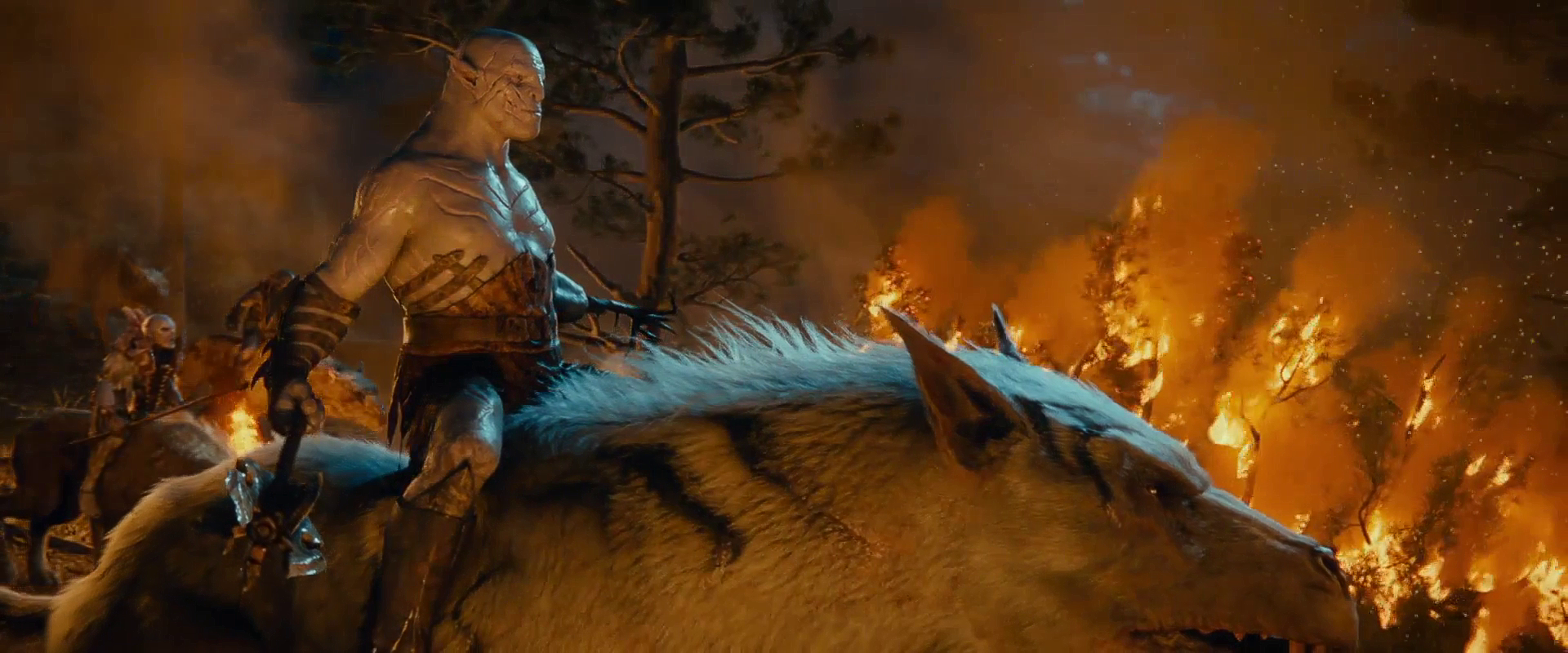
Peter Jackson’s often seems more invested in the character of Thorin Oakenshield than he is in Bilbo Baggins, the titular character.  Thorin is given not one, BUT TWO BACK STORIES. The first tells about how the dwarves were driven from Lonely Mountain by the dragon Smaug, the other is a lengthy flashback that details Thorin’s epic battle with the White Orc, Azog, (a character that is only mentioned in passing in the book).  Thorin mistakenly believes that he killed the White Orc a long time ago, but the bugger is still alive and seeks vengeance.  This, of course, leads to a show down at the film’s climax where Thorin and the White Orc duke it out. Thorin is thoroughly beaten, but Bilbo saves the day. Yup! Jackson finally remembers that Bilbo is the actual protagonist of the story and has him dabble in an act of heroism that wasn't in the book. In the novel, the dwarves are being chased by the Orcs and take refuge in the trees. The Orcs set the trees on fire and it looks like the Dwarves are cooked, when all of a sudden eagles swoop down and fly them to safety.
However, this resolution is not nearly bad ass enough for today’s audience, not to mention it wouldn't make for exciting 3D. So Jackson adds a small battle to the proceedings, after a horribly drawn out scene in which the trees tumble over like dominoes, forcing the Dwarves to hop from tree to tree until finally there is only one left and it’s hanging over the edge of a cliff. The tree slowly begins to uproot and leans at such an angle that Thorin is able to walk straight off it and face his tormentor face to face. The two duke it out, then Bilbo comes to save the day. The other Dwarves join in (the ones not hanging for their dear lives on the branches of the hanging tree) and it becomes a big free for all. When everything seems lost, the eagles come and save the day. BAD ASS! Go easy on the high fives, dude, you might spill the Mountain Dew.
The problem with this sequence, other then being horribly long, is that it resolves Bilbo's character arc much too early in the story; there's no reason to doubt his heroism after this scene, because he bravely risked his life to save Thorin's. In the book, the turning point for Bilbo is when the dwarves are captured by the giant spiders, he is on his own (Gandalf has left) and is essentially forced into an act of heroism. Up until this point in the book, Bilbo is a fairly timid character who is often more of a hindrance than actual help. After he slews the spiders and saves the Dwarves, Bilbo grows increasingly more confident in himself to the point that doesn't hesitate in facing Smaug. Of course, because Jackson decided to stretch the story out over the course of three movies, there needs to be some resolution at the end of the first film, hence, Bilbo's heroism and Thorin's new found respect for him.
It's also for this reason that the White Orc is such a prominent character throughout the film; without him there would be no clear antagonist. Smaug isn't set to make his appearance until the next film, the Necromancer is still in the shadows, and all the other baddies they encounter (Trolls, Goblin King) are stumbling blocks at best. Had Jackson just adapted The Hobbit into one film, there would absolutely  be no need for the White Orc, as Smaug would be more than enough to suffice. It's ironic that the 1977 Rankin/Bass version, despite being only 80 minutes in length, is far more faithful in tone to the novel than Peter Jackson's EPIC film. Of course, the Rankin/Bass was more in tune with their intended audience (children) than Jackson, who seemingly doesn't know who this movie is for; it seems like he's aiming for a children's movie that is frat boy approved. It ranges from being fairly whimsical at times (Bilbo's first encounter with Gandalf, the scenes with the wizard Radagast) to down right violent at others (practically all the fight scenes). It doesn't help that many of the scenes (especially the escape from Goblin Town) have the feel of Playstation video game. Like video games, their fun for the person that's playing it, but get fairly boring to the person who has to watch.


The Hobbit: An Unexpected Journey often seems less like an adaptation of Tolkien's novel and more of a rehash Jackson's version of The Fellowship of the Ring. In fact, The Hobbit follows The Fellowship of the Ring almost beat for beat.

1. In The Fellowship of the Ring we are shown a prelude that involves the War of the Ring. In The Hobbit we are shown a prelude of Smaug attacking Lonely Mountain and driving the Dwarves away from their homeland.

2. After the prelude, we go back to aged Bilbo (Ian Holm) writing his memories down in a journal. Frodo makes a brief appearance by getting the mail, while looking completely confused.

3. Thorin is essentially the stand in for Aragorn; a king without a kingdom. Of course, the difference is that Aragorn dodged his responsibility because of his inner doubts, Thorin has been waiting for the right moment to return. However, both are exceptional warriors and have an air of mystery about them that slowly gets revealed as the film progresses.

4. In The Fellowship of the Ring, Frodo and company are being stalked by the Black Riders. In The Hobbit, Bilbo and friends are being stalked by the Orcs, led by the extremely evil Azog.

5. The Fellowship of the Ring has the Council of Elrond, while The Hobbit has the White Council (NOT IN THE BOOK).  Both occur in Rivendell. Like Gimli, Thorin has an extreme dislike for Elves.

6. Goblin Town scene in The Hobbit occurs at about the same time as the Mines of Moria sequence from Fellowship of the Ring. The escape from Goblin Town isn't very detailed in the book, because as Gandalf and Dwarves are running away, Bilbo is knocked off the back of the Dwarf that is carrying him and falls down a chasm. It's then he meets Gollum. In the film, Bilbo falls down the chasm while the Dwarves are being captured by the Goblins. The Riddles in the Dark scene happens during the encounter with the Goblin King as opposed to after. This allows for Jackson to show the Dwarves escape in full detail and to take advantage of the 3D effects, hence, lots of shots of collapsing bridges and characters running towards the camera.

You shall not pass!


The pity is that somewhere in the rubble is a potentially great movie. Peter Jackson has assembled one hell of a cast; Martin Freeman is ideally cast as Bilbo and it's always a joy to see Ian McKellan as Gandalf. The Riddles in the Dark scene with Gollum is as good as I could have hoped for and the Goblin King is well realized. Had Jackson been more interested in adapting the story the Tolkien wrote as opposed ladling out subplots and ties in, he could have had a genuine classic on his hands. The Hobbit: An Unexpected Journey is not bad movie, but it's a disappointment nonetheless.

Credits:

Cast: Ian McKellan (Gandalf), Richard Armitage (Thorin), Martin Freeman (Bilbo Baggins), Andy Serkis (Gollum), Sylvester McCoy (Radagast),  Hugo Weaving (Elrond),Christopher Lee (Sauron), Cate Blanchett (Galadriel), Ken Stott (Balin), Graham McTavish (Dwalin), William Kircher (Bifus/Tom Troll), James Nesbitt (Bofur), Stephen Hunter (Bombur), Dean O' Gorman (Fili), Aidan Turner (Kili), John Callen (Oin), Peter Hambleton (Gloin/William Troll), Jed Brophy (Nori), Mark Hadlow (Dori/Bert Troll), Adam Brown (Ori), Barry Humphreys (The Great Goblin), Ian Holm (Old Bilbo), Elijah Wood (Frodo).

Director: Peter Jackson
Screenplay: Peter Jackson, Philippa Boyens, Fran Walsh, Guillermo del Toro.

Running Time: 166 min.


Thursday, December 13, 2012

She (1965)


When one thinks of Hammer Studios the image of a fanged, blood shot eyed Christopher Lee will probably be the first thing that comes to mind. In the 1950s and 60s, Hammer was king when it came to horror films, producing such titles like Curse of Frankenstein, Horror of Dracula, The Gorgon, and Curse of the Werewolf, to name a few. However, by the mid 60s Hammer began to broaden their output by producing a whole sub genre of Lost World films; these films were characterized by either setting the films in modern times and having an expedition stumble upon an ancient society hidden deep in the jungle/desert (She, Prehistoric Women), or setting the films in prehistoric times where cave people struggled to survive (One Millions Years B.C., When Dinosaurs Ruled the Earth). The other common trope found in these movies was the sight of gorgeous women running around in fur bikinis; Raquel Welch's bikini clad performance in One Million Years B.C. made her an international sex symbol. Needless to say these movies aren't very good, though they are highly entertaining; the stop motions effects in One Million Years B.C. and When Dinosaurs Ruled the Earth are especially good.
By default, She is probably the best film of  Hammer's Lost World sub genre and this is largely due to it's unusually strong supporting cast. One Millions Years B.C. and When Dinosaurs Ruled the Earth are populated with lots of eye candy and bogus caveman slang, but completely lack any strong characterizations; whereas the only worthwhile thing to be found in Prehistoric Woman is Martine Beswick's commanding performance as the cruel Queen Kari.
She is an adaptation of H. Rider Haggard's 1887 novel "She: A History of Adventure." In fact, it was the seventh screen adaptation of Haggard's novel; it was adapted a few times in the silent era and then most famously in 1935 with Helen Gahagan in the title role. It must be said that the 1935 is an extremely enjoyable film with wonderful sets by Van Nese Polglase, a great musical score by Max Steiner, and a lively performance by Helen Mack as Tanya Dugmore. Unfortunately, Helen Gagahan is simply awful in title role and lacks the ethereal beauty that was key to Haggard's novel.

 In the 1935 version, Leo (Randolph Scott) is never tempted by Ayesha's offer of immortality and seems content to spend the rest of his remaining years with the far more likable Tanya. In 1965 version, it is completely believable that the bland Leo would easily give up everything to be with the cruel Ayesha, because she's played by the extremely gorgeous Ursula Andress; still riding the fame of her bikini clad appearance in Dr. No.  The less I say about the 1982 adaptation, starring Sandahl Bergman and set in the post apocalyptic future, the better.

Sorry, I just had to. 

The Leo Vincey/Ayesha romance in the 1965 version is extremely interesting in that it never comes across as true love, but rather an act of impulse on the part of Leo. Ayesha is convinced that Leo is a reincarnation of her lost love, Killikrates, whom she murdered 2,000 years ago in an act of jealous rage. Leo, for his part, is taken aback by her the first time they meet. Ayesha tells Leo that in order for them to be together he must make a dangerous trek across the desert and if he survives everything he ever wanted will be his. Leo impulsively takes on this challenge, never thinking about how difficult and dangerous it might be. Hell, it never occurs to Leo that Ayesha, a woman he JUST MET, might be lying. Leo is willing to risk his life (and that of his companions) based on Ayesha's promise he will be given everything he ever desired if he makes this journey.


He is convinced that his love for Ayesha is genuine, yet his constantly tempted by the beautiful and kindly handmaiden, Ustane (Rosenda Monteros).  Ustane, for some inexplicable reason, is in love with and extremely loyal to Leo; when Leo gets deathly ill in the desert, after being shot by a tribe of Bedouins, Ustane is by his side, nursing him back to health. When he is taken to the city of Kuma, Ustane follows even though it might prove deadly to her existence. Leo's attraction to Ayesha is superficial one, based on the glories of now rather than the consequences of later. He enjoys Ustane's company and likes her devotion of him, but he can't shake himself free of Ayesha's beauty.  Ayesha offers Leo the gift of immortality (provided by the Flame of Eternal Life) and Leo, in his limited thinking, doesn't believe anything can possibly go wrong. Towards the end of the film Leo has this conversation with his friend Major Holly (Peter Cushing):

Maj. Holly: I suppose there's a time in everyone's life when the idea of immortality seems very desirable. But now at my age I'd have to give it a great deal of thought. 

Leo Vincey: What's age got to do with it? You'd stay as you are. 

Maj. Holly: That's not what I meant, Leo. What one would accept eagerly at your age doesn't necessarily have the same appeal at mine. It's the age of the mind that's important, not the body. You see, you're young. Still on the threshold of life. The joy of living is not to be denied, but to know that it'll be there for all time, without change. Life at a standstill. It's not quite the same thing. 

Holly is the voice of reason throughout the film, often questioning Leo's motives. Like the audience, Holly is not convinced that Leo's love for Ayesha is genuine, but rather just a superficial fantasy.  Leo is so entranced by her beauty that he completely overlooks her flaws, like her extreme cruelty and jealousy. In the end, Leo enters the Flame of Eternal Life with Ayesha and watches in horror as she ages to nothingness right in front of his eyes; the Flame gives eternal life the first time around, but takes it away the second time. In the end, Leo is forced to live the next thousands years alone, waiting for the Flame to reappear so he can end his miserable existence.


I mentioned before that She has an unusually strong supporting cast for what is essentially a silly adventure film, but it's these performances that really help elevate it to being a decent, watchable movie as opposed to being a painful mess. This is pivotal as both of the leads, Ursula Andress and John Richardson, are rather dull to watch. They are both appropriately attractive  and make for wonderful eye candy, but that's about it. Granted, Ayesha is  meant to be a fairly one dimensional, tyrannical character, but Richardson's Leo lacks any really personality; his character is defined by his longing for Ayesha. He's also kind of a cad, he talks about his endless love for Ayesha, yet consistently puts the moves on Ustane.
 
Peter Cushing is great in practically everything he's in, but really delivers the goods in this movie as Major Holly. In previous Hammer films Cushing portrayed Dr. Van Helsing, Baron Frankenstein, and Sherlock Holmes; extremely stiff and humorless characters who constantly obsess over one thing. Major Holly is a nice change of pace for the great actor. It's true that Major Holly is an authority figure, but he's not obsessive like these other roles and more importantly seems to actually get a joy out of living; in the film's opening scene we are shown two of Major Holly's vices, women and alcohol. While Leo is chatting it up with Ustane, Major Holly and his butler, Job, get up and start dancing with belly dancers; this antic gets uproarious laughter from Ustane. At the beginning of the film the idea of finding the lost city of Kuma excites Holly, but at the end he is disenchanted with the place and says, "All my life I've dreamed of finding a city such as this. But now that I have, I'd like to see it destroyed and all that is stands for."


In many ways She is about the battle for Leo's soul with Ayesha as the devil and Holly as the angel, pleading for him to make the right decision. In the end, Holly loses the battle and admits as much to Job when he observes,"We've lost him." Major Holly is the moral center to the film, constantly questioning both Leo and the high priest Billali's blind obedience to Ayesha, hoping that he can sway one of them into making a stand against her tyranny.

Billali is played by Cushing's longtime co-star and good friend, Christopher Lee, who like Cushing, makes the most out of the material he is given. There's no sense of condescension coming from either actor and both do their best to elevate the silly material. The film does a huge piece of misdirection with the character of Billali, it makes the audience believe that he will have a change of heart and help the heroes at the end. There is a sense that he is completely unhappy serving Ayesha and he longs to be free. This gets confirmed later on when he has a conversation with Holly inside the city's temple:

Maj. Holly: Will you tell me something? This women Ayesha, why do you all do her bidding without question? 

Billali: It has always been so. 

Maj. Holly: Yes, but why? She's only a woman and alone. You are men and many. 

Billali: And like all men we are born, live a span and we die. But she has been here forever. She is like the mountains, like the desert. Changeless, ageless, deathless. 

Maj. Holly: That I cannot believe. In your fear you have accepted the impossible as truth. No-one lives forever. And no one was born to be the vessel of another. You know this too, I've seen it in your eyes. Your body does her bidding but your spirit cries out to be free. Is that not true? 

Billali: Each one of us has his own destiny to fulfill. 

Maj.Holly: And yours, I suppose, is to fill the next alcove. I can't believe you're such a fool, Billali. 

Billali: No, Mr Holly. I am not such a fool. 


In the end Billali doesn't directly betray Ayesha, rather he tries to kill Leo so he can enter the Flame of Eternal Life himself. During the brawl he gets speared in the back by Ayesha and tries to crawl into the flame, but dies just inches short of his goal. As Holly predicted, Billali becomes just another in the long line of high priests that lived and died during Ayesha's long dictatorship.

The most thankless role goes to Bernard Cribbins as Holly's faithful butler, Job; he's really giving very little to do but stand around in the background and on occasion offer up a few quips. Cribbins makes the most out the very little he has to do, but it's to his and the filmmakers credit that the character never becomes a distraction. The filmmakers could have easily made Job a bumbling, Jar Jar Binks type of character, killing practically every scene he is every time he opens his mouth. Instead, Job is a fairly competent character, who serves his master faithful and does all he can to help out. In the film's climax Ayesha's slaves revolt and Job is shown fighting along side them; at point even saving Holly from the thresholds of death.


His best scene comes early in the movie when a rowdy patron steps on Job's bowler hat, while him and Holly are dancing with the belly dancers. Job picks up his crushed hat, laughs for a few second, and then proceeds to punch the offender in the face, which in turn sparks a bar fight. It's a throwaway scene that's played for laughs, but it does effectively set up Job's fighting skills for the film's climax; without this small scene, the audience might wonder how a butler could hold his own against Ayesha's guards.

And finally, there's Rosenda Monteros as the handmaiden Ustane. If She were a teen comedy, Ayesha would be the hot, popular bitch that all the males lust after and Ustane would be the awkward, but pretty misfit who eventually wins the heart of the male hero. Ustane is defined by her warm and rebellious spirit; she constantly defies the orders of Ayesha so she can be with Leo. First, she saves Leo and his companions from certain death in the desert when she arrives just in the nick of time to give them water. This goes counter to Ayesha's original orders, which was for Leo and his friends to make the trek alone. If Leo survived the journey, then, in the eyes of Ayesha, he most definitely is Killikrates reincarnated. If he died, then he was obviously an impostor. Ustane showing up throws a wrench in the works.
Second, Ustane begs Billali to let her go with Leo to the city of Kuma and he reluctantly agrees. This makes Ayesha furious and she threatens to kill Ustane, but Billali intervenes and states, "To be rid of her would be simple, but unwise. If you are to prevail, it is the fair one who must banish her, who must turn against her. He is a man of soul and conscience. These you must destroy."


Ayesha acquiesces for the time being, but inevitably her jealously towards Ustane consumes her and she orders for Ustane to be executed, by lowering her into a pit of lava. Leo protests and Holly interjects that if Ayesha executes Ustane, then it is doubtful that Leo would ever agree to join her in the Flame of Eternal Life. Ayesha tests this out by holding out a dagger and giving the Leo the chance to avenge himself by stabbing her in the heart. If Leo can bring himself to kill her, then Ustane will go free. Leo grabs the knife and it looks like he's going to lunge it into Ayesha's heart, but he can't bring himself to do it, turns to the jelly and bows down to Ayesha. This seals Ustane's doom.

Ustane's death is probably one of the most disturbing moments on film, because it happens off screen  In fact, the audience is given a sense of false hope that maybe she will survive after all. Ustane is last seen standing in a golden cage, looking on as Leo and Ayesha leave the room. We are then given a short love scene between Leo and Ayesha, this is then followed by a scene of Leo saying goodbye to Holly and Job.  Neither Holly or Job make a mention of Ustane's death, which leads the audience to believe that it hasn't happened yet or that  it won't happen. However, in the next scene one of Ayesha's guards walks up to Haumeid, overseer of the slaves and Ustane's father, carrying an urn and says, "Ayesha returns your daughter." The guards throws the urn on the ground and it shatters, revealing Ustane's ashes. This enrages Haumeid that, without any hesitation, he orders the slaves to revolts.

Next to Holly, Ustane is probably the most likable character in the movie. Whereas Ayesha is completely cold and unable to comprehend the human condition, Ustane is warm and genuinely caring soul. She puts Leo in front of her own needs and ultimately ends up paying the ultimate price for her devotion. She's a tragic character; her love and devotion is wasted a man that could never offer her happiness. The audience realizes that Leo is not deserving of Ustane's love, which makes her blind loyalty to him all the more frustrating.

She is an extremely flawed movie; half of the film's running time is devoted to Leo's journey to Kuma, the effects often quite chintzy and laughable, and the lead characters are wet mops. However, compared to The Lost World films that would follow it is entertaining and worth seeing mainly due to the contributions by the supporting cast. Not to mention that any film that has a scene with Peter Cushing dancing is definitely worth a look.


Credits:
Cast: Peter Cushing (Maj. Holly), Ursula Andress (Ayesha - She Who Must Be Obeyed), John Richardson (Leo Vincey/Killikrates), Rosenda Monteros (Ustane), Bernard Cribbins (Job), Christopher Lee (Billali), Andre Morrell (Haumeid).
Director: Robert Day
Screenplay: David T. Chandler (based off the novel by H. Rider Haggard)
Running Time: 106 min.


Tuesday, November 13, 2012

1941 (1979)


The question that often gets asked in Film Studies classes is: Who’s your favorite filmmaker? Without any hesitation I can tell you that my favorite filmmaker is Steven Spielberg. What? Blasphemy, you say! How can you rank Steven Spielberg higher than the likes of Alfred Hitchcock or Jean Luc Godard? Okay, maybe you’re not saying this, but this response was common amongst the UW-Milwaukee film professors. One of my professors had nothing but disdain for Spielberg, claiming that his films were “manipulative.” Which is true, but then again so are the films of Hitchcock and for that matter Jean Luc Godard.  In fact, the underlying success to all GREAT cinema is manipulating the audience into caring about the characters that inhabit the screen.  Alfred Hitchcock’s Psycho is possibly the most manipulative movie ever made; for the first 45 minutes the audience roots for Marion Crane, completely sympathetic to her plight, and are thus horrified when she is brutally murdered right before their eyes. The whole success of this scene is dependent on whether or not the audience cares for Marion, if they don’t, then it’s a complete bust! 
Now a film professor might respond with, “The shower scene is terrifying regardless as to whether or not the audience sympathizes with Marion.”  It might be, if the shower scene happened at the very beginning of the film, but it happens midway through the actual movie, after the audience has spent a good deal of time observing Marion Crane. If they don’t connect with her character on some level, then more than likely, they won’t make it to the shower scene, thus rendering it useless.  
I bring this point up, because the idea that Spielberg is a lesser filmmaker for being  manipulative is a completely INVALID point. In fact, what makes Spielberg a great filmmaker is his ability to get an emotional reaction out of his audience, despite the fact that what’s onscreen is absolute fiction (I’m of course talking about his wonderful fantasy films, as opposed to his problematic attempts at history).   E.T. The Extra-Terrestrial became one of the highest grossing films of all time, because Spielberg was able to make his audience care about a rubber puppet.  This may not seem impressive at first, but once you watch the 1989 rip off Mac and Me, you’ll totally appreciate just what Spielberg was able to accomplish. Jaws was a movie that in lesser hands could have been laughable, but thanks to Spielberg’s expertise became a classic. Again, if you doubt my word, watch any of the Jaws rip offs that have cluttered the video shelves and the Syfy channel for the last few decades, you will greatly appreciate the restraint Spielberg brought to the material.  Whether they admit or not, one of the main reasons why people from my generation got into film was because of Steven Spielberg. His films played a crucial part in most of our lives. 

Now, I’m sure one of the three people reading this article will say to him/herself, “Yeah, those films were good, but, God almighty did that last Indiana Jones film suck!  What was with that awful scene in which that annoying Shia kid swings from vine to vine like Tarzan? How embarrassing! Worst…Movie…EVER!”   First off, Indiana Jones and the Kingdom of the Crystal Skull is far from being the worst movie ever made, that dubious distinction belongs to the Robin Williams movie Patch Adams. Secondly, it’s true that Spielberg has had a few misfires in his long career, but then again, so has just about every director in cinema history. It happens. However, even Spielberg’s misfires often have a few scenes that make it worthwhile; Crystal Skull maybe laughable in many parts, but the chase scene through the college campus is a lot of fun.  The Lost World is a dreadful film, but I personally like the scenes of the T-Rex rampaging through the streets of San Diego; there’s very little logic at work, but they are amusing.  And this is when I turn my attention to Spielberg’s first major misfire 1941; a big budgeted comedy about the paranoia that enveloped the West Coast following Japan’s attack on Pearl Harbor. 


1941 was a God send for Spielberg’s detractors, “At last,” they proclaimed, “that Spielberg is finally being exposed for the fraud that he is.” They gleefully chuckled as the film died at the box office, hoping that this would be the last they would ever see of this “upstart” filmmaker, only to have their hopes dashed two years later when Raiders of the Lost Ark would prove to be a huge box office smash.  At this point in his career, Spielberg had never really tasted failure before; his first theatrical film The Sugarland Express did very little business at the box office, but it was made for a rather modest budget, hence it proved to be a low risk venture for the studio.  Jaws essentially created the blockbuster and Close Encounters of the Third Kind was a huge hit, even if its success was overshadowed by Star Wars. Spielberg was riding a hot hand and was thought to have the Midas touch; he could do no wrong in the studio’s eye. 

In theory 1941 had all the ingredients of a box office bonanza; a great director at the helm, a screenplay by two gifted writers (Robert Zemeckis, Bob Gale), an impressive array of stunts and special effects, and more importantly, an all star cast.  The most inspired piece of casting was getting John Belushi to play the small, but pivotal role of Wild Bill Kelso. Belushi at this point was a huge star on “Saturday Night Live” and was coming off his scene stealing role as Bluto in National Lampoon’s Animal House; he was a hot commodity and thus making it more impressive that he was willing to play a supporting role.  However, despite his limited screen time, Belushi is given prominent billing in the credits and it’s usually his face that is seen on the posters as well as most merchandise and promotional items. 
  

1941 is from the “the bigger the better” style of comedy that is seen in movies like: It’s a Mad, Mad, Mad, Mad World, The Great Race, Catch-22, and The Russians Are Coming, The Russians Are Coming. These films are not just comedies, but grand spectacles as well.  The irony is that, especially in the case of 1941 and It’s a Mad, Mad, Mad, Mad World, the biggest laughs often come from a well known dramatic actor, instead of the big named comedians that mug endlessly for the camera. Spencer Tracy’s performance in It’s a Mad, Mad, Mad, Mad World is easily the best thing about the movie, largely due to his understated acting; Tracy is able to get a laugh by slightly changing the expression on his face. In 1941, the funniest scene is not of Belushi hamming it up, but of Robert Stack (as General Stilwell) getting overwhelmed with emotion while watching Dumbo. Stilwell up until this point in the movie (and after) is a fairly straightforward, no nonsense character and it’s absolutely hilarious to see this rather uptight man tear up to the song “Baby Mine” and sing along to “When I See An Elephant Fly.”

I have a confession to make….I absolutely love 1941. It’s true that as a whole the film simply doesn't work; it never quite gels together and too often the characters get lost in all the chaos. The film’s main flaw is not the lack of original ideas, but it’s that there are just too many ideas onscreen. It is littered with endless subplots and supporting characters, so along with Stilwell watching Dumbo, we are shown the following stories:
1)      Bobby is a young man from the “wrong side of the tracks,” whose main goal is to dance with the lovely Betty as the USO. However, he is constantly being thwarted by the Neanderthal that is Corporal “Stretch” Sitarski (Treat Williams), who has his eyes on Betty as well, despite her resistance to him. In theory, Bobby is the true protagonist of 1941 as he’s the only character given an actual character arc; he goes from being a disrespected "hoodlum" to being put in charge of sinking the Japanese sub at the film’s end.  Bobby Diciccio is likable enough as Bobby and Dianne Kay is appealing as Betty, but Spielberg doesn’t do them any favors by constantly cutting away from their story line  Whenever it seems you’re just about to get caught up in their lives the film will cut another story line, already in progress. 

2)      Captain Birkhead’s (Tim Matheson) attempts to go all  the way with  Donna Stratton (Nancy Allen). It is revealed that Stratton has an airplane fetish and will only go all the way if she is up in an airplane. Birkhead finally gets her up in the air and is nearly killed for his effort.

3)      Wild Bill Kelso (John Belushi) is a crazy airplane pilot, who is convinced he is chasing a squadron of Japanese fighter pilots.  Kelso really doesn’t come into prominence until  the second half of the film, but ends up tying the stories together. (He shoots down the plane with Birkhead and Stratton, tells Stilwell about the sub, and orders Wally (after being trapped underneath a giant plastic Santa Claus) to sink the sub. Belushi is always amusing, but never really funny (except for the fall he does off the wing of the airplane).

4)      The Japanese submarine crew, whose mission it is to destroy Hollywood in hopes it will demoralize the Americans. They blow up an abandoned amusement park instead and think they have accomplished a great victory for Japan. The scenes are amusing largely due to the interaction between horror great Christopher and Kurosawa regular Toshiro Mifune. 

5)      Sgt. Frank Tree and his incompetent tank crew. Though, in one of the rare instances, the Frank Tree storyline nicely intertwines with Bobby’s, as Sitarski is a member of Tree’s crew. Tree himself is often the voice of sanity, when Sitarski is about to punch Bobby at the beginning, he intervenes saying, “I hate see Americans fighting Americans.” Later on, he suppresses a riot between the Zoot Suits, the Navy, and the Army by giving a similar speech.

6)      The army installs an anti-aircraft gun in Betty’s father’s (Ned Beatty) backyard and he destroys his house while trying to sink the Japanese sub with it.

7)      And there are minor scenes thrown in the mix, like those involving the insane Col. Maddox (the great Warren Oates), who is convinced the Japanese have already mounted a land invasion of the West Coast. And the scenes between two air raid wardens sitting on a ferris wheel, Claude Crumm (Murray Hamilton) and the ever annoying Herbie (Eddie Deezen) and his dummy. 

It’s like Spielberg and friends had a checklists of ideas they wanted to see in the movie and put them in there, regardless as to whether they worked or not. I actually think the film would work better without the Japanese submarine crew, instead have it be a figment of everyone's imagination. The film is about panic that swept the West Coast after Pearl Harbor, and in a way the submarine justifies the panic. Sure, they don't bomb anything important and no one is killed, but they were still threatening to do so.  

  Earlier, I mentioned that Psycho is a classic movie largely because it has a strong protagonist the audience can relate to (Marion Crane), this is completely lacking in 1941; we might like a few of the characters, but we are not drawn to them they way we are to Marion Crane. Bobby’s best moments often get overwhelmed by the pyrotechnics and stunts that are happening around him, while Betty is a fairly passive character.  General Stilwell has a few nice scenes, but is missing for most of the action; he’s determined to watch Dumbo at any costs and won’t even let a riot outside the cinema get in his way.  However, in spite of its flaws (or because of them) I am absolutely drawn to 1941 every time I watch it.  From a narrative perspective the film is rather weak, but as spectacle it is top notch; it has some of the best set pieces Spielberg has ever filmed. Here are just a few that I really like: 

1.       The opening scene is a parody of Spielberg’s own film Jaws. It opens the exact same way: a young lady (Susan Blacklinie, the same actress in Jaws) goes skinny dipping in the ocean, but instead of being attacked by a shark, finds herself straddling the periscope of a surfacing submarine. Modern day audiences may just shrug with complete indifference, as pop culture references have become prevalent in today’s comedies, but in 1979 this was basically unheard of in the movies. A year later, the Zucker brothers would also open their film Airplane with a parody of Jaws, instead of a sharks fin breaking the water surfacing; it’s an airplane fin breaking the surface of the clouds. 


2.       Stilwell assuring reporters that no bombs will be dropped on  California, while simultaneously a bomb is accidentally dropped from a bomber (after Donna has slugged Birkhead, who lands on the release mechanism) and rolls their way. 

3.       The jiggerbug dance scene in which Wally tries to simultaneously dance with Betty and evade the wrath of Sitarski.  This scene is a lot of fun to watch, thanks largely to its inventive choreography and the energy of the performers.  It would have paid off a lot better had the film been told solely from Wally’s perspective, but it works wonders as standalone sequence. This scene is followed up with an all out brawl after Sitarski punches Wally. 

4.       The scenes of Stilwell watching Dumbo. My favorite bit is when Stilwell is finally informed of the riot outside the movie theatre, but keeps trying to watch Dumbo and getting upset at a MP that is blocking his view of the screen. He orders the guy to sit down and relax. 

5.       The funny scene in which Wild Bill Kelso meets his soul mate in Col. “Madman” Maddox. Kelso is convinced there’s a Japanese squadron flying over California, while Maddox is convinced they have already launched a land invasion. Before Kelso takes off, Maddox asks Kelso if he can hear his guns. Kelso fires his guns, shooting up the place, while Maddox and his men cheer on. 


6.       In a futile attempt to sink the Japanese sub with the anti-aircraft gun in his backyard, Ward Douglas instead destroys his house.

7.       After having suppressed the riots, Frank Tree gives a patriotic speech that unifies the crowd.  It’s actually a fairly funny speech filled with paranoid xenophobia and “American can do” sentiment that was dominant during WWII. At one point Tree asks the crowd, “Look at Santy Claus? Isn’t he cute? Do you think the Japanese believe in Santa Claus? Instead of turkey for your Christmas dinner, how would you like to have raw fish heads and rice? Do you think the Krauts believe in Walt Disney? Yeah, well was that Mickey Mouse I saw blitzkrieging across France? Pluto in Poland? Or Donald Duck at Pearl Harbor?” 


8.       The destruction of the amusement park, which leads to the Ferris Wheel rolling into the ocean. It may be shallow spectacle, but it is impressive nonetheless.

9.       Sitarski getting his just desserts at the hands of Wally. The two foes meet face to face in the street and have the following exchange:
Wally: I know I can’t beat you in a fair fight.
Sitarski: Stupid, I don’t fight fair.
Wally: Neither do I.
Wally then kicks Sitarski in the crotch and hits him across the face with a gun belt. The Sitarski/Wally rivalry is one of the few storylines the film does good job of setting up and it is completely satisfying seeing Sitarski get his.  
      
      1941 has been labeled a flop by many sources; this isn’t true as it actually made a decent profit during its initial release. The reason why it was thought to be a flop was that compared to the box office of Spielberg’s last two films (Jaws, Close Encounters of the Third Kind) it was disappointing. The film was not a great success among critics and understandably so, it is a very loud and busy movie. There’s lots of spectacle, but very little heart.  However, any film that features a scene that has Slim Pickens being interrogated by Christopher Lee (speaking German) and the great Toshiro Mifune (speaking Japanese) can’t be all bad. 


Cast:  Dan Aykroyd (Sgt. Frank Tree), John Belushi (Wild Bill Kelso), Bobby Di Ciccio (Wally Stephens), Dianne Kay (Betty Douglas), Robert Stack (Maj. Gen. Joseph W. Stilwell), Ned Beatty (Ward Douglas), Treat Williams (Cpl. Chuck “Stretch” Sitarski), Warren Oates (Col. “Madman” Maddox), Tim Matheson (Capt. Loomis Birkhead), Nancy Allen (Donna Stratton), Toshiro Mifune (Cmdr. Akiro Mitamura), Christopher Lee (Capt. Wolfgang von Kleinschmidt), Murray Hamilton (Claude Crumm), Lorraine Gary (Joan Douglas), Slim Pickens (Hollis Wood), Wendie Jo Sperber (Maxine Dexheimer), Joe Flaherty (Raoul Lipschitz), Penny Marshall (Miss Fitzroy), John Candy (Pvt. Foley), Eddie Deezen (Herbie Kazlminsky), Lionel Stander (Angelo Scioli).

Dir: Steven Spielberg.
Screenplay: Robert Zemeckis, Bob Gale.
Running Time: 146 min. 

Snow White's Revenge/Scandal (2024)

  It is difficult to write about Snow White’s Revenge without bringing up the ending, so readers beware, this review will contain spoilers...