Powered By Blogger
Showing posts with label Sean Astin. Show all posts

Tuesday, October 31, 2017

Strangers Things 2 (2017) [SPOILERS]


When it was announced that Netflix was renewing Stranger Things for a second season, fans breathed a sigh of relief, and then started asking questions? Would Eleven be coming back? What was the deal with Will? How in the hell could Nancy choose Steve Harrington over Jonathan?  However, the most important question was: Would it be any good? It goes without saying that expectations for season two were exceedingly high and I’m happy to say that it doesn’t disappoint.  Stranger Things 2 is, thankfully, not merely a rehash of the first season and does a nice job of expanding the characters and story line. It isn’t without its flaws, but I’ll get to that later.
When I posted on Stranger Things least year, my review focused entirely on the relationship between Mike and Eleven, largely because I felt that these two characters were the “heart and soul” of the  season one (plus I was amazed by  Finn Wolfhard’s and Millie Bobby Brown’s onscreen chemistry).  In season two, however, both characters are sidelined for a good portion of the series.

Mike begins the series as a shell of his former self; he is no longer the effervescent leader of the Hawkins AV Club, but rather a sulking teenager who is antagonistic towards the world.  He is openly hostile to the character of Max and resents her wanting to be a part of the group; she is a poor substitute for Eleven. This characterization of Mike has led to a lot of online criticism, most notably by Angie Han in her article for Mashable,"What Was the Deal With Mike Wheeler in 'Stranger Things 2'?"  Han writes the following:

 Outside of his friendship with Will, though, Mike leaves much to be desired. He spends much of the season missing Eleven, and while it makes sense that this young man would be traumatized by the loss of his friend, it mostly manifests onscreen as whining and moping. He snipes at most characters who aren't Will and is downright hostile to Max, going out of his way to exclude her because they "don't need another party member."

It's a jarring shift from the boy who welcomed Eleven with open arms last year. Maybe that's the point. In context, though, it makes Mike seem petty and small, as if he begrudges his friends the opportunity to find love. Or as if, like the show itself, he struggles with the concept that more than one girl character can exist simultaneously.

This is entirely true, but it also ignores a huge plot point - Mike actually plays a significant part in defeating the monster in season two.  Earlier in the article, Han writes, "In season 1, Mike just wasn't part of the gang - he was the guy, around whom much of the action revolved." Except in episode eight, where Mike is given very little do;  he can only stare helplessly as Eleven sacrifices herself to save her friends from the Demogorgon. In fact, after the bike chase that opens episode seven, Mike essentially spends the rest of the first season on the bench. Sure, we are given that charming scene where he kisses Eleven, but that's about it. In the final episode of season two, Mike is not content with just sitting on the bench and hoping for the best; he is going to do whatever he can to assure a safe return for Eleven.  It is Mike that comes up with the actual plan to clear a path to gate for Eleven and Hopper. It is also Mike that  gets the ball rolling in coming up with a plan to defeat the Mind Flyer.  And it is Mike that comes to the realization that Will is "the spy" and needs to be incapacitated. By the end of the season two, Mike is once again "the guy." Yes, he starts out as a mopey teenager, but eventually is restored to his former self. It is called a character arc.

Eleven, like Mike, is filled with angst and desperately wants to contact Mike, but is forbidden by Chief Hopper.  When Eleven was with Mike she genuinely felt like she belong somewhere, however life with Hopper is akin to being in a prison.  Hopper has hidden Eleven away in a remote cabin, but forbids her from venturing outside and making any contact with the outside world.  Hopper is certainly a far more benevolent figure than Dr.  Brenner, but he is still her jailer. The way Hopper takes care of Eleven is in sharp contrast to the way Mike looked after her.  In season one, Mike instilled Eleven with a sense of values (Friends don’t lie; a promise is something that can’t be broken; and more importantly, undying loyalty) that allowed her to grow as an individual.  Hopper, on other hand, makes her abide by three rules (keep the curtains drawn, keep the door shut unless she hears his secret knock, and never go out alone). While these rules exist to insure her safety, they don’t really offer much in terms of individual growth; in fact they actually restrict her growth, because they put her in a constant state of paranoia. It isn’t surprising that she eventually begins to resent Hopper. It’s hard to live a full life when you are only told what you CAN NOT do.

While many might object that the show waits eight episodes to reunite Mike and Eleven, I think it was the right call by the Duffer Brothers. If they bring Eleven back into the fold too early, then there’s a good chance that the Mike/Eleven relationship completely overwhelms the narrative, thus giving little room for the rest of the characters to develop. The idea of doing a sequel is to expand the characters and the universe, that would be pretty hard to do if Stranger Things 2 is yet another season of Eleven going on adventures with the boys. The Duffers achieve this by essentially removing Eleven from the narrative and having Eleven go on an adventure of self discovery. It also allows for Mike to have a character arc instead of going through the exact same journey as the first season. Plus, if Eleven is reunited with Mike earlier in the season, their kiss at the end of episode nine has far less impact.

There’s been a huge divide among the fans over episode seven “The Lost Sister,” that revolves completely around Eleven’s attempt to contact Kali; another one of Dr. Brenner’s test subjects who managed to escape the laboratory. There are people that argue this episode isn’t necessary and is merely filler; while others resent it because it isn’t their “version” of Stranger Things, which apparently revolves around Eleven having adventures with the boys. I think this episode is absolutely necessary, because it’s where Eleven’s values are put to the test.  Eleven takes a bus to Chicago and finds that Kali is the leader of a punk gang that dabbles in crime. Kali wants to use Eleven in to seek out vengeance against all the men that wronged them; her philosophy is very simple – get your enemies before they can get you.

Much like Hopper’s three rules, Kali’s world view is extremely limited and can only result in a violent end. Kali represents what Eleven could have become had she not met Mike.  Eleven is tempted by Kali, but can’t bring herself to commit cold blooded murder. Eleven only kills in self defense or when her friends are being threatened; it’s completely different than breaking into a person’s house and killing him without an ounce of remorse. Especially since said guy (a former orderly of Brenner’s) isn’t really much of a threat.  It’s only after this descent into hell that Eleven realizes where her true place lies.The uglier Eleven's journey becomes the more nostalgic she (and the audience) gets for her time with Mike and the boys. I understand the backlash against the episode, because other than Eleven, the characters are completely unappealing. It is also humorless, which makes it seem longer than it actually is. I'm sure most fans will skip this episode when they rewatch season two.


Mike and Eleven have less than five minutes of screen time together, but Millie Bobby Brown and Finn Wolfhard sure make these brief moments count.  When they are reunited at the end of episode eight, it’s extremely difficult to hold back the tears.  It is amazing how this brief moment can still have such an emotional impact; given that we know minutes in advance their reunion is about to happen.  The gang is under siege by the Demodogs and are trapped in the Byers home; suddenly a Demodog is thrown throw the front window and is killed instantaneously. We know Eleven is about to make her grand entrance and seconds later she walks through the front door, looking all bad ass. Yet, upon seeing Mike, her bad ass exterior melts away and we are shown her more vulnerable side. The looks on Mike and Eleven’s faces says everything - this is the first time in the entire second season that these two characters experience genuine joy.  It is also fitting that it isn’t until Eleven sees Mike that she is able to smile. There’s a point of view from Eleven’s perspective and the camera slowly pans across the characters until, finally, Mike emerges from behind Hopper.  The camera zooms in a Mike, thus isolating him from the rest of the characters – turning it into personal moment between Eleven and him.  She smiles at him and he smiles right back. Sure, it's paying service to the fans, but it is an incredibly effective moment. 


There is an interesting theme throughout Strangers Things 2 that good intentions often lead to bad results. Hopper is not a malicious man and he genuinely cares about the welfare of Eleven, but by forbidding her to contact Mike he has done considerable harm to both of their psyches. It also turns Eleven into a ticking time bomb; it's only a matter of time before she is going to explode. The longer Hopper keeps her away from the Mike the angrier she become. At a certain point Hopper should have realized that reuniting Mike and Eleven would be worth the risk, because it's only possibly way to diffuse the situation.  Again, Hopper's intentions are good, but his approach towards raising Eleven is completely unhealthy; her only contact with the outside world is the television. When Hopper takes it away, she naturally flips out.  Her diet consists of TV dinners and Eggos; not exactly a nutritionally balanced meal. Hopper’s “hard love” approach towards Eleven works for a while, but once she rebels there is very little he can do about it. David Harbour, needless to say, is excellent. While Hopper has a tough exterior, he is vulnerable on the inside. His tough act is his way to trying to hide the pain of losing a daughter. He is overprotective of Eleven, because he doesn't want to lose another loved one. The irony being that he nearly drives her away permanently (and to a life a crime) because of his inability to loosen the leash.


The other example of good intentions gone awry is Bob’s advice to Will. Bob is a nice, well meaning man who is completely clueless to the danger Will is in; he naturally assumes that these visions Will has experienced are nightmares.  Therefore, he reasons that the best way to stop these nightmares is for Will to stand his ground and tell his tormentor to go away. Unfortunately, Will’s tormentor is not a nightmare, but a living, breathing entity.  Steve’s advice to Dustin for getting girls also falls under this category of good intentions gone bad. Steve tells Dustin the best way to get girls is to act indifferent and to have a great hair do. Dustin takes this to heart and goes to the Snow Ball with a new, big hair do, and a devil may care attitude, and is completely rejected by the girls at the dance. He sits alone and finally realizes that this tactic might work for Steven Harrington, but not him. Thankfully, Nancy comes along to lift his spirits.  

This leads me to my favorite part of Strangers Things 2 – the pairing of Steve Harrington and Dustin. Joe Keery and Gaten Matarazzo make for a wonderful double act. The great thing about this relationship is that while the two of them are polar opposites – Steve is a jock and Dustin is a nerd – they still manage to form a deep bond with one another. They often speak in analogies that neither of them understand (Steve uses sports terminology, while Dustin makes gaming and scientific references). Yet, despite all of this Steve becomes like an older brother to not only Dustin, but the rest of the gang – in episode nine he is the unwitting ringleader of the group and is hijacked into being their protector. Steve may talk tough, but you get a sense that he would willingly risk his life to protect these kids. It is a great, and totally unexpected, piece of character development for this character. Hell, if season three consists entirely of Steve and the gang fighting evil, I will be entirely satisfied. 

In a span of a few episodes, Steve went from being my least favorite character to one of my favorites. It is amazing how a season can change your perspective on a character; in season one I liked Jonathan and was indifferent towards Steve, now it is the exact reverse; I like Steve but find Jonathan to be fairly boring The Steve/Dustin pairing is also a good showcase for how to effortlessly incorporate humor into an otherwise serious show; the humor springs from the character’s reactions to one another and feels natural to the story. It’s easy to believe that a socially inept nerd like Dustin would seek dating advice from cool guy Steve Harrington.  He goes from being a dumb jock to essentially being the “Brand” of Stranger Things.  In The Goonies, Brand is Mikey’s older brother who becomes the reluctant guardian of Mikey and his friends.

I can’t make a reference to The Goonies without bringing up Sean Astin as Bob, Joyce’s boyfriend and manager of the Radio Shack.  At first glance, Bob comes off as being a complete dweeb.  He is kind hearted, but he is still a total dweeb. Jonathan fails to understand what his mother sees in Bob, but it’s really not that difficult to understand why Joyce would date him – Bob is a nice guy, with a stable job, and genuinely wants to do the right thing.  He also accepts Joyce and the baggage that comes with her. He attempts to bond with Jonathan and Will, and when the shit hits the fan he is still by her side.  He is the total opposite of Joyce’s ex-husband, Lonnie – who is a self serving douche bag.  Winona Ryder and Sean Astin don’t exactly light up the screen with chemistry, but that’s not really what this relationship is about. 

In true Stranger Things fashion, we begin to realize that there is more to Bob than meets the eye and that he is braver than he, and the audience, ever expected.  The casting of Sean Astin is a bit gimmicky – a symbolic passing down of the torch from Mikey of The Goonies to Mike of Stranger Things. It is no coincidence that it is Mike who eulogizes Bob and is determined to preserve his legacy as “founder of the AV Club.” Bob is a genuinely likable character and  when he is killed off in an unceremonious fashion, it feels like a slap in the face.  It’s seems doubtful that Joyce genuinely loved Bob, but it is clear she was fond of him, and feels slightly responsible for his death. Can Joyce ever catch a break?

I would be remiss if I didn’t mention Noah Schnapp’s heart wrenching turn as Will. In season one, Will is missing for most of the story and his limited screen time didn’t give the young actor much to do.  In Stranger Things 2, Will is, essentially, possessed by the Mind Flayer and as the season progresses his humanity begins to fade away.  There are scenes where Schnapp has to not only play Will, but also the Mind Flyer as well and he is genuinely creepy in these moments. One moment he’s a preteen boy desperately calling out for help, the next he is an ancient evil that is hell bent on destroying the world. 


The other pairings in the show, Jonathan/Nancy and Lucas/Max, didn’t really interest me as much.  After season one so much fuss was made by the fans about “Justice For Barb” that the Duffers gave in and made this into an entire subplot – Nancy and Jonathan are determined to blow the lid off the Department of Energy which has the town of Hawkins in its grip.  They naturally go to a conspiracy theorist, Murray, for advice, after having successfully recorded Dr. Owens into admitting the Department’s complicity in Barb’s death.  This subplot is less about “Justice For Barb” and more about consummating Nancy and Jonathan’s complicated relationship.  Brett Gelman as a Murray is a bit too much for my taste (this is an example of forced humor).  

The pairing of Lucas and Max is cute, that is really the only thing I can say about it. Both Caleb McLaughlin and Sadie Sink are first rate performers, but they don’t exactly light up the screen the way Finn Wolfhard and Millie Bobby Brown do (but then again very few child actors do).  Still, it is fun to watch Lucas bungle his way around Max in the early going and steadily gain confidence as their relationship grows.  The best  thing about Max is her willingness to call out the boys on their bullshit and hold her own when things take a turn for the worse. I’m sure there were fans hated this character (“SCREW MAX! WHERE’S ELEVEN?) but I thought she was a nice addition to the cast.  I’m also glad the Duffers refrained from turning Max into a potential love interest for Mike – NO MORE LOVE TRIANGLES, PLEASE! I already had enough with Nancy, Jonathan, and Steve. 

Then there’s Dacre Montgomery as Max’s abusive stepbrother, Billy.  He is the human villain of the piece and Montgomery is wonderfully vile in the role. As my sister put it so eloquently Billy is, “the perfect douche nacho from the 80s. Down to the creeper mullet.”  He has little regard for human life (he nearly runs the boys with his car) and is more interested in his looks than he is in making in friends.  In many, Billy represents what Steve was in danger of becoming had he not changed his ways.  Steve was fairly douchey in season one and a downright bully at times, but he saw the error of his ways, and redeemed himself in the end. I never really bought the transformation, but I applauded the Duffers for subverting the dumb jock stereotype.  Even Billy isn’t entirely one dimensional; he lashes out at Max and his friends because his father lashes out at him. It is one long vicious cycle.


There are few things I genuinely disliked about Stranger Things 2. In season one, I thought Joe Chrest (as Ted Wheeler) was the weakest link in the casts; his bumbling, over the top characterization seemed more fit for a Zucker brothers movie than a science fiction series. Unfortunately, he’s far worse in Strangers Things, because not only is Ted clueless, but extremely lazy to boot. There’s little substance to this character and he is the type of comic relief stumbling block that popped in old horror movies. It is also unfortunate that the character of Karen Wheeler has been reduced to a caricature of a frustrated house wife – she spends her time gossiping on the phone and reading trashy romance novels while taking a hot bath. The scene where she openly flirts with Billy is cringe worthy and is at odds the character we saw in season one. Also, where is baby Holly? Is she destined to be the Chuck Cunningham of Stranger Things? The sibling that mysteriously disappears and is never mentioned again. 

I also hate the writing in the scene where Billy and Steve get into a fight, because the boys just stand around and DO NOTHING. I felt this was a complete betrayal of the characters? Are these the same boys we have been watching for the last two seasons? You know the same boys that were willing to take the Demogorgon head on (even if was in futile fashion); that just seconds ago were devising a plan that put their lives at risk so they could buy Hopper and Eleven sometime. Remember when Mike jumped off a cliff to save Dustin? Yet, when Steve is getting beaten to a bloody pulp by Billy, they stand aside and scream at the top of their lungs.  The Hawkins AV Club that I know would have done something here, like a group rush Billy and pin him to the ground, or throw objects at the mullet wearing asshole.  This scene drove me nuts! I get that it’s supposed to be about Max finally standing up to her stepbrother, but it comes at the expense of the boys.

The writing is a bit contrived a times; the one day that Eleven decides to disobey Hopper and visit Mike at the school she immediately stumbles upon him having a conversation with another girl. Seriously? Of course Eleven stumbles upon this scene mere seconds after Mike and Max were having a conversation about her. It's a bit of stretch. 

What really separates Strangers Things from other science fictions shows (most big budgeted movies) is the warmth these characters have for one another. They are all flawed individuals that often made bad decisions, but they are filled with compassion. It's really  that "small" moments (like Steve giving pointers to Dustin, or (in season one) Mike gentle assuring Eleven that she is "not the monster") that has ingratiated the series to so many fans. Let's hope the Duffer Brothers remember this when season three comes along. The last thing I want to see is Strangers Things turn into a mindless action series where characters shout stupid catchphrases while battling a CGI atrocity.


Credits
Cast: Winona Ryder (Joyce Byers), David Harbour (Chief Hopper), Finn Wolfhard (Mike Wheeler), Millie Bobby Brown (Eleven/Jane), Gaten Matarazzo (Dustin), Caleb McLaughlin (Lucas), Joe Keery (Steve Harrington), Natalia Dyer (Nancy Wheeler), Charlie Heaton (Jonathan Byers), Noah Schnapp (Will Byers), Sean Astin (Bob), Sadie Sink (Max), Dacre Montgomery (Billy), Paul Reiser (Dr. Owens), Linnea Berthelsen (Eight/Kali), Brett Gelman (Murray), Aimee Mullins (Terry Ives),
Amy Seimetz (Becky Ives), Cara Buono (Karen Wheeler), Joe Chrest (Ted Wheeler).

Directors: Matt & Ross Duffer, Shawn Levy, Andrew Stanton, Rebecca Thomas.
Writers: Matt & Ross Duffer, Justin Doble, Jessie Nickson - Lopez, Kate Trefry.
Nine episodes (55 min)
Monday, April 29, 2013

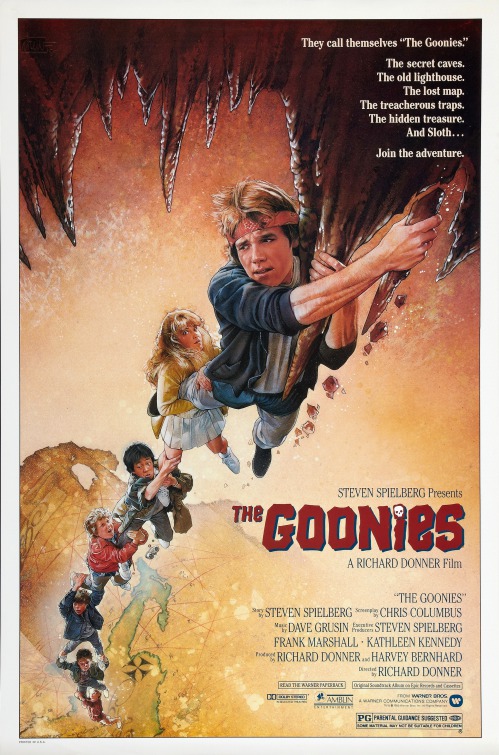
The Goonies (1985)


The blockbusters of the 1980s are fairly restrained when compared to the blockbusters of today. Computer technology has made it so that practically everything is possible, hence filmmakers have a tendency to go a bit overboard at times. The special effects of the 1980s were realized  by using more traditional and practical means, so that filmmakers often had go back to the drawing board if a particular effect didn't work. In The Goonies, there was initially supposed to be a scene in which the kids are attacked by an octopus, but much to the horror of the filmmakers it looked terrible, something right out of an Edward D. Wood, Jr picture, and they wisely discarded it (though a clip of it can still be seen in the second part of the Cyndi Lauper video for "The Goonies R Good Enough." )


If The Goonies were made today, no doubt the octopus would have been CG and it would have remained in the film, even though the scene is rather superfluous to the overall narrative. This is not meant as an attack on the films of today, but rather to defend The Goonies from the charge that it is a "loud, soulless Hollywood product." Sure, The Goonies is a loud film at times and it was, indeed, a Hollywood product, but soulless?! Absolutely not! The film has a lot of heart and it's clear that it was a labor of love for director Richard Donner and executive producer Steven Spielberg.

The Goonies was a huge staple in my (and probably most of my generation's) childhood. I first saw it at the Starlight Drive In Theater at the age of six and was elated when I found a VHS copy of it at the (then) recently opened Wal-Mart. I watched it over and over again to the point where I had the entire film memorized. I could relate to the character of Mikey, because I was a bit of an outsider in school and had fairly oddball friends. Not to mention, it was produced by Steven Spielberg and I was, and still am, a huge Spielberg fan boy. Even though Richard Donner was the director on the film, Spielberg's finger prints are all over it. The Goonies is unashamedly an old fashioned movie, it's a throwback to the adventure films of Hollywood's Golden Era with  preteens as its protagonists. It is the kind of film that would make Terry Gilliam heave and cause cynical movie goers to roll their eyes every five minutes. And I love absolutely every minute of it. It is one of the my personal favorite films. Sure, I maybe blinded by nostalgia, but I'd rather watch a movie that features likable characters succeeding in the end, then have some angry filmmaker preach to me about the injustices in the world.

There's a tendency among film scholars to frown down upon "popcorn" films, because they have nothing important to say. The irony is that the "popcorn" films tend to survive the test of time, while the topical "message" films become horribly dated. Just look at Guess Who's Coming To Dinner, it took an important topic, interracial marriage, and served up a heavy handed message at the film's end about how everyone should be nice to one another. It got great notices in 1967, but is nearly unwatchable by today's standards. Practically everyone remembers The Goonies, but  few remember the  "socially relevant" films of 1985.

The characters in The Goonies are all archetypes, they are reminiscent of the kind of friends we had during our childhood.

Brand: He's the jock of the group. In his spare time he lifts weights, works oddjobs to feed his bike hobby, and is smitten by the cheerleader Andy. He is the more practical one out of the group, while everyone is wanting to go on an adventure, he proceeds with caution. He is also the butt of many jokes, because he failed his driver's test.

Mikey: He is the complete opposite of his older brother Brand. Mike is an awkward teenager who wears braces and has asthma. While Brand is the more physically gifted of the two, Mikey is the intellectual one. He has a great knowledge of history and his enthusiasm for an adventures wears off on his friends.

Mouth: He is the wiseass of the group. Mouth is constantly cracking jokes, much to the annoyance of his friends. He talks a lot, but often has very little to say.

Chunk: The fat friend. Chunk devotes a good portion of his time to hanging out in arcades and eating lots of junk food. He is also a horrible liar, often telling incredible stories about famous people he meet or amazing events that he witnessed. He is the boy who cried wolf and that eventually costs him later in the film.

Date: The smart Asian stereotype. Data specialty is inventing gadgets that serve no real function and rarely work. He often stumbles over his English and gets extremely upset when people correct him.

Andy: She is popular cheerleader who Brand is smitten with. Andy is somewhat flakey, but extremely sweet girl who returns Brand's affections. She is initially at odds with the Goonies as she is comes from an upper class background, but by film's end has ingratiated herself with them.

Stef:  She is the slightly nerdy female of the group. She is Andy's close friend and is fairly antagonistic towards Mouth. She is extremely opinionated and vocal, often the voice of reason, especially when it comes towards her friend Andy. At one point Andy starts freaking out and Stef does her best to calm her nerves.

The movie's title refers to the fact that the characters live in "The Goon Docks" neighborhood of Astoria, Oregon. This threatens to be "The Goonies" last weekend together as their houses are being foreclosed on and they are moving to different parts of the country, barring an absolute miracle. That miracle comes in the form of old pirate treasure map that is stored in the Walshes' attic; Mikey and Brand's dad is the curator of the town museum. They read old newspaper clippings about the treasure of pirate One Eyed Willy, supposedly hidden somewhere in the area and Mikey is convinced that this is their ticket out of this mess. The other Goonies are hesitant at first, but Mikey is able to persuade them when he reveals that their houses will be torn down to make way for a new golf course. Brand, however, will have none of this. The Goonies usurp his authority by tying him up while he is working out. To add insult to injury, Mouth lets the air out of the new tires on Brand's bicycle, needless to say this makes Brand extremely mad. After Brand is released by his mom, he sees that his bicycle tires are flat and commanders  a little girl's bike so he can chase after Mikey and his friends. There are two obstacles standing in the way of One Eyed Willie's treasure: booby traps the pirate has scattered throughout the underground tunnel and the Fratellis, a family of criminals, led by their surly and ugly mom. The two brothers, Jake and Francis, are constantly at each other's throats and Mama Fratelli often has to (literally) slap some sense into their thick skulls.  They run into the Fratelli's by sheer happenstance, the entrance to the underground tunnel is located in the basement of a run down restaurant, where the Fratellis happened to be holed up. Chunk naturally gets hungry and opens the kitchen freezer to see if there's any ice cream, only to find much to his (and everyone else's) horror a dead body with a bullet hole in it's head. The Fratelli's come back at that moment and Chunk hides in the freezer with the corpse, while the rest of the gang enters the tunnel. When the Fratellis have exited, Brand and Mikey implore Chunk to call the police. Chunk goes out the window and tries to call the police, but the deputy doesn't believe him. Chunk then waves down a van, explaining to the driver what is going on, only to find that the driver is Jake Fratelli. Jake's brother Francis grabs Chunk and throws him in the back of the van, reuniting Chunk with the corpse from the freezer.


The Goonies has often been criticized for being an extremely loud and relentless film. And certainly there is a lot of truth to this criticism. The film does have a roller coaster feel to it, and too often there are close ups of characters screaming at the top of their lungs. It can wear the viewer down from time to time. On the other hand, it does a great job of establishing the relationships between the characters and can be extremely moving at times.  The most complex relationship in the film is between Brand and Mikey. The two of them are siblings, Brand is the oldest of the two and is often antagonistic towards Mikey. They are polar opposites in  both a physical and intellectual sense; Brand constantly works out and is in great shape, he is the brawn out of the two. Mikey, on the other hand, is the more scholarly type and has a fairly puny physique. Yet, despite constantly being at odds with one another, there is a mutual love between the two characters. Early in the film, after contractors have dropped off papers from their father to sign, everyone goes inside except for Mikey. He stands on the front patio staring into distance, contemplating what the future has in store for him and is on the verge of tears. Just then Brand walks into frame from the side door, Mikey runs toward him and the two of them hug. Brand may get annoyed with Mikey at times, but he does genuinely care about his younger brother.

The heart of the film is the relationship between Chunk and Sloth. Sloth is the black sheep of the Fratelli family; his face is deformed and he is extremely tall. They keep him chained up in the basement of the abandoned restaurant, so he will be out of their way. After the Fratellis have captured Chunk, they tie him up and put him in the same room as Sloth. Chunk is frightened at first, but breaks the ice by offering Sloth a Baby Ruth candy bar. Chunk throws the candy bar Sloth's way, but his aim is off and it hits Sloth in the forehead, landing a few feet away from Sloth's reach. Sloth begins to freak out and in the process breaks the chains that have been holding him. He picks up the Baby Ruth bar and feeds half of it to Chunk. The two of them form an inseparable bond and Sloth helps save the day at the film's end. Chunk offering his Baby Ruth bar is probably the first act of kindness Sloth has ever encountered in his entire life and he doesn't forget it.


It's also interesting how The Goonies will often slow down the action to give its characters breathing room. The most memorable moment is the interlude inside the wishing well. Mikey and company stumble upon a cavern that is glittering with coins. Stef points out that it is the old wishing well and Andy comments about how she used to believe that it actually granted people's wishes. Mikey and Data start gathering up coins, but Stef tells them they can't do that, because "These are other people's wishes. They are other people's dreams." Mouth then counters by telling a story about how he once made a wish and it didn't come true. He then adds, "I'm taking it back. I'm taking them all back."

It looks like The Goonies adventure is going to be short lived, when resident douchebag Troy and his friends are standing at the top of the well. Troy's main goal in life is too make it with Andy and he is naturally elated when he finds out that she is at the bottom of the well. They implore Troy to lower down the bucket, so he can pull them up one by one. Andy, naturally, is the first to go, so not only does it look like The Goonies adventures will be short lived, but Troy might make it with Andy as well. Uh-oh!

Mikey, however, persuades them to carry on with a long monologue about how "it's their time, down here." Meaning, this might be their last chance to go on a genuine adventure and it will come to a screeching halt when they go up "Troy's bucket." Sure, it might be a safer route, but they might regret their decision later. Mikey's words touches ever one, including the upper crust Andy, and they all carry on. Andy, who is wearing Troy's letterman jacket, for some reason, wraps it around the bucket. This naturally infuriates the horny Troy and he shouts, "ANDY! YOU GOOOOOOOOOONIE!"

Troy is quite possibly the biggest douchebag ever to grace the silver screen, he is the son of the contractor who hopes to build a new golf course over where The Goonies houses are currently stand. He is spoiled brat that has always gotten everything he wanted and has no concern for the feelings of others. In the beginning of the film, Troy is cruising in his car with Andy and Stef, when they spot Brand riding the little girl's bike. Troy pulls over and Andy asks Brand if he would like a ride. Brand declines, but Troy, being the dipshit that he is, grabs a hold of Brands hand (that is resting on the car door) and begins to drive a fast speed. Andy and Stef implore Troy to stop, but he won't listen. The car goes so fast that the training wheels fly off the little girl's bike. Troy releases his grip and Brand goes sailing off into the woods. Troy never really gets the come uppence he deserves; the worst that happens to him is when he flies through the air when the toilet he is sitting on explodes, but that's not exactly on even trade off, given the fact that he endangered Brand's life. Troy is completely one dimensional character that audiences love to hate, every time he's onscreen everyone boos. He's even more despicable than the Fratellis, who at least are amusing in their nonstop bickering.

There are other memorable moments in The Goonies as well:

Andy decides she wants to have a little make out session with Brand, so she calls for him to come to her. Brand, in the middle of taking a leak, sends Mikey to see what she wants. Mikey walks down a darken tunnel and Andy, mistaking him for Brand, gives him a long, passionate kiss on the lips. Stef, who happens to be holding a lantern, witnesses the entire thing and starts to laugh. Mikey completely dazed by the experience stumbles his way out of the tunnel. Andy, still oblivious that she just made out with a preteen, asks Stef is Brand wears braces. Stef starts laughing and Andy chides her for it and adds that she thinks it cute. Later on, Brand and Andy kiss and she asks, "What happened to your braces?"

The Fratellis capture Chunk and tell him to "spill everything." Chunk starts to confess all the horrible deeds that he has done throughout his short life, the most memorable being how he brought fake vomit into a movie theater, made some heaving sounds, and then threw it over the balcony and onto the audience below, which in turn caused the person it landed on to barf. Then the person sitting next to that person barfed and so on.


The special effects, the stunt work, and the sets (especially the life sized Pirate ship at the film's climax) are extremely impressive, but The Goonies is at its absolute best when the characters are given the reigns. The reason The Goonies has resonated with audiences is that there's at least one character they can relate to, be it Brand, Mikey, Chunk, Mouth, Data, Andy, and even Stef. If the audience likes the characters, they tend to the forgive flaws that are inherent in the film's production. The Goonies is a far from perfect film, but it's cast of colorful characters make it a treat to watch, nonetheless.  Of course, if you can't stand child actors, then this is definitely not the film for you.

Cast: Sean Astin (Mikey), Josh Brolin (Brand), Jeff Cohen (Chunk), Corey Feldman (Mouth), Kerri Green (Andy), Martha Plimpton (Stef), Jonathan Ke Quan (Data), John Matuszak (Sloth), Anne Ramsey (Mama Fratelli), Robert Davi (Jake), Joe Pantolianio (Francis), Steven Antin (Troy), Mary Ellen Trainor (Mrs. Walsh).

Director: Richard Donner
Screenplay: Chris Columbus. Steven Spielberg (story)
Running Time: 114


Thursday, May 17, 2012

Encino Man Vs Teen Wolf


IMDB synpopsis for Teen Wolf: Teen discovers that puberty for him means he turns into a werewolf. One of the beneficial side effects is that it also turns him into a top-notch basketball player. But will his notoriety cost him his friends and can he find true love?

IMDB synopsis for Encino Man: Stoney and Dave find a caveman (Link) trapped in ice, thaw him out, and show him around town. Although Link is slow to catch on to basic concepts of 20th century life, he has no trouble impressing all the girls and helping Stoney and Dave find the coolness they've been searching for.

There has been a long standing debate in the film community as to which film is better: Encino Man or Teen Wolf. Both films have been recognized by scholars and movie goers alike as being the two of the  greatest films EVER made; hence it has become an obsession to find out which one is better. They both share similar storylines: average high schooler wishes he was popular and through a set of extraordinary circumstance (one finds out he is a werewolf, the other finds a caveman in his backyard) have their wish fulfilled. However, despite the similarities in story, the films have two conflicting views on what it means to be popular:

 Encino Man - Dave gets everything he wants and it turns out to be even better than he expected;He gets the girl of his dreams, his arch nemesis has been embarrassed, and he becomes the most popular guy in high school, because of the awesome pool party at his house.

Teen Wolf - Scott gets everything he wants and it turns his life into a disaster: The girl he has longed for turns out to be a flake, his grandstanding on the basketball court has alienated his teammates, and his overall cockiness as the wolf has made him some bitter enemies. Success breeds contempt! When he finally comes to his senses, he realizes (like Dorothy in the Wizard of Oz) that happiness was always there to be found, he just had to look harder. Mick gets his comeuppance, but not nearly to the same degree as Matt Wilson.

The interesting thing about both films is that they take horror film premises (Teenage werewolf, thawed out cavemen let loose on the modern world) and turn them into teen comedies. I have always theorized that Teen Wolf began as an average teen comedy, but then one day the writer saw the 1957 horror film I Was a Teenage Werewolf on television and said to himself, “This movie would be much better if the lead character was a werewolf.” It would explain why Teen Wolf follows every teen comedy formula, despite having a werewolf in it.

To determine which film is better, I have decided to break each down into seven categories: Protagonist, Antagonist, Object of Desire, Sidekick, Romance, High School Dance sequence, and Montage. Whatever film edges out the other in these categories will be declared the winner. So let the analysis BEGIN! 

Protagonist:
Teen Wolf and Encino Man share similar protagonists in Scott Howard (Michael J. Fox) and Dave Morgan (Sean Astin). They both are ordinary, rather unremarkable high school students who long for bigger and better things.

Scott is an undersized player on a losing  high school basketball team (The Beavers) who yearns for the affection of pretty blonde (and high school stage actress) Pamela Wells. There are two obstacles standing in Scott’s way:

1) Pamela essentially blows him off every time he speaks to her.
2) She is dating baddie Mick, who is a star player on a rival basketball team.

 He is so infatuated with Pamela that he disregards his childhood friend (and The All American Girl Next Door) Boof. It’s a credit to Michael J. Fox that Scott is a likable character; many teen comedies from that era (see The Heavenly Kid) often suffer because the protagonist is an unlikable bore, too busy whining about his problems rather than doing anything to fix them. It certainly helps that Scott has a sense a humor about himself; in the film’s opening Scott’s basketball team is getting humiliated 71-12 at home and Mick (after offering Scott his hand and pulling him up for the floor) says, “You guys suck!” Scott, half smilingly, replies, “No, really?” It’s an embarrassing loss to be sure, but Scott takes it in stride and proceeds to move on with his life.

 Scott’s biggest flaw is that he temporarily lets the fame of being the Wolf get to his head; he’s been a fairly anonymous figure his entire life, so once the fanfare starts, he doesn't know how to handle it. He gives the people what they want at the expense of his friends and teammates. His antics are delightful to the masses, but absolutely irritating to those that are close to him (except Stiles, but more on that later). However, despite his temporary fall from grace, Scott is able to redeem himself with relative ease. When he realizes that there is a potential danger in being the Wolf, Scott vows never to turn into it again, even if it means getting shunned by his fellow classmates (and the sports loving community as well).


Encino Man's main flaw is its main character, Dave.
Sean Astin, while not a bad actor, is not particularly charismatic and his character suffers greatly for it; Dave is an unlikable bore, who isn’t deserving of the happiness he receives at the end. At the beginning of the film, Dave realizes he has wasted most of his high school experience and is determined to end it on a high note, namely getting his own page in the high school yearbook and hooking up with the  beautiful Robyn. There are two things standing in his way when it comes to Robyn:

1) She is embarrassed to be seen in public with him.
 2) She is dating baddie Matt Wilson.

 Dave bemoans the fact that Robyn is dating a complete jerk like Matt Wilson, but he is no prize turkey himself. It is revealed that Dave and Robyn were friends prior to high school; when Stoney points out that Dave had a chance with Robyn, he whines, “She hadn’t hit babehood yet!” 

 Things take a turn for a worse when Link enters the picture; whereas Stoney genuinely wants to be friends with Link, Dave is only interested in exploiting Link for his own personal gain. His whole plan of winning over Robyn and recognition from his classmates is by leaching off of Link’s popularity; essentially he’s the Ringo Starr of the three. Actually, I take that back, Ringo Starr wrote the awesome song “Don’t Pass Me By” and was the easily the best actor out of the Beatles, so Dave is nothing like him.

Even worse is that Dave is often very condescending towards Link, saying, “He’s practically a monkey. We found him! We can do whatever we want with him.” Therefore, it’s not too surprising that when Robyn expresses interests in going to the prom with the fun loving Link, Dave snaps and attempts to abandon him in the middle of nowhere. If not for Stoney’s intervention, it would be interesting to see if Dave would have gone through with his plan, or had a change of heart. 

 The filmmakers clearly relished filming the scenes with Stoney and Link; it would certainly explain why Dave’s character arc is so abrupt in its resolution. For nearly 75 minutes Dave is a complete tool not worthy of our attention, but then all of sudden (with less than ten minutes of running time left) he sees the error of his ways, realizes Link is special and is content with being his normal self. It is after he has this epiphany that he is then given a chance to be heroic at the film’s end, though even this moment is rather underwhelming: Matt Wilson has stolen Polaroids of Link frozen in a block of ice and is about to show them to the rest of the Senior class, when Dave comes flying out of nowhere and knocks them out of his hand. It is an admirable attempt by Dave to protect Link’s identity, but it get’s overshadowed by Link tossing Matt Wilson into a cake and Stoney pouring punch over his head. Granted, Scott has a similar character arc in Teen Wolf, but the difference is that the resolution to his story doesn’t seem rushed, nor does it take backseat to the goofy antics of his hilarious sidekick. In Encino Man, Stoney the sidekick (despite not having a character arc) and Link are given center stage, while Dave more or less waits in the wings, waiting for his cue.

The question all you Encino Man fans might be asking is: What about Link? Isn't he the protagonist as well?
The answer: No. Link doesn't go through a major character arc, while he does learn how to adapt to modern times, he essentially is the same person he was at the beginning of the film. Link is more of a walking plot device, whose function is to make sure Dave hooks up with Robyn by the film's end.  Hell, you could easily change Link from a caveman to a genie and you would still basically have the exact same movie.

Edge: Teen Wolf.

Antagonist:
 Teen Wolf has a pair of antagonists: Mick and Vice Principal Thorne. However, Thorne is relatively minor subplot and his story is resolved through the intervention of Scott’s father that it makes more sense to focus on Mick. The interesting thing about Mick is that for the first half of the film he is fairly indifferent towards Scott; the only time he ever encounters Scott is on the basketball court, but other than that the two of them have no real relationship, good or bad.
It isn't until Scott starts fooling around with Pamela (Mick's girlfriend) that Mick becomes antagonistic towards Scott. 
Scott is deserving of Mick's wrath, because not only is he seeing Pamela, but he rubs it in Mick's face: the two of them are goofing off at a bowling alley, when Scott notices Mick and asks "Did you know he was going to be here?"
Pamela continues to flirt with Scott by bending over and bowling the ball from between her legs, resulting in a gutter. Scott quips, "Wow! That was good form!"  He then teaches her the proper way to bowl by putting his hands all over her. Mick has had enough and shouts, "Hey, that's my girl. Don't touch her again."
Scott laughs it off and says, "She's my date tonight, pal!"
Mick, not one to back down, even from a werewolf, approaches Scott and says, "I'm not afraid of you freak! Underneath tall that hair you're still a dork, Scott. I've handled your kind before. You're mom used to steal chickens, 'til I blew her head off with a shotgun. Right, Scott?"
Scott gets angry and throws his bowling ball off screen, Mick just smiles.

As harsh as Mick's comments are, his anger is completely justified: Pamela is his girlfriend and Scott knows it, but still proceeds to flaunt her in front of Mick and his friends. It isn't until the dance scene that Mick crosses the line, first by punching Scott when he is in human form, and then by calling Boof a tramp, even though she hasn't done anything to deserve it. In the end though, Mick gets his comeuppance:

1) He is the goat of the Championship game. He snatches defeat from the jaws of victory when his late foul on Scott sets up the game winning basket for the Beavers. Scott makes both of his free throws and is the hero of the game, while Mick stares on in disbelief.
2) He loses Pamela. After the game, Mick walks over to collect Pamela and she tells him to "Drop dead!" The truth of the matter is that Pamela is a bigger villain than Mick, first by leading on Scott, then by spurning Mick in his hour of need.

The main antagonist in Encino Man is Matt Wilson.
He is not as complicated as his is Teen Wolf counterpart, Mick, he's just an asshole…pure and simple. He is also a far more memorable villain because:

1) He has a catchphrase. Instead of telling people to shut up, he simply says, "SHOOSH!"
2) He is a true bully in every sense of the word. He does everything in his power to make Dave's life at high school miserable, including stapling Dave to a bulletin board and writing "EAT ME" on his forehead.
Matt's villainy is seen throughout the course of the film, while Mick's was limited to the last half hour.
For the first half hour, Matt is likable, if only for the fact that he makes a living tormenting the unlikable Dave. But once Link enters the picture, you start to see him for the true asswipe that he is.

He takes an antagonistic attitude towards Link from the very first, mainly due to the fact that Link is very popular among the female students...including Robyn. When Matt first sees Link in the classroom, he asks, "What is this dipshit?"
Matt becomes even more embittered towards Link, when Robyn breaks up him for punching Link in the face at the local ice rink. Link sees that Matt is bullying Dave and decides to intervene. He steps on the ice and starts slipping, Matt skates up to him, says a few thing and proceeds to punch Link in the face, much to the disgust of everyone. In the blink of an eye Matt goes from being a class hero to a class zero, while the entire class begins to canonize Link.

After this incident, Matt is determined to discredit Link in front of his classmates and breaks into Dave's room, where he literally stumbles upon pictures of Link still frozen in the block of ice.  He is certain has found his ace in the hole and proceeds to the prom to reveal this stunning revelation to the rest of the students, but as expected (because Matt is a douchebag) it all back fires. When he announces that Link is a “caveman,” the audience erupts in applause. Matt is further humiliated when Link throws him into a cake and Stoney pours punch on his head, telling him to "SHOOSH!” In the end, Matt Wilson gets his comeuppance, while Dave undeservedly gets Robyn.

Edge: Encino Man


 The Object of Desire:
 In teen comedies there is usually the love interest and the object of desire. The object of desire is the popular girl the main character obsesses over in the beginning of the film and through series of contrivances (sometime supernatural) hooks up with towards the middle of the film. However, the object of desire usually turns out to be a superficial bitch more concerned about popularity than being in a real relationship; after a series of disastrous incidents the main characters dumps her and realizes that his true love was right there all along in the form of his pretty childhood friend (the true love interest of the story).

This is the formula Teen Wolf follows: Scott is infatuated with Pamela Wells, even though she doesn’t give him the time of the day. When he encounters her at a party, he walks up to her and asks, “You looking for someone in particular?” She responds, “Not you!” and walks away. 
 However, once Scott turns into the wolf, Pamela jumps aboard the bandwagon and makes it a point to be seen in public with him wherever/whenever possible. Since Pamela is the “bad girl” of the story, there’s naturally a mild sex scene between her and Scott that takes place in her dressing room: the scene begins with her parading about in her bra and panties, while Scott stares on wide eyed, trying to keep his composure. Pamela asks Scott, “What does it take to turn into the wolf?” 
Scott says he needs to be worked up. Pamela then replies, “What do you think about to get worked up?” She then takes off her bra, walks over to the seated Scott, leans over him, and starts kissing him on the lips. The two of them fall out of frame; the film then cuts to Vice Principal Thorne walking to his car and stopping as he hears a wolf’s howl coming from the school.

For sake of the narrative, Pamela has essentially served her purpose and is sidelined for the rest of the film. Without trying to come off as a shallow, I think the problem with Pamela is that she is a rather unremarkable object of desire. The fatal flaw of most teen comedies is that the “plain” best female friend is usually far more attractive than the unattainable object of desire that the male protagonist lusts after and Teen Wolf is no exception to the rule; Boof is not only prettier than Pamela Wells, but she’s far more interesting as well. 

Pamela has possibly the most unremarkable introduction in Film History: she’s first seen in a long shot, sitting on the gym bleachers, unable to hold back her yawns during the lopsided basketball game. This shot lasts less than a second and the only indicator that Scott has any interest in her is when he briefly glances her way during a time out. Of course, this could be the filmmaker’s way of showing just how distant Pamela is from Scott, but that seems unlikely, given the fact that almost everything else is telegraphed in advanced. 
 
Compare Pamela’s introduction to Robyn’s in Encino Man and you see what I mean. Robyn is first seen in close up, standing out doors on a sunny day (as opposed to the dreary gym Pamela is sitting in) and has a huge smile on her face. It is easy to understand Dave’s attraction to Robyn based on the visuals alone, but with Scott it’s more along the lines of, “Why are you interested in that boring blonde in that stands, when you have a far more lively brunette cheering you on?” Lorie Griffin is by no means an unattractive woman (she is pretty), but she’s filmed in the most unflattering way possible, where as Megan Ward in Encino Man is given a very glamorous (almost super model) entrance. 

 Encino Man is interesting because it combines The Object of Desire and The Girl Next Door into the character of Robyn, therefore eliminating the subplot of Dave having to choose which girl he wants. Robyn is a far more interesting character than Pamela for three reasons:

1) She and Dave were childhood friends, but grew apart once high school hit. She isn’t mean towards Dave, but it’s pretty clear that she is often embarrassed to be seen with him in the hallways; especially when he starts ranting about how he found a caveman in his backyard.
 2) She is more open minded than the standard Object of Desire. In most teen comedies when the main character gets with the popular girl, he is disappointed to learn that she is a self-absorbed, shallow bitch (Pamela in Teen Wolf); far different than what he fantasized her to be. He dreams of the perfect relationship, but instead is trapped in a living hell. Robyn is the exact opposite, the more you see of her the more you like her. A good scene that demonstrates this point is when Link enters a bar and the others follow him; Dave is uptight and nervous the entire time, Stoney befriends gang members, and Robyn starts dancing on the floor with Link. She even joins joins Link in a Congo line, while Dave sulks in the corner.
 3) She has a character arc. Pamela begins Teen Wolf as a self centered bitch and is still a self centered bitch by film’s end; Robyn begins Encino Man content with her social circle and being Matt Wilson’s girlfriend, but by the movie's end no longer cares about being popular and has fully embraced Dave and his friends.
In a normal teen comedy this would be a happy ending, but in Robyn's case it is a complete tragedy, as Dave is not worth her time and effort.

 Edge: Encino Man.

Sidekick:
 A popular trope in teen comedies is the sidekick, whose purpose is to provide the “comic relief.” While the main character is usually uptight and serious, the sidekick is more laid back and mainly interested in having a good time. However, as the film progresses the sidekick becomes less relevant to the plot and is forgotten about to make way for the protagonist’s character arc (ex: fighting the bully, winning the girl, etc). Encino Man subverts this trend in many ways, because Stoney remains pretty relevant throughout the movie. This is probably due to the fact that in 1992 Pauly Shore was the best known out of the three leads for his MTV show, Totally Pauly. Brendan Fraser was on an unknown, while Sean Astin had faded into obscurity (and was primarily known for his role in The Goonies). Of course, a decade later, Shore was the one who faded into obscurity, while Astin and Fraser would go onto bigger and better things. Stoney’s defining features are his hippie attire and his usage of bogus slang. Here are just a few of the phrases he throws out during the course of the film:

When talking to Dave about his infatuation with Robyn:
The truth is bro, life's about greasing the 'do back, buddy, and wheezin' on the buff-fest, man. High school was interesting, alright? It was kinda like a harsh ride. Ah, ah...

To Dave’s parents about why he is always eating dinner at their house:
If  you're edged 'cause I'm weezin all your grindage, just chill. 'Cause if I had the whole Brady Bunch thing happenin' at my pad, I'd go grind over there, so dont tax my gig so hard-core cruster.

To the convenient store employees:
 Link and I are cruising the Mountain, bro, and we’d figured we wheeze a little juice.


Stoney’s bogus slang will either crack you up or irritate the living hell out of you; it’s definitely a acquired taste. If you were a teenager in the late 80/early 90s, then chances are you will find Stoney funny……OTHERS BEWARE! 

 While Dave only thinks of Link as his ticket to fame and fortune, Stoney develops a genuine bond with Link to the point that Link starts talking like Stoney (“Weezin’ the juice!”) Stoney in many ways is the heart of Encino Man, because despite his oddball appearance and personality, he’s often the voice of reason: when Dave is about to abandon Link in the middle of nowhere, Stoney pulls up on his scooter and calls Dave out on his bullshit, “You’re the one who weezed off his gig the whole time, ‘cause you thought maybe it would get you somewhere. And now the guy gets a little crusty and you’re going to bag him. It’s not happening Dave! I’m sorry, that’s not how it works with friends, man. You don’t bag your friends, just because they get in your way; no matter what, dude!” 

 It could be argued that Stoney has too much screen time and that Dave (the main character) gets lost in the mix. It’s certainly no coincidence that Dave is nowhere to be found on the DVD cover; it’s Stoney and Link striking silly poses. In fact, the filmmakers don’t really seem all that interested in Dave’s character arc and treat it as an afterthought. I could just picture the producer and the director on the set:

Director: Great job, everyone! That’s a wrap! Pauly, you were hilarious! Brendan, get job!
Producer: What about Dave?
Director: Who?
Producer: You know…the main character! Sean Astin plays him!
Director: Oh, that’s right! Sean Astin is in this movie. What about him?
Producer: You never resolved his character’s storyline.
Director: Ummmmmmm….what was that again?
Producer: His crush on Robyn…..
Director: Oh yeah! I know, we’ll film a kissing scene between the two of them and everything will be peachy keen!
Producer: OK! But shouldn’t we develop the storyline just a little bit, you know to make it seem more genuine.
 Director: And cut out some hilarious Pauly Shore antics? HELL NO!

In Teen Wolf, Stiles is the exact opposite of Stoney, in that he has no problem exploiting Scott’s lycanthropy for his own personal gain. Stiles main goal is to be popular and comes up with various schemes achieve this goal. 

At the beginning of the film, there is a party and Stiles takes it upon himself to get a keg of beer, so he will be viewed as being cool. His first attempt at getting the keg (dressing up like a delivery man and attempting to bribe the store owner) is an embarrassing failure: the owner takes the cash and then tells Stiles he still needs to see some ID. He then lassos Scott into his plan, by giving Scott money and a toy gun. His idea is that Scott will hold the owner at gun point, get the beer keg, and throw the money on the counter (“That way he can’t say we robbed him.”) Scott realizes how ridiculous this plan is and sees if he can talk the owner into selling him a keg.


However, Stiles goes through all the trouble for absolutely nothing: he arrives at the party with the keg and asks where to put it. The host points to whole pile of beer kegs and say “OK, put it down over there. If we don't get to it, take it home."

 Stiles uses Scott’s lycanthropy for his own personal gain; he sells Teen Wolf merchandise in the school hallways and christens his van “The Wolfmobile” so he can be seen by spectators while cruising the town. It’s never revealed if he uses his connections to Scott to get laid, but it wouldn’t be out of character for a guy like Stiles. When Scott decides to drop the wolf for good, Stiles is devastated. It never dawns on him that being the Wolf has been an incredible burden on Scott; all he can think about is how it will effect him both socially and financially. Stiles is an enabler and often encourages Scott’s douchebag behavior: at one point in the film Stiles is driving the Wolfmobile with a beer can in his hand, while Scott does flips and hand stands on top of the van. Stiles is your standard teen movie sidekick, in that his main function is to offer up a few laughs here and there, and to be completely invisible at the film’s climax. Though, Jerry Levine deserves a good deal of credit for bringing lots of energy and likability to what could have been a thankless role: In one funny throw away bit (buried in the middle of montage), Stiles is awaiting for the results of a test he took; the teacher hands it to him, he turns it over and is completely excited over the D- he got on it. He shows the results to the guy sitting next him (Chubbs) and flashes a thumbs up. It’s a brief moment (and is a background action) but it perfectly sums up Stiles. 

Edge: Encino Man

Romance: 
The biggest flaw of Encino Man is the coupling of Dave and Robyn at the film’s end, mainly because the film does a horrible job of developing their relationship; there is no scene in the movie in which Robyn comes to the stunning realization that she has feelings for Dave. Their relationship does progress throughout the course of the film: It goes from her being slightly embarrassed by Dave to her embracing him as a friend, but there’s nothing else present on screen that would make you believe she would ever want to date Dave. NOTHING! Ten minutes before the dance scene takes place, we are presented with a scene in which Dave calls Robyn up on a pay phone (FROM JAIL) and asks her to go to prom with him. She says no and to add insult to injury tells Dave that she wants to go with Link and then asks Dave to ask Link for her. Needless to say this makes Dave furious; Robyn tries to smooth it over by suggesting they go as a group instead, but Dave won’t hear any of it and hangs up the phone, determined to get rid of Link. Dave redeems himself later by trying to cover up Link’s secret at the dance, but even then it’s hard to believe that this act would be enough for Robyn develop romantic feelings towards him. The other problem is that Robyn is almost nowhere to be seen in the first half of the film; she makes an occasional appearance and here, but it isn’t until the second half that she becomes a more pivotal part of the story. 

The Robyn/Dave storyline is shoved into the background to make room for more zany antics involving Link and Stoney. The biggest mistake the film makes is that when it does focus on Robyn and Dave, the two of them are never alone; Link and Stoney are always in tow to provide comedy relief. They are never given an intimate moment together, hell even their kiss at the end is interrupted by Link. The closest thing Dave and Robyn had to an intimate moment is when he calls her on the phone to ask if she will go the dance with him, it’s the only time in the film in which he doesn't get cock blocked by Link or Stoney, but even that ends disastrously for him.

Teen Wolf establishes a bond between Scott and Boof right from the get go; she is first introduced cheering Scott from the bleachers during a high school basketball game. When Scott has a chance to score two MEANINGLESS points at the game’s end (his team is losing 71-12), Boof is at the edge of her seat, crossing her fingers that Scott makes the basket, even though it has no bearing on the game. When the ball bounces off the rim, she is deflated. More importantly, the two of them are given nice, quiet moments together scattered throughout the film to show that there is a deep bond: after the game, she walks with Scott to his dad’s hardware store and listens to him as airs out his frustrations; the main one being why Pamela Wells won’t say those “two words” to him. Later in the film Scott tries to pick up Pamela at a party, using the line, “You looking for someone in particular?” Pamela replies, “Not you!” and walks away. Boof sees the whole thing and jokingly says to Scott, “There you go! She said two words to you!” 

 In the middle of the movie (before Scott reveals that he is a werewolf to the entire school) Scott is walking Boof home and they two of them recall a time when they were kids and tried to run away from home, but their plan was thwarted because they weren't allowed to cross the street. Then she pulls Scott aside and tells him that if he ever needs someone to talk, she will always be there.


He appreciates the concern, but doesn’t think she would be able to understand that whole “I’m a werewolf” thing. It’s a nice scene that doesn’t necessarily advance the story, but it provides depth to the Scott/Boof storyline that is completely lacking in Encino Man. Boof remains the voice of reason throughout the film and isn’t afraid to call Scott out on his bullshit, towards the film’s end they have the following exchange: 

Scott: Will you go to the dance with me? 
Boof: I’ll think about it! 
Scott: Is that a yes? 
Boof: Yes. On one condition, you take me to the dance. 
Scott: I thought we just established…. 
Boof: You, Scott Howard. Not the wolf. 
Scott: No. Look, I’ve got to be the wolf. That’s what everyone expects. 
Boof: Is that what you want? Scott: Everybody likes the wolf. (Boof flashes Scott a dirty look). Well, almost everybody. You said it yourself, if I go as Scott Howard, I’m going to be average. Why do I have to be like everybody else? 
Boof: That’s not a problem for you anymore. 

The ending in which Scott blows off Pamela and embraces Boof feels genuine, because the filmmakers actually took time to establish that the two of them have a deep bond. Scott doesn’t have a romantic interest in Boof at first, but that’s largely due to the fact that they have been friends since childhood and in many ways she is like a sister to him. But when shit hits the fan, Boof is still supportive of him and  FINALLY Scott realizes that she is indeed the right woman for him. It may be a teen comedy cliché, but it works remarkable well in this movie. It almost feels destined that Scott and Boof would end up together, where as Dave and Robyn’s kiss at the end of Encino Man feels forced, something done out of necessity to wrap up all the loose ends. 

 Edge: Teen Wolf 

High School Dance Sequence:

High School dance sequences are a pivotal part of almost every teen comedy, because it’s usually a convenient way to get all the characters together in one room and help resolve the storyline. The dances usually happen towards the end of the film, but in some cases (Better Off Dead) they are stuck in the middle. The dance sequence in Encino Man is a device used to resolve all the plot threads at the same time (Matt’s demise, Dave’s redemption, Robyn’s realizing her love for Dave, etc). It begins with Link and Robyn being voted the Prom King and Queen; their coronation is interrupted by Matt, who bursts in claiming that he has learned Link’s true identity. He has broken into Dave’s home and stumbled (literally) onto photos of Link frozen in a block of ice. Matt gets up onstage and says, “He’s a caveman.” The audience breaks into applause, much to Matt’s dismay, as he’s about to take out the photos, Dave comes flying into the gym and knocks them out of Matt’s hands. Matt punches Dave in the face, this anger Link and he picks Matt up on his shoulders, spins him around, and sends Matt flying fast first into a cake that is sitting on the refreshment table. Stoney walks into frame, takes a ladle of punch, tells Matt to “SHOOSH!” and then pours it over the vanquished villain’s head. Everyone breaks out into applause and gets onto the dance floor. Link, Stoney, and Dave breakout a new dance and within a second the whole school has it memorized and starts dancing along. The party is the moved to Dave’s new swimming pool in his backyard and he has finally realized his dream of being the most popular boy in school. Link gets his cavewoman back, after it is revealed that she has thawed out too and is in the bathtub washing away all the dirt. Stoney remains Stoney!


The dance sequence in Teen Wolf serves a far different function; it is where the shit hits the fan for Scott and, hence, it carries more dramatic weight. Scott enters the dance as the wolf; everyone sees him, starts clapping their hands and clears a path for him to walk through. Scott walks up to Boof and asks, “Care to dance with the wolf?” The crowd starts chanting “Wolf” and Boof quips, “You’re public wants you.” Scott tells her to come on and they start dancing. The Teen Wolf is one of the greatest awful dances of all time! That’s the closest way of describing just how ridiculous it is. Scott shakes his elbows back and forth, throws his hands into the air, and then does some random clawing motions. It’s AMAZING! As was the case with Encino Man, the other students see this dance and have it memorized within a second. Boof has had enough of this nonsense, takes Scott by the hand, leads him into the hallways, and asks “What am I gonna do about you?” Then throws herself at Scott and starts to make out with him.
Cut to Pamela and Mick at the dance:

 Pamela: All I said was: I might wanna dance with him. 
Mick: You can’t possibly take it seriously. Not unless you want to have his puppies. 

 Cut to Scott and Boof still kissing in the hallway. Scott is back to his normal self. Boof takes notice and says, “I want Scott for just a half hour. I really missed him.” Scott acquiesces, holds her hand, and walks back into the gym with her. Mick sees Scott in his human form, wastes no time in exacting his revenge and proceeds to punch Scott in the face, which sends Scott sailing into the gym floor. Mick stands over Scott, points his finger and says, “Stay away from Pamela. She’s mine. Stick with your own kind, freak. (Points to Boof) Like that little tramp.” 
 Scott, enraged, turns into the werewolf, lunges at Mick and rips off his shirt. This elicits laughter from most of the crowd, except Scott’s estranged friend Lewis, who is disturbed by Scott’s actions. A look of shame fills Scott’s face and he runs out of the gym. This moment last only a few seconds, but is a pivotal turning point for three reasons:

1) Scott is finally paying for his sins as the wolf. As the wolf, Scott’s ego has ballooned to such gigantic proportions that he isolated an old friend(Lewis), while making an enemy out of Mick. As mentioned before, Mick had no interest in Scott whatsoever until Scott started to fool around with Pamela. While Mick’s anger maybe misdirected (he should really be upset at Pamela for fooling around), it is in many ways justified. It is only when he insults Boof (who did nothing to him) that he crosses the line.
 2) This moment confirms Scott’s true love for Boof. When Mick punches Scott in the face, he is more stunned than anything else. In many ways, he seems to realize that he had it coming. What triggers Scott’s transformation into the wolf is when Mick calls Boof “a tramp.” Mick has crossed the line in insulting Scott’s true love and he takes it upon himself to defend her honor.
3) Scott fully realizes that being the wolf has its consequences and can be dangerous. After Scott’s temper has cooled, he realizes that he could have seriously harmed Mick, even killed him, if it wasn't for the intervention of a few students. This scares Scott and  he vows never to become the wolf again, he might not win any popularity contests, but he finally starts to appreciate the “average” things he had prior to being the wolf. Being Scott Howard is not so bad after all. Not to mention Boof is vastly superior to Pamela (in looks and personality. Stupid Scott for not realizing this!)

The dance sequence in Teen Wolf is definitely the stronger of the two, because there’s a lot going on, despite the very little screen time devoted to it. It doesn't end on a happy note, but it helps set up the finale in which Scott faces Mick on the basketball court for the championship game. Encino Man’s dance scene’s primary function is to help set up the unconvincing kiss between Robyn and Dave at the film’s end. It doesn’t work, because there’s no emotional weight to it. Plus, it ends rather abruptly to segue way into the pool party at Dave’s house.

Edge: Teen Wolf

Montage:

Whether chronicling a nerdy girl’s makeover into a hottie, or the male protagonist getting progressively better at sports, the montage has served teen comedies well over the last 30 years. The two go hand in hand. 

 Encino Man has three montage sequences: Dave and Stoney giving Link much needed make over, Dave training Link how to defend himself (by watching Kung Fu movies and wrestling videos), and Link and Stoney having fun at an amusement park. The makeover montage is set to the song, "I'm Too Sexy" by one hit wonder Right Said Fred. It's your typical makeover sequence, the characters fuss over what clothes Link should wear, how they should style his hair, etc.

The amusement park sequence is set to song "Stone Cold Crazy" by Queen and while it isn't relevant to the actual story, it is a fun moment, largely due to the fact that it's just Link and Stoney clowning around. Not to mention, Dave isn't around to ruin their fun. The training montage is fairly useless as well, though it does get paid off at the film's end, when Link uses a wrestling move on Matt Wilson. Still, it's a fairly fun sequence and does have an awesome moment when Link smashes a board over Dave's head.


Teen Wolf is heavily reliant on montages to advance the story line: 
The first montage takes place during/after Scott's first public transformation into the wolf and chronicles his sudden rise to fame. It's set to an obscure song called "Way To Go," which has the memorable line, "Supposing my clothes catch on fire and my car hits a tree." 
Not only does this montage chronicle Scott's popularity, but it shows how the novelty of the wolf starts to wear thin on the people closest to him, namely Boof and the basketball team. At first they find his show boating amusing, but begin to resent it when he starts to hog the spotlight.  At one point, his teammate Brad is dribbling the ball, when Scott steals it away from him and does a slam dunk. 

The second montage happens after Scott has given up on the wolf and decides to play the championship game as "himself." The audience boos Scott and his teammates at first spurn him, but he changes their mind when he makes an impassioned speech about how they don't need the wolf and they can win it as a team, thus setting up one of the greatest come from behind wins in cinema history: The Beavers are losing 22-3 and look like they are out of gas, when Scott shows up and gives his inspirational speech. The comeback is further sparked when Chubbs makes a basket, after Mick shouts, "Shoot it, fatboy!" This gives the Beavers confidence and their miraculous comeback is chronicled in an exciting montage, set to a song called "Win In the End." This set's up the finale in which Scott has a chance to win the game by making two free throws...HE DOES! Thus proving that the whole "be yourself" message we were taught as kids is, indeed, true! 


Edge: Teen Wolf

It was a close race, but it looks the winner is TEEN WOLF! Not only does Teen Wolf have a better lead character, a more believable romance, and a kick ass dance sequence, but it also proves once and for all that teen comedies would nothing without awesome montages to help advance the story. Thank you!

Credit:

Teen Wolf (1985)
Cast: Michael J. Fox (Scott Howard), James Hampton (Harold Howard), Susan Ursitti (Boof), Jerry Levine (Stiles), Lorie Griffin (Pamela), Jim McKrell (Principal Thorne), Jay Tarses (Coach Finstock), Mark Arnold (Mick), Mark Holton (Chubby), Scott Paulin (Kirk), Matt Alder (Lewis).

Director: Rod Daniel
Screenplay: Jeph Loeb, Matthew Weisman
Running Time: 92 min.


Encino Man (1992)
Cast:  Brendan Fraser (Link), Sean Astin (Dave Morgan), Pauly Shore (Stoney) Megan Ward (Robyn), Richard Masur (Mr. Morgan), Mariette Hartley (Mrs. Morgan), Robin Tunney (Ella), Michael DeLuise (Matt Wilson), Rick Ducommun (Mr. Bush), Jonathan Ke Quan (Kim), Patrick Van Horn (Phil), Dalton James (Will), Rose McGowan (Nora), Jack Noseworthy (Taylor).

Director: Les Mayfield
Screenplay: Shawn Schepps
Running Time: 88 min.

Snow White's Revenge/Scandal (2024)

  It is difficult to write about Snow White’s Revenge without bringing up the ending, so readers beware, this review will contain spoilers...