Powered By Blogger
Showing posts with label Halloween. Show all posts

Sunday, October 26, 2014

Halloween: Resurrection (2002)


The only controversy that really surrounds Halloween: Resurrection is whether it is the worst or second worst movie in the franchise. Occasionally, a brave soul will come out of the woodwork and admit that they “kind of” liked it, but otherwise it’s greeted with absolute disdain from the fans.  I admit, while I find the movie terrible, I am compelled to watch it every now and again, but more on that later. The main reason for the hate is that it completely negates  the ending to the previous movie, Halloween H20: 20 Years Later which saw Laurie Strode beheading Michael Myers with an axe. Halloween: Resurrection retcons the ending of the previous film, so that instead of beheading Michael Myers, Laurie Strodie mistaken decapitated a paramedic wearing the Michael Myers mask – he pulled the old switcheroo on Laurie. Laurie, haunted by the guilt of killing an innocent man, spends the next few years in a psychiatric hospital, convinced that Michael will come for her.  When audiences heard this explanation, they let out a collective groan. It is revealed that Michael crushed the man’s larynx, so he couldn’t cry out for help.  Okay, but then, why didn’t he just take off the mask?  A policeman does so later on without any effort – so why couldn’t he?  Granted, the filmmakers needed to find away to bring Michael Myers back, but this is so stupid that it is completely insulting.  

The only thing more cringe worthy is the unceremonious death of Laurie Strode (Jamie Lee Curtis).  Laurie successfully snares Michael in a trap and is about to drop him to his death, when doubt begins to creep into her mind – she has to make sure that this is the right man.  She’s about to remove the mask, when Michael stabs her in the back, and then drops her to her death off the hospital roof.  Pretty pathetic!  This scene also undermines Laurie’s character arc in Halloween H20; in that movie Laurie has spent her adult life running away from her past – she fakes her death in car accident, relocates to Northern California, and changes her name to Keri Tate. After Michael has found her, and has killed a few people, Laurie chooses to stay behind and face him head on; her character becomes stronger as the movie progresses and she emerges victorious at the end.  Of course, that was until the filmmakers of Halloween: Resurrection said, “Too hell with Laurie’s character arc! Let’s have her institutionalized at the beginning!”  It was all a ruse!  


Oddly enough, the opening scene is rather superfluous to the actual movie itself; it exists solely to establish that Michael is still alive (and because Jamie Lee Curtis was contractually obliged to appear in it).  The movie could have easily opened with Sara sitting in her college lecture and no one would have batted an eye. Sure, someone in the audience might have wondered how Michael is still alive, but the filmmakers could have easily bullshitted their way through it. After all, in Halloween 4, the filmmakers made no effort in explaining how Dr. Loomis survived the explosion in Halloween II, or, for that matter, how Michael not only survived the same explosion, but also got back his eye sight (Laurie shot out his eyes in that film). 

I mentioned before that I am compelled to watch Halloween: Resurrection every once in awhile and that’s because I can easily imagine the thought process of the (original) screen writer as he typed up his script: 

This isn’t going to be your standard Halloween movie – it’s going to be a scathing satire on reality TV, man. Even though it claims to be real, it is completely fake. Well, I’m going to turn that on its head, dude. The participants are going to be on a fake reality show, only to find that the horror is real. Everything is staged, except the murder. Oh, the irony! 


Then, the screenwriter saw the actual movie and was horrified by what director Rick Rosenthal did with his concept.  The movie actually has an intriguing premise – six college students win a competition to appear on an internet reality show in which they will spend the night searching Michael Myer’s childhood home for clues that might explain homicidal tendencies. They are all equipped with head cameras and there are cameras stationed throughout the house as well; this gives the viewers the option of which point of view they want to follow.  I’ll give Halloween: Resurrection this – it accurately predicted the supernatural reality show; it was released two years before Syfy launched the TV show Ghost Hunters. Like that show, and many copycats, the characters spend most of the time scaring the living shit out of each other.  It turns out that many of the “clues” in the house have been planted by the director, Freddie Harris (Busta Rhymes), who also dresses up as Michael Myers at one point to scare the contestants.  Of course, everyone remains oblivious to the fact that the REAL Michael Myers is in the house until it is too late.  

What exactly went wrong? Well, despite the interesting premise, the movie doesn’t do anything interesting with it.  The only thing Rick Rosenthal can come up with is to cut to different camera angles; the point of view seems to shift every ten seconds. This, in theory, should ratchet up the tension, but it quickly becomes a distraction, not to mention redundant, and is simply irritating. Also, it’s amazing that, given the number of cameras in the house, Michael Myers is able to glide through the house undetected. It also interesting that not once, but twice in the movie, characters manage to look away from the TV monitors at just the right (wrong) time – at the psychiatric hospital, a security guard is called away from the monitor, which allows Michael to sneak in undetected. Later on, Michael kills a crew member, with the tripod of a camera, while Nora, Freddie’s producer, makes herself a Cappuccino.  She sings and shakes her booty to a song on the radio, while making her Cappuccino, meanwhile Michael is very slowly dragging the corpse out of the house. Simply amazing! It should be noted that Rick Rosenthal also directed Halloween II, where he was content in aping John Carpenter’s style. This is not a bad thing, considering that Halloween II directly picks up where the first one left off, so at least, visually, it is consistent with the first movie.  In Halloween: Resurrection, he seems to take many of his visual cues from The Blair Witch Project; he even references the most famous moment in that movie – the close up of the girl’s eyes and nose as she apologizes to the camera.  

Then there’s the characters, oh boy, the awful, awful characters. Let’s take a look, shall we?

Sara - The poor man’s Laurie Strode. She is a fairly pretty, but socially awkward girl.  She isn’t the worst leading lady, just forgettable. It’s hard to distinguish her from all other attractive, but bland attractive women that have dominated modern horror films; the movie is set in the Midwest, yet Sara looks like she’s wandered off the set of Dawson’s Creek. Sara is, supposedly, the movie’s protagonist, but too often she gets lost in the shuffle.  Hell, she even botches her one true heroic moment; she comes after Michael with a chainsaw, but gets it tangled up in wires hanging from the garage ceiling and it dies on her. Luckily, Freddie arrives in the nick of time to save her. 


Jen – Sara’s best friend and complete smart ass. She specializes in annoying the shit out of other people, which means, her time on earth is fairly limited.


Rudy – Sara’s other friend and gourmet enthusiast. He talks about food nonstop and his good for a few laughs, but that’s about it.


Bill – The most obnoxious character in the entire movie. It doesn't help that he is played by Rookie of the Year (and American Pie) star, Thomas Ian Nicholas. He is slightly nerdy, but, more importantly, a complete pervert. He constantly throws all sorts of stupid innuendos at Jen. Thankfully, he only has about ten minutes of actually screen time.


Jim – He is a horny musician with a morbid sense of humor. He spends most of his time trying to bed the attractive red head, Donna, and nearly succeeds. 


Donna – The flakiest psych major in movie history.  She spends the entire movie putting down Jim, but then, rather unexpectedly, throws herself at him in the next scene. There is literally no transition – one minute she finds him disgusting, then seconds later she wants to have sex with him. Hmmm….. I wonder if she’s going to survive the night. Her main function is to provide the gratuitous nudity (we get a brief flash of her breasts).  


Freddie – The flamboyant reality show director. He is a kung fu enthusiast and provides much of the comedy relief.  He utters the catchphrase, “Trick or treat, mother fucker!”  He is one of two characters that are given a character arc – he learns that it is wrong to sensationalize a serial killer like Michael Myers.


Nora –She has no real narrative purpose. She is just there.


Myles – Easily the best character in the entire movie. Myles is Sara’s online chat buddy; he never actually meets her and they only interact through online messaging. Though, in an alternate ending, he does show up and save Sara. In fact, it is better than the actual ending that was tacked on for the theatrical release. He is the other character that is given an arc - he goes from being a complete outsider to the life of the party (literally).  


The subplot involving Myles (his screen name is Deckard) may be the only part of the movie that actually works for me.  He is at a Halloween party, but separates himself from every one else so he can watch the broadcast, in a study room, on a big TV screen. As the movie progresses other party goers begin to trickle into the study room to watch the broadcast with him. When the bodies begin to pile up, the other party goers thinks it is all a hoax and laugh it off. Myles, on the other hand, believes the murders are real and even tries to contact the police.  When Sara is the only survivor left, she uses her Palm Pilot to contact Myles and he helps navigate her through the house, using instant messaging.  It is the one moment where Sara actually displays common sense – using modern technology to her advantage. Though, I’m still confused as to why Myles needs to change the font every time he messages Sara. 

The movie lacks a proper foil for Michael Myers; Sara is too dull and Freddie is a living cartoon. Busta Rhymes is clearly having fun with the role, but he is just silly. Laurie Strode is killed off early on and, sadly, Donald Pleasence passed away in 1995, so there’s no Dr. Loomis to liven up the proceedings.  One of the few positives you can say about Halloween: Resurrection is that it makes you appreciate Donald Pleasence’s performance in the earlier entries.  Dr. Loomis was a unique character and really is what separated the Halloween series from all the other Slasher movies
The bland cast would be forgivable if Michael Myers was scary, but that is simply not the case. In the original Halloween, there was a childlike simplicity to Michael Myers – he viewed everything as one big game; he dresses up as a ghost to trick Lynda and constantly plays dead to fool Laurie. Here, he is just another superhuman psychopath that stumbles through the scenery while butchering attractive people in gruesome ways.  The original Halloween was innovative, Halloween: Resurrection, other the hand, is pretty indistinguishable from all the other Slasher movies that were popping up in the early 2000s.  

Credits

Cast: Busta Rhymes(Freddie Harris),  Bianca Kajlich (Sara Moyer),  Jamie Lee Curtis (Laurie Strode), Brad Loree (Michael Myers), Ryan Merriman (Myles Barton), Sean Patrick Thomas (Rudy), Katee Sackhoff (Jen),  Luke Kirby (Jim), Daisy McCrackin (Donna), Thomas Ian Nicholas (Bill), Tyra Banks (Nora),  Billy Kay (Scott),  Gus Lynch (Harold), Dan Joffre (Willie), Haig Sutherland (Aron), Natassia Malthe (French Maid), Lorena Gale (Nurse Wells), Marisa Rudiak (Nurse Philips), Brent Chapman (Franklin), Kyla Labine (Teen Party Guy), Rick Rosenthal (Professor).

Director: Rick Rosenthal
Screenplay: Larry Brand, Sean Hood.
Running Time:  86 min.

Tuesday, October 30, 2012

My Top 25 Horror/Monster Film, Part II (20-11)


20. The Texas Chainsaw Massacre (1974)


Dir: Tobe Hooper
Running Time: 84 min.
The Texas Chainsaw Massacre is one of the most unnerving films ever made; it is completely unrelenting in its horror and never allows the audience a moment to breathe. You never feel comfortable around the main characters, because they are often at each other’s throats.  Franklin, despite being in a wheel chair, is completely unsympathetic and is often a huge burden on Sally and her friends.  Despite it’s rather gruesome title, the film is fairly tame in its use of gore; most of the horror is implied, rather than shown in full detail. The 2003 remake with Jessica Biel tried to replicate the look of the original film, but failed in that in tried too hard in making Leatherface a sympathetic character by giving him a painful back story. In the original, it is implied that the family turned to cannibalism largely due to economic factors (the closing down of the slaughter house, the scarcity of gas). It was a nice, subtle touch that was completely lacking from the remake, which went for the whole, “Leatherface was picked on when he was a kid, which is why he hacks up people.” 


19. Horror of Dracula (1958)

Dir. Terence Fisher
Running Time: 80 min.
Horror of Dracula is far and away my favorite Dracula film, largely because it moves at a very swift pace. The 1931 Dracula starring Bela Lugosi has a great opening in Transylvania, but comes to a complete halt once it switches locations to London.  The actors just stand around, read their lines, and wait for their cue to exit the scene; it’s like watching a stage play.  Christopher Lee as Dracula is a commanding presence, while Peter Cushing is wonderful as Van Helsing. Cushing’s no nonsense approach to the role really sells the threat of Dracula, while Lee is menacing regardless of what he is doing, be it baring his fangs at his potential victims or just walking into the frame.


18. Black Christmas (1974) 


Dir: Bob Clark
Running Time: 98 min.
Black Christmas has one of the most interesting gimmicks in history; a horror film in which you never actually see the killer. It’s this very ambiguity that makes it such a creepy film, the audience is never given a back story on who the killer is and why he is stalking a house of sorority girls, so they have to rely on their imaginations to fill in the blanks. However, despite never seeing the killer, the audience is still never given a chance to fully relax, because they are forced to listen to the killer; he calls up the sorority and makes obscene phone calls; after he kills a victim he laughs for what seems to be an eternity.  The film was remade in 2006 and (as is the case for most horror remakes) the body count increased while the very little was left to the imagination; in this case the killer was given an elaborate back story and looked like a cast off from The Hills Have Eyes.


17. Poltergeist (1982)


Dir: Tobe Hooper
Running Time: 112 min.
Poltergeist has two scenes that still creep me out:
1)  The opening shot, which begins on a close up a television signing off and then follows the family dogs as it walks room to room. Nothing happens onscreen, but it is completely unnerving, mainly due to the fact that it shot from the point of view of a child. This scene establishes that the family is being watched by an unseen force and that it’s only a matter of time before it reveals itself to the Freelings.
2) The attack on Robbie by the freaky clown doll. This scene is set up beautifully; first there is a shot of the clown doll sitting on a chair facing Robbie while he’s in bed. Then it cuts to Robbie as he hides his head beneath his blanket. Then he pulls down the blanket to see if the clown is still there, only to find to his horror that it has disappeared. He then checks to see if it is hiding under the bed and when he gets back up, the clown doll is standing right behind him and proceeds to attack him. I've seen this scene numerous times and it gets me every time.


16. House of Wax (1953)


Dir: Andre de Toth
Running Time: 88 min.
House of Wax is a remake of the 1933 Warner Brothers film Mystery of the Wax Museum and is a vast improvement. The original film is laden with comedy relief; the main protagonist is a wisecracking blonde reporter (Glenda Farrell) who is trying to solve the mystery of all the disappearing corpses from the city morgue and her research leads her to a Wax Museum in New York, where her roommate is the mad sculptor’s next target.  The remake does away with this character and focuses more on the mad sculptor’s (Vincent Price) attempt to recreate his old Wax Museum (that was burned down by his greedy partner, hoping to cash in on the insurance) in London by using the cadavers of murder victims. It’s biggest claim to fame is that it was shot in 3-D and, having seen it in 3-D, it’s one of the few films that actually works, largely because the director Andre de Toth fully embraces the gimmick, whether it’s relevant to the story or not. The most famous 3-D scene is the paddle ball man, who for no reason other than to show off the effect, continuously hits rubber balls at the screen, while telling the audience all about the wonders of the wax museum. It’s hokey, but it is a lot of fun and Vincent Price is in top form as the mad sculptor Jarrod.


15. Night of the Living Dead (1968)


Dir: George A. Romero
Running Time: 96 min.
Night of the Living Dead is almost relentless in its horror, because you never get the feeling that the characters are safe from the terror lurking outside. They don’t board themselves inside a house, because they are trying to find a solution, but rather out of a fear.  Even when the zombies are off screen, you get the feeling that it’s all going to come crashing down sooner rather than later. This is largely due to the fact that when the characters aren’t fighting the zombies they are at odds with one another. Harry Cooper thinks its best that they all go into the cellar and try to wait out the night, while Ben (the character the audience roots for) is adamant they remain in the living room, where they at least have a fighting chance if the zombies should break in. However, the irony of the film is that Ben survives the night by locking himself in the cellar, after the shit has hit the fan.  It’s a film that plays with the audience’s expectations, where we think one thing is going to happen, only to get blindsided by something else; the two romantic leads are killed in explosions and their remains gets gobbled up by the zombies, Helen is viciously murdered by her daughter, and Ben shoots an unarmed Harry.  It’s a disturbing film and is hard to shake off after having seen it. 


14. The Mummy (1959)


Dir: Terence Fisher
Running Time: 88 min.
Christopher Lee is my favorite Mummy actor of all time, with apologies to the great Boris Karloff. What I like about Lee’s mummy is that he is nothing but sheer, brute strength...a force of a nature to be reckoned with.  Boris Karloff’s Mummy (Ardeth Bay) used black magic to strike terror into the hearts of his enemies, but was physically weak. When Universal revived the series in the 1940s, starting with The Mummy’s Hand, the character of Kharis plodded through the scenery and never seemed a believable threat, despite the look of horror on the actor’s faces. The problem was that Kharis only had one good leg and one good arm; his victims could have easily gotten out of harm’s way had they just walked at a brisk pace, instead of just gawking at him like complete morons. Lee’s Mummy is a sight to behold; he smashes through doors, bends prison bars, and in one case gets impaled by a poker and still keeps on coming.   


13. Halloween (1978)


Dir: John Carpenter
Running Time: 90 min.
The creepiest aspect of Halloween is the idea that a seemingly normal kid for a normal family could just one day flip out and murder his teenage sister. The film never explains why this happened, but the implication is terrifying. The horrible Rob Zombie remake tries to fill in the blanks by giving Michael Myers an over the top back story; he comes from a dysfunctional family, his mother is a stripper and his dad is an abusive redneck that is stuck in a wheel chair. It’s a pretty needless opening and really doesn't give you much insight into the character of Michael Myers.  The original film left things to the imagination, while Zombie’s version does a full assault on the viewer’s senses, there’s nothing ambiguous about his film. There’s really nothing more I can say about Carpenter’s film that hasn't been said before, so I will use the awful pun from the 2003 making of documentary, it’s a “cut above the rest.”


12. Carnival of Souls (1962)


Dir: Herk Harvey
Running Time: 84 min.
Carnival of Souls was the only full length commercial film Herk Harvey ever did and it’s a good one.  An emotionally aloof woman finds herself drawn to a crumbling lake side a pavilion, while being stalked by a pale faced man. The film is amazingly effective in its simplicity; in one scene the heroine finds herself wandering the streets of Salt Lake City while citizen’s fail to acknowledge her existence, she literally becomes a lost soul.  In another jarring sequence, the heroine is driving at night, only to find a face staring at her through the passenger window. It’s these little moments that make the film so eerie. If they film were remade now a days, they would probably be CG ghoulies run amok, mutilating the people closest to the heroine as she decides what her next course of action  should be.


11. Dr. Jekyll and Mr. Hyde (1932)


Dir: Rouben Mamoulian
Running Time: 96 min.
There have been many adaptations of the Robert Louis Stevenson novel The Strange Case of Dr. Jekyll and Mr. Hyde, but Rouben Mamoulian’s is by far the best. This is largely due to Mamoulian’s imaginative direction; the first transformation is done in a long continuous take, the camera never leaves Jekyll as he slowly begins to change. This simple effect baffled film historians for years, it was until the 1990s (and after Mamoulian’s death) that it was figured out how it was done, let’s just say it involved lighting and filters. Fredric March is terrific as the suffering Dr. Jekyll and the feral Mr.Hyde.  As the film progresses Mr. Hyde becomes increasingly more and more terrifying, at first his antics are slightly comical as he is more a prankster than a monster, but with each successive transformation he turns a tad bit darker until he’s a fully fledged homicidal maniac.


Tuesday, October 23, 2012

Halloween 4: The Return of Michael Myers (1988)


Halloween 4?! Surely, this is a mistake. Why would you want to devote an entire review to an unnecessary sequel to a classic horror film? Why not just review the original one instead?  I tell you why, my incredulous readers, because Halloween has been written about so many times that there is really nothing more I can say to it.  Halloween 4, on the other hand, is essentially up for grabs, because despite a strong cult following, it has essentially been overlooked by the critics.  It’s also the best of all the Halloween sequels; its gore is kept to a minimum and the characters are fairly likable. It’s definitely a mixed bag, but compared to the awful horror sequels that saturated the market in the 80s, it comes off rather well. 
Despite the 4 in the title, it is actually the third film in the Michael Myers saga; Halloween III: Season of the Witch had nothing what so ever to do with the character (except for a brief clip of the first Halloween playing on the television), instead it revolved around a plot by a Druid cult to take over the world through the use of Halloween masks and a television signal, or something to that effect. As you can imagine this didn’t go over so well with the Halloween fan base and when Halloween 4 rolled along, Michael Myers was back, giving free reign to once again terrorize the small town of Haddonfield. However, the filmmakers couldn’t get Jamie Lee Curtis to return, so instead they introduced the character of Jamie Lloyd (Danielle Harris), the daughter of Laurie Strode (Curtis’ character from the first two Halloween films).  The filmmakers did manage to Donald Pleasence to reprise his role as the slightly crazy Dr. Sam Loomis. It must be said that Dr. Loomis is one of the most resilient heroes in cinema history; not only does he survive a stab wound, but a fiery explosion as well. At the end of Halloween II, Dr. Loomis sacrifices himself by blowing up the hospital room him and Michael Myers are trapped in. Or so it seemed, because he’s very much alive in Halloween 4. 

The film does reference the explosion by having burn scars on Loomis’ face and hands, he also walks with a limp, but otherwise he’s doing fine. As is Michael Myers, who apparently has the ability to regenerate his eyes; at the end of Halloween II his eyes were shot out by Laurie. Continuity has never been the strong suit of any horror franchise, especially if it gets in the way of making a profit. We clearly saw Michael Myers blinded and burnt to a crisp at the end of Halloween II, but thanks to the magic of the movies (and ticket sales) he is alive and in the best shape he’s ever been; some how he’s managed to bulk up, despite being in a coma for ten years.

I mentioned before that Halloween 4 is the best of all the sequels and that is largely due to two things:

1)      The silliness is kept down to a bare minimum; it exists, but it’s not nearly as prevalent as it is in other horror sequels. The characters don’t wander down dark alleys, asking, “Who’s there?” At one point, the heroine Rachel is looking for Jamie and wanders into a junkyard. She’s sees a shape heading her way and rather than asking useless questions, she instead runs away. It turns out to be a false alarm as the shape is a prankster dressed up like Michael Myers.  The only head slapping moment is when Rachel and Jamie are running up a flight of stairs and Rachel turns around and screams, “Why don’t you leave us alone?”  As if somehow Michael will realize the error of his ways, apologize for being mean, and then go straight on home. On top of that, Rachel gives away their location.  Other than this blooper, the characters behave in a pretty consistent manner. There’s (thankfully) no scene in which two random characters decide to have sex in the least likely of places;   Halloween II has a scene in which a curvaceous nurse and an ambulance driver decide to get it on in a hot tub inside the hospital. And not surprisingly, they both meet a rather untimely and fairly grisly end. The nurse gets her face scalded off. There is a mild sex scene between two characters, but it occurs inside a well furnished house, and is promptly interrupted by the arrival of the town sheriff (who is the woman’s father). It’s played for laughs and only lasts for a few seconds.

2)      An attempt at character development. 
      The characters of Rachel and Jamie are far more complex than the genre dictates, but more importantly they are likable. You genuinely feel for Jamie when she is getting picked on by school mates, because her uncle is the town Boogeyman. Rachel genuinely loves her adopted sister Jamie, but kind of resents having to watch her all the time.  Her social life is constantly put on hold, because the burden of watching Jamie usually falls on her shoulders. However, as the film progresses it is pretty clear that Rachel would die for Jamie.  She constantly puts her life at risk to protect Jamie from Michael Myers.   Both are relatable characters and the actresses do a fine job of bringing them to life. The actress who plays Rachel (Ellie Cornell) has a natural look to her which gives the film an air of credibility. She’s attractive, but not overwhelming pretty, unlike the supermodels that tend to dominate most horror films today. Danielle Harris is extremely good as Jamie, odd considering that she was a child actress at the time and this was her first major film.  The Jamie/Rachel dynamic is the heart of the story; the film is at its best when it focuses on them.

The character of Sam Loomis is what gives the Halloween films a slight edge over the other horror franchises made during the same period; he is obsessed with destroying Michael Myers, but also adopts a very gentle approach when the two meet face to face.  When he meets up with Michael in a gas station he implores him not to go to Haddonfield and to leave those people in peace. He also adds, “If you want another victim, take me!”  Of course, his pleas fall on deaf ears and Michael heads to Haddonfield any ways. It’s interesting to note that Michael never goes after Dr. Loomis directly. The scene in the gas station is a great example, Loomis is ripe for the picking, but Michael never approaches him. The only time Loomis gets attacked is when he stands in Michael’s way. This is where having a veteran actor like Donald Pleasence pays off, because despite how silly the story might get, he brings a lot of dramatic weight and dignity to the role.  If a serious actor like Pleasence thinks the situation is dangerous, then chances are the audience will too.
In the first film, Pleasence sells the film’s premise with a memorable monologue:

I met him, fifteen years ago. I was told there was nothing left. No reason, no conscience, no understanding; even the most rudimentary sense of life or death, good or evil, right or wrong. I met this six-year-old child, with this blank, pale, emotionless face and, the blackest eyes... the devil’s eyes. I spent eight years trying to reach him, and then another seven trying to keep him locked up because I realized what was living behind that boy's eyes was purely and simply... evil. 

While Loomis is slightly batty, he is wise enough to know he can’t take on Michael by himself and alerts the Haddonfield police.  Thankfully, the police take his warnings seriously and send squad cars out to the patrol the area. In most horror films from that period the law was either incompetent or nonexistent. In the Friday the 13th series, the law (with the exception of Friday the 13th Part VI: Jason Lives) was usually nowhere to be seen, except in small patches. In the first two films, there is a brief scene in which a patrolman shows up and serves up a warning to the teenagers, which gets promptly ignored.  Other than that, the teenagers are by themselves and picked off one by one. In Halloween 4, the town sheriff is fairly competent and does the right things, but even that is not enough to stop Michael Myers.  Loomis is essentially the Dr. Van Helsing of the series - a thorough expert on Michael Myers and is completely obsessed at stopping him, no matter the costs.

There are other nice touches in Halloween 4 that would I like to comment on, before I get to its biggest flaw:

1)      The specter of Michael Myers still haunts Haddonfield. In most horror film sequels, the characters develop a sense of amnesia and seem to forget all the horrible things that happened to their community years ago. In Friday the 13th-The Final Chapter, the heroine’s family has lived near Camp Crystal Lake all their lives, but yet has never heard of Jason Voorhees.  In Halloween 4, Michael Myers is still very much a part of Haddonfield, especially around Halloween. As a prank, teenagers dress up as Mike Myers to scare one another and random citizens. The house Michael grew up in still stands and is thought to be haunted by the locals.  Jamie is teased by her classmates, because her uncle is the town Boogeyman. Even though the Haddonfield murders happened a decade ago, the town is still very much haunted by them.    

2)      The vigilantes.
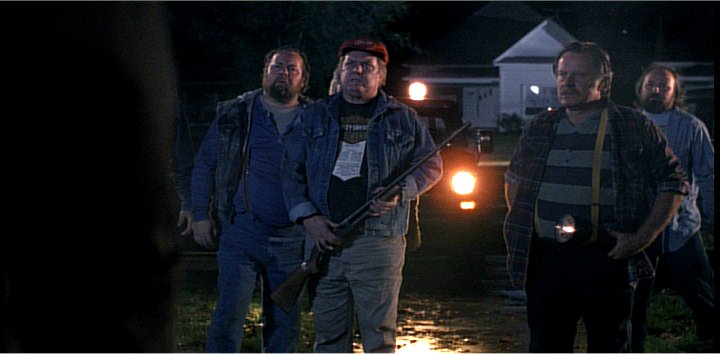
      Chances are if there was an escaped killer lurking about your hometown, most people would opt to stay indoors and lock their doors and windows. However, there would probably be a small crowd who would arm themselves, take the law into their own hands, and hunt down the killer. In Halloween 4, local bar owner Earl gathers up all his redneck buddies and they proceed to hunt down Michael, hoping to get to him before he can take another life. However, as is the case with most vigilantes, they cause more trouble than good.  Earl and his men are bit on edge, and at one point their hear rustling come from the bushes and fire away, adopting the whole “shoot first-ask questions” later mentality. Unfortunately, the man they gun down is the local town drunk, Ted Hollister, who was urinating behind the bushes. Earl tries to deflect blame by yelling at one of his men, “You dumb son of a bitch. You said you saw Myers.”  Earl and his lackeys prove to be rather ineffectual against Michael as well; he sneaks up behind them (while they are standing on the pack of moving pickup truck) and proceeds to kill them one by one.  


The biggest flaw of Halloween 4 is, unfortunately, Michael Myers himself. In the first Halloween, Michael Myers was a fairly average sized male who was very slow and methodically in the way he stalked his victims. In fact, the main reason the first Halloween is so effective is that is slowly builds to the violence at the film’s end.  You know the characters are going to get it, but you don’t know when.  The body count is relatively low (five total) and the gore is kept to an absolute minimum. The interesting thing about Michael is that he is, in fact, very much a kid trapped inside a man’s body.  In his excellent book Cult Movies, Danny Peary writes:

               I think Michael is an incredibly interesting character, not the typical vengeful movie psycho. Carpenter defines him as Evil itself (the real boogeyman), but I don’t believe he goes around killing people because he is evil. Insane, yes; evil, no. There is still a little boy inside the man’s body, and everything he does is part of a game. In fact, his activities are less suited for Halloween than “Mischief Night” (the night after Halloween “celebrated” in many American towns when kids play dirty tricks on their neighbors). He has fun scaring characters before he kills them, or teasing them by making noises, or jumping out of closets. The scariest moment is when Michael drives past Laurie, Annie, and Lynda and stops for a moment. He could kill any of these people any time he wants to, but he prefers to hide behind bushes and in closets, peer into windows, or, as in the case with Annie, play tricks with her car door.

One of the more memorable moments in the first Halloween is after Michael stabs Bob, the camera lingers on him in a long shot as he stares at Bob in a most curious manner and slowly tilts his head to the side.  By the time of Halloween 4, such nuances got thrown out the window in favor of a more one dimensional, lumbering giant. The irony is that while most slasher films took their cue from Halloween, the Halloween sequels took their cue from the many rip offs that dominated the 80s.  The Michael Myers in Halloween 4 has more in common with Jason Voorhees than he does with the Michael Myers seen in the original film.  Between Halloween II and Halloween 4 Michael has somehow bulked up and increased in height, and completely lacks the grace that defined his characters movements in the first film. No longer is he a shadow in the background, but rather a super human brute who dominates the proceedings.

In the original film the bloodshed and the violence was implied, whereas the sequels the gore factor increased greatly and the violence started to get ridiculously over the top. For instance, there is a scene in Halloween 4 in which Michael impales a curvaceous blonde girl with a rifle with very little effort.
In another scene, his hand comes crashing through a pick up truck window and proceeds to rip off Earl’s head. Granted, the gore in Halloween 4 isn’t as gruesome as it is in present horror films, but it’s still there. While many horror fans applaud the gore scenes, I find them rather redundant and boring; to me gore diffuses the tension, rather than adds to it.  When Michael rips off Earl’s head, it makes me cry out, “Oh! Come on,” rather than, “OH MY GOD!”  If the execution is poor, gore scenes can be incredibly laughable. In the Lucio Fulci film The Beyond there is a scene in which an idiot is attacked by tarantulas that proceed to rip his face apart. This sounds disgusting, but because of Fulci’s inept direction it becomes a laugh riot. For one, despite walking on a wooden floor, it sounds like the Tarantula’s are walking on potato chips, and secondly, despite having his face torn apart, the guy doesn’t seem to be in any pain. At one point he gets his eye ripped off and mere says, “OH NO!” It’s a scene that lingers on and on, and doesn’t necessarily add to the overall narrative, though Fulci films rarely make any sense.

The other aspect I can’t stand about the Halloween sequels (not just part 4) is the idea that Michael Myers hunts down his next blood relative. In Halloween II, it was revealed that Laurie Strode is Michael Myers’ sister.  This storyline was added to give Michael motivation for going after Laurie, but otherwise it added nothing to the overall narrative.  When Halloween 4 rolled along, the filmmakers couldn’t get Jamie Lee Curtis to reprise her role as Laurie, so they changed the premise from Michael Myers stalks his sister to Michael Myers stalks his niece.  I absolutely hate both story lines, because they take the idea of chance out of the equation.  In Halloween, Laurie was a random person Michael encountered and proceeded to stalk her and her friends; it was a chance encounter that leads to the death of three teenagers.  What makes the film so frightening is the idea that this could happen to anyone in any town. Laurie just happened to be at the wrong place at the wrong time and as a result she finds herself fighting for her life at the film’s end. It is also through chance that Loomis spots the car Michael stolen, sees children fleeing from a house, and arrives in the nick of time to save Laurie.  However, by making Michael and Laurie siblings this idea of chance goes tossed out of the window in favor of the idea that fate is what brought the two together.  In Halloween 4, Michael has waited patiently for ten years, so he can escape and stalk his poor niece.  This also presents the problem of “How does Michael know he has a niece?” and Halloween 4 never really answers that question; in Halloween 5 it is revealed that the two share a psychic link (when it is convenient for the plot). 

*Spoiler*

I especially loathe the twist ending in which Jamie turns evil and attacks her stepmother with a knife, thus implying that she will take Michael Myers place. There are many fans that like this ending, because how it parallels the first Halloween, but it’s absolutely needless and unoriginal. For one, Friday the 13th: The Final Chapter sports a similar twist ending, in which it is implied that Tommy Jarvis (Corey Feldman) might have not survived the ordeal of killing Jason with his sanity intact. In Friday the 13th: The New Beginning this isn’t so much as implied as  it is explicit; we see Tommy wearing Jason’s mask and clutching a knife as the film’s heroine is oblivious to her soon to be demise. In Halloween 5 this idea of Jamie being Michael’s heir apparent is completely dropped and instead she spends a good deal of the film mute and recovering in a hospital. Secondly, it’s seemed to a common theme amongst horror films of the 80s to end on a rather downbeat note, just when you thought the killer was defeated, he would come back for one more scare. It’s a cliché that got rather tiresome as the decade wore on and seeing a cute girl turn evil is just a bit too much. And Pleasence shouting, “NOOOO!” in slow motion doesn’t really help matters.

I have love/hate relationship with Halloween 4. I like the characters of Jamie and Rachel, as well a few other touches by the filmmakers. It’s still a step above the majority of the slasher films of that decade, and certainly a masterpiece compared to the dreadful sequels that followed, but unfortunately I find the character of Michael to be rather lifeless and uninteresting. He’s no longer the Michael Myers of the first film, but rather a Jason rip off.  

Cast: Donald Pleasence (Dr. Loomis), Danielle Harris (Jamie), Ellie Cornell (Rachel), George P. Wilbur (Michael Myers), Beau Starr (Sheriff Meeker), Sasha Jensen (Brady), Kathleen Kinmont (Kelly Meeker), Michael Pataki (Dr. Hoffman), Gene Ross (Earl), Carmen Filpi (Rev. Jackson P. Sayer).
Director: Dwight H. Little

Snow White's Revenge/Scandal (2024)

  It is difficult to write about Snow White’s Revenge without bringing up the ending, so readers beware, this review will contain spoilers...