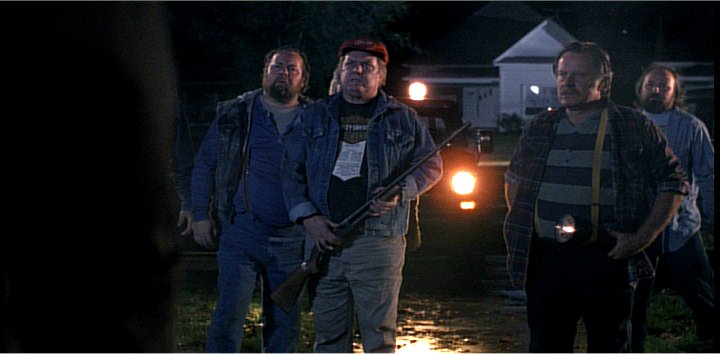
10) Halloween II (2009)

Dir: Rob Zombie.
Cast: Scout Taylor-Compton, Taylor Mane, Malcolm McDowell, Brad Dourif, Danielle Harris, Sheri Moon Zombie, Margot Kidder, Mary Birdsong, Bea Grant.
Running Time: 105 min.
Cast: Scout Taylor-Compton, Taylor Mane, Malcolm McDowell, Brad Dourif, Danielle Harris, Sheri Moon Zombie, Margot Kidder, Mary Birdsong, Bea Grant.
Running Time: 105 min.
I absolutely loathed Rob Zombie's remake of Hallween, the only reason it isn't on my top 10 list is because Halloween II is infinitely worse. Slasher films aren't exactly high works of art, but even the bottom feeders tend to have at least one character you an empathize with...... not so with Halloween II. For instance, I enjoy the first four entries in Friday the 13th series, largely because the characters are at least fun too watch. Sure, their main function is to meet grisly ends, but at least they are pleasant company. They are the kind people you would want to be on a weekend get away with. In Halloween II, everyone is miserable.
I like Rob Zombie, his music is entertaining for the most part and he comes off as being highly intelligent in interviews, therefore it's complete shame that this film is mind numbingly awful. Zombie is more of a "shock" director than an actual "horror" director. Meaning, he'll lull you into a hypnagogic state, only to jump out and scream "BOO" at you! Take for instance the death of Laurie's friend, Harley. She is at a costume party, dressed up as Dr. Frank-N- Furter (from The Rocky Horror Picture Show) and is fixing to fornicate in the back of a van with a guy wearing a werewolf mask! UH-OH! The guy, however, ask to take a leak first and is dispatched by Michael, while he is urinating on a tree. Then Michael crashes through the back window of the van and snaps poor Harley's spine. It's an extremely violent moment, yet it's not in the least bit scary, and eventually the shock value wears off on the viewer. The original Halloween slowly builds to it's inevitable climax, the audience is constantly in a state of unease, wondering when Michael Meyers is going to strike. In Halloween II, we don't really care, we just want the damn movie to end.
9) Hell of the Living Dead (1980)

Dir: Bruno Mattei, Claudio Fragasso.
Cast: Margit Evelyn Newton, Franco Garofolo, Selan Karay.
Running Time: 101 min.
Dir: Bruno Mattei, Claudio Fragasso.
Cast: Margit Evelyn Newton, Franco Garofolo, Selan Karay.
Running Time: 101 min.
My summary of Hell of the Living Dead: Endless bickering among the characters, endless nature stock footage, and lots of cheap looking gore. Rinse. Wash. Repeat. The zombie make up looks like play dough, and is often on the verge of falling off the faces of the poor extras. It's a third rate Dawn of the Dead, which is probably giving it too much credit. The hilariously awful dubbing is amusing for a little bit, but gets old after awhile.
8) Maniac (1934)

Dir: Dwain Esper
Cast: William Woods, Horace B. Carpenter, Ted Edwards, Phyllis Diller (not the comedienne), Theo Ramsey.
Running Time: 51 min.
Cast: William Woods, Horace B. Carpenter, Ted Edwards, Phyllis Diller (not the comedienne), Theo Ramsey.
Running Time: 51 min.
Maniac is about a hammy ex-vaudeville actor Don Maxwell that finds himself an assistant to Dr. Meirschultz, a mad scientist experimenting on resurrecting the dead. Maxwell kills Meirschultz and covers up his crime by impersonating the mad doctor, driving himself insane in the process. Maniac is noteworthy in that in tries to pass itself of as an educational film about mental illness; there are inter titles scattered throughout explaining what the main character is experiencing. To visualize Maxwell's descent into madness, director Esper superimposes footage from the Benjamin Christensen classic Haxan: Witchcraft Through the Ages over his face. By posing as an educational film it gave Esper leeway to show woman in the nude, as well as get away with extreme violence; at one point Maxwell plucks out a cat's eyeball and eats it. It's a horrible film to be sure, but probably the only film on this list that is remotely fascinating, given the era that it was made.
7) Jaws:The Revenge (1987)

Dir: Joseph Sargent.
Cast: Lorraine Gary, Lance Guest, Mario Van Peebles, Karen Young, Michael Caine, Judith Barsi.
Running Time: 90 min.
Jaws is one of my favorite movies. Jaws: The Revenge, on the other hand, is pure schlock, only good for a few unintended laughs. Whereas Jaws kept the shark off screen for the majority of the movie, The Revenge makes the mistake of showing too much.In one laughable bit, the shark jumps out of the water and devours a woman that is sitting on top of a banana boat.

Lorraine Gary returns as Ellen Brody, who constantly has flashbacks to the first film. In fact, she some how able to remember events that she wasn't apart of, like Martin Brody disposing of the shark in the first film. Gary tries her hardest, but the material lets her down. Apparently, some genius decided that if the Great White Shark roared like King Kong, it would be much more scary. Thankfully, we were spared a Jaws 5: In Space.
Dir: Joseph Sargent.
Cast: Lorraine Gary, Lance Guest, Mario Van Peebles, Karen Young, Michael Caine, Judith Barsi.
Running Time: 90 min.
Jaws is one of my favorite movies. Jaws: The Revenge, on the other hand, is pure schlock, only good for a few unintended laughs. Whereas Jaws kept the shark off screen for the majority of the movie, The Revenge makes the mistake of showing too much.In one laughable bit, the shark jumps out of the water and devours a woman that is sitting on top of a banana boat.
Lorraine Gary returns as Ellen Brody, who constantly has flashbacks to the first film. In fact, she some how able to remember events that she wasn't apart of, like Martin Brody disposing of the shark in the first film. Gary tries her hardest, but the material lets her down. Apparently, some genius decided that if the Great White Shark roared like King Kong, it would be much more scary. Thankfully, we were spared a Jaws 5: In Space.
6) The Snow Creature (1954)

Dir: W. Lee Wilder.
Cast: Paul Langton, Leslie Denison, Teru Shimada, Rollin Moriyana, Darlene Fields.
Running Time: 70 min.
A real snoozer! W. Lee Wilder is name that completely gets overlooked in the “Worst Director of All Time” conversation, possibly because his films are so boring that they are easy to forget. He sneezed out three non classics in the 1950s: Killers From Space (with Peter Graves), Phantom From Space, and The Snow Creature. Amazingly, he was the older brother of Billy Wilder, quite possibly the greatest director in Hollywood history. The Snow Creature is not only hampered by a low budget, the same shot of Yeti walking towards the camera is recycled throughout the film, but by an incredibly dull cast.

It’s an incredibly uninvolving and joyless film; when a Himalayan village is attacked by a Yeti, the main character shrugs with complete indifference. It also blatantly steals the plot from King Kong; the Yeti is captured and brought to Los Angeles, where it escapes and runs amok. There are better ways to spend 70 minutes.
Dir: W. Lee Wilder.
Cast: Paul Langton, Leslie Denison, Teru Shimada, Rollin Moriyana, Darlene Fields.
Running Time: 70 min.
A real snoozer! W. Lee Wilder is name that completely gets overlooked in the “Worst Director of All Time” conversation, possibly because his films are so boring that they are easy to forget. He sneezed out three non classics in the 1950s: Killers From Space (with Peter Graves), Phantom From Space, and The Snow Creature. Amazingly, he was the older brother of Billy Wilder, quite possibly the greatest director in Hollywood history. The Snow Creature is not only hampered by a low budget, the same shot of Yeti walking towards the camera is recycled throughout the film, but by an incredibly dull cast.
It’s an incredibly uninvolving and joyless film; when a Himalayan village is attacked by a Yeti, the main character shrugs with complete indifference. It also blatantly steals the plot from King Kong; the Yeti is captured and brought to Los Angeles, where it escapes and runs amok. There are better ways to spend 70 minutes.
5) Zombie Lake (1981)

Dir: Jean Rollin.
Cast: Howard Vernon, Pierre-Maris Escourrou, Anouchka, Antonio Mayans, Nadine Pascal, Youri Radionow.
Running Time: 90 min.
A squad of green skinned, bugged eyed Nazi zombies arise from the bottom lake and terrorize a French village that murdered them years ago. Their main victim of choice: curvaceous, female skinny dippers. There's also a "heart warming" subplot in which one of the zombies is reunited with his daughter, the product of an affair he had with a local woman. The fact that he is able to recognize his daughter is, in itself, a mystery, considering he was killed before her birth. This subplot also highlights just how incompetent of a film Zombie Lake truly is; his daughter is roughly ten years old, which would put the setting of this movie some time in the mid 1950s, yet the fashions, hair styles, and technology place it in the late 70s/early 80s. The filmmakers were to lazy to replicate a 1950s setting, which makes everything more confusing. Not to mention, director Jean Rollin seems to have confused zombies for vampires; the undead Nazis bite the necks of their victims and suck their blood.

Dir: Jean Rollin.
Cast: Howard Vernon, Pierre-Maris Escourrou, Anouchka, Antonio Mayans, Nadine Pascal, Youri Radionow.
Running Time: 90 min.
A squad of green skinned, bugged eyed Nazi zombies arise from the bottom lake and terrorize a French village that murdered them years ago. Their main victim of choice: curvaceous, female skinny dippers. There's also a "heart warming" subplot in which one of the zombies is reunited with his daughter, the product of an affair he had with a local woman. The fact that he is able to recognize his daughter is, in itself, a mystery, considering he was killed before her birth. This subplot also highlights just how incompetent of a film Zombie Lake truly is; his daughter is roughly ten years old, which would put the setting of this movie some time in the mid 1950s, yet the fashions, hair styles, and technology place it in the late 70s/early 80s. The filmmakers were to lazy to replicate a 1950s setting, which makes everything more confusing. Not to mention, director Jean Rollin seems to have confused zombies for vampires; the undead Nazis bite the necks of their victims and suck their blood.
4) Monster a-Go Go (1965)

Dir: Bill Rebane, Herschell Gordon Lewis.
Cast: Philip Morton, June Travis, George Perry.
Running Time: 70 min.
Dir: Bill Rebane, Herschell Gordon Lewis.
Cast: Philip Morton, June Travis, George Perry.
Running Time: 70 min.
Monster a-Go Go is about an astronaut that crash lands on Earth and has been transformed into a deformed, radioactive monster. This idea was done before in The First Man In Space (1959) and The Quatermass Xperiment (1955), but while those films were actually interesting, Monster a Go-Go is 70 minutes of pure boredom. There's lot of narration and very little characterization. It's also extremely disjointed; characters often disappear without explanation. It also is extremely anti-climatic; the military follows the monster into the sewer, only to find that is has disappeared. We are then treated to this mind blowing piece of narration:
As if a switch had been turned, as if an eye had been blinked, as if some phantom force in the universe had made a move eons beyond our comprehension, suddenly, there was no trail! There was no giant, no monster, no thing called "Douglas" to be followed. There was nothing in the tunnel but the puzzled men of courage, who suddenly found themselves alone with shadows and darkness! With the telegram, one cloud lifts, and another descends. Astronaut Frank Douglas, rescued, alive, well, and of normal size, some eight thousand miles away in a lifeboat, with no memory of where he has been, or how he was separated from his capsule! Then who, or what, has landed here? Is it here yet? Or has the cosmic switch been pulled? Case in point: The line between science fiction and science fact is microscopically thin! You have witnessed the line being shaved even thinner! But is the menace with us? Or is the monster gone?
Brilliant!
As if a switch had been turned, as if an eye had been blinked, as if some phantom force in the universe had made a move eons beyond our comprehension, suddenly, there was no trail! There was no giant, no monster, no thing called "Douglas" to be followed. There was nothing in the tunnel but the puzzled men of courage, who suddenly found themselves alone with shadows and darkness! With the telegram, one cloud lifts, and another descends. Astronaut Frank Douglas, rescued, alive, well, and of normal size, some eight thousand miles away in a lifeboat, with no memory of where he has been, or how he was separated from his capsule! Then who, or what, has landed here? Is it here yet? Or has the cosmic switch been pulled? Case in point: The line between science fiction and science fact is microscopically thin! You have witnessed the line being shaved even thinner! But is the menace with us? Or is the monster gone?
Brilliant!
3)The Creeping Terror (1964)

Dir: Vic Savage.
Cast: Vic Savage, Shannon O’ Neill, William Thourlby, John Careisio.
Running Time: 75min.
The soundtrack to The Creeping Terror was supposedly erase during post-production, so instead of dubbing over lines, the filmmakers opted to go with an omniscient narrator that never shuts up. The narrator constantly reaffirms things that are being shown onscreen, "The military was called in....," etc. The terror is essentially a walking carpet with a tip shaped like a piece of asparagus that meanders across the countryside and devours people that get in its path. The deaths in this film could easily be avoided if the monster's victims, instead of just lying perfectly still waiting to be devoured, got up and walked a way at a leisurely pace. Every horrific moment consists of the monsters very slowly crawling towards its next meal, while the person just lies there helpless, never once thinking to get up. The camera also lingers on the behinds of the monster's young, female victims as it gobbles them up.

Dir: Vic Savage.
Cast: Vic Savage, Shannon O’ Neill, William Thourlby, John Careisio.
Running Time: 75min.
The soundtrack to The Creeping Terror was supposedly erase during post-production, so instead of dubbing over lines, the filmmakers opted to go with an omniscient narrator that never shuts up. The narrator constantly reaffirms things that are being shown onscreen, "The military was called in....," etc. The terror is essentially a walking carpet with a tip shaped like a piece of asparagus that meanders across the countryside and devours people that get in its path. The deaths in this film could easily be avoided if the monster's victims, instead of just lying perfectly still waiting to be devoured, got up and walked a way at a leisurely pace. Every horrific moment consists of the monsters very slowly crawling towards its next meal, while the person just lies there helpless, never once thinking to get up. The camera also lingers on the behinds of the monster's young, female victims as it gobbles them up.
2) Curse of Bigfoot (1976)

Dir: Dave Flocker.
Cast: Bob Clymire, Bill Simonsen, Jan Swihart.
Running Time: 88 min.
Dir: Dave Flocker.
Cast: Bob Clymire, Bill Simonsen, Jan Swihart.
Running Time: 88 min.
Here's a typical moment in Curse of Bigfoot:
Two lumberjacks are driving through the woods in a pick up truck, when all of a sudden Bigfoot runs across the road. One of them (wearing a wool hat) goes into the woods to investigate, while the other one waits at the truck. Wool Hat Man walks through the woods and then is attacked. Sounds exciting, right? Well, the scene in question goes on for nearly seven minutes and the attack in question happens off screen and is signified by a scream. It's a film that builds up to nothing! There's never any real sense of danger,because we're never shown an actual murders. It doesn't help that the Monster suit looks like it came from a kindergarten pageant.
 It's a tedious film that desperately apes the Howard Hawks film The Thing From Another World, but fail miserable. A nice cure for those who suffer from insomnia.
Two lumberjacks are driving through the woods in a pick up truck, when all of a sudden Bigfoot runs across the road. One of them (wearing a wool hat) goes into the woods to investigate, while the other one waits at the truck. Wool Hat Man walks through the woods and then is attacked. Sounds exciting, right? Well, the scene in question goes on for nearly seven minutes and the attack in question happens off screen and is signified by a scream. It's a film that builds up to nothing! There's never any real sense of danger,because we're never shown an actual murders. It doesn't help that the Monster suit looks like it came from a kindergarten pageant.
1) Manos: The Hands of Fate (1966)

Dir: Harold P. Warren.
Cast: Tom Neyman, John Reynolds, Diane Mahree, Harold P. Warren, Jackey Neyman.
Running Time: 74 min.
Dir: Harold P. Warren.
Cast: Tom Neyman, John Reynolds, Diane Mahree, Harold P. Warren, Jackey Neyman.
Running Time: 74 min.
It's only 74 minutes long, but it's the longest 74 minutes you'll ever experience. Manos: The Hands of Fate is quite possibly the most inept movie ever made. Supposedly, it was made on a bet between director Harold P. Warren and screenwriter Stirling Silliphant, in which the former bet the latter he could make a movie for $19,000. It was never stated that the movie actually had to be good, so Warren won the bet. It's obvious that Warren is not familiar with the concept of editing, as there are scenes where characters stand around awkwardly staring blankly into thin air, as if awaiting their cue from the director. In another scene, the hillbilly satyr Torgo gets a bit touchy feely with the lead actress, who responds by staring in abject horror, then after enduring this abuse for about two minutes finally yells at him to stop.
In another famous moment, two cops hear a gun shot in this distance and decide to investigate. They get out of their squad car, take a few steps into the desert, scan the area for a few seconds, and then call it a day. Exciting!
In another famous moment, two cops hear a gun shot in this distance and decide to investigate. They get out of their squad car, take a few steps into the desert, scan the area for a few seconds, and then call it a day. Exciting!