

In the last few years, with the rise of Netflix and other
streaming services, the local TV stations have essentially dropped movies from
their schedules to focus more on television series. As a result, many Christmas classics that
were in heavy rotation during the 1980s and 1990s have been dropped to the
wayside to make room for more contemporary programming. This is the fate that has, unfortunately,
befallen the Laurel and Hardy classic Babes
in Toyland (March of the Wooden
Soldiers).
I first saw Babes in
Toyland in third grade; our principal owned a 16 mm print and screened it
for the entire school. This came shortly after I had discovered Laurel and
Hardy, so naturally I was elated when I saw their names in the opening credits.
The rest of the students were indifferent at first, but eventually got into the
movie. Imagine my joy a few years later when, while browsing through the
(then) brand new Wal-Mart, I found it to buy on VHS (in color) for the low
prices of 12.99. WHAT A DEAL!!! I just
recently purchased the DVD for five dollars, so I guess it wasn’t much of deal
after all.

The first thing that immediately stands out about Babes in Toyland is that it fully
embraces its theatrical roots (it’s based off a 1903 operetta by Victor
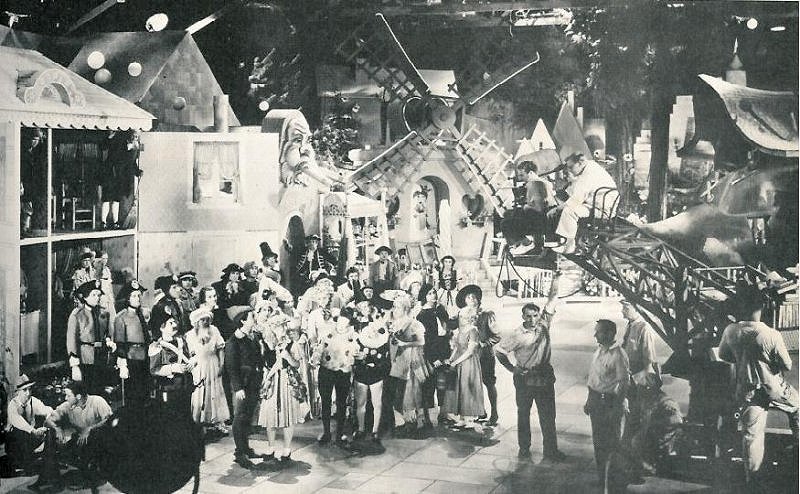
Herbert). For instance, most of the sets
are two dimensional mocks ups, and the costumes look like something you might
find at Target during the Halloween season.
The idea is to give it the feel of a storybook come to life. This is
actually confirmed in the opening song number (“Toyland”) when Mother Goose
emerges from a storybook and sings about the setting of the story. Midway
through the number, she opens the book, and with each turn of the page, we are
introduced to each of the principle characters (Little Bo Peep, Tom Tom, Little
Old Lady That Lived in a Shoe, Barnaby, and Stannie Dum and Ollie Dee).
This is
actually a really clever way of introducing the characters and allows the
filmmakers to do away with stilted exposition that might impede the plot. When Little Bo Peep is looking for her sheep, Tom
Tom appears and the movie can immediately jump into song because we know who
Tom Tom is. A lesser movie would have some awkward dialogue exchange between
the two: “Don’t worry, Bo Beep. I, Tom
Tom the Piper’s son, will help you find your sheep.” I also have to wonder, given the way this
scene is set up; did Walt Disney use it as a template for “Some Day My Prince
Will Come” scene in Snow White and the
Seven Dwarfs? Hal Roach and Walt Disney were friends; Disney gave Roach
permission to use the song “Who’s Afraid of the Big Bad Wolf?” in this movie. There is also a mouse that looks suspiciously
Mickey who appears sporadically throughout the movie. It seems likely Walt
Disney saw the movie, so was it a source of inspiration, or just a mere
coincidence?
This story book setting also pays dividends in the movie’s climax when Toyland is under siege by Barnaby and the Boogeymen. In a more “realistic” fairy tale, the Boogeymen would be absolutely laughable and embarrassing. They are essentially stuntmen in furry body suits, grass skirts, and weird rubber masks with Troll-like hair. They are less than convincing, but work extremely well in the context of this movie. These are the type of monsters you would find in a classic children’s storybook. The fact that they are genuinely menacing (especially in the scene where they emerge from hiding to terrorize Little Bo Beep and Tom Tom) speaks volumes about the skill of the filmmakers. Gus Meins and Charley Rogers will never be considered cinematic geniuses, but they keep things moving at a nice pace; even the “slow” musical numbers are the right length. I would also like to point out that Babes in Toyland is one of those rare instances where I prefer the colorized version to the original black and white. The gaudy colorization process actually adds to the overall storybook feel of the movie.

The weakest aspect of Babes
in Toyland (at least from a child’s point of view) is the romance between
Little Bo Peep and Tom Tom. This is largely due to the fact that neither character
is particularly interesting; though, Charlotte Henry has an appealing screen
presence as Little Bo Peep. Felix Knight, as Tom Tom, doesn’t fare quite as well,
but at least he can sing. What separates
this romance from other Laurel and Hardy comedies of the era is that it
actually plays a significant part in the movie’s plot. There was tendency among many comedies
(starring famous comedy teams) of the era to shoe horn in a romantic subplot
that had nothing to with the actual story (see Bonnie Scotland as example).
While the Little Bo Peep/Tom Tom story might be a tad bit boring at
least it has a point and isn’t overly obnoxious.

Henry Brandon, appropriately, chews the scenery as the
villainous Barnaby – he is wonderfully loathsome. Brandon’s performance is even
more impressive when you realize that he was only twenty one years-old when the
movie was made. He is very convincing as a miserly old man – he constantly walks
in a stooped manner, sneers at everyone around him, and leers at the much
younger Little Bo Peep. He also brings a physicality to the role that would be
far too demanding of an older actor – he gets into fist fight with Tom Tom and
later on carries off the screaming Little Bo Peep (who, in a bad piece of
continuity, disappears from Barnaby’s arms when he is hit by a giant cork shot
from a cannon). It’s a terrific performance
and Brandon nearly steals the movie with it.

Babes in Toyland (next
to Way Out West) is probably the most
tightly scripted out of all Laurel and Hardy’s full length feature. Their other full length features tended to be
more episodic in nature; they were essentially three two reel comedies stitched
together to make up a full length feature (A
Chump at Oxford is great example of this).
There is also a time element at work: Barnaby owns the mortgage on Widow
Bo Peep’s house (a giant shoe) and if she can’t pay it off by morning he will
have her (and her entire family) thrown out on the street. Barnaby is willing to forget the mortgage if
her daughter, Little Bo Peep, will agree to his wife, but she will have none of
that. The boys, Stannie Dum and Ollie
Dee, are tenants in Widow Bo Peep’s shoe and will do anything in their power to
help her out. It also does a nice job of setting up events that happen later in
the movie: the six foot tall wooden
soldiers that drive out the boogeyman at the end don’t just appear out of thin
air, there is a scene early on that establishes their existence. Stan and Ollie are toymakers and Stan manages
to botch an order that was placed by Santa; instead of making six hundred solider
at one foot high, Stan misreads it as hundred soldiers at six feet high. This scene effectively establishes two
things: that Stan is absent minded and
the army of six foot wooden soldiers. There is a button on the back of the soldiers
that activates them and once they are started up they are near impossible to
stop.

I need to point out just how efficiently paced the movie’s
climax is: between the siege of Toyland
by the Boogeymen and their being driven out by the wooden soldiers, only ten
minutes of screen time has passed. The movie cross cuts between the Boogeymen
terrorizing the citizens of Toyland and the boys (as well as not-Mickey Mouse
and the Three Little Pigs) fighting back. It’s an incredibly suspenseful
sequence and it’s not until Stan and Ollie activate the wooden soldiers that we
are allowed to breathe. Imagine if this same sequence where done today: It would be half an hour long
with lots of CGI thrown at our faces, rapid editing, and a few explosions
thrown in for good measure. It would also be incredibly boring. There’s also something wonderful about
Toyland being saved by two lowly toy workers as opposed to your typical muscle
bound badass.
It also surprised me while
re-watching Babes in Toyland how Tom
Tom completely disappears from the movie in the last ten minutes. You would
think the romantic lead would play a part in bringing down Barnaby, but nope he
spends the entire battle in hiding. This
is either a brilliant deconstruction of the pointless juvenile lead, or it’s
just sloppy writing. It’s probably the latter, but I’m going to keep convincing
myself that it is the former.
Credits
Cast: Stan Laurel (Stannie Dum), Oliver Hardy (Ollie Dee), Charlotte Henry (Little Bo Peep), Henry Brandon – billed as Henry Kleinbach (Silas Barnaby), Felix Knight (Tom Tom), Florence Roberts (Widow Bo Peep), Virginia Karns (Mother Goose), Kewpie Morgan (Old King Cole), Marie Wilson (Mary Quite Contrary).
Cast: Stan Laurel (Stannie Dum), Oliver Hardy (Ollie Dee), Charlotte Henry (Little Bo Peep), Henry Brandon – billed as Henry Kleinbach (Silas Barnaby), Felix Knight (Tom Tom), Florence Roberts (Widow Bo Peep), Virginia Karns (Mother Goose), Kewpie Morgan (Old King Cole), Marie Wilson (Mary Quite Contrary).
Directors: Gus Meins, Charley Rogers
Screenplay: Frank Butler, Nick Grande
Running Time: 78 min.
Screenplay: Frank Butler, Nick Grande
Running Time: 78 min.


