Powered By Blogger
Showing posts with label Donald Pleasence. Show all posts

Wednesday, October 31, 2018

Halloween 5: The Revenge of Michael Myers (1989)


In my review for Halloween 4: The Return of Michael Myers I described my overall attitude towards it as a love/hate relationship.  I really liked the relationship between Rachel and Jamie, and I enjoyed Donald Pleasence’s over the top performance as the half crazed Dr. Loomis. Unfortunately, it is the horror aspect of the movie that fell completely flat for me.  When it comes to Halloween 5: The Revenge of Michael Myers, I am not nearly as conflicted – I don’t care for it.  I wouldn’t go so far to say I hate Halloween 5, and it is by no means the worst movie in the franchise, but it is quite possibly the most difficult to watch.  

The most curious part of Halloween 5 is how it shrugs off the ending to the previous movie – Michael Myers has been defeated but the evil has been passed on from him to his niece, Jamie.  When Jamie gets home, she (donned in a similar clown costume and mask that Michael wore in the first movie) apparently kills her foster mother with a pair of scissors.  She appears at the top of the stairs with the bloodied scissors and Dr. Loomis, realizing she has been consumed by evil, is about to fire upon her with his gun, but it is stopped the sheriff.  I personally didn’t care for this ending, but it is an almost perfect set up for Halloween 5.  Sure, Michael Myers may have been stopped but the evil lives on.  This would have been an ideal opportunity to take the Halloween franchise in a completely new direction, while also further developing the character of Rachel. How would she react to her foster sister being turned to the dark side? Would she try to reach out to Jamie? Could she bring herself to kill her foster sister? 

Instead, director Dominique Othenin - Girard went for the safe approach and brought Michael Myers back, yet again. AAAHHHH!!!After the events of Halloween 4, Michael has been in a coma for a year (while given shelter by a homeless guy) and Jamie has been institutionalized in a children’s hospital (while being watched over by Dr. Loomis).  It has been retconned so that Jamie merely injured her foster mother rather than murdered her.  It also turns out that Jamie is psychically linked to Michael and can sense when he is about to kill her loved ones.  Unfortunately, her previous experience with Michael was so traumatic that it rendered her mute. She can only communicate through gestures and hand written notes.  Honestly, I’m really not bothered by this plot device because it does create some genuine tension.  There are a few scenes where Jamie senses her friends are in danger and Dr. Loomis, and company, have to prod the information out of her to prevent a senseless killing.  Again, these scenes are fairly tense and give the movie a sense of urgency; it is really everything else that I have a problem with. 

The biggest bone headed decision was killing off the character of Rachel. I get that killing off Rachel is supposed to signal to the audience that “no one is safe in this movie,” but the problem is that “killing off the survivors of the previous movie” had become fairly clichéd by 1989. In fact, the previous year’s Nightmare on Elm Street 4: The Dream Master did the exact thing.  It would have been more shocking had the kept the character alive.  It is also a bit disheartening to see the likable Rachel killed off in a similar manner that was reserved for all the interchangeable sex kittens in the Friday the 13th series.  

The appeal of Rachel is that she looked and behaved like your average Midwest teenager.  She was the type of girl who, while pretty, was often overlooked by her male peers.  There is a scene in the town drug store where a group of guys are gawking at Kelly, the town hottie, and don’t even bat an eye when Rachel enters.  When Rachel discovers her boyfriend, Brady, has been cheating on her with Kelly, it stings for two reasons: the fact he is cheating on her and the fact that it is with Kelly, the girl who is constantly getting the better of Rachel. When Brady tries to explain his position, Rachel sarcastically snaps back, “I thought you were different from other guys.”  There is a sense that Brady wasn’t first guy that Rachel lost to Kelly.  Yet, in Halloween 5 there is an odd decision by the filmmakers to sex up the character of Rachel; she spends most of her brief screen time either wet in a towel or half dressed.  After she has come home from visiting Jamie, Rachel opts to take a shower.  There is a long shot where her figure is slightly obscured by the translucent shower curtain.  Jamie senses Rachel is in danger and Dr. Loomis calls her on the telephone. Rachel, wet and in a towel, answers the phone and, on the advice of Dr. Loomis, runs out the house and calls out to her neighbor to call the police. 

After the danger is over, Rachel goes back into the house and lounges around in a half dressed manner (director Othenin- Girard shoots this scene at an extremely low angle thus allowing the audience a good look at Rachel’s underwear).  Granted, this stuff is fairly tame compared to the gratuitous nudity in other slasher movies. It’s just depressing to see this character be given this kind of treatment.  In Halloween 4, a half dressed Kelly is murdered by Michael Myers (impaled with a shotgun), and in Halloween 5, a half dressed Rachel is stabbed to death by Michael Myers. Way to go, Dominique! 


With Rachel out of the way, it is the character of Tina who assumes the role of big sister to Jamie.  There a few flaws with this idea, the first being that Tina isn’t nearly as interesting as Rachel.  She is your fairly stereotypical party girl who pops up in just about every slasher movie imaginable.  While I’m sure Tina genuinely likes Jamie, they idea that the two of them formed a sisterly bond seems far fetched. Tina just wants to go out and have a good time (get drunk, get laid), she doesn’t want to bind herself to an 11 year-old with serious issues.  It actually infuriates me that the first word to come out of Jamie’s mouth, after a year of silence, is “Tina.”  This is meant to be an emotional scene: Tina cries tears of joy and asks Jamie to say it again.  Unfortunately, this entire scene rings hollow and would have worked much better with Rachel in Tina’s place. Danielle Harris does her best to sell this moment (and nearly succeeds) but is defeated by the material. A history between Rachel and Jamie has already been established, and it would have been for more believable for Jamie to call out Rachel’s name.  Again, there is no reason to assume, other than because it’s in the script, that Tina would have formed a sisterly bond with Jamie. In fact, prior to this “heart warming” moment, the two of them only shared one brief scene together, in Jamie’s hospital room, at the beginning. The only reason Tina shows up in the first place is because Rachel is there, visiting Jamie. It is also more in line for Rachel to sacrifice herself to save Jamie than it is Tina. 


 I can appreciate  Othenin-Girard’s attempt to flesh out the character of Tina instead of making her a routine sex kitten (if this were a Friday the 13th movie, Tina would be introduced at the beginning and then killed off a few scene later), but it falls flat. If Rachel wasn’t such a strong presence, the bait and switch might have worked. However, her presence (or lack thereof) completely haunts the movie. Every time there is a scene between Jamie and Tina, I find myself thinking, “This would have worked better with Rachel.”  Sorry, Tina! The brief interaction with Jamie and Rachel reiterates this point; the interplay between Ellie Cornell and Danielle Harris is fantastic (even though there is no little dialogue involved).  You can sense the genuine affection between these two actresses.  Jamie wakes up in her hospital bed and finds Rachel sleeping at her side.  Rachel wakes up and Jamie notices there is eyeliner running down Rachel’s cheeks (indicating she’s been crying). Jamie points it out, Rachel wipes off the eyeliner, and the two of them laugh it off.  It is a GENUINELY touching scene.  

The other piece of awkward direction is the introduction of two bumbling deputies, Ross and Farrah.  It’s really hard to describe just how jarring these two characters are; whenever they appear onscreen they are accompanied by zany sound effects (straight out of a Looney Tunes cartoon).   These wacky deputies would completely be at home in a Police Academy movie but are total distraction in a dour horror movie. My personal theory is that that these two actors meant to audition for Police Academy 6: City Under Siege but took a wrong turn and ended up auditioning for Halloween 5 by mistake. Then Dominique Othenin-Girard mistook their broad slapstick for postmodern art and enthusiastically gave them the roles. “This is a brilliant deconstruction of the stereotypical movie policemen.  You guys are geniuses. You’re hired!” 


It is implied….actually that is too subtle of word….it is blatantly presented that Dr. Loomis is as much of a threat to Jamie as Michael Myers is.  Dr. Loomis is so obsessed with finding and destroying Michael Myers that to him no cost is too great, even Jamie’s life.  In the previous movies Dr. Loomis was a bit nutty, but he also genuinely wanted to save lives.  He contacted the Haddonfield police department after Myers’ escape and co-operated with them to the best of his ability.  At the end of Halloween 5, Loomis sets up a trap for Michael Myers (in Michael’s childhood home) and he uses Jamie as bait to lure the killer in.  The house is swarming with police and then Jamie (on Loomis’ instructions I assume) sends the officers on a wild goose chase by claiming that Michael is stalking her friend Billy at the children’s hospital. This leaves Dr. Loomis and a couple of deputies to protect Jamie.  When the deputy that is guarding Jamie suggests they take her to the police station, Loomis holds him at gun point and tells him that they’re not going anywhere. Sure enough, with the police force on the other side of town, Michael makes his move.  Because of Loomis, the deputy is killed and Jamie barely makes it out alive. This is Donald Pleasence at his hammiest; he completely chews the scenery every time he is onscreen.  Though, I actually think it’s fairly consistent with the character of Dr. Loomis; he has spent nearly a decade trying to destroy Michael Myers and he is finally at the point where anything goes. If he can successfully capture Michael Myers, then the end justifies the means.  


There is a rather neat scene where Dr. Loomis tries to reason with Michael; the two of them stand side by side and, in a calm voice, Loomis tries to reach that child within. He knows that is probably futile, but he’ll give a go, any ways.  Again, at this point Loomis is willing to try anything.  There is also a sense that Dr. Loomis is reaching Michael and when it looks like he is about to give up his blade, the evil takes control and Michael severely injures Loomis.  There are interesting moments in Halloween 5, but they are far and few between.  


My biggest issue with Halloween 5, other than the sense of déjà vu,  is sheer sadism that hangs in the air. I know this is an odd criticism to levy against a horror movie. After all, the whole point of the horror movie is to explore mankind’s darker side.  Halloween 5 is by no means the most violent, or even gruesome, horror movie that I watched but I still find it difficult to watch.  It is just difficult for me to watch a sweet little girl go through so much suffering without even a ray of hope insight.  I know the argument will be, “Well, in the real world….”  Yes, there is a lot of suffering in the real world but movies are supposed to be an escape from the real world (even horror movies).  In the course of 98 minutes, we can only watch as Jamie:  witnesses a friend get knifed to death; gets chased by a car across a corn field; crawls her way out of a laundry chute as a madman stabs at her with a knife; gets manhandled by Dr.  Loomis, who uses her as bait to capture Michael Myers; stumbles upon the corpse of her caring foster sister; and breaks down in tears when she realizes that Michael Myers has been sprung from jail by a mysterious man in black. It is a complete downer of a movie.  It is not just me that feels way; Halloween 4 was lowest grossing movie in the entire franchise.  Though, it is leagues above Halloween: Curse of Michael Myers and the abhorrent Halloween:Resurrection. 


 It is fairly interesting listen to Danielle Harris’ commentary on both Halloween 4 and Halloween 5; her memories of the former movie seem to be fairly cheerful, while she has far less positive things to say about the latter. She praises her co-stars, especially Michael Myers portrayer, Don Shanks, but she isn't too keen on director Dominique Othenin – Girard.   Ellie Cornell, in her interviews and commentary, seems even less thrilled about Halloween 5 than Harris, and I don’t blame her.

Credits 
Cast: Donald Pleasence (Dr. Loomis), Danielle Harris (Jamie), Ellie Cornell (Rachel), Wendy Kaplan/Foxworth(Tina), Don Shanks (Michael Myers/Man in Black), Beau Starr (Sheriff Ben Meeker), Jeffery Landman (Billy), Tamara Glynn (Samantha), Matthew Walker (Spitz), Jonathan Chapin (Mikey), Troy Evans (Deputy Charlie), Betty Carvalho (Nurse Patsey), Frankie Como (Deputy Nick Ross), David Ursin (Deputy Tom Farrah).
Director: Dominique Othenin-Girard
Screenplay:  Michael Jacobs, Dominique Othenin – Girard, Shem Bitterman.
Running Time:  98 min.

Thursday, September 5, 2013

You Only Live Twice (1967)


James Bond is one of the few characters that has transcended his literary origins to become a world wide phenomenon. You rarely hear anyone complaining about how the latest James Bond film has a desecrated Ian Fleming's original vision. The movies have taken on a life of their own.  It wasn't until my teens that I became  familiar with the world of James Bond. I vaguely remember catching bits and pieces of the Roger Moore films on television as a child, but for the most part I knew very little about the character. In 1995, my dad broke down and got us a satellite dish, Primestar was the company, and now we had access to countless channels, one of which happened to be TBS, which coincidentally was having a week long marathon of James Bond movies. I immensely enjoyed all the Bond films, but for some reason I was in absolute awe of You Only Live Twice, probably because of my immense crush on Akiko Wakabayashi, though Mie Hama is fairly attractive as well. Hey, I was SIXTEEN at the time! It was a ridiculously larger than life adventure with a villain that had a scar running down the side of his face, man eating piranhas, and a base hidden underneath a volcano. All these stuck with my through the years that when I finally purchased the video (and inevitably the DVD) I was looking forward to reliving the adventure again, well, let's just say I was less impressed with it on subsequent viewings. I still enjoy You Only Live Twice, but it's kind of amazing just how convoluted and tension free it is at times.


Granted, Bond film aren't exactly known for their scripts, practically all the Bond films are littered with plot holes; the story often takes a back seat to the action. The problem with You Only Live Twice is that its flaws are far more glaring than the previous entries in the Bond series. It’s lacking the one thing that is essentially to the Bond series…memorable villains. Donald Pleasance is memorable as Blofeld, the head of SPECTRE, but he’s only in the movie for about ten minutes, the rest of the rogue’s gallery is fairly weak, especially in comparison to the previous (and later) Bond films.  Mr. Osata is a Japanese businessman, and Blofeld’s main lackey, but he’s so horribly inept at his job that he poses absolutely no threat to James Bond.  He lacks the cunning and resourcefulness of say Goldfinger, Dr. No, Largo, and Rosa Klebb, all of whom were underlings to Blofeld (at least in the movie series).  When things (inevitably) go wrong, he gets squeamish and tries to dodge blame by pointing the finger at his secretary/interrogator Helga Brandt.

Helga Brandt is probably the one of the weakest, if not the weakest, femme fatales in Bond history, despite being played by the ravishing Karin Dor. The character, in many ways, seems to be modeled after the femme fatale from Thunderball, Fiona.  However, the main difference between the two is that Fiona was genuinely menacing and packed quite the sexual charge; the bed scene between her and Bond is genuinely sexy.
The scenes with Helga Brandt, on the other hand, are absolutely ridiculous and laughable at times, largely because the script does a horrible job of establishing the character. The first time we met her is at a meeting between Bond and Mr. Osata; she stands in the background and eyes up Bond throughout the scene.  The second time she pops up in the film, Bond has been captured and is tied up to a chair, Helga enters the room and it looks like she is going to interrogate him for some information. She grabs a surgeon’s knife and it looks like she is going to torture Bond…..BUT instead throws herself at him and two indulge in some off screen spooning.  The love scene between Fiona and Bond was genuinely a sexy moment, largely due to the onscreen chemistry between Sean Connery and Luciana Paluzzi, this love scene is just plain silly and fairly chaste, by the standards of a Bond film. It almost feels like Roald Dahl was obliged to write a femme fatale into the script, because it wouldn't be a James Bond film without one. It would explain why this movie seems to be going through the motions at times. Bond and Helga are making out, then Bond grabs the surgeon’s knife and cuts the straps off of Helga’s dress and then we fade into the next scene; even the filmmakers knew how goofy this bit was and just wanted to get it out of the way as quickly as possible.


Unfortunately, the next scene is even more ludicrous. So, after having indulged in some carnal pleasure, Bond and Helga are flying in an airplane; Helga is piloting the plane, while Bond is the passenger. Bond promises to protect her from the wrath of Osata, but she tells them that it won’t be necessary, then she hits a button that traps Bonds arms beneath a food tray on the back of her seat. She then parachutes out of the plane to leave Bond to a fiery death. However, since the film is only at the midway point, we know Bond will free himself from the tray and pilot himself to safety. This scene is executed in such a half assed manner that it’s absolutely devoid of any suspense. Hell, James Bond doesn't even break a sweat.  It begs the question, if Helga was planning to kill Bond, why wait until now? Why do it a manner that you have absolutely no control over? Helga assumes that it will go off without a hitch, but this is a clearly a resourceful man she’s dealing with, so why even risk a chance for escape? Granted, this is prevalent in almost all James Bond movies, the villain has a chance to put a bullet in Bond’s head, but instead opts for the over elaborate, drawn out death that gives him ample opportunities to escape. The difference is that the villains in other Bond films are fairly well established and, up until that point, have a reason to be over confident, every aspect of their plan seems to be falling into place. The same cannot be said of Helga Brandt, given that she has already failed to kill Bond before.  In fact, Bond has consistently evaded Osata’s men, which makes Helga’s mode of death for him all the more questionable. It’s another instance in which the movie seems content with going through motions, rather than dreaming up something genuinely original.

The third in the trifecta of unmemorable villainy is Blofeld’s bodyguard, Hans, a character that comes off as being a complete after thought.It’s almost like Roald Dahl turned in his final screenplay and then the producers asked him, “Where’s the muscle? It’s not a Bond film, unless he has fight scene with the muscle. From Russia With Love had Red Grant. Goldfinger had Oddjob. This film has no one.” So Dahl reluctantly added Hans just to appease the producers.  Hans' is a non-entity for practically the entire film that the final fight between him and Bond comes as a complete surprise. “Who is this guy?” screams the audience. “Why haven’t we seen him before?”  Well, we have, it’s just that he hasn't done anything that is remotely memorable; he just stands in the background. We never once are given a test of strength to show just how much of bad ass this guy truly is. In From Russia With Love, there’s a brief moment early in the film in which Rosa Klebb, an agent of SPECTRE, puts on a brass knuckles and punches Red Grant in the gut with all her might and he doesn't even flinch. He’s absolutely numb to pain. The audience knows he is going to pose a serious threat to Bond. Hell, he even has the upper hand on Bond aboard the Orient Express, until he allows his over confidence to get the better of him.  We don’t get that with Hans, he’s just a generic muscle bound henchman. Hell, even the final fight between him and Bond is pretty pathetic; it lasts less than thirty seconds. Bond and Hans are fighting on a bridge, underneath them are Blofeld’s man eating piranhas awaiting their next meal. He takes a swing at Bond, Bond ducks and flips him over his shoulders, sending Hans into the waiting jaws of the piranhas.


On the “good” Bond girl front, I have often wondered why the filmmakers didn't just combine Aki and Kissy Suzuki into one character, because neither of them really makes much of an impression. Both actresses, Akiko Wakabayashi (Aki) and Mie Hama (Kissy) are lovely to look at, but they’re given very little to do. Aki is Bond’s love interested for the first half, but then dies an inglorious death by being accidentally poisoned in her sleep; the poison is meant for Bond.  Bond doesn't bat so much an eye after she dies right in front of him, he just shrugs it off and goes on with his life.


 The character of Kissy is a wasted opportunity, she has the potential of being an extremely kick ass heroine, but the filmmakers pretty much sideline the character just when she starts to become interesting. She helps Bond locate Blofeld’s underground lair and then swims back to the mainland to get reinforcement. We see her brandishing a gun during the film’s climatic shoot out and she even saves Tiger Tanaka’s life, but then she gets lost in the shuffle.  Kissy’s introduction comes at the 77 minute mark of the film, thus giving the actress Mie Hama precious little time to establish the character.  She is at first distant towards Bond, unwilling to mix business with pleasure.  However, eventually Bond breaks down her defenses and they indulge in a short make out session while on the job. The total amount of screen time that elapses before Kissy capitulates to Bond's charms – five minutes.  Aki should have been omitted from the final film and Kissy should have been promoted to the main Bond girl; it would have allowed the filmmakers more time to flesh out the relationship between her and  Bond, instead she’s reduced to a lovely piece of scenery.


Kissy seems to be modeled after the most famous Bond girl, Honey Ryder (Ursula Andress), the most obvious link between the two is that the don a white bikini.  Honey makes a living collection sea shells and selling them for a profit, while Kissy dons the disguise of a diver girl, who also sells seashells for a living. In the novel, Kissy isn't an undercover agent working under Tiger Tanaka, but just a plain diver girl that falls in love with Bond.  Dr. No ends with James Bond and Honey Ryder drifting aboard a speed boat (that has run out gas) and You Only Live Twice ends with Bond and Kissy drifting aboard a raft.  In both films Bond is ready to indulge in some serious hanky panky with his gorgeous female companion only for it to be interrupted by an external force. In Dr. No, CIA agent Felix Leiter comes around in a Coast Guard boat and offers Bond a tow. In You Only Live Twice, a submarine surfaces below the raft containing Kissy and Bond.  The movie then cuts to an interior of the sub to reveal M and Miss Moneypenny  are on board. Honey Ryder is much more memorable character, despite being fairly inconsequential to the actual story line. She maybe a useless character, but there is a genuine spark between her and Bond; something that is completely lacking in his relationship with Kissy.


What is the point of Bond faking his death? It does make for a striking pre-title sequence; Bond gets gunned down while in bed, leaving the audience to wonder how he is going to get out of this one.  However, since this happens within the first five minutes of the movie, we know that Bond is alive and well, it’s just a matter of how faking his death will factor into the story. Other than the shock value of seeing Bond murdered, it really doesn't serve any narrative function; Bond blows his cover almost immediately. It would make sense if Bond faked his death and then donned this disguise of Japanese fisherman to infiltrate Blofeld’s underground lair, but this isn't case. Bond doesn't don the Japanese fisherman disguise until after he has been positively identified by Blofeld. A movie that I liken You Only Live Twice to is The Spider Woman, the seventh entry in the Universal - Sherlock Holmes series. In that film, Holmes (Basil Rathbone) fakes his death in the early going and then dons the disguise of an Indian Officer, Rajni Singh, so he can get close to Adrea Spedding, the brains behind the “pajama suicides” that has terrorized London. As Singh, Holmes frequents London’s gaming clubs, because he suspects that is where Spedding picks up her victims.  The point is Holmes fakes his death and dons a disguise so he can work in methodical manner without drawing attention to himself.  Bond, on the other hand, creates a scene just minutes after arriving in Japan that it completely negates the point of faking his death. It also doesn't help that he sticks out like a sore thumb in Japan. It makes one wonder why even have Bond fake his death in the first, considering that it gives him very little advantage.

The subplot about Bond donning this disguise of Japanese fisherman is fairly inane as well, though it’s actually one of the plot points lifted directly from the novel.  To make Bond look “Japanese,” he is given a crooked black wig, a fake tan and make up that slants his eyes. However, Bond is significantly taller than anyone else on the island, so he tries to hide this by constantly slouching over. It’s an idea that reads well, but doesn't translate to the big screen. Despite the makeover, Sean Connery still looks like Sean Connery, just with a bad tan and a horrible wig.  As the movie progresses the makeup slowly comes off that by the time Bond confronts Blofeld face to face he looks like his normal self. There’s no scene of Bond wiping off the makeup, it just magically disappears.That’s the power of cinema for you. his subplot would make much more sense if Bond would have donned this disguise of a Japanese fisherman right after he faked his death, but this development doesn't occur until the movie is nearly 2/3 over.


 Bond’s identity has already been compromised and even heavily made up he still sticks out like a sore thumb. It was around this time that Sean Connery was getting fed up with the role of James Bond and there a few scenes in which he is clearly phoning in his performance. Connery's frustration is understandable, too often Bond gets lost in narrative to make way for the latest gadgets that the screenwriters have devised.

Granted, most of these criticisms come after multiple viewings of the movie. The first time I saw You Only Live Twice, I was able to check my brain at the door and have a good time. Even with its numerous flaws and plot holes, it is still a fairly entertaining James Bond.  I especially enjoy Tetsuro Tanba’s performance as Tiger Tanaka, the head of Japanese Intelligence. Tanaka is a mirror image of Bond, they both enjoy the same vices, alcohol and women.  They finally siege of Blofeld’s underground lair is exciting and was copied in the Roger Moore film The Spy Who Love Me, also directed by Lewis Gilbert. The action scenes are first rate, especially the helicopter attack on Bond's autogyro (Little Nellie). On a pure visual level, it’s one of the most beautiful looking Bond films, largely due to the fact that it was shot by Academy Award winning cinematographer Freddie Young, who also shot Lawrence of Arabia. As a mindless action film, You Only Live Twice works rather well. Oh, I also like the theme song (sung by Nancy Sinatra) as well.


I'm probably in the minority, but I like Donald Pleasence's over the top performance as Blofeld, it's just a shame that he is given so very little screen time. Sure, he hams it up, but it's definitely welcome departure from the rather dull henchmen that we have been given prior to his arrival. There's also a nice dynamic between Connery's Bond and his Blofeld. Pleasence is a rather short man and Connery completely dominates the frame, but Blofeld is an extremely intelligent man that it never comes across as being a mismatch. In the novel, Blofeld is 6'3" with  silver hair and dons a samurai armor, he overwhelms Bond. Yet, some how he comes off as a less of threat, because his motives in the novel are fairly spotty; he has a garden of poisonous plants that has become a hot bed for suicides in Japan. In the movie, Blofeld is short, bald, and has a scar that runs down the right side of his face. He is extremely intelligent and, while his plan is thwarted, he manages to evade Bond at the end. His motive is also clear, he wants to pit the United States against the (then) USSR.


You Only Live Twice was the first Bond adaptation that completely discarded the plot of it's source material. In the novel, Bond's goal is a much more personal and straight forward one, REVENGE!
(WARNING: Spoilers for those who haven't seen nor read On Her Majesty's Secret Service). In the previous novel, On Her Majesty's Secret Service, Bond and his wife of a few hours, Tracy, are driving towards their honeymoon when Blofeld drives by and machine guns their car. Bond is unscathed, but Tracy has been killed in the attack. You Only Live Twice begins with Bond in complete shambles; he drinks heavily and has botched two assignments. He is on the verge of being discharged by M, but Bond's psychiatrist steps in and insists that he be given another chance. M sends Bond to Japan on a fairly light weight mission, to get a hold of an intelligence machine that is currently in the possession of Japanese Head of Intelligence (and American Ally), Tiger Tanaka. Bond and Tanaka hit it off almost immediately and become almost inseparable. Tanaka agrees to give Bond the machine, if Bond will assassinate the sinister Dr. Shatterhand, whose garden of poisonous plants has become popular among the suicidal crowd. In a (not too) surprising turn of events, Bond discovers that Dr. Shatterhand is really Ernst Stavro Blofeld, and his main objective is revenge, pure and simple, everything else is secondary. When it was time to adapt these two novels to the screen, the filmmakers opted to flip the order around, producing You Only Live Twice first and then following it up with On Her Majesty's Secret Service. This decision ruined the causality of the novels and a new story was needed for the film adaptation of You Only Live Twice; Roald Dahl was given carte blanche to write any story he wants as long as it adhered to the Bond formula. Oddly enough, the adaptation of On Her Majesty's Secret Service is fairly faithful to the source material, thus creating a glaring continuity error in the process. Why doesn't Blofeld recognize Bond in On Her Majesty's Secret Service? By switching the order of the novels, Bond has first met Blofeld in You Only Live Twice, therefore it seems odd that he would fail to recognize his most hated adversary in the following movie. Of course, On Her Majesty's Secret Service was the first and only Bond film to star George Lazenby as 007, so maybe the new face threw off Blofeld.

Credits

Cast: Sean Connery (James Bond), Donald Pleasence (Ernst Stavro Blofeld), Mie Hama (Kissy Suzuki), Tetsuro Tanba (Tiger Tanaka), Akiko Wakabayashi (Aki), Karin Dor (Helga Brandt), Teru Shimada (Mr. Osata), Bernard Lee (M), Lois Maxwell (Miss Moneypenny), Desmond Llewelyn (Q), Charles Gray (Henderson), Tsai Chin (Ling).

Director: Lewis Gilbert
Screenplay: Roald Dahl. Based off the Ian Fleming novel.
Running Time: 116 min.

Tuesday, October 23, 2012

Halloween 4: The Return of Michael Myers (1988)


Halloween 4?! Surely, this is a mistake. Why would you want to devote an entire review to an unnecessary sequel to a classic horror film? Why not just review the original one instead?  I tell you why, my incredulous readers, because Halloween has been written about so many times that there is really nothing more I can say to it.  Halloween 4, on the other hand, is essentially up for grabs, because despite a strong cult following, it has essentially been overlooked by the critics.  It’s also the best of all the Halloween sequels; its gore is kept to a minimum and the characters are fairly likable. It’s definitely a mixed bag, but compared to the awful horror sequels that saturated the market in the 80s, it comes off rather well. 
Despite the 4 in the title, it is actually the third film in the Michael Myers saga; Halloween III: Season of the Witch had nothing what so ever to do with the character (except for a brief clip of the first Halloween playing on the television), instead it revolved around a plot by a Druid cult to take over the world through the use of Halloween masks and a television signal, or something to that effect. As you can imagine this didn’t go over so well with the Halloween fan base and when Halloween 4 rolled along, Michael Myers was back, giving free reign to once again terrorize the small town of Haddonfield. However, the filmmakers couldn’t get Jamie Lee Curtis to return, so instead they introduced the character of Jamie Lloyd (Danielle Harris), the daughter of Laurie Strode (Curtis’ character from the first two Halloween films).  The filmmakers did manage to Donald Pleasence to reprise his role as the slightly crazy Dr. Sam Loomis. It must be said that Dr. Loomis is one of the most resilient heroes in cinema history; not only does he survive a stab wound, but a fiery explosion as well. At the end of Halloween II, Dr. Loomis sacrifices himself by blowing up the hospital room him and Michael Myers are trapped in. Or so it seemed, because he’s very much alive in Halloween 4. 

The film does reference the explosion by having burn scars on Loomis’ face and hands, he also walks with a limp, but otherwise he’s doing fine. As is Michael Myers, who apparently has the ability to regenerate his eyes; at the end of Halloween II his eyes were shot out by Laurie. Continuity has never been the strong suit of any horror franchise, especially if it gets in the way of making a profit. We clearly saw Michael Myers blinded and burnt to a crisp at the end of Halloween II, but thanks to the magic of the movies (and ticket sales) he is alive and in the best shape he’s ever been; some how he’s managed to bulk up, despite being in a coma for ten years.

I mentioned before that Halloween 4 is the best of all the sequels and that is largely due to two things:

1)      The silliness is kept down to a bare minimum; it exists, but it’s not nearly as prevalent as it is in other horror sequels. The characters don’t wander down dark alleys, asking, “Who’s there?” At one point, the heroine Rachel is looking for Jamie and wanders into a junkyard. She’s sees a shape heading her way and rather than asking useless questions, she instead runs away. It turns out to be a false alarm as the shape is a prankster dressed up like Michael Myers.  The only head slapping moment is when Rachel and Jamie are running up a flight of stairs and Rachel turns around and screams, “Why don’t you leave us alone?”  As if somehow Michael will realize the error of his ways, apologize for being mean, and then go straight on home. On top of that, Rachel gives away their location.  Other than this blooper, the characters behave in a pretty consistent manner. There’s (thankfully) no scene in which two random characters decide to have sex in the least likely of places;   Halloween II has a scene in which a curvaceous nurse and an ambulance driver decide to get it on in a hot tub inside the hospital. And not surprisingly, they both meet a rather untimely and fairly grisly end. The nurse gets her face scalded off. There is a mild sex scene between two characters, but it occurs inside a well furnished house, and is promptly interrupted by the arrival of the town sheriff (who is the woman’s father). It’s played for laughs and only lasts for a few seconds.

2)      An attempt at character development. 
      The characters of Rachel and Jamie are far more complex than the genre dictates, but more importantly they are likable. You genuinely feel for Jamie when she is getting picked on by school mates, because her uncle is the town Boogeyman. Rachel genuinely loves her adopted sister Jamie, but kind of resents having to watch her all the time.  Her social life is constantly put on hold, because the burden of watching Jamie usually falls on her shoulders. However, as the film progresses it is pretty clear that Rachel would die for Jamie.  She constantly puts her life at risk to protect Jamie from Michael Myers.   Both are relatable characters and the actresses do a fine job of bringing them to life. The actress who plays Rachel (Ellie Cornell) has a natural look to her which gives the film an air of credibility. She’s attractive, but not overwhelming pretty, unlike the supermodels that tend to dominate most horror films today. Danielle Harris is extremely good as Jamie, odd considering that she was a child actress at the time and this was her first major film.  The Jamie/Rachel dynamic is the heart of the story; the film is at its best when it focuses on them.

The character of Sam Loomis is what gives the Halloween films a slight edge over the other horror franchises made during the same period; he is obsessed with destroying Michael Myers, but also adopts a very gentle approach when the two meet face to face.  When he meets up with Michael in a gas station he implores him not to go to Haddonfield and to leave those people in peace. He also adds, “If you want another victim, take me!”  Of course, his pleas fall on deaf ears and Michael heads to Haddonfield any ways. It’s interesting to note that Michael never goes after Dr. Loomis directly. The scene in the gas station is a great example, Loomis is ripe for the picking, but Michael never approaches him. The only time Loomis gets attacked is when he stands in Michael’s way. This is where having a veteran actor like Donald Pleasence pays off, because despite how silly the story might get, he brings a lot of dramatic weight and dignity to the role.  If a serious actor like Pleasence thinks the situation is dangerous, then chances are the audience will too.
In the first film, Pleasence sells the film’s premise with a memorable monologue:

I met him, fifteen years ago. I was told there was nothing left. No reason, no conscience, no understanding; even the most rudimentary sense of life or death, good or evil, right or wrong. I met this six-year-old child, with this blank, pale, emotionless face and, the blackest eyes... the devil’s eyes. I spent eight years trying to reach him, and then another seven trying to keep him locked up because I realized what was living behind that boy's eyes was purely and simply... evil. 

While Loomis is slightly batty, he is wise enough to know he can’t take on Michael by himself and alerts the Haddonfield police.  Thankfully, the police take his warnings seriously and send squad cars out to the patrol the area. In most horror films from that period the law was either incompetent or nonexistent. In the Friday the 13th series, the law (with the exception of Friday the 13th Part VI: Jason Lives) was usually nowhere to be seen, except in small patches. In the first two films, there is a brief scene in which a patrolman shows up and serves up a warning to the teenagers, which gets promptly ignored.  Other than that, the teenagers are by themselves and picked off one by one. In Halloween 4, the town sheriff is fairly competent and does the right things, but even that is not enough to stop Michael Myers.  Loomis is essentially the Dr. Van Helsing of the series - a thorough expert on Michael Myers and is completely obsessed at stopping him, no matter the costs.

There are other nice touches in Halloween 4 that would I like to comment on, before I get to its biggest flaw:

1)      The specter of Michael Myers still haunts Haddonfield. In most horror film sequels, the characters develop a sense of amnesia and seem to forget all the horrible things that happened to their community years ago. In Friday the 13th-The Final Chapter, the heroine’s family has lived near Camp Crystal Lake all their lives, but yet has never heard of Jason Voorhees.  In Halloween 4, Michael Myers is still very much a part of Haddonfield, especially around Halloween. As a prank, teenagers dress up as Mike Myers to scare one another and random citizens. The house Michael grew up in still stands and is thought to be haunted by the locals.  Jamie is teased by her classmates, because her uncle is the town Boogeyman. Even though the Haddonfield murders happened a decade ago, the town is still very much haunted by them.    

2)      The vigilantes.
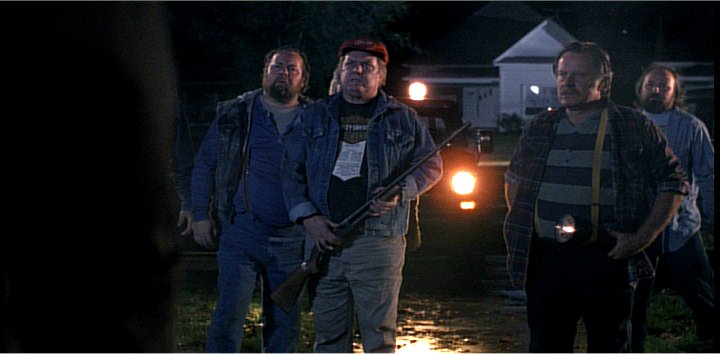
      Chances are if there was an escaped killer lurking about your hometown, most people would opt to stay indoors and lock their doors and windows. However, there would probably be a small crowd who would arm themselves, take the law into their own hands, and hunt down the killer. In Halloween 4, local bar owner Earl gathers up all his redneck buddies and they proceed to hunt down Michael, hoping to get to him before he can take another life. However, as is the case with most vigilantes, they cause more trouble than good.  Earl and his men are bit on edge, and at one point their hear rustling come from the bushes and fire away, adopting the whole “shoot first-ask questions” later mentality. Unfortunately, the man they gun down is the local town drunk, Ted Hollister, who was urinating behind the bushes. Earl tries to deflect blame by yelling at one of his men, “You dumb son of a bitch. You said you saw Myers.”  Earl and his lackeys prove to be rather ineffectual against Michael as well; he sneaks up behind them (while they are standing on the pack of moving pickup truck) and proceeds to kill them one by one.  


The biggest flaw of Halloween 4 is, unfortunately, Michael Myers himself. In the first Halloween, Michael Myers was a fairly average sized male who was very slow and methodically in the way he stalked his victims. In fact, the main reason the first Halloween is so effective is that is slowly builds to the violence at the film’s end.  You know the characters are going to get it, but you don’t know when.  The body count is relatively low (five total) and the gore is kept to an absolute minimum. The interesting thing about Michael is that he is, in fact, very much a kid trapped inside a man’s body.  In his excellent book Cult Movies, Danny Peary writes:

               I think Michael is an incredibly interesting character, not the typical vengeful movie psycho. Carpenter defines him as Evil itself (the real boogeyman), but I don’t believe he goes around killing people because he is evil. Insane, yes; evil, no. There is still a little boy inside the man’s body, and everything he does is part of a game. In fact, his activities are less suited for Halloween than “Mischief Night” (the night after Halloween “celebrated” in many American towns when kids play dirty tricks on their neighbors). He has fun scaring characters before he kills them, or teasing them by making noises, or jumping out of closets. The scariest moment is when Michael drives past Laurie, Annie, and Lynda and stops for a moment. He could kill any of these people any time he wants to, but he prefers to hide behind bushes and in closets, peer into windows, or, as in the case with Annie, play tricks with her car door.

One of the more memorable moments in the first Halloween is after Michael stabs Bob, the camera lingers on him in a long shot as he stares at Bob in a most curious manner and slowly tilts his head to the side.  By the time of Halloween 4, such nuances got thrown out the window in favor of a more one dimensional, lumbering giant. The irony is that while most slasher films took their cue from Halloween, the Halloween sequels took their cue from the many rip offs that dominated the 80s.  The Michael Myers in Halloween 4 has more in common with Jason Voorhees than he does with the Michael Myers seen in the original film.  Between Halloween II and Halloween 4 Michael has somehow bulked up and increased in height, and completely lacks the grace that defined his characters movements in the first film. No longer is he a shadow in the background, but rather a super human brute who dominates the proceedings.

In the original film the bloodshed and the violence was implied, whereas the sequels the gore factor increased greatly and the violence started to get ridiculously over the top. For instance, there is a scene in Halloween 4 in which Michael impales a curvaceous blonde girl with a rifle with very little effort.
In another scene, his hand comes crashing through a pick up truck window and proceeds to rip off Earl’s head. Granted, the gore in Halloween 4 isn’t as gruesome as it is in present horror films, but it’s still there. While many horror fans applaud the gore scenes, I find them rather redundant and boring; to me gore diffuses the tension, rather than adds to it.  When Michael rips off Earl’s head, it makes me cry out, “Oh! Come on,” rather than, “OH MY GOD!”  If the execution is poor, gore scenes can be incredibly laughable. In the Lucio Fulci film The Beyond there is a scene in which an idiot is attacked by tarantulas that proceed to rip his face apart. This sounds disgusting, but because of Fulci’s inept direction it becomes a laugh riot. For one, despite walking on a wooden floor, it sounds like the Tarantula’s are walking on potato chips, and secondly, despite having his face torn apart, the guy doesn’t seem to be in any pain. At one point he gets his eye ripped off and mere says, “OH NO!” It’s a scene that lingers on and on, and doesn’t necessarily add to the overall narrative, though Fulci films rarely make any sense.

The other aspect I can’t stand about the Halloween sequels (not just part 4) is the idea that Michael Myers hunts down his next blood relative. In Halloween II, it was revealed that Laurie Strode is Michael Myers’ sister.  This storyline was added to give Michael motivation for going after Laurie, but otherwise it added nothing to the overall narrative.  When Halloween 4 rolled along, the filmmakers couldn’t get Jamie Lee Curtis to reprise her role as Laurie, so they changed the premise from Michael Myers stalks his sister to Michael Myers stalks his niece.  I absolutely hate both story lines, because they take the idea of chance out of the equation.  In Halloween, Laurie was a random person Michael encountered and proceeded to stalk her and her friends; it was a chance encounter that leads to the death of three teenagers.  What makes the film so frightening is the idea that this could happen to anyone in any town. Laurie just happened to be at the wrong place at the wrong time and as a result she finds herself fighting for her life at the film’s end. It is also through chance that Loomis spots the car Michael stolen, sees children fleeing from a house, and arrives in the nick of time to save Laurie.  However, by making Michael and Laurie siblings this idea of chance goes tossed out of the window in favor of the idea that fate is what brought the two together.  In Halloween 4, Michael has waited patiently for ten years, so he can escape and stalk his poor niece.  This also presents the problem of “How does Michael know he has a niece?” and Halloween 4 never really answers that question; in Halloween 5 it is revealed that the two share a psychic link (when it is convenient for the plot). 

*Spoiler*

I especially loathe the twist ending in which Jamie turns evil and attacks her stepmother with a knife, thus implying that she will take Michael Myers place. There are many fans that like this ending, because how it parallels the first Halloween, but it’s absolutely needless and unoriginal. For one, Friday the 13th: The Final Chapter sports a similar twist ending, in which it is implied that Tommy Jarvis (Corey Feldman) might have not survived the ordeal of killing Jason with his sanity intact. In Friday the 13th: The New Beginning this isn’t so much as implied as  it is explicit; we see Tommy wearing Jason’s mask and clutching a knife as the film’s heroine is oblivious to her soon to be demise. In Halloween 5 this idea of Jamie being Michael’s heir apparent is completely dropped and instead she spends a good deal of the film mute and recovering in a hospital. Secondly, it’s seemed to a common theme amongst horror films of the 80s to end on a rather downbeat note, just when you thought the killer was defeated, he would come back for one more scare. It’s a cliché that got rather tiresome as the decade wore on and seeing a cute girl turn evil is just a bit too much. And Pleasence shouting, “NOOOO!” in slow motion doesn’t really help matters.

I have love/hate relationship with Halloween 4. I like the characters of Jamie and Rachel, as well a few other touches by the filmmakers. It’s still a step above the majority of the slasher films of that decade, and certainly a masterpiece compared to the dreadful sequels that followed, but unfortunately I find the character of Michael to be rather lifeless and uninteresting. He’s no longer the Michael Myers of the first film, but rather a Jason rip off.  

Cast: Donald Pleasence (Dr. Loomis), Danielle Harris (Jamie), Ellie Cornell (Rachel), George P. Wilbur (Michael Myers), Beau Starr (Sheriff Meeker), Sasha Jensen (Brady), Kathleen Kinmont (Kelly Meeker), Michael Pataki (Dr. Hoffman), Gene Ross (Earl), Carmen Filpi (Rev. Jackson P. Sayer).
Director: Dwight H. Little

Snow White's Revenge/Scandal (2024)

  It is difficult to write about Snow White’s Revenge without bringing up the ending, so readers beware, this review will contain spoilers...