Powered By Blogger
Showing posts with label Laurel and Hardy. Show all posts

Saturday, December 23, 2017

Babes in Toyland (March of the Wooden Soldiers) (1934)


In the last few years, with the rise of Netflix and other streaming services, the local TV stations have essentially dropped movies from their schedules to focus more on television series.  As a result, many Christmas classics that were in heavy rotation during the 1980s and 1990s have been dropped to the wayside to make room for more contemporary programming.  This is the fate that has, unfortunately, befallen the Laurel and Hardy classic Babes in Toyland (March of the Wooden Soldiers).

I first saw Babes in Toyland in third grade; our principal owned a 16 mm print and screened it for the entire school. This came shortly after I had discovered Laurel and Hardy, so naturally I was elated when I saw their names in the opening credits. The rest of the students were indifferent at first, but eventually got into the movie. Imagine my joy a few years later when, while browsing through the (then) brand new Wal-Mart, I found it to buy on VHS (in color) for the low prices of 12.99. WHAT A DEAL!!!  I just recently purchased the DVD for five dollars, so I guess it wasn’t much of deal after all. 


The first thing that immediately stands out about Babes in Toyland is that it fully embraces its theatrical roots (it’s based off a 1903 operetta by Victor Herbert).  For instance, most of the sets are two dimensional mocks ups, and the costumes look like something you might find at Target during the Halloween season.   The idea is to give it the feel of a storybook come to life. This is actually confirmed in the opening song number (“Toyland”) when Mother Goose emerges from a storybook and sings about the setting of the story. Midway through the number, she opens the book, and with each turn of the page, we are introduced to each of the principle characters (Little Bo Peep, Tom Tom, Little Old Lady That Lived in a Shoe, Barnaby, and Stannie Dum and Ollie Dee). 
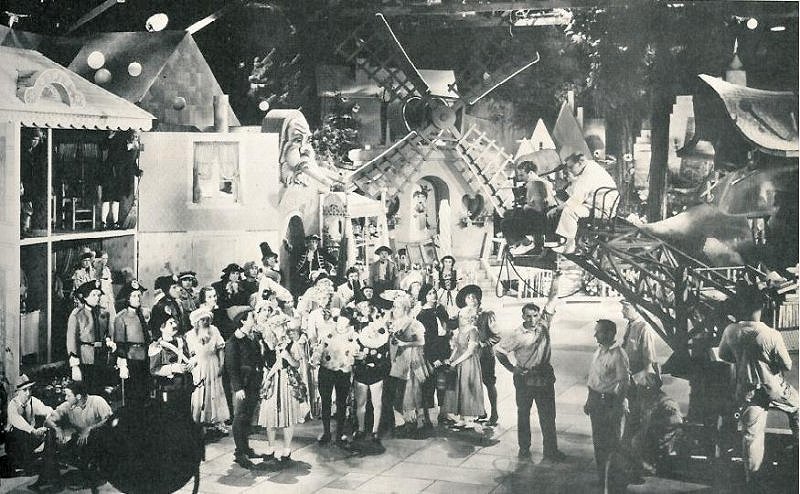
 This is actually a really clever way of introducing the characters and allows the filmmakers to do away with stilted exposition that might impede the plot.  When Little Bo Peep is looking for her sheep, Tom Tom appears and the movie can immediately jump into song because we know who Tom Tom is. A lesser movie would have some awkward dialogue exchange between the two:  “Don’t worry, Bo Beep. I, Tom Tom the Piper’s son, will help you find your sheep.”  I also have to wonder, given the way this scene is set up; did Walt Disney use it as a template for “Some Day My Prince Will Come” scene in Snow White and the Seven Dwarfs? Hal Roach and Walt Disney were friends; Disney gave Roach permission to use the song “Who’s Afraid of the Big Bad Wolf?” in this movie.  There is also a mouse that looks suspiciously Mickey who appears sporadically throughout the movie. It seems likely Walt Disney saw the movie, so was it a source of inspiration, or just a mere coincidence?

This story book setting also pays dividends in the movie’s climax when Toyland is under siege by Barnaby and the Boogeymen.  In a more “realistic” fairy tale, the Boogeymen would be absolutely laughable and embarrassing. They are essentially stuntmen in furry body suits, grass skirts, and weird rubber masks with Troll-like hair. They are less than convincing, but work extremely well in the context of this movie. These are the type of monsters you would find in a classic children’s storybook.  The fact that they are genuinely menacing (especially in the scene where they emerge from hiding to terrorize Little Bo Beep and Tom Tom) speaks volumes about the skill of the filmmakers.  Gus Meins and Charley Rogers will never be considered cinematic geniuses, but they keep things moving at a nice pace; even the “slow” musical numbers are the right length.  I would also like to point out that Babes in Toyland is one of those rare instances where I prefer the colorized version to the original black and white. The gaudy colorization process actually adds to the overall storybook feel of the movie. 


The weakest aspect of Babes in Toyland (at least from a child’s point of view) is the romance between Little Bo Peep and Tom Tom. This is largely due to the fact that neither character is particularly interesting; though, Charlotte Henry has an appealing screen presence as Little Bo Peep. Felix Knight, as Tom Tom, doesn’t fare quite as well, but at least he can sing.  What separates this romance from other Laurel and Hardy comedies of the era is that it actually plays a significant part in the movie’s plot.  There was tendency among many comedies (starring famous comedy teams) of the era to shoe horn in a romantic subplot that had nothing to with the actual story (see Bonnie Scotland as example).  While the Little Bo Peep/Tom Tom story might be a tad bit boring at least it has a point and isn’t overly obnoxious. 


Henry Brandon, appropriately, chews the scenery as the villainous Barnaby – he is wonderfully loathsome. Brandon’s performance is even more impressive when you realize that he was only twenty one years-old when the movie was made. He is very convincing as a miserly old man – he constantly walks in a stooped manner, sneers at everyone around him, and leers at the much younger Little Bo Peep. He also brings a physicality to the role that would be far too demanding of an older actor – he gets into fist fight with Tom Tom and later on carries off the screaming Little Bo Peep (who, in a bad piece of continuity, disappears from Barnaby’s arms when he is hit by a giant cork shot from a cannon).  It’s a terrific performance and Brandon nearly steals the movie with it. 


Babes in Toyland (next to Way Out West) is probably the most tightly scripted out of all Laurel and Hardy’s full length feature.  Their other full length features tended to be more episodic in nature; they were essentially three two reel comedies stitched together to make up a full length feature (A Chump at Oxford is great example of this).  There is also a time element at work: Barnaby owns the mortgage on Widow Bo Peep’s house (a giant shoe) and if she can’t pay it off by morning he will have her (and her entire family) thrown out on the street.  Barnaby is willing to forget the mortgage if her daughter, Little Bo Peep, will agree to his wife, but she will have none of that.  The boys, Stannie Dum and Ollie Dee, are tenants in Widow Bo Peep’s shoe and will do anything in their power to help her out. It also does a nice job of setting up events that happen later in the movie:  the six foot tall wooden soldiers that drive out the boogeyman at the end don’t just appear out of thin air, there is a scene early on that establishes their existence.  Stan and Ollie are toymakers and Stan manages to botch an order that was placed by Santa; instead of making six hundred solider at one foot high, Stan misreads it as hundred soldiers at six feet high.  This scene effectively establishes two things:  that Stan is absent minded and the army of six foot wooden soldiers.   There is a button on the back of the soldiers that activates them and once they are started up they are near impossible to stop. 


I need to point out just how efficiently paced the movie’s climax is:  between the siege of Toyland by the Boogeymen and their being driven out by the wooden soldiers, only ten minutes of screen time has passed.  The movie cross cuts between the Boogeymen terrorizing the citizens of Toyland and the boys (as well as not-Mickey Mouse and the Three Little Pigs) fighting back. It’s an incredibly suspenseful sequence and it’s not until Stan and Ollie activate the wooden soldiers that we are allowed to breathe. Imagine if this same sequence where done today: It would be half an hour long with lots of CGI thrown at our faces, rapid editing, and a few explosions thrown in for good measure. It would also be incredibly boring.  There’s also something wonderful about Toyland being saved by two lowly toy workers as opposed to your typical muscle bound badass.   

It also surprised me while re-watching Babes in Toyland how Tom Tom completely disappears from the movie in the last ten minutes. You would think the romantic lead would play a part in bringing down Barnaby, but nope he spends the entire battle in hiding.  This is either a brilliant deconstruction of the pointless juvenile lead, or it’s just sloppy writing. It’s probably the latter, but I’m going to keep convincing myself that it is the former.

Credits
Cast: Stan Laurel (Stannie Dum), Oliver Hardy (Ollie Dee), Charlotte Henry (Little Bo Peep), Henry Brandon – billed as Henry Kleinbach (Silas Barnaby),  Felix Knight (Tom Tom), Florence Roberts (Widow Bo Peep), Virginia Karns (Mother Goose), Kewpie Morgan (Old King Cole), Marie Wilson (Mary Quite Contrary).
Directors: Gus Meins, Charley Rogers
Screenplay: Frank Butler, Nick Grande
Running Time: 78 min.

Sunday, April 27, 2014

Way Out West (1937)


It’s really hard to describe the impact that Laurel and Hardy had on my life; they were my gateway to classic cinema. I first saw Way Out West when I was six years old (in 1985) and was amazed to find that I actually enjoyed a movie that my father found hilarious. Prior to this, I spent most of my time watching He-Man (and other dreadful 1980s cartoons) and had no desire whatsoever to watch “old” movies. When my dad purchased Way Out West on video (a colorized copy), I was absolutely skeptical. “It’s so old,” I cried. “How can it possibly be any good?”  Then I watched it and I have been hooked on Laurel and Hardy ever since. If this “old” movie was funny, then maybe other “old” movies were just as good, too.

Way Out West is my favorite Laurel and Hardy film. It is well directed by James W. Horne, who not only manages to get great performances from his supporting cast, but more, importantly never allows for the pace to lag; it is an extremely fast moving film. Way Out West is, thankfully, devoid of the unnecessary romantic subplot that often plagued comedies from that era (for a good example, see Bonnie Scotland, or The Marx Brothers' A Day at the Races). It also benefits from a great supporting cast: James Finlayson as the shady bar owner, Mickey Finn, Stanley Fields as the gruff Sheriff, and, most memorably, Sharon Lynn as the bitchy saloon singer, and Finn's wife, Lola Marcel.  Finlayson was a regular member of the Laurel and Hardy stock company and always proved to be a great foil for the boys. 


This was  Stanley Fields only appearance in a Laurel and Hardy film, but he is convincingly menacing in the role of the Sheriff. My favorite bit is when he tells the boys to get out of town in the next coach, or they’ll riding out of town in a hearse. Then after having made his threat, he adds, “Good day, strangers.”

Lynn is genuinely funny as Lola, especially when pretending to be Mary Roberts; she dabbles in  melodrama by adopting a fake southern accent and exaggerated body gestures (putting the back of her hand to her forehead, etc).  In the tradition of Laurel and Hardy, she is a very domineering woman and completely has Mickey Finn whipped.  She can turn on the charm in a heartbeat, but when crossed, LOOK OUT!!! 


What also helps Way Out West is that it actually has a solid story to build its jokes on; the boys have been entrusted to deliver the deed to a gold mine to Mary Roberts, the daughter of a deceased prospector. Mary lives in Brushwood Gulch with her guardians, Mickey and Lola, who treat her like a slave. When Finn finds out why the boys are in town, he tricks them into giving him the deed by having Lola pose as Mary.  The boys eventually get wise to the ruse and the rest of the movie concerns them trying to steal the deed back, so they can give it to the “real” Mary Roberts.  This adds an element of suspense that is generally lacking in Laurel and Hardy’s films, because we are curious to see whether or not the boys will succeed in their goal.  Mary Robert is played by Rosina Lawrence, who is fairly likable in the role, even if she isn't really given much to do.


Way Out West has four musical numbers in it, but they actually add to the charm, rather than detract from the overall comedy. The opening scene has Lola doing a song and dancer number at the saloon, “Will You Be My Lovey Dovey,” and is punctuated by shots of old men ogling her. The scene ends when one of the wives of the men arrives unexpectedly and starts slapping him across the head. This is the main reason why the musical numbers in Way Out West work so well; the filmmakers wisely incorporate comedy into the narrative. Compare this to the Marx Brother’s vastly overrated A Day at the Races (released the same year) where the comedy comes to a complete standstill while Allan Jones warbles out a few tunes. These musical numbers are completely dull and seem to go on forever.  Not only are the songs in Way Out West catchy, but they are fairly short, too. The most endearing scene in the film is when Stan and Ollie do a soft shoe dance while the Avalon Boys sing, “At the Ball.” From a narrative stand point there’s no reason for this scene to exist, but it is an absolute joy to watch, and, more importantly, it feels organic to the actual movie. They are about to enter Finn’s saloon, but notice the Avalon Boys singing and stop to listen to them. The music eventually overtakes them and they being to dance. It is a very naturalistic moment and doesn't seem contrived, unlike the dreadful musical numbers in A Day at the Races. 


Way Out West is loaded with hilarious comedy bits, here are a few of my favorite moments: 

Stan and Ollie have hitched a ride in a stagecoach and find that the other passenger is an attractive blonde (Vivien Oakland).  Ollie attempts to flirt with her and breaks the ice with, “A lot of weather we’ve been having.” He then follows up with, “Only four months until Christmas.”
 The movie repeatedly cuts to a close up of the woman who constantly wears an annoyed expression on her face. In a turn of events, it is revealed that the woman is the Sheriff’s wife.  She complains to her husband that Stan and Ollie annoyed her throughout the entire trip and he then tells them to take the next stagecoach out of town, or else. It’s a quintessential Laurel and Hardy moment; they are genuinely well meaning guys, but they have a tendency to get on other people’s nerves.


After having learned of Mickey and Lola's deception, Stan and Ollie confront them, and it turns into one big wrestling match; the deed constantly changes between hands and Stan ultimately stuffs it in his shirt, this leads to risque scene in which Lola locks Stan in her bedroom and then wrestles the deed away from him underneath her bed. Stan is extremely ticklish and whenever he is touched by Lola, he begins to laugh maniacally. This scene is interesting, because, with the exception of a few bits of dialogue, it plays like a silent movie; the humor is completely visual. 


Stanley's ability to use his thumb as a lighter. This gag gets repeated throughout the film; whenever the boys need a light, Stanley will snap his thumb and a flame with shoot out from the tip of it. This baffles Oliver and he constantly attempts to do it himself and, after numerous failures, is finally successful, but this completely freaks him out and he begins to scream, nearly blowing the boys cover in the process. 


Way Out West is one of the earliest movies to directly reference another movie, in this case Frank Capra's It Happened One Night. In that film, Clark Gable and Claudette Colbert are attempt to hitchhike, but with no success. Finally, Colbert is able to get a motorist to stop by slightly pulling up her dress and revealing her shapely leg. In Way Out West, Stan and Ollie are trying to catch a stagecoach, but with little success. Finally, Stan is able to get a stagecoach to stop by rolling up his trousers and showing off his right leg. It's a joke that would have resonated with 1930s audiences, yet is still able to work on it's own merits. When I first saw this movie when I was six, I (obviously) had not seen It Happened One Night, but I still laughed at this moment; it is so wonderfully absurd.  

While the film is brimming with slapstick, there is a lot of extremely funny dialogue as well. My favorite exchanges is Lola, impersonating Mary, asks, "Tell me about my dear, dear Daddy! Is it true that he's dead?"
To which Stan replies,"We hope so, they buried him."  

Way Out West is the kind of movie that gets ignore when film critics/historians (namely AFI) compose their Greatest Films list. It's certainly not a top 10 film, but it's definitely on par with the likes of Duck Soup and A Night at the Opera (critics have a raging hard on for the Marx Brothers), movies that often end up on  top 100 lists. C'mon AFI. 
Note: Just for the record I like the Marx Brothers. Duck Soup is one of my favorite comedies, but I definitely prefer Laurel and Hardy. 

Just for the hell of it, here are my top 10 Laurel and Hardy movies:
1)      Way Out West (obviously) (1937)
2)      The Music Box (1932)
3)      Sons of the Desert (1933)
4)      Two Tars (1928)
5)      Men O’ War (1929)
6)      Big Business (1929)
7)      Babes in Toyland (1934)
8)      Blotto (1930)
9)      Me and My Pal (1933)
10) The Live Ghost (1934)

Credits

Cast: Stan Laurel (Stanley), Oliver Hardy (Ollie), James Finlayson (Mickey Finn), Sharon Lynn (Lola Marcel), Rosina Lawrence (Mary Roberts), Stanley Fields (Sheriff), Vivien Oakland (Sheriff’s wife), The Avalon Boys (Singers), Harry Bernard (Man Eating at Bar), Tex Driscoll (Paw), Flora Finch (Maw), Mary Gordon (Cook).

Director: James W. Horne
Screenplay: Charley Rogers, Felix Adler, James Parrott.
Running Time:  65 min. 

Thursday, April 10, 2014

Hollywood Revue of 1929


It’s hard to criticize a movie like Hollywood Revue of 1929, because it has no story to tell, it is a series of musical numbers and comedy skits strung together over the course of two hours.  It’s the equivalent of watching a high school talent show; the only exception being that the performers are some of biggest stars of the day as opposed to awkward teenagers hoping to make a name for themselves. Indeed, the Hollywood Revue of 1929 was a novelty film to cash in on the latest craze in motion pictures – sound; it was, rather inexplicably, nominated for Best Picture at the 1928/29 Academy Awards (it lost to The Broadway Melody).

For the audience of the time, it must have been pretty jaw dropping to see some of their favorite silence actors speaking and singing on the big screen. In a few cases (specifically and tragically John Gilbert), the voices of the actors did not live up to their silent screen image and their film careers would come to an abrupt end.  The problem is that the novelty has worn out for modern audiences, most of whom are oblivious to half the actors in the cast, and, as a result, Hollywood Revue is an extremely arduous task to sit through; this has more to do with the unimaginative staging (and primitive sound recording) than the actual talent on display.  It is photographed like a stage play, done in complete long shots and extended takes with on occasional close up of the performer to create a dramatic effect.  The camera, for most part, remains stationary throughout the film; there are a few instances where a crane shot is used. Sometimes this stylistic choice can be beneficial, the most memorable example being Laurel and Hardy’s comedy skit, but it gets tiresome really fast. It’s also amazing just how slopping the editing is at the times; the film looks like it was edited with a chainsaw.  The jarring moments are when the position of the chorus girls will slightly change between camera sets up.

There are a few fairly offbeat moments in the movie; the two that really come to mind are William Haines ripping apart Jack Benny’s tuxedo shirt and Bessie Love making her introduction in Jack Benny’s inside coat pocket.  The comedy bit with Haines is extremely odd as if comes completely out of nowhere; The two of them banter back and forth, then Haines starts ripping apart Benny’s shirt.  Bessie Love’s introduction is a stand out moment, because it’s one of the few moments that involve a special effect.  Love is miniaturized in Benny’s pocket and does a little wave to the audience. Benny picks her up, places her on the stage floor, and then she grows to her normal height.  It’s really weird directorial decisions, but at least it’s interesting, if not entirely successful.

The movie, for all its flaws, still manages to have a few memorable moments that make it worthwhile. My favorite bits are the following:

1)      Bessie Love singing, “I Never Knew I Could Do a Thing Like That.”  After seeing Bessie Love in this movie and The Broadway Melody, I’m amazed that she didn't have a bigger career in sound films as she is an absolute joy to watch.  She has a rather lively personality and, more importantly, looks like she’s genuinely having a good time. She certainly comes off a lot better than some of her more famous co-stars; compare her energetic musical number to Joan Crawford’s rather stilted song and dance routine at the beginning of the movie. Her exuberance must have rubbed off on the producers, because she appears again later on the movie, in a musical number (“Marie, Polly, and Bess”) with Marie Dressler and Polly Moran.  While most silent stars were fairly reluctant to embrace sound pictures, Miss Love doesn't seem to have such a hang up; she seems eager to conquer the new medium. In this musical number she sings about the difficulties of transitioning from silents movies to sound movies; it's a very interesting scene to watch, because it's about a very specific moment in cinema history. It essentially encapsulates the anxiety that most Hollywood stars were feeling in 1929. Would they still have a film career by 1930? 
On an interesting side note: Love would make a cameo appearance in the James Bond film On Her Majesty’s Secret Service.


2)      Laurel and Hardy’s Magic Act.  Hollywood Revue of 1929 is not a classic film, but it is invaluable in that it features an early sound appearance by the great comedy team, Stan Laurel and Oliver Hardy. It’s not necessarily one of their best routines, but it is still rather amusing; Oliver fumbles his way through magic tricks and gets frustrated by Stan’s inattentiveness. It’s interesting to note that Oliver does all the talking, while Stan remains mute throughout the skit. While Stan was usually the quieter of the two, he was still given plenty of dialogue in their later films. This comedy routine feels like a test run for the two comedians; a chance to try out  few ideas and then later perfect them in later films. Was it their original intention that Stan would remain mute in their later sound pictures? Or was this a one time thing? 


3)      Gus Edwards singing “Lon Chaney’s Gonna Get You if You Don’t Watch Out.” This is a rather fun number. In it, Gus Edwards warns a couple of comely lasses that if they’re not careful Lon Chaney will snatch them in their sleep, then insanity ensues as a group of male dancers wearing monster masks force the women to dance with them, before they drag them to the bowels of hell. Sure, it’s not political correct, but it’s done with its tongue firmly implanted in its cheek and is fairly well staged.  It is interesting how audiences couldn't divorce Chaney from the horror films he made to the point that he was equated to being the boogeyman; this song isn't about how one of his screen creations is going to get you - NO - Lon Chaney, himself, is going to get you if you don’t watch out.  


4)      The Adagio Dance with the Natova Company.  This dance routine is one of the few times were the stationary camera is actually beneficial to the act being performed onstage. It’s probably the one scene that will have you at edge of your seat. The dance involves a petite woman being swung around like a doll by three male dancers; at point her head is just a fraction of an inch away from crashing into the floor. If this sequence were done in more conventional style, with lots of edits and close ups, the audience would assume there was a lot of fakery involved. Here, there is absolutely no doubt of the authenticity of the routine, because the filmmakers allow it to play out in front of us.


5)      Cliff Edwards and the Brox Sisters performing “Singin’ in the Rain.” This isn’t one of the earliest, if not the earliest, renditions of this song preserved on film, thus making is a historically significant moment. It’s also interesting to note that there’s a midsection (performed by the Brox Sisters) that later versions would omit. It’s also staged in a rather imaginative fashion; the most effect moment being the use of back light to create silhouettes of dancers in raincoats.  The number ends with the dancers ascending an arched stairway to form a silhouetted rainbow. The song is later reprise (in two strip technicolor) by the entire cast at the film's finale.


6)      Jack Benny as the Master of Ceremonies.  Hollywood Revue of 1929 actually has two master of ceremonies, Conrad Nagel and Jack Benny, but Benny comes off a lot better thanks to his brand of self deprecating humor. He is always amusing to watch, even when the jokes are not all that funny.  Nagel, on the other hand, is extremely stiff and looks like he would rather be somewhere else. The filmmakers must have noticed the contrast, because Nagel disappears in the film’s second half, while Benny is given free reign to do whatever he wants.


Leonard Maltin perfectly sums up this movie in his Movie Guide book, “Definitely a curio for film buffs, rough sledding for others.” If you are a fan of classic movies, especially from the silent era, then this movie is definitely worth a look.  It can be tedious at times, but there are enough moments to make it worth your while.


Credits
Cast:  Conrad Nagel (Master of Ceremonies), Jack Benny (Master of Ceremonies), Cliff Edwards, Bessie Love, Joan Crawford, John Gilbert, Norma Shearer, Stan Laurel, Oliver Hardy, Marie Dressler, Polly Moran, Gus Edwards, Buster Keaton, Lionel Barrymore, Anita Page, Charles King, Marion Davies, William Haines, Karl Dane, The Brox Sisters.
Director: Charles Reisner.
Screenplay: Al Boasberg, Robert E. Hopkins, Joseph Farnham.
Running Time:  120 min.

Snow White's Revenge/Scandal (2024)

  It is difficult to write about Snow White’s Revenge without bringing up the ending, so readers beware, this review will contain spoilers...