Powered By Blogger
Showing posts with label Psycho. Show all posts

Tuesday, October 16, 2018

Snowbeast (1977)


The true sign of a landmark movie is not its success at the box office, but rather the many bad imitations it spawns.  Immediately after the success of Jaws (1975) a whole slate of imitations were rushed into productions by rival studios (and low budget merchants).  In the span of five years, we were given such forgettable fare like: Orca, Grizzly, Barracuda, The Last Shark, Tentacles, and the subject of this review, Snowbeast.

While watching Snowbeast, I devised a theory about the movie’s origin: the director, Herb Wallerstein, desperately wanted an all expense paid vacation to the slopes of Colorado, so he Xeroxed the script to Jaws, showed it to the NBC studio heads, and was granted his vacation under the ruse that he was making a movie. When he wasn’t hitting the slopes, or yakking it up with the locals, he would spend a few hours directing the movie.  This would explain why the movie is so directionless;  Snowbeast is 86 minutes long, but a good percentage of its running  time is devoted to scenes of people skiing or riding on snowmobiles (shot by the second unit). 
Some exciting Snowbeast action!!!


Wallerstein’s direction is completely flat – the scenes are usually acted out in a master shot and it will cut to a close up to emphasize a point. It is something straight out of a television sitcom from that era.  It also doesn’t help that Snowbeast is extremely drab looking movie; its muted colors prove to be an eye sore.  It’s the equivalent to being boxed inside on a dreary winter day – the sky has a permanent grey overcast, the roads are slippery, and you just want to nod off.  

 Snowbeast shamelessly rips off Jaws in an almost beat for beat fashion; instead of a small island community being terrorized by a Great White Shark, it is a ski resort that is laid siege to by a Bigfoot.  Just like in Jaws, the authorities ignore the problem and carry on with the festivities that have planned (the 4th of July in Jaws, a winter carnival in Snowbeast). In the third act, our protagonists venture out into the wilderness, in a camper, to kill the monster.  The Bigfoot destroys the camper and, without their guns, must resort to desperate measure to kill the creature.  I was half expecting one of the characters to capture a glimpse of the Bigfoot and quip, “We’re going to need a bigger camper.” Sadly, this didn’t’ happen. 


In Jaws, there is a scene where a group of fishermen capture a tiger shark and the mayor prematurely declares that the beaches are safe again. Of course, this backfires when the real shark rears its ugly head on the 4th of July and eats a man. There is a similar moment like this in Snowbeast; the sheriff kills a Grizzly bear and public declares the danger is over.  However, the placing of this scene is incredibly awkward, because it comes AFTER the Snowbeast has laid siege to the Ice Queen ceremony at the Town Hall; meaning that the Bigfoot has been seen by multiple witnesses, all of whom could attest that what they saw was no Bear.  It also serves no narrative purpose, because minutes after the sheriff has killed the Bear, he agrees to help our heroes kill the blood thirsty Bigfoot.  The scene, essentially, plays out like this:

Sheriff: I caught the Bear. Our troubles are over.
Gar (our hero):  It wasn’t a Bear and you know it. It was Bigfoot. We need to kill it.
Sheriff: Okay. Let’s go! 


In one of the main deviations from Jaws, the character of Chief Brody is divided up into three roles: Gar Seberg, Tony Rill, and Sheriff Paraday.  The first time (and probably only time) one watches Snowbeast you mistakenly believe that Tony Rill is the main character - he dominates the first half of the movie. It is Tony that first acknowledges the existence of the Bigfoot and whose warnings are promptly ignored by the authorities (the Sheriff and his grandmother, who owns the ski resort). Grandma Rill is dismissive of Tony's Bigfoot theory; she blames the disappearance of a female skier on an avalanche. Tony will have none of that, however, and is determined to kill the beastie.


It also feels like the writer is setting it up so that Tony and Ellen (Gar’s long suffering wife and TV journalist) are going to rekindle their romance, while Gar will end up a victim of the Snowbeast.  I initially thought that Gar would attempt to murder Tony for “cutting in on his action” and would fall prey to the Snowbeast before he could go through with his plan, but that would be too interesting plot for this movie.  Instead, the movie shifts focus from Tony to Gar in the second act, while Ellen is essentially relegated to background noise.  

The love triangle that never was.

 I will give the movie this: at least it attempts to give Gar a character arc and Bo Svenson, bless his soul, does his best with the material that he is given.  In 1968, Gar won the skiing gold medal in the Winter Olympics but his star quickly faded after that defining event.  This is largely due to self doubt and complacency on Gar’s part; after winning the gold medal, he was certain that he could never top this achievement, so he gave up competing. His complacency drives a wedge in his marriage to Ellen.  Gar comes to Tony's ski resort hoping he can get a job; skiing is the only thing he knows, so naturally a ski resort would be a perfect fit for him. 


However, instead of entertaining the tourists with his celebrity, Gar is given the assignment of killing the Snowbeast.  Apparently, he is an expert shot. Gar initially refuses as he views it as cold blooded murder, but when he witnesses the carnage first hand he has a change of heart.  He also gets his swagger back; when Ellen goes missing, he dons the skis and searches for her. They are reunited and their marriage is saved. YAY!!!! 

I find the character of Ellen to be perplexing. This is not Yvette Mimieux’s fault. Her character isn’t given much to do.  It is established that she is a TV journalist, but in no way does that factor into the plot. You would think that Ellen would realize that Bigfoot on the loose makes for a great story and would promptly contact her station. If she captures a Bigfoot live on camera, it would boost her career; make her a national celebrity. It would also give her character some depth; she is simultaneously repulsed by the killings and yet excited by what it means for her career. Instead, she is just happy being Gar’s wife. Her character arc is essentially she goes from being Gar’s long suffering wife to Gar’s supportive wife. It is a really odd decision by screenwriter, Joseph Stefano.  

Left - Long suffering wife mode. Right - Supportive wife mode.

 The movie apes Jaws by keeping the Bigfoot off screen for most of the movie; the filmmakers use point of view shots and off screen roars to suggest its presence. Normally, I wouldn’t have a problem with this gimmick, but the point of view shots expose two huge problems with this premise.

1.       The cameraman often struggles to find his footing in the snow covered landscape and makes a lot of noise while doing so. It is hard to believe that none of the victims would be alerted to his presence much earlier.  The first death is extremely laughable; a female skier just idly stands there while the camera slowly descends upon her.  If she would only stop screaming she would have ample time to get away on her skis. 


2.      The landscape is completely barren and really doesn't offer the Snowbeast much in terms of cover. In the climax, when the heroes are talking outside of the camper, they should be able to see the creature looking down upon them.  He is probably less than twenty feet away and hiding behind a tree that is devoid of any foliage. Yet, because the script demands that creature destroy their camper in stealthy attack, they remain oblivious. It is a laughable attempt at building suspense.


It should be noted that the movie’s credit writer was Joseph Stefano, who his most famous for writing the screenplay to Alfred Hitchcock’s Psycho. He went from writing one of the most influential movies of all times to ripping off one the most influential movies of all time. How the mighty have fallen.  Though, in his defense, he was working with one of the great cinematic masters on Psycho, while on the Snowbeast he was stuck with an insipid director for hire.  

The two scariest moments in Snowbeast.


Credits
Cast: Bo Svenson (Gar Seberg), Yvette Mimieux (Ellen Seberg), Robert Logan (Tony Rill), Clint Walker (Sheriff Paraday), Sylvia Sidney (Carrie Rill), Thomas Bobson (Buster), Annie McEnroe (Heidi)
Director: Herb Wallerstein
Writer:  Joseph Stefano
Running Time: 86 min
Tuesday, April 9, 2013

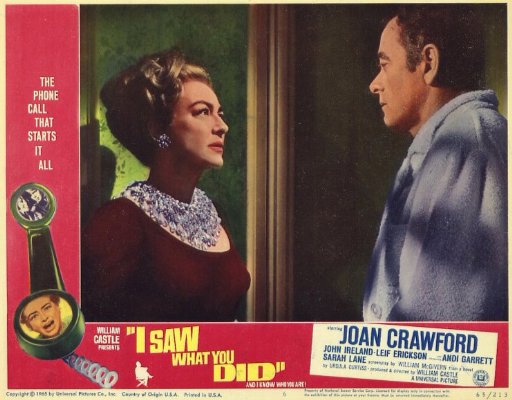
I Saw What You Did (1965)


It's common for film critics to bemoan the lack of originality in today's cinema, consistently grumbling over the latest horror remake or sequel that is due for release. Why things can't things be like the good old days? The problem with this attitude is two fold:

1) It completely romanticizes old Hollywood. Sure, a lot of great movies were made during the studio system, but for every great movie Hollywood churned out there were just as many clunkers. So, for every Gone With the Winds there were just as many Return of Dr. Xs.

2) It ignores the fact that the Hollywood of today is EXACTLY like the Hollywood of yesterday. Hollywood has always been about the profit. If one film is extremely successful, then it's only a matter of time before the other studios release a film exactly like it. When Easy Rider became an unexpected hit in 1969, the studios followed suit by making movies in a similar vain. In the 40s, two of Universals biggest money makers were the Monster films and Abbott and Costello series. MGM made a lot of great films in the 30s, but made countless Andy Hardy films as well. To quote Billy Joel, "the good old days weren't always good and tomorrow is not as bad as it seems."

In 1960 Alfred Hitchcock's Psycho hit the cinemas and proved to be a huge commercial hit. Hitchcock took a relatively obscure horror novel (by Robert Bloch) and, with a fairly low budget, turned it into a gold mine. It was only a matter of time before other filmmakers jumped on the bandwagon and produced their own Psycho, complete with relatively predictable twist endings. It is staggering just how many derivatives of Psycho were made throughout the 60s; Hammer studios would produce films like Paranoiac, Nightmare, and Scream of Fear, a young Francis Ford Coppola would direct Dementia 13 for his mentor Roger Corman, and William Castle got in the act by making THREE Psycho-like films.

William Castle is probably best known for the outrageous gimmicks he used to promote his horror films. His best known gimmick is probably Percepto-vision used for the movie The Tingler. Percepto consisted of attaching buzzers underneath select seats in the theater and setting them off during the film's climax (in which Vincent Price implores the audience to scream for their lives). Another gimmick was Emergo, which essentially was a plastic skeleton attached to a wire that floated over the heads of the audience during the climax of House on Haunted Hill. 

I Saw What You Did was William Castle's third attempt at mimicking Hitchcock, his two previous attempts were Homicidal and Strait Jacket, both of which hinge on a twist ending regarding the killer's REAL identity. Castle tries to pull a sleight of hand like Hitchcock did with Psycho, but ultimately fails, because the twist is fairly predictable in both films. I Saw What You Did is probably the most successful out of the three films, because it's the least gimmicky. The film follows two mischievous teenage girls, Libby and Kit, who amuse themselves by prank calling random numbers and whispering the phrase, "I know who you are and I saw what you did."  Unfortunately, one of their recipients, Steve Marak, has just murdered his wife. Libby mistakenly thinks that Steve is playing along with the prank and starts to grow curious as to what he actually looks like. The girls decide to drive by his home to have a look. Their plan is thwarted by Steve's next door neighbor (and would be lover), Amy, who thinks that Steve is having an affair with Libby. The girls beg Amy not to say anything, fearing that they will get in trouble with Libby's parents (who are at party) for leaving the house. Amy, out of spite, takes Libby's ID. The girls drive home dejected. Amy is aware that Steve has murdered his wife and plans to use this information to blackmail him into marrying her. Fat chance! Steve, not one to be caged, offs Amy and discovers Libby's ID. He then drives to Libby's house to confront her. Uh-oh!


I Saw What You Did "borrows" two distinct elements from Alfred Hitchcock's Psycho:

1. The killing of a star name fairly early in the proceedings: In Psycho, it was a genuinely shocking to see Janet Leigh killed off in the middle of the film. It was simply unheard of at the time to kill off a star name so early in the proceedings and naturally the audience had no idea how to react. William Castle takes a page from Hitchcock's book and bumps off Joan Crawford's character, Amy Nelson, with nearly a half hour remaining in the film. However, Crawford's death isn't nearly as shocking and disorienting as Janet Leigh's, because Amy is a supporting character and a fairly unsympathetic one at that. When she thinks Steve is having an affair with Libby, she becomes extremely jealous and possessive, to the point of blackmailing Steve into marrying her.

2. The shower scene: The shower scene is the most famous set piece in Psycho, so it's not surprising that Castle would ape it in his own movie, but with a twist. Steve is taking a shower when his wife starts to yell at him, he has had enough, pulls her in and stabs her to death. It is the Psycho shower scene done in reverse. The stabbing is shot in a similar fashion to the one in Psycho; shots of blood going down the drain, close ups of the woman's face, etc.

After Steve has murdered his wife, he attempts to cover up the crime by burying her in the woods. This is very similar to how Norman Bates tried to cover up Marion's murder, by dumping her car (with her body in the trunk) in the swamp. Castle milks these scenes to great effect, Steve is constantly on the verge of being discovered. At one point Steve hears a rustle in the woods and realizes a dog is coming his way. The gig is up, or so Steve thinks, but at the last possible second the dog's owner calls it back to the car.

I Saw What You Did is pretty jarring at times due to how tonally inconsistent it is. The scenes with the girls are done in a fairly light hearted manner with upbeat music playing on the soundtrack. These scenes would be more at home in a TV sitcom like Gidget than in a horror film. The scenes with Steve and Amy are extremely intense with your typical "spooky" horror/suspense music playing in the background. The fatal flaw of the film (other than plagiarizing Hitchcock) is that it hinges on characters behaving in the stupidest manner possible. Libby MUST know what Steve looks like, so she drives down to his house, gets caught snooping on his lawn by Amy, and in the process gives Steve the information he needs (her ID that Amy has taken) to track her down. Amy, out of fear of losing to Steve to much a younger woman, tries to blackmail him into marrying her, which, given the fact that he has just murdered his wife for her constant nagging, isn't exactly a bright idea. If Steve wasn't going to allow himself to be tied down to a constant nagger, then why would he allow himself to be held prisoner to a potential blackmailer. It's enough to make you smack your forehead in complete disbelief. On the other hand, at least the girls are played by actual teenagers (instead of the twenty something that often populate high school horror films) and behave as such. John Ireland makes for a compelling villain as well, he's absolutely cold and frigid to the world around him, and shows no remorse for the crimes he has committed. However, he only lashes out at the world when he feels he is being boxed in; his first murder was one of passion, the second was for self preservation. The confrontation between Steve and Libby (and Libby's younger sister Tess) at the end is extremely well done; at one point he tosses a knife as Tess when she screams out a warning to Libby. Castle really pumps up the atmospherics; the outside of the Mannering house is shrouded in fog, while Tess hides in the woods from her pursuer.
I Saw What You Did certainly pales in comparison to Psycho, but it's fairly entertaining in its own silly way.

Credits
Cast: Joan Crawford (Amy Nelson), John Ireland (Steve Marak), Andi Garrett (Libby Mannering), Sara Lane (Kit Austin), Sharyl Locke (Tess Mannering), Leif Erickson (Dave Mannering), Patricia Breslin (Ellie Mannering), John Archer (John Austin).

Director: William Castle
Screenplay: William P. McGivern
Running Time: 82 min.

Tuesday, November 13, 2012

1941 (1979)


The question that often gets asked in Film Studies classes is: Who’s your favorite filmmaker? Without any hesitation I can tell you that my favorite filmmaker is Steven Spielberg. What? Blasphemy, you say! How can you rank Steven Spielberg higher than the likes of Alfred Hitchcock or Jean Luc Godard? Okay, maybe you’re not saying this, but this response was common amongst the UW-Milwaukee film professors. One of my professors had nothing but disdain for Spielberg, claiming that his films were “manipulative.” Which is true, but then again so are the films of Hitchcock and for that matter Jean Luc Godard.  In fact, the underlying success to all GREAT cinema is manipulating the audience into caring about the characters that inhabit the screen.  Alfred Hitchcock’s Psycho is possibly the most manipulative movie ever made; for the first 45 minutes the audience roots for Marion Crane, completely sympathetic to her plight, and are thus horrified when she is brutally murdered right before their eyes. The whole success of this scene is dependent on whether or not the audience cares for Marion, if they don’t, then it’s a complete bust! 
Now a film professor might respond with, “The shower scene is terrifying regardless as to whether or not the audience sympathizes with Marion.”  It might be, if the shower scene happened at the very beginning of the film, but it happens midway through the actual movie, after the audience has spent a good deal of time observing Marion Crane. If they don’t connect with her character on some level, then more than likely, they won’t make it to the shower scene, thus rendering it useless.  
I bring this point up, because the idea that Spielberg is a lesser filmmaker for being  manipulative is a completely INVALID point. In fact, what makes Spielberg a great filmmaker is his ability to get an emotional reaction out of his audience, despite the fact that what’s onscreen is absolute fiction (I’m of course talking about his wonderful fantasy films, as opposed to his problematic attempts at history).   E.T. The Extra-Terrestrial became one of the highest grossing films of all time, because Spielberg was able to make his audience care about a rubber puppet.  This may not seem impressive at first, but once you watch the 1989 rip off Mac and Me, you’ll totally appreciate just what Spielberg was able to accomplish. Jaws was a movie that in lesser hands could have been laughable, but thanks to Spielberg’s expertise became a classic. Again, if you doubt my word, watch any of the Jaws rip offs that have cluttered the video shelves and the Syfy channel for the last few decades, you will greatly appreciate the restraint Spielberg brought to the material.  Whether they admit or not, one of the main reasons why people from my generation got into film was because of Steven Spielberg. His films played a crucial part in most of our lives. 

Now, I’m sure one of the three people reading this article will say to him/herself, “Yeah, those films were good, but, God almighty did that last Indiana Jones film suck!  What was with that awful scene in which that annoying Shia kid swings from vine to vine like Tarzan? How embarrassing! Worst…Movie…EVER!”   First off, Indiana Jones and the Kingdom of the Crystal Skull is far from being the worst movie ever made, that dubious distinction belongs to the Robin Williams movie Patch Adams. Secondly, it’s true that Spielberg has had a few misfires in his long career, but then again, so has just about every director in cinema history. It happens. However, even Spielberg’s misfires often have a few scenes that make it worthwhile; Crystal Skull maybe laughable in many parts, but the chase scene through the college campus is a lot of fun.  The Lost World is a dreadful film, but I personally like the scenes of the T-Rex rampaging through the streets of San Diego; there’s very little logic at work, but they are amusing.  And this is when I turn my attention to Spielberg’s first major misfire 1941; a big budgeted comedy about the paranoia that enveloped the West Coast following Japan’s attack on Pearl Harbor. 


1941 was a God send for Spielberg’s detractors, “At last,” they proclaimed, “that Spielberg is finally being exposed for the fraud that he is.” They gleefully chuckled as the film died at the box office, hoping that this would be the last they would ever see of this “upstart” filmmaker, only to have their hopes dashed two years later when Raiders of the Lost Ark would prove to be a huge box office smash.  At this point in his career, Spielberg had never really tasted failure before; his first theatrical film The Sugarland Express did very little business at the box office, but it was made for a rather modest budget, hence it proved to be a low risk venture for the studio.  Jaws essentially created the blockbuster and Close Encounters of the Third Kind was a huge hit, even if its success was overshadowed by Star Wars. Spielberg was riding a hot hand and was thought to have the Midas touch; he could do no wrong in the studio’s eye. 

In theory 1941 had all the ingredients of a box office bonanza; a great director at the helm, a screenplay by two gifted writers (Robert Zemeckis, Bob Gale), an impressive array of stunts and special effects, and more importantly, an all star cast.  The most inspired piece of casting was getting John Belushi to play the small, but pivotal role of Wild Bill Kelso. Belushi at this point was a huge star on “Saturday Night Live” and was coming off his scene stealing role as Bluto in National Lampoon’s Animal House; he was a hot commodity and thus making it more impressive that he was willing to play a supporting role.  However, despite his limited screen time, Belushi is given prominent billing in the credits and it’s usually his face that is seen on the posters as well as most merchandise and promotional items. 
  

1941 is from the “the bigger the better” style of comedy that is seen in movies like: It’s a Mad, Mad, Mad, Mad World, The Great Race, Catch-22, and The Russians Are Coming, The Russians Are Coming. These films are not just comedies, but grand spectacles as well.  The irony is that, especially in the case of 1941 and It’s a Mad, Mad, Mad, Mad World, the biggest laughs often come from a well known dramatic actor, instead of the big named comedians that mug endlessly for the camera. Spencer Tracy’s performance in It’s a Mad, Mad, Mad, Mad World is easily the best thing about the movie, largely due to his understated acting; Tracy is able to get a laugh by slightly changing the expression on his face. In 1941, the funniest scene is not of Belushi hamming it up, but of Robert Stack (as General Stilwell) getting overwhelmed with emotion while watching Dumbo. Stilwell up until this point in the movie (and after) is a fairly straightforward, no nonsense character and it’s absolutely hilarious to see this rather uptight man tear up to the song “Baby Mine” and sing along to “When I See An Elephant Fly.”

I have a confession to make….I absolutely love 1941. It’s true that as a whole the film simply doesn't work; it never quite gels together and too often the characters get lost in all the chaos. The film’s main flaw is not the lack of original ideas, but it’s that there are just too many ideas onscreen. It is littered with endless subplots and supporting characters, so along with Stilwell watching Dumbo, we are shown the following stories:
1)      Bobby is a young man from the “wrong side of the tracks,” whose main goal is to dance with the lovely Betty as the USO. However, he is constantly being thwarted by the Neanderthal that is Corporal “Stretch” Sitarski (Treat Williams), who has his eyes on Betty as well, despite her resistance to him. In theory, Bobby is the true protagonist of 1941 as he’s the only character given an actual character arc; he goes from being a disrespected "hoodlum" to being put in charge of sinking the Japanese sub at the film’s end.  Bobby Diciccio is likable enough as Bobby and Dianne Kay is appealing as Betty, but Spielberg doesn’t do them any favors by constantly cutting away from their story line  Whenever it seems you’re just about to get caught up in their lives the film will cut another story line, already in progress. 

2)      Captain Birkhead’s (Tim Matheson) attempts to go all  the way with  Donna Stratton (Nancy Allen). It is revealed that Stratton has an airplane fetish and will only go all the way if she is up in an airplane. Birkhead finally gets her up in the air and is nearly killed for his effort.

3)      Wild Bill Kelso (John Belushi) is a crazy airplane pilot, who is convinced he is chasing a squadron of Japanese fighter pilots.  Kelso really doesn’t come into prominence until  the second half of the film, but ends up tying the stories together. (He shoots down the plane with Birkhead and Stratton, tells Stilwell about the sub, and orders Wally (after being trapped underneath a giant plastic Santa Claus) to sink the sub. Belushi is always amusing, but never really funny (except for the fall he does off the wing of the airplane).

4)      The Japanese submarine crew, whose mission it is to destroy Hollywood in hopes it will demoralize the Americans. They blow up an abandoned amusement park instead and think they have accomplished a great victory for Japan. The scenes are amusing largely due to the interaction between horror great Christopher and Kurosawa regular Toshiro Mifune. 

5)      Sgt. Frank Tree and his incompetent tank crew. Though, in one of the rare instances, the Frank Tree storyline nicely intertwines with Bobby’s, as Sitarski is a member of Tree’s crew. Tree himself is often the voice of sanity, when Sitarski is about to punch Bobby at the beginning, he intervenes saying, “I hate see Americans fighting Americans.” Later on, he suppresses a riot between the Zoot Suits, the Navy, and the Army by giving a similar speech.

6)      The army installs an anti-aircraft gun in Betty’s father’s (Ned Beatty) backyard and he destroys his house while trying to sink the Japanese sub with it.

7)      And there are minor scenes thrown in the mix, like those involving the insane Col. Maddox (the great Warren Oates), who is convinced the Japanese have already mounted a land invasion of the West Coast. And the scenes between two air raid wardens sitting on a ferris wheel, Claude Crumm (Murray Hamilton) and the ever annoying Herbie (Eddie Deezen) and his dummy. 

It’s like Spielberg and friends had a checklists of ideas they wanted to see in the movie and put them in there, regardless as to whether they worked or not. I actually think the film would work better without the Japanese submarine crew, instead have it be a figment of everyone's imagination. The film is about panic that swept the West Coast after Pearl Harbor, and in a way the submarine justifies the panic. Sure, they don't bomb anything important and no one is killed, but they were still threatening to do so.  

  Earlier, I mentioned that Psycho is a classic movie largely because it has a strong protagonist the audience can relate to (Marion Crane), this is completely lacking in 1941; we might like a few of the characters, but we are not drawn to them they way we are to Marion Crane. Bobby’s best moments often get overwhelmed by the pyrotechnics and stunts that are happening around him, while Betty is a fairly passive character.  General Stilwell has a few nice scenes, but is missing for most of the action; he’s determined to watch Dumbo at any costs and won’t even let a riot outside the cinema get in his way.  However, in spite of its flaws (or because of them) I am absolutely drawn to 1941 every time I watch it.  From a narrative perspective the film is rather weak, but as spectacle it is top notch; it has some of the best set pieces Spielberg has ever filmed. Here are just a few that I really like: 

1.       The opening scene is a parody of Spielberg’s own film Jaws. It opens the exact same way: a young lady (Susan Blacklinie, the same actress in Jaws) goes skinny dipping in the ocean, but instead of being attacked by a shark, finds herself straddling the periscope of a surfacing submarine. Modern day audiences may just shrug with complete indifference, as pop culture references have become prevalent in today’s comedies, but in 1979 this was basically unheard of in the movies. A year later, the Zucker brothers would also open their film Airplane with a parody of Jaws, instead of a sharks fin breaking the water surfacing; it’s an airplane fin breaking the surface of the clouds. 


2.       Stilwell assuring reporters that no bombs will be dropped on  California, while simultaneously a bomb is accidentally dropped from a bomber (after Donna has slugged Birkhead, who lands on the release mechanism) and rolls their way. 

3.       The jiggerbug dance scene in which Wally tries to simultaneously dance with Betty and evade the wrath of Sitarski.  This scene is a lot of fun to watch, thanks largely to its inventive choreography and the energy of the performers.  It would have paid off a lot better had the film been told solely from Wally’s perspective, but it works wonders as standalone sequence. This scene is followed up with an all out brawl after Sitarski punches Wally. 

4.       The scenes of Stilwell watching Dumbo. My favorite bit is when Stilwell is finally informed of the riot outside the movie theatre, but keeps trying to watch Dumbo and getting upset at a MP that is blocking his view of the screen. He orders the guy to sit down and relax. 

5.       The funny scene in which Wild Bill Kelso meets his soul mate in Col. “Madman” Maddox. Kelso is convinced there’s a Japanese squadron flying over California, while Maddox is convinced they have already launched a land invasion. Before Kelso takes off, Maddox asks Kelso if he can hear his guns. Kelso fires his guns, shooting up the place, while Maddox and his men cheer on. 


6.       In a futile attempt to sink the Japanese sub with the anti-aircraft gun in his backyard, Ward Douglas instead destroys his house.

7.       After having suppressed the riots, Frank Tree gives a patriotic speech that unifies the crowd.  It’s actually a fairly funny speech filled with paranoid xenophobia and “American can do” sentiment that was dominant during WWII. At one point Tree asks the crowd, “Look at Santy Claus? Isn’t he cute? Do you think the Japanese believe in Santa Claus? Instead of turkey for your Christmas dinner, how would you like to have raw fish heads and rice? Do you think the Krauts believe in Walt Disney? Yeah, well was that Mickey Mouse I saw blitzkrieging across France? Pluto in Poland? Or Donald Duck at Pearl Harbor?” 


8.       The destruction of the amusement park, which leads to the Ferris Wheel rolling into the ocean. It may be shallow spectacle, but it is impressive nonetheless.

9.       Sitarski getting his just desserts at the hands of Wally. The two foes meet face to face in the street and have the following exchange:
Wally: I know I can’t beat you in a fair fight.
Sitarski: Stupid, I don’t fight fair.
Wally: Neither do I.
Wally then kicks Sitarski in the crotch and hits him across the face with a gun belt. The Sitarski/Wally rivalry is one of the few storylines the film does good job of setting up and it is completely satisfying seeing Sitarski get his.  
      
      1941 has been labeled a flop by many sources; this isn’t true as it actually made a decent profit during its initial release. The reason why it was thought to be a flop was that compared to the box office of Spielberg’s last two films (Jaws, Close Encounters of the Third Kind) it was disappointing. The film was not a great success among critics and understandably so, it is a very loud and busy movie. There’s lots of spectacle, but very little heart.  However, any film that features a scene that has Slim Pickens being interrogated by Christopher Lee (speaking German) and the great Toshiro Mifune (speaking Japanese) can’t be all bad. 


Cast:  Dan Aykroyd (Sgt. Frank Tree), John Belushi (Wild Bill Kelso), Bobby Di Ciccio (Wally Stephens), Dianne Kay (Betty Douglas), Robert Stack (Maj. Gen. Joseph W. Stilwell), Ned Beatty (Ward Douglas), Treat Williams (Cpl. Chuck “Stretch” Sitarski), Warren Oates (Col. “Madman” Maddox), Tim Matheson (Capt. Loomis Birkhead), Nancy Allen (Donna Stratton), Toshiro Mifune (Cmdr. Akiro Mitamura), Christopher Lee (Capt. Wolfgang von Kleinschmidt), Murray Hamilton (Claude Crumm), Lorraine Gary (Joan Douglas), Slim Pickens (Hollis Wood), Wendie Jo Sperber (Maxine Dexheimer), Joe Flaherty (Raoul Lipschitz), Penny Marshall (Miss Fitzroy), John Candy (Pvt. Foley), Eddie Deezen (Herbie Kazlminsky), Lionel Stander (Angelo Scioli).

Dir: Steven Spielberg.
Screenplay: Robert Zemeckis, Bob Gale.
Running Time: 146 min. 

Wednesday, October 31, 2012

My Top 25 Horror/Monster Films, Part III (10-1)


10. The Thing (1982)

Dir: John Carpenter
Running Time: 108 min.
The Thing was largely criticized when it came for being  overly violent and too gory, yet compared to the horror films of the last decade it is pretty tame. More importantly, the gore effects in The Thing actually serve a function to the overall story; the titular creature survives by assimilating the creatures around it. The audience never truly realizes the sheer horror of the Thing, until it is shown trying to assimilate sled dogs that are around it, and later when one of the humans is revealed to be a part of the Thing. The real tension in the film doesn't lie in its gruesome effects, but on the idea that the characters (and the audience) can never be certain as to who is human and who has been assimilated. This one of the few remakes that improves upon the original film, The Thing From Another World.  This is largely due to the fact that it’s more faithful to novella both films are based on, “Who Goes There?” by John W. Campbell. Lots of scenes from Carpenter’s film are taken directly from the novella, like the famous blood test scene.


9.  The Bride of Frankenstein (1935)

Dir: James Whale
Running Time: 75 min.
It’s often a tough choice for me to decide which film I like better: Frankenstein or The Bride of Frankenstein, because both are wonderful movies. In the end, I choose Bride of Frankenstein because it’s a far more complete film. The original Frankenstein sets up a love triangle that never pays off; it is hinted throughout that Henry Frankenstein’s fiancée, Elizabeth, will inevitably end up with his best friend, Victor, but this subplot gets abandoned by the film’s end. In the sequel Victor is completely forgotten about and Henry is allowed to create another monster with his demonic mentor, Dr. Pretorious (the wonderful Ernest Thesiger). Boris Karloff once again plays the monster in a sympathetic light and the ending in which his “bride” rejects him is truly saddening.  Once Karloff relinquished the role of the monster, it essentially was relegated to a walking prop, occasionally showing up at the end of future films to stumble around the set for a few minutes before everything went up in flames.


8. Rosemary’s Baby (1968)

Dir: Roman Polanski
Running Time: 136 min.
Rosemary’s Baby is a wonderful piece of misdirection: the first few minutes play like a cheesy day time soap; two newlyweds get an apartment in New York and are hoping to add a child into the mix. Then surely, but slowly everything starts to unravel, until it is revealed that the weird old couple next door are actually Satan worshipers and Rosemary’s husband is in on the plot to impregnate Rosemary with the devil’s child. In lesser hands this film would be completely laughable, but director Polanski builds tension with the power of mere suggestion.  In one famous shot, the character of Minnie (Ruth Gordon) is seen talking on the phone in her bedroom, but her face is blocked by the doorway; it’s a seemingly normal scene, but the blocking suggests something isn't quite right. Also, because the film is largely seen from Rosemary’s point of view, there are a few times where the audience starts to question her sanity; is there really a conspiracy going on or is all in her head? In fact, there are many people who claim that the film’s film scene is in fact, a hallucination caused by the stress Rosemary has put herself through. I don’t agree with the interpretation, but these ambiguities are what make Rosemary’s Baby such a classic horror film.


7. Island of Lost Souls (1932)

Dir: Erle C. Kenton
Running Time: 70 min.
Island of Lost Souls was the first adaptation of the H.G. Wells novel “The Island of Dr. Moreau” and it’s by far the best, even though the author himself hated it. In the novel Moreau is seen in a more kindly light, whereas he’s completely diabolical in the film version. Charles Laughton is a magnificent as the maniacal Moreau, who through vivisection hopes to accelerate the evolution of animals by transforming them into humans.  Bela Lugosi is terrific in a small, but memorable role as the Sayer of the Law.


6. Evil Dead II (1987)

Dir: Sam Raimi
Running Time: 84 min.
Evil Dead II is simply a joy to sit through. The first Evil Dead was a straight forward horror film filled with lots of gore and Bruce Campbell stumbling through the scenery as the cowardly Ash. Evil Dead II takes the same premise, but adds humor to the mix to make it one of the more memorable films of the 80s. It’s hard to dislike such a silly movie like this, hell, even Roger Ebert gave it a good review. Yet, despite the humor, there still are a few genuine scares scattered throughout, like the sudden emergence of the possessed Ed, or when the corpse of Henrietta bursts from the cellar floor. However, the highlight has to been Ash’s continuous battle with his possessed severed hand.


5. The Pit and the Pendulum (1961)

Dir: Roger Corman
Running Time: 80 min.
Vincent Price is one of my all time favorite actors; so it’s a sure bet that at least one of his film would be included in my top five. I decided on The Pit and the Pendulum largely due to the fact that it was the first Vincent Price film I ever saw, at the tender age of six. It was one of the first films my dad recorded on our new VCR, and I remember staying up late to watch it with him, my sister, and my cousin Mike, but not being able to finish it, because it creeped me out. It’s still rather chilling nearly 26 years later; especially the idea of being buried alive. The film presents this motif twice: When, in a flashback, Nicholas’ (Vincent Price) dad is shown interring his mother alive by building a wall of bricks around her, and later when it is revealed Nicholas wife was buried alive, which drives him to the brink of insanity.  And who can ever forget the ending, with an insane Price leering on as poor Francis (John Kerry) is strapped to a table while the pendulum swings ever closer to his body.


4. Invasion of the Body Snatchers (1956)

Dir: Don Siegel
Running Time: 80 min.
Invasion of the Body Snatchers doesn’t contain too many effects shots, but it’s far more effective than the many effects laden monstrosities that have dominated the horror genre in the last two decades. The film moves at a fast pace, largely due to the fact that the characters are constantly on the run. The premise is genuinely frightening:  the people in our community are not who we think them to be and, are in fact, duplicates lacking in the emotion department.  The most horrifying shot is when Miles (Kevin McCarthy) kisses Becky (Dana Wynter) and realizes she has been replaced due to the dead look in her eyes. A lot of political subtext has been attached to the film; there are some people who claim that it is anti-communist, while other are adamant it is anti- McCarthy, but regardless of its intentions (or lack thereof) it succeeds as a scary sci-fi/horror film.


3. Psycho (1960)

Dir: Alfred Hitchcock
Running Time: 109 min.
What’s amazing about Psycho is that despite the fact that I went in knowing both of its twists (the heroine get killed halfway through in a shower, the reveal that Mrs. Bates is actually her son Norman in drag), I was still drawn in by the narrative. The film succeeds because the audience relates to the character of Marion Crane (Janet Leigh), which makes even more shocking and appalling when she is killed off right before our eyes forty five minutes into the film. If there is a flaw in Psycho it is the fact that the second half of the film is far less compelling, largely due to the fact that Marion’s sister Lila (Vera Miles) is not a particularly likable character. However, Psycho still remains a favorite due to its wonderful set pieces:  Marion being stalked by a highway patrolman, the shower scene; Norman (Anthony Perkins) cleaning up after his mother, the murder of detective Arbogast (Martin Balsam), and the reveal at the end. If you have hard time appreciating Psycho, then I suggest you watch the many imitations that followed it (William Castle’s Homicidal, I Saw What You Did, and Hammer’s Paranoiac and Nightmare); I guarantee these minor films will make realize what a genius Hitchcock truly was.


2. King Kong (1933)

Dir: Merian C. Cooper, Ernest B. Schoedsack
Running Time: 100 min.
The first time I saw King Kong was when I was twelve years old. I was stayed up until three in the morning on a Saturday night to finally catch a film I had heard so much about throughout my childhood. Practically everyone knows about King Kong a top the Empire State Building, whether they have seen the film or not. The first forty minutes of the film effectively builds up to Kong’s first appearance, and I remember being excited that I was finally going to see Kong, BUT when he made his appearance…I LAUGHED! I thought to myself, “Wow! These effects are horrible. Kong looks like he’s made of clay.” However, as the film progressed, a funny thing happened….. I stopped thinking of Kong as a dated special effect and began to think of him as a genuine character. King Kong is a highly entertaining film, but it’s most amazing achievement is that somehow Willis O’ Brien and his team of animator were able to inject a personality and life into an 18 inch model covered with rabbit fur. Kong is  a fully realized character; he goes through a whole array of emotions throughout the course of the film and, despite being the villain, his death at the end is truly heart breaking. King Kong is one of the most influential films ever made and it’s a tribute to directors Merian C. Cooper and Ernest B. Schoedsack that the film is just as popular today as it was eighty years ago.


1. Jaws (1975)

Running Time: 124 min.
Dir: Steven Spielberg
Jaws, like Psycho, has inspired countless imitations (and three unnecessary sequels) and once you have seen any of them, it makes you realize just how wonderful the original truly is. Jaws is the kind of the film that in lesser hands could have been absolutely dreadful, but director Steven Spielberg builds the suspense by never allowing the audience a good look at the shark until the film is two thirds over. The icing on the cake is that the characters are extremely likable and are capable of having genuine conversations; the most memorable being Quint (Robert Shaw) recounting surviving the U.S.S. Indianapolis sinking. It’s a scene that’s not necessarily relevant to the plot, but it adds depth to the character of Quint and explains why he’s so obsessed with killing this one shark.  It’s a highly entertaining and, in my opinion, one of the greatest films ever made. 

House of Spirits (2016)

A theme that has eluded Hollywood for the last decade is forgiveness. Hollywood prefers the strawman approach to villainy – they will ofte...