Powered By Blogger
Showing posts with label Tim Burton. Show all posts

Thursday, June 13, 2019

Ed Wood (1994)


Edward D. Wood, Jr. is often regarded as the worst director in cinema history. He might have been destined for obscurity if it wasn’t for the 1980 book “The Golden Turkey Awards” by Harry and Michael Medved.  In their book, Wood was voted the “worst director of all time” and his magnum opus Plan 9 from Outer Space was voted “the worst movie of all time.” This brought Wood new found fame among bad movies aficionados, who eagerly sought out his body of work.  Wood was a fairly interesting character, not only was a bad movie auteur but also – a World War II vet (he survived one of the bloodiest battles in the South Pacific); a writer of lurid pulp novels; a pornographer (after his failed career in Hollywood he relegated himself into making hardcore porn); and a transvestite.  His pseudo-documentary Glen or Glenda is (rightfully) ridiculed for its sheer ineptitude, but it’s also one of the most personal movies ever committed to celluloid – it’s based on Wood’s own struggles to come to terms with his cross dressing.   His movies are genuinely unique, even if they are terrible. He was a true auteur!  It is no wonder that Tim Burton was compelled to tell Ed Wood’s story – he is the ultimate misfit. 


It is important to note that Ed Wood is not your typical Hollywood biopic. It only focuses on a small portion of Wood’s life (1953 – 1959) and completely plays around with the facts – it glosses over Wood’s alcoholism and omits his brief marriage to Norma McCarty. It recreates the behind the scenes of three Wood movies – Glen or Glenda, Bride of the Monster, and Plan 9 from Outer Space – but skips over the making of Jail Bait (which was shot on the same sets as Glen or Glenda).  While most of Wood’s stock company is portrayed in the movie, Lyle Talbot is noticeably absent (even though he appeared in three of Wood’s movies).  

There are also a lot of liberties taken in the storytelling (mostly for comedic effect); in the movie, while making Bride of the Monster, Ed talks Bela Lugosi into wrestling with a rubber octopus in a pond, when in reality it was a stunt double (this is even more obvious in the cleaned up DVD of Bride of the Monster).  There has been a dispute as to how Loretta King was cast in Bride of the Monster – in the movie, Ed mistakenly believes that Loretta has the money to finance the entire production (after she lends him two hundred dollars) and he cast her in the lead out of obligation, while Loretta King claims that she was contacted by Wood, via her agent, and that money was never a factor.  I tend to be believe King’s account of the story, because while filming Bride of the Monster Wood ran out of money and had to briefly shutdown production until he could get financing – so,  if King was cast under false pretenses, then wouldn’t Wood just recast the role once production started up again?  It should be noted that it was Dolores Fuller, Ed Wood’s ex-girlfriend and one time lead actress, who kept pushing this story about Loretta King. Initially, Fuller was supposed to play the heroine in Bride of Monster but Wood eventually cast King in the role.  There is a theory that Wood lied to Fuller about the circumstance of King’s casting in a desperate attempt to let his girlfriend down gently.  “I desperately wanted to cast you in the lead role, baby, but she has all the money.  I need to placate her whims.”  Either way, Fuller’s account of Loretta King is second hand, at best, and is fairly biased towards Ed Wood.   Also, despite what the movie claims, Loretta King was not allergic to water.  


The movie is less of a biography of Wood and more a retelling of his life through a fairy tale lens.  Wood, as played by Johnny Depp, is an enthusiastic, good natured young man who is looking for the big break. He desperately wants to make movies but just can’t seem to get his foot into the door.  He finally gets a chance when he learns that sleazy producer, George Weiss, is making a biography of Christine Jorgenson and Wood manages to convince Weiss he is the man for the job because of his cross dressing history.  Weiss grudgingly hands Wood the assignment and then is dismayed (albeit briefly) that Wood’s script has nothing to do with Christine Jorgenson, but he really doesn’t care too much about the content as long as Wood delivers the movie on time and it makes a profit.  The running gag throughout the movie is that Wood often has to swindle his way into making movies; he’ll do anything because the ends justify the means.  When his landlord tells him that his church is interested in making a series of movies on the apostles, Wood tells him that they should invest their money into a proven genre (science fiction) and then they can use the profits from that film to finance their apostle movies.  He then persuades the church to fund Plan 9 From Outer Space (they later regret the decision after seeing Wood’s absent minded approach to filmmaking).  When they point out all errors in a scene, Wood barks back, “movies are not about the small details, they are about the big picture.”  What is incredible about this scene is that, despite the legitimate criticism of his backers, we find ourselves siding with Wood. The movie does such an excellent job of portraying Wood as an underdog figure that we naturally root for him, despite his lack of talent. 

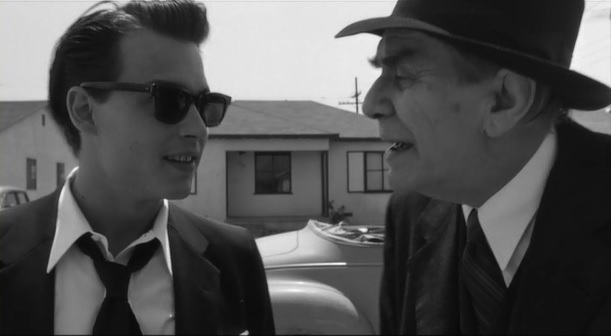
The heart of the movie is the relationship between Ed Wood and Bela Lugosi (wonderfully played by Martin Landau).  There is an interesting dynamic between the two men - Wood is a fairly young man struggling to get into the movie business while Lugosi is washed up movie star who has been forgotten by the industry.  The two of them are kindred spirits despite their age gap.  Wood’s relationship with women is pretty much secondary:  His girlfriend, Dolores Fuller, leaves him midway through the movie and his courtship of Kathy (his second wife) is extremely rushed.  The two of them meet while Bela is in rehab and then Ed Wood woos her at a carnival. 


 Burton really isn’t interesting in this aspect of Wood’s life (probably because it is too conventional for his sensibilities).  The most moving scene in the movie is not when Ed wins over Kathy, but rather when he persuades Bela, hopped up on pain killers, to check into rehab. Up until this scene, the movie was been fairly light hearted, but this scene is extremely nightmarish.  Everything is a state of disarray– Bela’s household is a complete mess and he his babbling incoherently. At one point he pulls out a gun and insists that Ed and him should kill themselves. Ed defuses the situation by calmly talking Bela down and then driving his friend to rehab.  Both of the actors are spot on in their performances – Landau is so good that  you can genuinely feel  Bela’s pain and confusion, and Depp rather effectively underplays the scene - instead of trying to compete with Landau, he basically stands back and gives Landau room to perform. It is a nice give and take between the two talented actors.  This is the rare instance where Ed is the voice of reason. He is clueless most of time, but when it comes to his friendship with Bela he is absolutely committed.  


There is the criticism that Wood exploited Bela Lugosi’s name to further his own career – this view is largely expressed by Bela Lugosi, Jr. in the documentary The Haunted World of Ed Wood.  Lugosi, Jr. views his father’s work with Wood as being the absolute “bottom of the barrel” and a total disgrace to his father’s memory.  In all fairness to Junior, he isn’t wrong – his father’s appearances in Glen or Glenda and Bride of the Monster are huge step down from Dracula, The Black Cat, and, hell, Abbott & Costello Meet Frankenstein. However, what Lugosi, Jr. conveniently overlooks is that his father’s career had already reached the bottom of the barrel long before his association with Ed Wood. The year before Lugosi appeared in Glen or Glenda he starred in a truly execrable comedy called Bela Lugosi Meets a Brooklyn Gorilla  (which featured the second rate comedy duo  Sammy Petrillo and Duke Mitchell – a Martin & Lewis knockoff).  Truth to be told, if you take the time to look at Lugosi’s filmography, you will find that the bad movies greatly outnumber the good ones. While it’s true the Wood movies are bottom of the barrel, it’s a bit disingenuous of Junior to blame Wood for his father’s downfall.

 Did Wood exploit the Lugosi name? Definitely.  Was it sole reason he cast Lugosi in his movies? Definitely not.   While a few curious filmmakers might have been drawn into by Lugosi’s billing on the movie poster, the fact is he wasn’t exactly a major star at this point in his career.  In the 1950s he was pretty much forgotten – it wouldn’t be until the sixties that he would become a cult figure. I believe Wood genuinely cared about Lugosi and did whatever he could to get his friend work – like writing a nonsensical role in the pseudo-documentary Glen or Glenda. I’ m sure having Lugosi as his “star” persuaded investors to fund his movie, but the fact is these roles seem tailor made for Bela (especially the made scientist in Bride of the Monster).  To be honest, other than the Wood pictures, the movies Lugosi made in the 1950s are pretty forgettable.  


There is an interesting parallel between Ed Woods friendship with Bela Lugosi and Tim Burton’s friendship with Vincent Price – they were both fairly young filmmakers who befriended aging horror icons.  Vincent Price did the narration for Burton’s animated short, Vincent, and then later appeared in Edward Scissorhands, while Lugosi spent his final years making movies for Ed Wood.  However, unlike Wood before him, Burton managed to find mainstream success fairly early in his career (his third feature length movie was Batman) and Price never quite reached the bottom of the barrel that Lugosi did.  Lugosi spent most of his career living in the shadow of Dracula, while Price managed to adapt with the times (most people from my generation know him for the rap he did on Michael Jackson’s “Thriller.”) 


Is Edward D. Wood, Jr. truly the worst director of all time? Is Plan 9 from Outer Space the worst movie of all time? My answer is a staunch…..NO!!!!  Granted, it’s this title that made Wood a posthumous celebrity but it’s simply not true.  Sure, Ed Wood’s movies are bad, but they are also fairly watchable.  There is also a nice sincerity about Wood’s movies – he genuinely loved the medium of filmmaking and wanted to tell compelling stories.  Unfortunately, his movies are interesting for all the wrong reasons but at least the passion there.  In all honesty, Wood often displayed some flashes of competence – the nightmare sequence in Glen or Glenda is genuinely creepy and disorienting;  Bela Lugosi is genuinely good in Bride of the Monster; and there a few atmospheric shots of Tor Johnson and Vampira wandering through the cemetery in Plan 9 From Outer Space.  I can think of a few filmmakers that are more deserving of the worst director of all time:  Coleman Francis, Larry Buchanan, Dwain Esper, to name a few.  These filmmakers were in the movie industry for monetary gain and would gladly have given up the craft if they could find an easier way to make money.  There also plenty of movies that are infinitely worse than Plan 9 from Outer Space, I will gladly name a few:  The Creeping Terror, The Beast of Yucca Flats, Manos: The Hands of Fate, Child Bride, Mesa of Lost Women, They Saved Hitler’s Brain, and Larry Buchanan’s entire filmography. Compared to these movies, Plan 9 from Outer Space is a veritable masterpiece.  

 While Ed Wood was a critical success, it was a complete dud at the box office. This isn't too surprising given that the vast majority of movie goers probably have never heard of Ed Wood - his movies appeal to a fairly niche audience. Ed Wood is not only Burton's most personal film, but it also signified the end of his "Golden Era."  Beginning with Pee-Wee's Big Adventure in 1985 and ending with Ed Wood in 1994, Tim Burton had nearly a decade of solid film making under his belt. He was truly a unique movie director - but after the financial failure of Ed Wood his movies became increasingly more inconsistent and, worst of all, forgettable.   He has basically relegated himself to big budget remakes of classic movies and TV shows- with the occasional "personal" film thrown in for good measure.  His newer movies feel less like a personal statement and more like a corporate product meant for mass consumption.  I'm not going to begrudge Tim Burton his success (he absolutely earned it) but it's shame to see a once unique and extremely original filmmaker get swallowed up by the Hollywood system.


Credits
Cast: Johnny Depp (Ed Wood), Martin Landau (Bela Lugosi), Sarah Jessica Parker (Dolores Fuller), Patricia Arquette (Kathy O’ Hara), Bill Murray (Bunny Breckinridge), Jeffrey Jones (Criswell), Lisa Marie (Vampira), George “The Animal” Steele (Tor Johnson), Juliet Landau (Loretta King), Mike Starr (George Weiss), Max Casella (Paul Marco), Brett Hinkley (Conrad Brooks), Clive Rosengren (Ed Reynolds), G.D. Spradlin (Reverend Lemon), Vincent D’ Onofrio (Orson Welles), Ned Bellamy (Dr. Tom Mason), Rance Howard (Old Man McCoy).
Director: Tim Burton
Writers: Scott Alexander, Larry Karaszewski.
Running  time: 126 min.

Sunday, November 20, 2016

Batman (1989)


There is a tendency in the comic book community to retroactively hate on earlier film adaptations of their superheroes, while anointing the new version as “the best adaptation ever.” This was the fate that befell the Tim Burton Batman movies when Christopher Nolan’s “The Dark Knight” trilogy hit theatre screens (the same fate also befell Richard Donner’s Superman movies after the release of Man of Steel). This is predicated on the logic that the Nolan movies are a far more faithful recreation of the Batman comic books than Tim Burton’s more gothic approach. The flaw with this argument is that there have been various incarnations of Batman throughout the decades, therefore the argument that the Nolan films are the most “faithful” is based entirely on what version of Batman you grew up with: Everyone talks about how the early Batman comics were dark and gritty, but they quickly took a more fantastical turn; as early as 1939, Batman was fighting vampires. By the time World War II rolled along, Batman went from being a dark vigilante to being a full-blooded patriot who devoted his time to fighting Nazis and the Japanese. In the 1950, he was a warm and fuzzy father figure who easily thwarted his incredibly inept enemies. 

I like the Christopher Nolan movies, but they didn’t nearly have the cultural impact that the Tim Burton movie had back in 1989. It is really hard to describe to younger audiences just how big Batman was in the summer of 1989; it wasn’t merely a movie; it was an event!  Super Hero movies have become a fixture in modern day cinema (Marvel has three movies slated for release in 2017, while DC has two), but they were a complete scarcity in the 1980s; the Superman series hit an all-time low with the 1987 Superman: The Quest for Peace. Before the Tim Burton, if you were to bring up Batman in a conversation, the Adam West television show would undoubtedly spring to mind. Sure, the comic book had already adopted a darker tone in the 1970s, but West’s tongue in cheek approach had cast a long shadow. It was the Tim Burton movie that helped shift the public perception of the character; he was no longer goofy Boy Scout but a dark, brooding vigilante that would resort to whatever means necessary to capture his guy. There have been complaints over the fact that Burton’s Batman kills, but this isn’t far removed from the early Batman comic books in which The Dark Knight often racked up a body count. 

I prefer the style of Burton’s movies to Nolan’s more “realistic approach.”  There is a timeless look to the Burton’s Batman movies; the characters dress in different fashions that it is really hard to pinpoint what time period it takes place in. The only thing that really dates the first movie to the 1980s are the songs by Prince. In my opinion, Tim Burton's Batman has the best opening of any comic book movie: two scuzzy muggers hold up a family in an alley way and are dividing the take on top of a building, when Batman swoops in and kicks their asses.  The reveal of Batman is extremely clever – the two muggers are stationed in the foreground when the Batman descends into frame in the background, while the two thieves remain oblivious to his presence. This effectively builds suspense, when will Batman strike? 


The main mugger shoots Batman multiple times and he falls to the ground, only to rise up again and take out the two bad men; bullets seemingly have no effect on Batman.  Batman then grabs the main mugger and holds him over the edge of the building, and then commands, “I want to you tell all your friends about me.”  Batman throws the man aside and jumps off the building. The mugger is scared shitless! It’s an incredibly exciting way to open a movie and definitely preferable to the disjointedness of Batman Begins. It is not only a visually exciting opening, but it sets up the psychological warfare Batman wages on crime – what makes Batman frightening is the idea that he could be watching you any place and any time, so you better be on your best behavior.  A mythic stature has already been bestowed upon Batman – the two muggers arguing over his existence before he punches them into next week. The interesting thing about Burton’s movie is that it avoids the structure of most Super Hero movies – the first half is devoted to the origin story, the second half has the hero fighting the villain – Batman has already begun his crime fighting campaign and has become a newsworthy topic. The police deny his existence, while secretly viewing him as a threat to the public.  
 
The main criticism of Tim Burton’s adaptation is that it is more of a Joker movie than an actual Batman film; this isn’t entirely false.  It is the Joker that is given a lengthy back story, while Bruce Wayne’s is told in a brief flashback.  Jack Nicholson certainly dominates the proceedings with his wonderfully over the top performance as the Joker.  However, even this isn’t too far removed from the comic books – Batman’s foes were often far more colorful (and interesting) than he was.  Tim Burton’s interpretation of the character is that he is a man that keeps to the shadows and has a very low key personality; Bruce Wayne goes through the motions of being a millionaire – he holds fundraisers, he attends business meetings, and he dates attractive women.  The only time he comes to life is when he dons the bat suit and fights criminals. This is not the flamboyant character from the Batman TV series. He is so obsessed with his work that he foregoes a social life and is willing to sacrifice a potential romance with Vicki Vale. I always felt that Michael Keaton was miscast in the role of the Caped Crusader, but he is good enough of an actor that it isn’t too big of an issue. I also prefer his interpretation of The Dark Knight to Christian Bales nonstop grunting. 


I like the fact that Burton and company don’t go to the default ending of most modern Super Hero movies – the leveling of an entire city. It ends on a rather small, personal note: Batman faces off against the Joker in a church bell tower.  It’s a completely unique sequence and certainly trumps the massive amounts of destruction seen in most modern day Super Hero movies; it’s really hard to distinguish one from the other.  Batman certainly has its share of flaws; I never bought Alfred showing Vicki Vale into the Batcave behind his master’s back.  Alfred over steps his bounds and would probably feel the wrath of Batman in some form or other. Also, Bruce Wayne has only known Vicki Vale for a couple of days; therefore it’s a bid odd that he would want to reveal his true identity to her.  In Batman Returns, it is revealed that their relationship didn’t work out. Way to go, Alfred.  Plus, the reveal that it was the Joker that murdered Bruce Wayne’s parents is a bit too convenient. It’s an unnecessary addition to the script that doesn’t really serve any purpose. If Batman is solely drive by revenge, then killing the Joker should be enough for him to move on. 


I know I’m in a minority when I say that I prefer the Burton movies to Christopher Nolan’s trilogy, and I’m willing to admit that there is a nostalgic bias at work. The Tim Burton movie came at the right time in my life (I was ten) and is what got me hooked on the Batman comic books. It was the first time I, and most fans, had seen a more serious adaptation of the comic books.  The Christopher Nolan movies are terrific movies, but I’ve notice they are much easier to nitpick because of Nolan’s “realistic” approach.  It is easier to accept the flaws in the Burton movie, because it never makes an attempt at realism and is much more fantastical in its approach.  However, the Nolan films deserve credit for willing to take risks, when most Super Hero movies play it safe. However, it must be said that if it wasn’t for the success of Tim Burton’s 1989 movie, there is a good chance that the Nolan movies would have never been made. 

Credits
Cast: Jack Nicholson (Jack Napier/The Joker), Michael Keaton (Bruce Wayne/Batman), Kim Basinger (Vicki Vale), Robert Wuhl (Alexander Knox), Michael Gough (Alfred), Pat Hingle (Commissioner James Gordon), Billy Wee Williams(Harvey Dent), Jack Palance (Carl Grissom), Jerry Hall (Alicia), Tracey Walter (Bob the Goon), William Hootkins (Lt. Eckhardt), Lee Wallace (The Mayor).
Director: Tim Burton
Screenplay: Sam Hamm, Warren Skaaren.
Running Time: 126 min.

Wednesday, April 3, 2013

Batman (TV Series): Why It's Friggin' Awesome, despite what comic book purists would have you believe.


I think for most people from my generation (and my parents) their first exposure to Batman was the campy 1960s television show starring Adam West. It was a show that I watched religiously when I was a kid, to the point that when it was taken off syndication I was absolutely devastated. I sat in my room for days and sulked about it. How could I live without my daily dose of The Dynamic Duo? It also meant that I would deprived of the greatest TV theme song in history.

The highlight of each episode was the fight scenes, whenever Batman and Robin would punch villain, words like, POW, BAM, BOOF, would appear on the screen. It was away to emphasize the very comic book nature of the television show.
The Batman in the TV show was an upstanding citizen who apparently had no vices, he didn't drink, didn't smoke and was able to keep his sexual urges in check, despite the fact that beautiful women were constantly throwing themselves at him. He was a goody two shoes who packed a mean wallop.

As a kid, Adam West was the DEFINITIVE Batman, until 1989, when the Tim Burton/Michael Keaton movie was released. The Tim Burton film went back to Batman's roots and made him a dark, brooding character haunted by the death of his parents, as opposed to the rather whimsical, benevolent authority figure of the old Adam West series. It was the DEFINITIVE Batman movie, until 2005 when Batman Begins was released to the cinemas.  Christopher Nolan's version was more grittier and less stylized than Burton's interpretation, and more importantly, Bruce Wayne was the central figure in the story, rather than a supporting player. Tim Burton's films, Batman and Batman Returns, were more interested in the plight of the villains and often pushed Batman/Bruce Wayne to the sidelines. Last year, Nolan finally completed his trilogy with The Dark Knight Rises, so it's only inevitable that in a few years time another reboot of the Batman franchise will be commissioned. Whether or not it will replace Nolan's Dark Knight trilogy as the DEFINITIVE Batman remains to be see.

I have done a complete 360 on the 1960s television series: I loved it as a kid, was embarrassed by it as a teen (especially after seeing the "serious" Burton films), and now love it as an adult. The television series may be a complete bastardization the original character, but it makes for some rather enjoyable (and funny) television. Of course, it's often overlooked that throughout the 1950s and most of the 1960s (the Silver Age) the Batman comic books themselves had devolved into rather silly children's stories. The villains weren't so much evil geniuses as they were merry pranksters with too much time on their hands. A typical story line from this era might involve the Joker trying to rob a pie factory in Gotham so he could stage the biggest pie fight in history. These comic books were aimed solely at kids and the TV show, for the most part, followed suit. It was also the campy TV show that brought Batman back into the spotlight after years of dwindling comic book sales.

What makes the TV show entertaining is Adam West's ability to deliver his lines in a straight manner, regardless as to how ridiculous they might sound. Oddly enough, when I was a kid, the campy humor went above my head, and I took the show absolutely seriously. When I watch the 1966 feature length film, I couldn't comprehend why my dad was laughing hysterically during the scene where Batman is punching a rubber shark that latched on his leg. This scene features the immortal line, "Hand me down the shark repellent bat spray." It is a moment that makes serious comic book fans cringe, but it is absolutely hilarious, especially with West's dry delivery.

I never liked character of Robin, even in the comic books and cartoons, and Burt Ward's take on the character can be extremely grating at times; to the point where one wishes Batman would give the Boy Wonder a nice crack in the jaw after his latest outburst of "HOLY______, Batman!"  Robin in the TV series main function was to get caught so Batman would have an excuse to fight the villains. Every once in a blue moon the writers would give him something useful to do, but otherwise he was a complete hindrance to the Caped Crusader's war on crime.  Robin in the TV series was essentially a boy scout in tights. 

Then there was the rogues gallery of villains, some of the most colorful characters in television (and comic book) history:
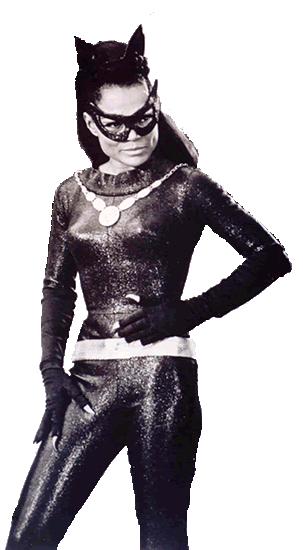
Catwoman: Three actresses played Catwoman during the show's run (well, two played the role on the television, one played the character in the movie), Julie Newmar, Eartha Kitt, and Lee Meriwether. 
Julie Newmar's interpretation is probably the most famous and best loved out of three, partly due to the fact that she had a wonderful chemistry with Adam West, but mostly because she was.....extremely... hot. 


Newmar's Catwoman was flirtatious with Batman and had a soft spot for him, to the point where she even contemplated giving up crime to be with him. In one of my favorite exchanges from the TV series, Catwoman offers turn a new leaf:

Batman: I'll do everything I can to rehabilitate you.
Catwoman:  Marry me!
Batman: Everything, except that! A wife, no matter how beauteous or affectionate, would severely impair my crime fighting.
Catwoman: But I can help you with your work. As a former criminal, I would be invaluable. I can reform. Honestly I can! 
Batman: What about Robin?
Catwoman: Robin?! Oh, I've got it. We'll kill him!

As a kid (and still as an adult) I was absolutely irate that Batman turned down her offer. Sure, killing Robin is excessive, but Catwoman would certainly be a more apt crime fighting partner than Robin, the Boy Blunder. She even tells him as much, but Batman turns her down. IDIOT! For my money, Newmar's portrayal is still the best (and yes that includes Michelle Pfeiffer and Anne Hathaway). 

Lee Meriwether (Miss America 1955) take on the character was much different, she had an icy cold exterior and didn't get all starry eyed when she encountered Batman. She took her role as a criminal very seriously and used her pretty looks (and sexuality) to lure Bruce Wayne into a trap. 

Catwoman and her cohorts (The Joker, Penguin, The Riddler), came up with an elaborate scheme to kidnap Bruce Wayne, so they could trap Batman when he came to rescue the famous millionaire. They wanted to lure Batman into a giant spring that would send him soaring into the arms of the Joker's exploding octopus. Needless to say, it didn't go according to plan. 


Meriwether was the first Catwoman I ever saw, so I will always I have a soft spot for her portrayal. 

When Earth Kitt inherited the role in the show's final season, the sexual tension between Batman and Catwoman was nonexistent, instead she purred her way through the scenery. Earth Kitt was by no means a bad Catwoman, but the dynamic between the two characters was far less interesting; she lacked Newmar's sex appeal and didn't quite possess Meriwether's cold hearted villainy, either. Though, Kitt's distinctive voice was a lot of fun to listen to.  

The Joker (Cesar Romero): It's common to disparage Caesar Romero's portrayal of the Joker, especially when compared to the much darker interpretations that Jack Nicholson (an multiple Oscar Winner) and Heath Ledger (the role he won the Oscar for) gave to the character.  Romero's Joker is a jovial prankster whose main goal in life is to embarrass Batman on a national stage. His schemes are completely impractical and, as a result, there is often no collateral damage involved when his plan is inevitably foiled. The Joker doesn't wish anyone (except for Batman) harm, he's mainly a criminal for his own amusement. 


While the Nicholson/Ledger incarnations are more truer to the comics, they would be completely out of place in the television series. The TV show was meant to be fun for the family, so the sight of the Joker smashing a guy's skull into a pencil would probably not go over well with parents.  Nor would him hand buzzing a gangster to death. Romero brought a lot of energy to the role, so even though his Joker may not be remotely like the one in the comics, he was still a lot of fun to watch. 

The Riddler (Frank Gorshin): Frank Gorshin's manic portrayal of the Riddler is vastly superior to any of the actors that followed in his footsteps; Jim Carrey's take on the character in Batman Forever is a piss poor imitation of Gorshin. The Riddler absolutely enjoyed toying with the Caped Crusader, his main down fall was his over confidence. He was so certain that he would succeed that he would give Batman and Robin clues to those crimes in the form of riddles, thinking that they wouldn't be able to figure them out, or that he and his cronies would be ready for the dynamic duo when they showed their faces. He always failed, but it never dissuaded him (then again, that applies to all the Batman villains).  The less I say about John Astin's brief stint as the Riddler, the better. 


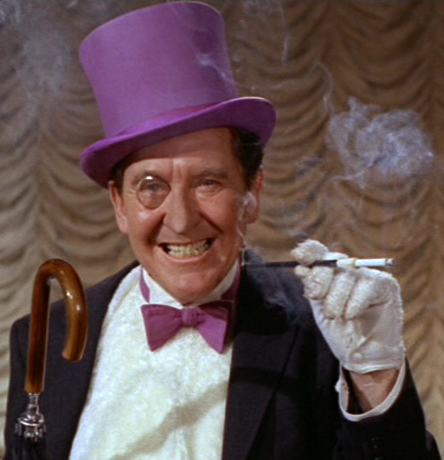
The Penguin (Burgess Meredith): The Penguin was always a silly character, not even a gritty reboot would be able to disguise just what a ridiculous villain he truly was. He walked like a penguin, had an extremely long nose, wore a monocle, and always had a cigarette holder protruding from his mouth. While he is extremely out of place in the dark, gritty Batman comics, he is a perfect fit for the campy TV show. 
The Penguin's crimes were always bird related and always chose extremely transparent bird themed aliases to throw the law off his track. In Batman: The Movie, he buys a pre-atomic submarine under the pseudonym P. N. Guin.  He labeled himself as being a SUPER GENIUS criminal mastermind, but was always bested by Batman. Whenever the Penguin disapproved of something he would let out a "Quack" sound. 


There were other colorful villains in the shows run as well: Egghead, King Tut, The Book Worm, False Face,The Minstrel, Mr. Freeze, but it's the four highlighted above that were, and still are, the most popular.

In the show's final season the character of Barbara Gordon/Batgirl was introduced. She was portrayed by beach movie regular (and frequent Elvis co-star) Yvonne Craig. Her character served dual purposes, it offered the girls a positive role model and it gave the boys more eye candy to look at. 
Batgirl's identity was a completely mystery to Batman and Robin, and she would often slip away before the Dynamic Duo had a chance to ask her any questions. She was a certainly more competent hero than Robin (and all the Gotham police force, but that goes without saying). Her alter ego, Barbara Gordon, was an extremely intelligent woman and could often figure out the criminals schemes/ where abouts before Batman and without the aid of a computer. She was also fairly adept at handling herself in fights, often holding her own with Batman and Robin (well, maybe not Batman, but she often bested Robin in terms of knock outs). Unfortunately, for all her toughness, she also had a tendency to get herself captured by the villains, then Batman would come along to save the day. Still, she was infinitely better than Robin. Yvonne Craig is leagues better than Alicia Silverstone, who stuttered her way through the role in 1997's Batman & Robin. 


As I mentioned before, Batman purists absolutely loathe the 60s TV show, because in their minds it makes a complete mockery out of the character. It wouldn't be until the 1989 Tim Burton film that the character would be a given a more serious minded treatment and since then the dark, troubled Batman of the Burton/Nolan films have supplanted the warm, whimsical Batman of the 60s. When Joel Schumacher went back to the camp format in Batman & Robin the movie going public rejected it, to the point where it's regarded as one of the worst movies ever made. In all fairness, it is a fairly dreadful film. It successfully killed the first Batman movie series but made way for the Christopher Nolan reboot. It's easy to rag on the Batman show for its camp aesthetics, but let's not forget that the comic book itself was extremely silly at the time. The 1960s Batman TV show is just one of the many faces the Caped Crusader has donned over the last eighty plus years, rather than being disgusted by it, Batman fans should embrace it. There's more than enough for room for two different interpretations of the same character (and in the comic book's case there's been 
more than that), so LIGHTEN UP PEOPLE! 
Besides, nothing in the Nolan films can top the sight of Batman running through this streets with a bomb over his head, looking for a place to dispose of it. (NOTE: This clip has been replaced with music from Benny Hill, as I could't find a decent clip with the original score.) 


Snow White's Revenge/Scandal (2024)

  It is difficult to write about Snow White’s Revenge without bringing up the ending, so readers beware, this review will contain spoilers...