Powered By Blogger
Showing posts with label Lyle Talbot. Show all posts

Thursday, June 13, 2019

Ed Wood (1994)


Edward D. Wood, Jr. is often regarded as the worst director in cinema history. He might have been destined for obscurity if it wasn’t for the 1980 book “The Golden Turkey Awards” by Harry and Michael Medved.  In their book, Wood was voted the “worst director of all time” and his magnum opus Plan 9 from Outer Space was voted “the worst movie of all time.” This brought Wood new found fame among bad movies aficionados, who eagerly sought out his body of work.  Wood was a fairly interesting character, not only was a bad movie auteur but also – a World War II vet (he survived one of the bloodiest battles in the South Pacific); a writer of lurid pulp novels; a pornographer (after his failed career in Hollywood he relegated himself into making hardcore porn); and a transvestite.  His pseudo-documentary Glen or Glenda is (rightfully) ridiculed for its sheer ineptitude, but it’s also one of the most personal movies ever committed to celluloid – it’s based on Wood’s own struggles to come to terms with his cross dressing.   His movies are genuinely unique, even if they are terrible. He was a true auteur!  It is no wonder that Tim Burton was compelled to tell Ed Wood’s story – he is the ultimate misfit. 


It is important to note that Ed Wood is not your typical Hollywood biopic. It only focuses on a small portion of Wood’s life (1953 – 1959) and completely plays around with the facts – it glosses over Wood’s alcoholism and omits his brief marriage to Norma McCarty. It recreates the behind the scenes of three Wood movies – Glen or Glenda, Bride of the Monster, and Plan 9 from Outer Space – but skips over the making of Jail Bait (which was shot on the same sets as Glen or Glenda).  While most of Wood’s stock company is portrayed in the movie, Lyle Talbot is noticeably absent (even though he appeared in three of Wood’s movies).  

There are also a lot of liberties taken in the storytelling (mostly for comedic effect); in the movie, while making Bride of the Monster, Ed talks Bela Lugosi into wrestling with a rubber octopus in a pond, when in reality it was a stunt double (this is even more obvious in the cleaned up DVD of Bride of the Monster).  There has been a dispute as to how Loretta King was cast in Bride of the Monster – in the movie, Ed mistakenly believes that Loretta has the money to finance the entire production (after she lends him two hundred dollars) and he cast her in the lead out of obligation, while Loretta King claims that she was contacted by Wood, via her agent, and that money was never a factor.  I tend to be believe King’s account of the story, because while filming Bride of the Monster Wood ran out of money and had to briefly shutdown production until he could get financing – so,  if King was cast under false pretenses, then wouldn’t Wood just recast the role once production started up again?  It should be noted that it was Dolores Fuller, Ed Wood’s ex-girlfriend and one time lead actress, who kept pushing this story about Loretta King. Initially, Fuller was supposed to play the heroine in Bride of Monster but Wood eventually cast King in the role.  There is a theory that Wood lied to Fuller about the circumstance of King’s casting in a desperate attempt to let his girlfriend down gently.  “I desperately wanted to cast you in the lead role, baby, but she has all the money.  I need to placate her whims.”  Either way, Fuller’s account of Loretta King is second hand, at best, and is fairly biased towards Ed Wood.   Also, despite what the movie claims, Loretta King was not allergic to water.  


The movie is less of a biography of Wood and more a retelling of his life through a fairy tale lens.  Wood, as played by Johnny Depp, is an enthusiastic, good natured young man who is looking for the big break. He desperately wants to make movies but just can’t seem to get his foot into the door.  He finally gets a chance when he learns that sleazy producer, George Weiss, is making a biography of Christine Jorgenson and Wood manages to convince Weiss he is the man for the job because of his cross dressing history.  Weiss grudgingly hands Wood the assignment and then is dismayed (albeit briefly) that Wood’s script has nothing to do with Christine Jorgenson, but he really doesn’t care too much about the content as long as Wood delivers the movie on time and it makes a profit.  The running gag throughout the movie is that Wood often has to swindle his way into making movies; he’ll do anything because the ends justify the means.  When his landlord tells him that his church is interested in making a series of movies on the apostles, Wood tells him that they should invest their money into a proven genre (science fiction) and then they can use the profits from that film to finance their apostle movies.  He then persuades the church to fund Plan 9 From Outer Space (they later regret the decision after seeing Wood’s absent minded approach to filmmaking).  When they point out all errors in a scene, Wood barks back, “movies are not about the small details, they are about the big picture.”  What is incredible about this scene is that, despite the legitimate criticism of his backers, we find ourselves siding with Wood. The movie does such an excellent job of portraying Wood as an underdog figure that we naturally root for him, despite his lack of talent. 

The heart of the movie is the relationship between Ed Wood and Bela Lugosi (wonderfully played by Martin Landau).  There is an interesting dynamic between the two men - Wood is a fairly young man struggling to get into the movie business while Lugosi is washed up movie star who has been forgotten by the industry.  The two of them are kindred spirits despite their age gap.  Wood’s relationship with women is pretty much secondary:  His girlfriend, Dolores Fuller, leaves him midway through the movie and his courtship of Kathy (his second wife) is extremely rushed.  The two of them meet while Bela is in rehab and then Ed Wood woos her at a carnival. 


 Burton really isn’t interesting in this aspect of Wood’s life (probably because it is too conventional for his sensibilities).  The most moving scene in the movie is not when Ed wins over Kathy, but rather when he persuades Bela, hopped up on pain killers, to check into rehab. Up until this scene, the movie was been fairly light hearted, but this scene is extremely nightmarish.  Everything is a state of disarray– Bela’s household is a complete mess and he his babbling incoherently. At one point he pulls out a gun and insists that Ed and him should kill themselves. Ed defuses the situation by calmly talking Bela down and then driving his friend to rehab.  Both of the actors are spot on in their performances – Landau is so good that  you can genuinely feel  Bela’s pain and confusion, and Depp rather effectively underplays the scene - instead of trying to compete with Landau, he basically stands back and gives Landau room to perform. It is a nice give and take between the two talented actors.  This is the rare instance where Ed is the voice of reason. He is clueless most of time, but when it comes to his friendship with Bela he is absolutely committed.  
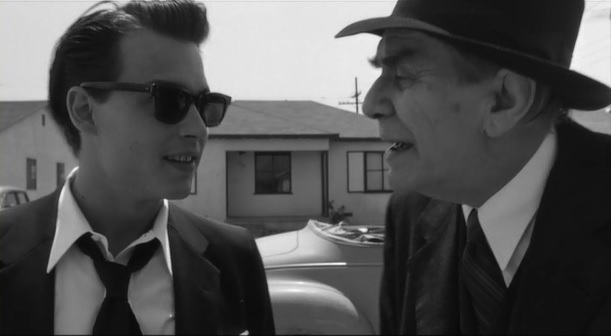


There is the criticism that Wood exploited Bela Lugosi’s name to further his own career – this view is largely expressed by Bela Lugosi, Jr. in the documentary The Haunted World of Ed Wood.  Lugosi, Jr. views his father’s work with Wood as being the absolute “bottom of the barrel” and a total disgrace to his father’s memory.  In all fairness to Junior, he isn’t wrong – his father’s appearances in Glen or Glenda and Bride of the Monster are huge step down from Dracula, The Black Cat, and, hell, Abbott & Costello Meet Frankenstein. However, what Lugosi, Jr. conveniently overlooks is that his father’s career had already reached the bottom of the barrel long before his association with Ed Wood. The year before Lugosi appeared in Glen or Glenda he starred in a truly execrable comedy called Bela Lugosi Meets a Brooklyn Gorilla  (which featured the second rate comedy duo  Sammy Petrillo and Duke Mitchell – a Martin & Lewis knockoff).  Truth to be told, if you take the time to look at Lugosi’s filmography, you will find that the bad movies greatly outnumber the good ones. While it’s true the Wood movies are bottom of the barrel, it’s a bit disingenuous of Junior to blame Wood for his father’s downfall.

 Did Wood exploit the Lugosi name? Definitely.  Was it sole reason he cast Lugosi in his movies? Definitely not.   While a few curious filmmakers might have been drawn into by Lugosi’s billing on the movie poster, the fact is he wasn’t exactly a major star at this point in his career.  In the 1950s he was pretty much forgotten – it wouldn’t be until the sixties that he would become a cult figure. I believe Wood genuinely cared about Lugosi and did whatever he could to get his friend work – like writing a nonsensical role in the pseudo-documentary Glen or Glenda. I’ m sure having Lugosi as his “star” persuaded investors to fund his movie, but the fact is these roles seem tailor made for Bela (especially the made scientist in Bride of the Monster).  To be honest, other than the Wood pictures, the movies Lugosi made in the 1950s are pretty forgettable.  


There is an interesting parallel between Ed Woods friendship with Bela Lugosi and Tim Burton’s friendship with Vincent Price – they were both fairly young filmmakers who befriended aging horror icons.  Vincent Price did the narration for Burton’s animated short, Vincent, and then later appeared in Edward Scissorhands, while Lugosi spent his final years making movies for Ed Wood.  However, unlike Wood before him, Burton managed to find mainstream success fairly early in his career (his third feature length movie was Batman) and Price never quite reached the bottom of the barrel that Lugosi did.  Lugosi spent most of his career living in the shadow of Dracula, while Price managed to adapt with the times (most people from my generation know him for the rap he did on Michael Jackson’s “Thriller.”) 


Is Edward D. Wood, Jr. truly the worst director of all time? Is Plan 9 from Outer Space the worst movie of all time? My answer is a staunch…..NO!!!!  Granted, it’s this title that made Wood a posthumous celebrity but it’s simply not true.  Sure, Ed Wood’s movies are bad, but they are also fairly watchable.  There is also a nice sincerity about Wood’s movies – he genuinely loved the medium of filmmaking and wanted to tell compelling stories.  Unfortunately, his movies are interesting for all the wrong reasons but at least the passion there.  In all honesty, Wood often displayed some flashes of competence – the nightmare sequence in Glen or Glenda is genuinely creepy and disorienting;  Bela Lugosi is genuinely good in Bride of the Monster; and there a few atmospheric shots of Tor Johnson and Vampira wandering through the cemetery in Plan 9 From Outer Space.  I can think of a few filmmakers that are more deserving of the worst director of all time:  Coleman Francis, Larry Buchanan, Dwain Esper, to name a few.  These filmmakers were in the movie industry for monetary gain and would gladly have given up the craft if they could find an easier way to make money.  There also plenty of movies that are infinitely worse than Plan 9 from Outer Space, I will gladly name a few:  The Creeping Terror, The Beast of Yucca Flats, Manos: The Hands of Fate, Child Bride, Mesa of Lost Women, They Saved Hitler’s Brain, and Larry Buchanan’s entire filmography. Compared to these movies, Plan 9 from Outer Space is a veritable masterpiece.  

 While Ed Wood was a critical success, it was a complete dud at the box office. This isn't too surprising given that the vast majority of movie goers probably have never heard of Ed Wood - his movies appeal to a fairly niche audience. Ed Wood is not only Burton's most personal film, but it also signified the end of his "Golden Era."  Beginning with Pee-Wee's Big Adventure in 1985 and ending with Ed Wood in 1994, Tim Burton had nearly a decade of solid film making under his belt. He was truly a unique movie director - but after the financial failure of Ed Wood his movies became increasingly more inconsistent and, worst of all, forgettable.   He has basically relegated himself to big budget remakes of classic movies and TV shows- with the occasional "personal" film thrown in for good measure.  His newer movies feel less like a personal statement and more like a corporate product meant for mass consumption.  I'm not going to begrudge Tim Burton his success (he absolutely earned it) but it's shame to see a once unique and extremely original filmmaker get swallowed up by the Hollywood system.


Credits
Cast: Johnny Depp (Ed Wood), Martin Landau (Bela Lugosi), Sarah Jessica Parker (Dolores Fuller), Patricia Arquette (Kathy O’ Hara), Bill Murray (Bunny Breckinridge), Jeffrey Jones (Criswell), Lisa Marie (Vampira), George “The Animal” Steele (Tor Johnson), Juliet Landau (Loretta King), Mike Starr (George Weiss), Max Casella (Paul Marco), Brett Hinkley (Conrad Brooks), Clive Rosengren (Ed Reynolds), G.D. Spradlin (Reverend Lemon), Vincent D’ Onofrio (Orson Welles), Ned Bellamy (Dr. Tom Mason), Rance Howard (Old Man McCoy).
Director: Tim Burton
Writers: Scott Alexander, Larry Karaszewski.
Running  time: 126 min.

Friday, January 10, 2014

Mesa of Lost Women (1953)


Mesa of Lost Women is regarded as one of the worst movies ever made and with a good reason; it's an extremely incompetent piece of cinema. It is so inept that the "Lost Women" of the title are fairly incidental to the actual plot of the movie. This is the IMDB synopsis of movie:

A mad scientist named Aranya is creating giant spiders and dwarfs in his lab on Zarpa Mesa in Mexico. He wants to create a master race of superwomen by injecting his female subjects with spider venom.

This isn't entirely incorrect, except that Aranya has probably less than ten minutes of actual screen time, despite Jackie Coogan's top billing.  When we first meet Aranya, he is showing off his experiment to fellow scientist, Leland Masterson. He hopes to make a race of superwomen by injecting them with a venom taken from a giant spider. This venom has made these women almost indestructible, yet unfortunately, it has transformed Aranya's male test subjects into dwarves.  Dr. Aranya hopes that Masterson will join him in his quest to make a species of super women, but Masterson denounces him. Disappointed, Aranya has his mute, sexy assistant Tarantella inject Masterson with a serum that transforms him into a raving lunatic. After this brief scene, Aranya completely vanishes and doesn't reappear until the film's climax.

The film is told in the flashback from the point of view of pilot Grant Philips...or is it? Just as soon as Grant begins tell his story, an omniscient narrator (Lyle Talbot) hijacks his account and begins to fill the audience in on how it all really began. The narrator is extremely condescending towards the characters in the movie, often mocking their bravery and intelligence. Other times, the film will cut to a close up of a character and the narrator will tells us their thoughts. When Grant starts talking about the Spider Women, there is a close up of the character of Pepe (who is has heard tales of such monstrosities), and the narrator starts chiding him for keeping his mouth shut.

The movie opens on a medium close up of man, just then a pair of hands (with claw like finger tips) crawl into frame and grab the guy's face. The camera pans over to reveal an attractive brunette. She pulls the man in for a kiss and he (understandably) doesn't offer up any sort of resistance. However, his immense joy is short lived as her kiss proves to be lethal and he falls down dead. Just then an off screen voice asks,"Have you ever been kissed by a girl like this?" Then the opening credits roll. Initially, I thought that this was a flash forward into the story, considering that man being kissed reappears a few minuter later. I was wrong.


This opening scene is disconnected from the rest of the story; it only serves to set up how dangerous the Spider Women really are. It leads you to believe that the plot will revolve around Spider Women luring unsuspecting (and extreme dense) men to their dooms. However, the Spider Women prove to a complete non-threat to our protagonists; their role consists mainly of close ups as they stare on, from afar, at our hapless heroes. Even Tarantella, the main Spider Woman, turns out to be a rather inadequate villain. She shows up long enough to do a "seductive" dance at a complete dive of a bar, only to be shot for her effort.  Earlier in the film, Dr. Aranya says that Tarantella is virtually indestructible and could live for hundreds of years, yet the film never properly explores this idea; we get a brief glimpse of it when Tarantella literally walks off her bullet wound. After her apparent "resurrection," she disappears from the proceedings (she briefly reappears at the movie's climax). This is rather a wasted opportunity as Tandra Quinn actually has great screen presence and could have made for one memorable vamp, instead she is absolutely wasted in relatively small role (even though she graces all the movie posters).

Tarantella's dance reminds me greatly of Salma Hayek's seductive snake dance in Robert Rodriguez's From Dusk Til Dawn. Tandra Quinn and Hayek play fairly similar characters; there's an aura of mystery surrounding both women due to their silent nature (though Hayek has a few lines in From Dusk Til Dawn), and both of them strut their stuff at a sleazy bar while the male protagonists leer on, much to the disgust of the sole female in the group. Of course, Hayek is much more scantily clad than Quinn and her character has an actual function to the story, while Tarantella vanishes from sight. Tarantella's dance is the highlight of the film and, once seen, is extremely hard to forget.


The real "heart" of the film are the characters Grant Phillips and Doreen Culbertson, who develop a budding romance as the film progresses. Grant is a handsome, individualistic pilot, while Doreen is an insecure, gold digger. She is set to marry the nebbish (and significantly older) businessman Jan van Croft, however, fate, taking the form of insane scientist Dr. Leland Masterson and a downed airplane, intervenes. Masterson, after having shot Tarantella, abducts Jan and his soon to be trophy wife and forces Phillips to fly him to safety. However, the plane crash lands on the very same mesa where Aranya is performing his experiments. It turns out that this crash landing is no accident as it is revealed that Jan's servant, Wu, is really Dr. Aranya's lackey. His sole mission was to bring Masterson back to Aranya. How Wu was able to track Masterson's whereabouts is never revealed; he just happened to be at right place at the right time. Character development is fairly slim in this movie and even that doesn't occur until that last fifteen minutes of the movie; Grant and Doreen have a heart to heart while everyone else is asleep. The two share a passionate kiss, but Grant pulls away and apologizes to Doreen for taking advantage of the moment. Then the film jump cuts to a long shot of the two star crossed lovers as Doreen tries to persuade Grant that she has heard a noise coming from the woods. This is an extremely jarring edit; the audience never hear the noise Doreen is shouting about and it happens in mid sentence. I don't if it's just a poor print of the movie or complete incompetence on the part of the filmmaker, though I suspect the latter. The brief interlude between Grant and Doreen was probably shot later on in production (as a pick up) and the editor haphazardly spliced it into the film, hoping the audience wouldn't notice the jarring edit.


Other than Tandra Quinn, the most memorable thing about Mesa of Lost Women is its extremely repetitive score by Hoyt S. Curtin; which consists mainly of a flamenco guitar and a piano. Legendary schlockmeister, Edward D. Wood Jr., like it so much that he later recycled it in his crime film Jail Bait. However, this is not the Mesa's  only ties to Wood, it is narrated by his frequent collaborator, Lyle Talbot, and his (then) girlfriend, Dolores Fuller, can be briefly glimpsed as one of the Spider Women. Great minds think a like!

It's often hard to explain the appeal of bad movies like Mesa of Lost Women, after all, they are the absolute nadir when it comes to the cinema, but their disjointed nature often gives them a surreal quality that is often lacking in movies that are intentionally campy. Mesa of Lost Women often plays like a nightmare; the juxtaposition of beautiful women and dwarves (not to mention a giant spider) gazing directly at the camera is very unnerving at times.


Credits

Cast: Jackie Coogan (Dr. Aranya), Tandra Quinn (Tarantella), Harmon Stevens (Dr. Leland Materson), Robert Knapp (Grant Phillips), Paula (Mary) Hill (Doreen Culbertson), Nico Lek (Jan van Croft), George Burrows (George), Chris-Pin Martin (Pepe), John Martin (Frank), Allan Nixon (Doc Tucker), Richard Travis (Dan Mulcahey), Samuel Wu (Wu), Dolores Fuller (Blonde Watcher In Woods), Katherine Victor (Car Driver Spider Woman).
Narrated by Lyle Talbot.

Director: Ron Ormond, Herbert Tevos.
Screenplay: Herbert Tevos, Orville H. Hampton.
Running Time: 70 min.

Sunday, February 17, 2013

Atom Man Vs. Superman (1950)


There have been many Lex Luthor's in cinema/television history, but for my money Lyle Talbot was the absolute best! Gene Hackman was great, but tended to overdo the wisecracks. Ditto Kevin Spacey. Whereas the other actors who portrayed the role never really left much an impression on me. Of course, Lyle Talbot has a distinct advantage over the others, in that he was the first actor to portray Lex Luthor on the big screen. Interestingly, he was also the first actor to portray Commissioner Gordon (another DC character) on the big screen in the 1949 serial Batman and Robin, made by the same team. Talbot is probably best known for his association with the the infamous movie director Edward D. Wood, Jr. Talbot co-starred in three of Woods films: Glen or Glenda?, Jail Bait, and Plan Nine From Outer Space. 
Talbot's Luthor is downright sinister, yet has an air of dignity about him. Clark Kent sums up best when he proclaims, "Luthor has a strange evil genius. Far above any scientist I've ever known."

 In Atom Man vs. Superman, Luthor is released from prison and vows to change his ways; he does so by becoming a respected television producer. This, not surprisingly, turns out to be a front for his criminal deeds. He has television trucks stationed all across the cities and each truck has a secret compartment in which his thugs can hide out after having robbed a jewelry store or some other establishment. He even manages to get the lovely Lois Lane (Noel Neill) to work for him, so she can can do puff pieces about the city. This is just one of many phases in Lex Luthor's agenda; the other is to rid the world of Superman by transporting the Man of Steel into a parallel dimension (The Empty Doom as he calls it) via his teleportation machine. To get Superman into the machine, Luthor creates a synthetic form of Kryponite, which weakens the Superman while he is at a public ceremony. Luthor's henchmen (disguised as ambulance drivers) steal away the Man of Steel to his apparent doom. Will Luthor succeed? Of course not!


Atom Man Vs. Superman was one of the few times (if not the only time) that a movie serial actually used a villain from the comic book it was adapted from. It was common for serial adaptations to invent their own villain. The villains in  serials tended to be masked scientists/criminals out for world conquest; in the first Superman serial, the Man of Steel faced a masked villainess called the Spider Lady. In Batman and  Robin, the villain was a masked scientist called the Wizard. Even Atom Man Vs. Superman follows the masked villain format by having Lex Luthor don the disguise of Atom Man to throw the law and Superman off his scent. Granted, Superman from the get go is convinced that the Atom Man is really Lex Luthor, but everyone else is convinced that Luthor has gone straight.
Despite a few changes the Superman serials remained fairly faithful to the comic book, which was fairly rare for a movie serial. The most famous case of a serial being drastically different from it's comic book source was 1944's Captain America, starring Dick Purcell in the title role. In the comic books, U.S. Army Private Steve Rogers became Captain American after being injected with a super serum that gave him great strength. Most of this adventures happened overseas as he fought Nazis and, most famously, the Red Skull. In the serial adaptation, Captain America's secret identity is Grant Gardner, who is not an army soldier, but a district attorney. His nemesis is a masked villain known as the Scarab, who turns out to museum curator Dr. Cyrus Maldor.  Most adaptations didn't take as many liberties with the source material like Captain America, but often, due to budgetary problems, a lot of compromises had to be made. In Batman and Robin there is no Batmobile, instead the dynamic duo drive around in a 1949 Mercury.
Atom Man Vs. Superman is a fairly ambitious serial, but the problem is that it doesn't have the budget nor the resources to match its scope. In chapter one, Luthor builds a sound ray and threatens to destroy the Metropolis River Bridge if his demands are not met. The authorities scoff at Luthor's demand, so he turns his ray towards the bridge and it begins to sway back and forth. This is achieved through the use of stock footage.....well known stock footage I might add; the collapse of the Tacoma Narrows Bridge (or the Galloping Gertie as it was called). Much to the horror of the Daily Planet Staff and police there is a woman on the bridge passed out in her car. Just when everything seems lost, Superman flies into frame to save the damsel in distress. Initially, I thought Superman would grab the woman and fly her to safety.......NOPE! Instead he stops the bridge from swaying by grabbing hold of its suspension cable and then calls for the cops to rescue the woman. The cops run in, grab the lady, and then run to safety. Superman lets go of the suspension cable and we then cut to footage of the Galloping Gertie collapsing. After the woman is taken to safety, Lois Lane coos, "Superman saved her! I knew he would do it!"


Chapter seven is a re-cap of Superman's origin, narrated by Luthor, with footage lifted from the first Superman serial. Jor-El (Superman's Krypton father) managed to send out radio waves in his Kryton language and Luthor was some how able to translate them, thus making him an expert on everything Superman - with the exception of Superman's secret identity.
When Superman flies he turns into an animated figure and then will land behind a landmark, where Kirk Alyn will then emerge from. This was done because the wire work on Kirk Alyn was so bad that the footage had to be scrapped and the producers, rather hastily, decided to settle on animation. Of course, the problem with the animation is that not only is it jarring at times, but it often kills the urgency that is required in the scene. Superman will often land behind a huge boulder, or some other landmark, and then run the rest of the way to his destination, hence wasting precious time.


It is these lapses in budget and plotting that prevent Atom Man Vs. Superman from being a classic.  Too often the plot is set up by complete coincidence; Lois and Jimmy have a knack for running into Luthor's henchmen, who then proceed to kidnap them just so Superman can save them at the last second. The perils tend to be a bit redundant as well; twice Jimmy is saved from an exploding car. Granted, these flaws are more apparent to the modern day viewer with a DVD player than a movie goer of the 50s, especially little children.
Yet, there are a couple of genuinely clever ideas scattered throughout the serial, the most compelling being "The Empty Doom." Lex Luthor builds a machine that transports Superman to another dimension  that he christened "The Empty Doom." The ghostly image of Superman often pops into frame and attempts to stop a crime from happening, but is forced into the role of a spectator, helpless to do anything about it. He, through sheer will power, is able to communicate with Lois Lane through her electronic typewriter and sets up a plan that will set him free. It also finally dawns on the Daily Planet staff that Clark Kent and Superman just might be the same person.  Perry White orders Lois Lane to write an article that asks the question, "Is Clark Kent Superman?" Lois is hesitant to do so, but obeys White's orders. However, she conspires with Jimmy Olsen to keep the story from every being printed by having him call White and pretending to be Clark Kent. The fairly convincing imitation fools White and he orders the story to be scrapped. However, once Superman is released from "The Empty Doom" the "Is Clark Kent Superman" subplot is completely discarded; Lois and Jimmy never seem interested in finding out the answer for themselves. Luthor becoming a successful TV producer in many way anticipates DC reboot of Superman in the 80s, in which Lex Luthor went from being mad scientist to a respected multi-millionaire with a sinister side.
Kirk Alyn's Superman is appropriately bland; he's pretty much a boy scout with super hero strength. This was essentially how Superman was depicted in the comics at the time and Alyn plays it to perfection. His Clark Kent is way more interesting character, in that he's not nearly as wimpy and bumbling as Clark was in the comic books. Alyn's Clark Kent is slightly clumsy (or pretending to be clumsy), but he's an excellent reporter and is fairly handy in a fight as well. Lois Lane thinks him a coward for always disappearing when danger is near, but we know better.  In TV Show The Adventures of Superman, starring George Reeves, there were very little difference between the Clark Kent and Superman personas, the only thing that really separated them was that Clark wore glasses and suit, while Superman wore a leotard costume. In the two Superman serials starring Kirk Alyn, there is just enough of difference between the two personas that makes it plausible (if not entirely believable) that no one would suspect Clark Kent of being Superman.
My favorite part of the serial is how it doesn't shy away from showing off Superman's strength; in one of the early chapters Luthor's henchmen fire bullets at Superman and they bounce off him, while he grins off the entire thing like it's nothing. This is done with animation, but it's a neat moment nonetheless  At another point, Superman effortlessly lifts up two henchmen, raises them above his head, and bangs their heads together, knocking them out cold.
I've never been a fan of Noel Neill's "Golly Gee Whiz" approach to the role of Lois Lane, granted, it's not nearly as bad in the movie serials as it was in the television show. In season one of The Adventures of Superman, Lois Lane was played by Phyllis Coates, who's interpretation of the role was far and a way my favorite. Coate's Lois Lane was a no nonsense reporter who took her job seriously and often put it ahead of her own safety. Secondly, she didn't have a school girl crush on Superman, like all the other Lois Lanes, but rather admired him and was grateful for his help. In the first season, there was a sense that Lois and Clark were beginning to bond as friends; initially Lois resented him for joining the Daily Planet, but by season's end she grew to appreciate him. However, when season two began filming Coates was no longer available and was replaced by Noel Neill, because of her appearance in the serials. Lois Lane went from being a professional trying to create her own breaks to being a fairly clueless reporter more interested in swooning over Superman than doing her actual job. In the serial, there's is very little sense of growth between Clark Kent and Lois Lane, even when he keeps constantly bailing her out; she constantly talks about him in a very condescending manner and is fairly resentful of his success. When it is suggested that Clark Kent might be Superman, Lois Lane has this to say, "If Clark Kent is Superman, we have no right in revealing in his secret. If he isn't, then why give a dope such a big build up."  Half the time, I was almost hoping the villains would succeed in bumping off Lois Lane, just so it would finally shut her up. Neill certainly isn't aided by the writing, which often relegates  Lois Lane to a plot device  so Superman has an excuse to fight the villains. Lois gets capture, Superman saves her. Wash. Rinse. Repeat. Not to mention her dialogue is fairly cringe worthy as well, practically ever other sentence has her referencing Superman. "Not even Superman himself could do such a thing."
Tommy Bond as Jimmy Olsen main function is comic relief, but to his credit, he's not nearly as annoying as Jack Larson's portrayal on The Adventures of Superman. At least, Bond's Jimmy Olsen was occasionally useful in capturing the villains, whereas Larson stumbled through the scenery and practically killed every scene he was in.
Atom Man vs. Superman is fairly entertaining serial, despite it's many limitations. However, it's best to view it over the course of a few days (like the audiences of 1950) than in one sitting, otherwise you might go insane.


Cast: Lyle Talbot (Lex Luthor), Kirk Alyn (Clark Kent/Superman), Noel Neill (Lois Lane), Tommy Bond (Jimmy Olsen), Pierre Watkin (Perry White), Jack Ingram (Foster), Don C. Harvey (Albor), Rusty Wescoatt (Carl), Terry Frost (Baer).
Director: Spencer Bennett.
Screenplay: George H. Plympton, Joseph F. Poland, David Mathews.
Running Time: 252 minutes (15 episodes)

Snow White's Revenge/Scandal (2024)

  It is difficult to write about Snow White’s Revenge without bringing up the ending, so readers beware, this review will contain spoilers...