Powered By Blogger

Monday, February 11, 2013

Get Yourself a College Girl (1964)


One of the disadvantages about having Turner Classic Movies is that they play so many movies I want to watch that I constantly find myself firing up the VCR, as a consequence I have a huge back log of movies that I have to watch. After nearly two years, I finally got around to watching Get Yourself a College Girl and thought it would serve as an interesting companion piece to my A Hard Day's Night/ Girl Happy review.

Get Yourself a College Girl was made in 1964 and as a result it often gets lumped in with the Beach Party genre that was popular during the period. While the similarities are there, the truth is, it has more in common with films like Rock Around the Clock (1956), and its semi-sequel Don't Knock the Rock (1956), than it does with the Frankie and Annette films that were popular at time. This isn't too surprising considering that not only does Get Yourself a College Girl have the same producer as those two films (Sam Katzman), but the same screenwriter as well (Robert E. Kent). Katzman was a legendary producer of low budget films and most famously brought not one, but two DC comic book heroes to the screen, Batman and Superman, in serial form. Rock Around the Clock and Don't Knock the Rock both would serve as templates for rock n' roll films of the future, including Get Yourself a College Girl.

Rock Around the Clock is officially the first Rock N' Roll film ever produced and it follows band manager, Steve Hollis (Johnny Johnston), as he attempts to bring Bill Haley and the Comets to the mainstream. One day, while driving across country with his musician friend, Steve stumbles upon Bill Haley and the Comets playing a dance in a small town located in the middle of nowhere. Steve his amazed at the amount of excitement Bill Haley and his band are generating among the locals; at point Steve's friend taps a dancing girl on the shoulder and asks, "What do you call that exercise you're getting?" She replies with, "It's rock n' roll, brother. And we're rocking tonight!"


Steve is convinced rock n' roll is the wave of the future and sets about getting Bill Haley national exposure. The only thing standing in his way is a manipulative, domineering music agent named Corinne Talbot (Alix Talton), who also has her heart set on marrying Steve, despite his lack of interest. When she finds Steve has become smitten with the female half of a brother/sister dancing act that accompanies the Comets, she sets about trying to sabotage Steve's chances. First, she books the Comets to play at a high school prom, thinking that the Comets "wild music" will get them booed offstage, but is utterly shocked when the youth respond in a wildly enthusiastic manner. After her first plan has failed, she attempts to have Steve and the Comets blackballed from the music industry by calling up her friends at other agencies. Steve circumvents her by calling upon popular DJ, Alan Freed, who owes Steve a favor. Finally, Corinne concedes defeat and offers the Comets are huge three year contract. A few other contrivances follow, but it ends on a happy note, with the Comets and other rock n' roll acts getting national exposure on a televised musical jamboree.

Two thoughts about Rock Around the Clock:
1) As a movie it is relatively worthless; the characters and acting (with the exception of Talton) are fairly bland. Bill Haley, despite his top billing, is relegated to the sidelines for the most of the film. But as time capsule for the period (mid 1950s) it is absolutely invaluable; it gives modern day viewers an opportunity to see rock n' roll acts of that time in their absolute prime. (Bill Haley, The Platters, The Bellboys, etc). 


2) The character of Corinne; she's a highly successfully, intelligent career woman, yet the filmmakers imply that she can never be happy unless she's married to a man. Throughout the film, she tries hard to break down Steve's will, so he will come crawling back to her, begging her to marry him. At the end, when she has failed, she seems content on settling for the next best thing (her assistant, Mike Dobbs). This theme of the highly successfully but lonely woman gets revived in Get Yourself a College Girl. 

Don't Knock the Rock, the semi-sequel to Rock Around the Clock, takes a defensive stance towards rock n' roll music; in it a successfully rock singer, Arnie Haines, returns to his hometown to find that he has fallen out of the favor with the elders. Their concern is that rock n' roll leads to juvenile delinquency, so he takes it upon himself (with help from Bill Haley and the Comets and other music acts) to put their fears to rest. After a couple of mishaps, he eventually wins over the elders and everything is peachy keen at film's end.

Flash forward to 1964, and the focus gets shifted from successful male rock star to successful female songwriter, Terry Taylor, who is still attending college at Wyndham. It is revealed that Wyndham is a fairly conservative musical college that looks down upon rock n' roll; to keep herself from being expelled, Terry has her songs published under a pseudonym. However, the cat is let out of the bag when her publisher, Gary Underwood, calls the college in regard to ideas he has for promoting her album. This naturally infuriates the Board of Directors, which consists mostly of old men, who demand that Terry be expelled. The student body marches in on the proceedings and objects to Terry's possible suspension, stating that she's been like a "Joan of Arc" to them with her progressive attitude towards women. However, the Dean, being a woman, is sympathetic towards Terry and asks that the Board wait until after Christmas Break to make their final decision.  One of the board members is Senator Hubert Morrison, who is up for reelection and whose grandmother founded the college. He is, at first, appalled by Terry's music, but the Dean tells him he's old fashioned and should try to get to know the girl before he passes judgment on her. Morrison takes this advice to heart and, by sheer coincidence, happens to be vacationing at the same ski resort as Terry and her friends. All sorts of hilarity ensue!


As I mentioned before Robert E. Kent was a screenwriter on all three films and I suspect a good majority of his screenplays contained the phrase, "Insert musical number here." These films are a more or less an excuse to showcase the musical talent of the day while the "story" mainly functions to bridge the musical numbers together. The actual story for Get Yourself a College Girl doesn't begin until nearly twenty minutes into the movie; the beginning has a few bits of exposition (Terry being a songwriter), but the majority of it is musical acts (The Dave Clark Five, The Animals) accompanied with shots of various college students dancing. One of the musical acts is Terry singing her new song, "Get Yourself a College Girl."


What I find interesting about this sequence (and the end as well) is that the two headlining bands (The Animals, The Dave Clark Five) were part of the British invasion. Get Yourself a College Girl maybe the first American film to openly embrace the British invasion, whereas most Beach Party films were either condescending toward it (Bikini Beach, The Girls on the Beach), or didn't bother to acknowledge its existence. Like A Hard Day's Night, I'm sure getting these bands was an attempt by Sam Katzman to cash in on their fame before it waned, but nonetheless, it is interesting that Katzman willingly jumped on this trend, while Samuel Z. Arkoff and other producers thumbed their nose at it. In fact, despite being labeled a "Beach Party Movie," there is absolutely no surf rock to be found in Get Yourself a College Girl. It is also interesting to note that many of the rock n' roll scenes often take a Direct Cinema approach to film making; often there will be shots of college students dancing done with handheld cameras to give it a more immediate look. This was obviously influenced by shots of the screaming audience at the end of A Hard's Day Night. 


Mary Ann Mobley is a far more engaging lead than the two stiffs (Johnny Johnston, Alan Dale) who sleepwalked through Rock Around the Clock and Don't Knock the Rock. Her character, Terry Taylor, is a woman who is trying to get ahead on her terms and takes offense when a man, Gary Underwood (Chad Everett), tries to run her life for her.  When Gary shows up at the ski resort, she is infuriated and threatens to sue him for breaching her contract; it was stipulated that the music publisher would never telephone Terry at Wyndham College. Gary's idea for promoting her new single is a painting of her holding an acoustic guitar and wearing a revealing nightgown; he then plans to have it plastered on billboards across the country. He has brought an artist along with him, Armand, to capture her likeness. Terry naturally takes offense to this and kicks Gary out of her room. Gary isn't defeated yet, he connives to use the body of another woman while painting Terry's face on top. He approaches various shapely woman at the ski resort, tells them his idea, and is met with a slap in the face. However, before the face slapping commences the audience is treated to an "Insert musical number here" moment with Astrud Gilberto singing "Girl From Ipanema."


While Get Yourself a College Girl features a relatively strong, independent woman in the lead, it's feminism is shaky at best. In the beginning, Terry stresses that a woman should be able to chose her path in life, without the interference of men; be it a career or romance. In the Frankie/Annette Beach Party films of the sixties, the main tension between the two of them was in regards to matrimony; Annette wanted to settle down and have a family, while Frankie wanted to have fun and avoid responsibility at all costs. In Get Yourself a College Girl, Terry's education and singing career come first, while a steady relationship is the last thing on her mind; she plays the field (as the lyrics to her songs suggest), but she's not quite ready to fall for any man. Of course, that all changes when Terry meets Gary. It's true that Terry initially resents Gary, but the audience knows that it's only a matter of time before the two fall in love. The romance is handled in an incredibly clumsy and lazy manner; Terry and Gary happen to be skiing on the same slope and Terry gives him the cold shoulder. She skis down the slope with Gary following her, she looks back to see where he is, and crashes into a snowbank. Her arms are stuck inside the snowbank and Gary takes advantage of the situation to kiss Terry on the lips. Rather than protest the situation, Terry gives in and after they are done kissing she comments that his kiss has melted the snow. She then frees her arms from the snow bank and embraces him.

There is a similar moment in Rock Around the Clock in which the band manager Steve Hollis is met with initial resistance by Lisa Johns (Lisa Gaye), the female half of the brother/sister dance act that performs with Bill Haley and the Comets. When Steve offers to manage that band he proposes a 60/40 split, meaning he'll get 40% of the earning. Lisa, acting as the spokes person for the band, insists that he should be only given 10% and tells him to call back later when he's changed his mind. Steve decides he will seduce Lisa into seeing his way. Later, the two of them are on the beach in bathing suits and Steve is about to make his move, but Lisa completely takes him off guard by kissing him first. The two kiss for a few minutes; Lisa tries to use her womanly charms to persuade Steve into taking 10%, while Steve uses his manly swagger into keeping the entire 40%, eventually they settle on 25%.  By the scene's end, they are hopelessly in love with one another. With the whole romantic subplot settled, the film can now focus on Steve's attempt to land the Bill Haley and The Comets a gig.

The most inexplicable moment that happens in Get Yourself a College Girl is when the character of Sue Ann (Chris Noel), the sexpot out of the group, starts to dance around in the girl's hotel room, clad in a bikini. It's real a head scratching moment...hell even Teresa and their friend Madge (Joan O' Brien) are confused by what is going on. This is a moment that is ripped from the many Beach Party films of the decade, except that it takes place at a ski resort in the WINTER! Which leads me to believe that the screenwriter, after having watched a marathon of earlier Beach movies, decided there needed to be at least one scene in which a busty blonde shakes her booty for all the world to see, regardless as to whether or not it made any sense. Granted, Chris Noel looks great in a bikini.


The best thing about Get Yourself a College Girl is the subplot involving Senator Hubert Morrison (Willard Waterman). At the beginning of the film, the Senator is fairly prudish in regards to the younger generation and finds Terry's songs offensive but, after the Dean of Wyndham tells him he's "old fashioned" in his view points and needs to be more open minded, he actually soaks in what she has to say and takes her advice. When he arrives at the ski resort, he makes it a point to introduce himself to Terry, so he can get to know her better. As the film progresses, his attitude begins to soften towards Terry and the younger generation, and they, in turn, begin to warm up towards him, to the point that they are willing to back him in his upcoming election. It's even implied that the Senator and the girl's beautiful dance teacher, Madge (Joan O' Brien), develop romantic feelings toward one another.
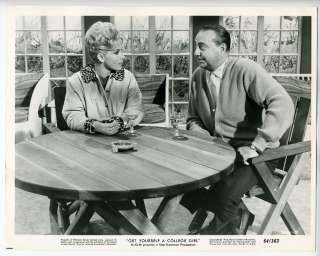
The older vs. younger generation is the staple of most rock n' roll pictures, and usually it's resolved in a fairly unconvincing manner (or in the case of A Hard Day's Night, not at all). In most rock n' roll pictures, the older generation remain firm on their preconceived idea that rock n' roll music is bad for society, and then, through some absolute miracle, have a change of heart at the film's end.  Yet, in Get Yourself a College Girl, because the Senator discards his presuppositions about the younger generation, it makes his conversion at the end all the more believable. The Senator is quite possibly the most likable character in the film; this is largely due to Willard Waterman's funny and engaging performance. 

Finally! In an interesting bit of trivia, all four leading actresses (Mary Ann Mobley, Joan O' Brien, Nancy Sinatra, Chris Noel) all co-starred with Elvis Presley at some point in their career.  Mobley would co-star with Elvis in Girl Happy and Harum Scarum. Joan O' Brien was his leading lady in the fairly well done It Happened At the World's Fair. Sinatra wouldn't be so fortunate, as her leading lady gig was in Speedway. And Noel played one of Shelley Fabares spring break friends in Girl Happy. Joan O' Brien was easily the best actress out of the bunch and had a fairly interesting career, co-starring with Cary Grant in Operation Petticoat and John Wayne in The Alamo, but after this film her career came to a complete halt. 

Cast: Mary Ann Mobley (Teresa "Terry" Taylor), Joan O' Brien (Marge Endicott), Chad Everett (Gary Underwood), Willard Waterman (Senator Hubert Morrison), Nancy Sinatra (Lynne), Chris Noel (Sue Ann),
Fabrizio Mioni (Armand), Dorothy Neumann (Martha Stone, Dean of Wyndham College), Astrud Gilberto (Herself), The Dave Clark Five, The Animals, The Standells, The Bell Boys.

Director: Sidney Miller
Screenplay: Robert E. Kent, Robert G. Stone.
Running Time: 86 min.

Wednesday, January 23, 2013

The Beatles vs. Elvis: A Hard Day's Night (1964), Girl Happy (1965)


In high school, there was a book that I constantly checked out from the library called The Great Movies by William Bayer; it was essentially a greatest movies ever list, but what made Bayer's book so compelling was that instead of choosing 100 movies, he chose 60. He made his selections by choosing 12 genres of film and then choosing five movies from each genre, hence the 60 movies. It was to my utter joy that years later I was able to locate a copy online and purchase it for an extremely low price ($7.99).  What's amazing about Bayer's book is that  he was well ahead of the curve in his selections; the book was published in 1973 and a lot of his selections were from the 60s. Among the films he chose were: 2001: A Space Odyssey, Psycho, Dr. Strangelove, Easy Rider, The Manchurian Candidate, Contempt, and A Hard Day's Night. These films often are found on most critics greatest movies list, but in 1973 these films were fairly recent and it was simply ( at least at the time) unheard to place such current films on a greatest list.  Bayer ranked A Hard Day's Night one of the five greatest Musicals ever made and has this to write:

Like any Astaire-Rogers film, A Hard Day's Night was contrived as a star vehicle. It was commissioned in frantic haste by United Artists as an exploitation film about the Beatles. Executives of the UA were convinced that the group's popularity would crest in 1964 and were most anxious that the film be completed before the bubble burst. (How badly they misunderstood the temper of the times. There is no question that the Beatles' place in musical history is more secure than that, for example, of Julie Andrews, but the film-industry executives, who business is presumably is fantasy fulfillment, rarely have shown much understanding of what the public craves.) 

At the same time the Beatles were making A Hard Day's Night, Elvis Presley was cranking out movies (and high profitably movie soundtracks) for MGM.  Like A Hard Day's Night these films were low risk, high reward ventures; they cost relatively little to make and often made a profit. Unlike the Beatles, Elvis Presley (at this time at least) was not working with a director of the caliber of Richard Lester, though I'm sure most  Superman fans would differ. His films were fairly formulaic and were turned out in an efficient, factory pace. His director on Girl Happy was the workmanlike Boris Sagal, who was more interested in delivering a product than making a genuinely good movie. Elvis films in the 60s all had the same skeletal outline:

1) An attractive leading lady that would serve as a romantic interest for the Elvis character. Often the two got off to a shaky start, but inevitably Elvis' charms and the scenery would win over the lovely lady.
2) A rock n roll number practically every ten minutes, just to remind the audience that this is an Elvis film and the soundtrack was readily available in stores.
3) A misunderstanding that throws a wrench in the romantic works; the leading lady makes a false assumption about Elvis that could easily be settled if they chose to listen what he had to say, as opposed to just brushing him off.
4) An old, respected character actor who brings humor and warmth to the proceedings.
5) Attractive scenery, be it nice summer beaches, palm trees, or beautiful women in bikinis.


Girl Happy is the quintessential Elvis Presley movie, because it has all of these things. In it, Rusty Wells (Elvis Presley) and his band promise a Chicago mobster/club owner that they will look after his daughter, Valerie (Shelley Fabares), who is on spring break in Ft. Lauderdale with her friends. Rusty and his band initially plan on going to Ft. Lauderdale for a week long vacation, but their plans seem dashed when Big Frank tells them that he's going to book them to play his club for the next four, maybe even six weeks. However, when Rusty finds out the Big Frank's daughter is going to Ft. Lauderdale for spring break, he uses Big Frank's fatherly concerns his advantage; he talks Big Franks into letting him and his band go down to Ft. Lauderdale to "protect" Valerie from all the sex maniacs running amok.Big Frank is grateful for Rusty's concerns and offers to pay all the expenses their trip, but he also makes it clear to Rusty that if anything should happen to his daughter, then it will be curtains for him and his band. This is to be done with Valerie being completely ignorant of the arrangement; Big Frank wants to make it appear as if Valerie has complete freedom over the week.  At first this seems like an easy task as Valerie comes off as being something of a nerd, she wears *the horror* GLASSES and dresses in a fairly conservative, drab manner. However, things take a turn for the unexpected when at the poolside, Valerie strips off the conservative wear to reveal a fairly rockin' bikini clad body. This gives Rusty a near heart attack. At first, Rusty finds Valerie to be a complete burden; looking after her has become a near full time job and becomes a wearisome cock block on his budding romance with the curvaceous Deena (Mary Ann Mobley). However, eventually Rusty warms towards Valerie and finds himself falling in love with her, much to the surprise of his band members, but not to the audience. Valerie returns his feelings and all indicators are that this going to be a happy ending. Valerie is so happy that when Big Frank calls her, she tells him the wonderful news about Rusty. Big Franks laughs and spills the beans to Valerie that he is paying Rusty to look after her. This naturally upsets Valerie and she decides to make Rusty's life a living hell, first by calling one of her admirers, the Italian exchange student Romano, and then by getting completely plastered. UH-OH! Will Rusty be able to win her love back? Of course, he will! This is an Elvis movie, not Contempt. 

It's often a misconception that while Elvis was a great singer, he was not a particularly good actor. This conception is largely due to the fact that Elvis movies got progressively worse as the decade wore on and he was, for the most part, never allowed to play an actual character but a rather variation of himself. Yet, when given good material, Elvis was actually quite good. Elvis made 31 feature films and while most of them are rather forgettable, there were a few that were rather good: Jailhouse Rock, It Happened at the World's Fair, Flaming Star, and King Creole. Flaming Star is of interest, because it is not a typical Elvis film, it is in fact a straightforward western with an excellent performance by Elvis. Not surprisingly, it's one of the few times Elvis was paired with a genuinely good director (Don Siegel), resulting in a genuinely good movie.
While Girl Happy is by no means a "good" movie, it definitely benefits greatly from having Elvis as the lead. It could have easily been written for Frankie Avalan, or any other popular croner at the time; with the exception of Elvis, it's fairly indistinguishable from all the other Beach movies of the time. In fact, four of Elvis co-star were beach movie regulars (Fabares, Mary Ann Mobley, Chris Noel, and Gail Gilmore).
The script was essentially dusted off in 2003 and made into the legendary bomb From Justin to Kelly. Girl Happy is a forgettable, yet fairly entertaining movie, while From Justin to Kelly is genuinely awful, despite the complimentary things the cast and director say on the commentary track. Yet, for the most part both screenplays are equally silly and at times cringe worthy, while the soundtracks to both are nothing special. However, the difference between the two is:

1) Elvis is quite possibly the most charismatic singer in modern history and this carries over onto film. Elvis' talent was limitless to the point where he could take a moldy jockstrap and turn it into pure gold. The musical numbers in Girl Happy are forgettable, but Elvis performs them with such energy that they are fun to watch. Justin Guarini and Kelly Clarkson, however, lack Elvis' screen presence and are complete bores, which in turn makes the musical numbers are a complete chore to sit through. From Justin to Kelly is only 80 minutes long, but it feels a lot longer.

2) Elvis and Shelley Fabares actually have onscreen chemistry.It's extremely easy to believe that Valerie would fall for a charismatic singer like Rusty, but it's also not surprising  when Rusty admits his love for Valerie, because she is a likable character. In the film Valerie is an extremely smart, but sheltered woman and Fabares manages to pull this with a simple gesture. When she first meets Rusty, he is serenading her with a guitar, yet rather than falling for him completely, she views him with complete skepticism. She may have lead an overprotected life, but she is not naive to ways of the world.  Incidentally, Fabares would  co-star with Elvis in two more films Clambake and Spinout, and by all accounts, she was his favorite leading actress.
Justin Guarini and Kelly Clarkson on the other hand, look and act as if they would rather be somewhere else.  It's hard to believe that a self absorbed, superficial guy like Justin would obsess over Kelly Clarkson's character. Not to sound superficial and sexist, but the average looking Clarkson wouldn't exactly stand out on a beach that is littered with bikini clad beauties. The budding romance between Justin and Kelly never feels organic to the film, rather it happens, because the script demands it. Hell, the two stars would have been served had they made a film where the played arch rivals out to destroy one another. It would be far more believable than them being lovers. Oddly enough, despite being set in Ft. Lauderdale during spring break and being made in 2003, From Justin to Kelly is so chaste that Girl Happy is a soft core porn by comparison. Justin is looking to get laid, like most college guys during spring break, but is content with just holding hands with the sweet natured Kelly. It sets up a couple of potentially raunchy scenarios (a whip cream bikini contest), but resolves them in the most unoffensive, G-Rated way possible; Kelly sprays Justin with a whip cream aerosol can, while the the female contestants are in the background, out of focus. Whereas in Girl Happy, it is fairly obvious what's on Rusty's mind when he's with the shapely Deena.  In one scene, Rusty and his band are playing a gig at a local bar, while  Valerie, in a skimpy costume, struts around the stage, carrying a sign that reads "I'm Evil." This musical number alone has more of a sexual charge to it than anything that can be found in From Justin To Kelly...yet it's completely tame by today's standards.


While Girl Happy was your standard 60s beach movies, with a great lead, A Hard Day's Night was something completely different; the Beatles played themselves as opposed to a fictional band. This, in itself,  isn't anything new; in the first "official" rock n' roll film Rock Around the Clock, Bill Haley and The Comets played themselves, but were essentially relegated to supporting roles, despite their first billing. Rock Around the Clock is more about their manager trying to promote their music to the record companies and the complications that ensue, rather than the personalities of Bill Haley and the Comets. This was the formula that most rock n' roll musicals from the 50s followed, the rock n' roll acts would show up just long enough to sing a few hit song, take a few bows, and then exit from the film.
It was also common for rock n' roll films at the time to take a defensive stance towards the music, Rock Around the Clock features a subplot in which a parent group protests Bill Haley playing his music in their town, because they are afraid it will lead to juvenile delinquency.  However, by the film's end, Bill Haley has won the parent group over and everyone lives happily ever after. A Hard Day's Night does away with all of this. There is never any attempt by the filmmakers to defend the Beatles music, nor are they ever made out to be "heroes." There's no scene in which John heroically saves a child from the fire. Or where Ringo lectures a children about the importance of the school. The Beatles are presented simply as themselves, vices and all.
A Hard Day's Night is a pseudo-documentary about the day in the life of The Beatles. The first shot says it all; the Beatles are being chased by a mob screaming fans as they try to get aboard a train. The Beatles may dodge a few responsibilities (answering fan mail), but they take their music seriously.
I said A Hard Day's Night is a pseudo-documentary, because despite it's direct cinema approach (hand held camera, improvisation), it often bends the rules of reality. In one scene, John is playing with a toy submarine, while taking a bath. He pretends he has been hit by a torpedo and sinks beneath the soap suds. Meanwhile, George is giving Shake lessons on how to use a safety razor; he demonstrates his technique by using Shake's reflection in a mirror. Just then the manager Norm comes in and tells George that a car is waiting outside to take them to the TV studio. He asks George where John is and George says in the bathtub. Norm yells at John to get out of the bathtub, but gets no response. He then drains the bathtub by pulling out the plug and to his utter shock John is not there. He looks down the drain and screams, "John!" Just then John emerges from the right of frame, in a bathrobe, and berates Norm for standing around.


The humor in A Hard Day's Night is often absurd, extremely nonsensical, it springs from the Beatles personalities rather than from the plot itself. The scene mentioned above really has no function to the overall story line, it's just John being John. In one scene, the Beatles have to mingle with the press and they often give silly answers to rather silly questions. My favorite bit being:

Reporter: What would you call that hair cut?
George: Arthur!

The film in may ways is stolen by Wilfred Brambell, who plays Paul's mischievous grandfather. He always seems to have a scheme up his sleeve; at one point he uses Ringo's invitation to get inside a casino and proceeds to accumulate a huge debt. At the end of the film, he persuades Ringo to quit the band and go parading across the city; this naturally ends with Ringo winding up in jail, as he unintentionally manages to offend the locals with his clumsiness.  Paul's grandfather is essentially the glue that holds the movie together, because he is the center of the story; it's his antics that often lead to crisis-es that the Beatles must overcome.


The humor in Girl Happy is fairly contrived, often something that could be found in a TV sitcom. In Girl Happy, Rusty has just spent the entire day hanging out with Valerie and the two agree to meet in his hotel room for dinner, he goes inside his room and much to his surprise finds Deena waiting for him. Rather than tell Deena the truth, he tells her that he's tired and tries to escort her out the front door, only to find Valerie heading in his direction. He takes Deena and hides her on the back patio, telling her he will be right back. As the scene plays out, Rusty keeps running back and forth, entertaining both women simultaneously, hoping to keep them hidden from one another's sight. This scene mercifully comes to an end when Valerie is called to the telephone. You can find this scene in practically every TV sitcom and it's just as irritating in this film, as it was in Three's Company and other TV shows  At this point in the film Rusty has completely fallen for Valerie and has essentially forgotten about Deena, which makes his dishonesty all the more annoying. You're practically screaming at him to just tell Deena the truth, so she can be on her way and find someone else, but instead he keeps stalling. It's an extremely long and lame scene that exists solely to create tension between our two love birds. It's at this moment that Big Frank reveals to Valerie that he hired Rusty to look after her. Right after hearing this startling revelation, Valerie looks out her window to see Deena leaving Rusty's room with Rusty in tow. UH-OH! It's also the moment where everyone in the theater lets out a collective groan. Really? I know Elvis movies are formulaic, but do they have to be this obvious?

The other main difference between the two films is the way they stage their musical numbers. Girl Happy was shot on a sound stage at MGM, so everything is shot in a conventional manner: An establishing shot of the location, followed by a close up of Elvis singing. The number that stands out is "Spring Fever" in which the film cross cuts between shots of Rusty and his band singing in his car with shots of Valerie and her friends singing in her car. This scene is done with the rear projection effect; in which a mock up of a car is placed in front of a screen, where road footage is being projected on. It's not a convincing effect and is especially clumsy looking in this film, but the song itself is fairly catchy and a lot of fun to listen to.
In A Hard Day's Night, each musical number is shot in a different fashion. The "Can't Buy Me Love" number is done in a non diagetic fashion, in which the music springs from the soundtrack, as opposed from a source within the narrative; The Beatles dance around on a field, while the song blares on the soundtrack. Whereas, "I Should Have Known Better" is interesting, because it often the bends the laws of reality for the sake of the song; the scene cuts between shots of the Beatles playing cards  to shots of the Beatles playing instruments.The number is set in a baggage car on a train, while a bunch of young woman look on from behind a fence; at one point one of the girls sticks her hand through the cage to have a grab at Ringo's hair. In some shots John is seen singing, in others he's fully invested in the card game. It's an extremely unconventional musical number and would serve as a template that music videos would later follow.


The question often asked is: are you a Beatles person or an Elvis person? Well, to be frank..I am both. The Beatles are probably my favorite band of all time, but Elvis is one of the most remarkable talents the world has ever seen. And it's safe to say without Elvis, there might have been no Beatles.While Elvis never came close to making a film as good as A Hard Day's Night, his presence alone was often enough to overcome weak scripts and bad direction. The Beatles managed to capture lighting in the bottle with A Hard Day's Night; they only made two other feature films afterwards, Help! and The Magic Mystery Tour; I don't include Yellow Submarine, because their involvement was fairly minimal and Let It Be is a documentary. Help! is an extremely entertaining film, but it's not on par with A Hard Day's Night, even though it was directed by Richard Lester. Too often the Beatles gets overshadowed by the wacky supporting cast, though Leo McKern is hilarious as a cult leader. The Magical Mystery Tour has a great soundtrack...and that's about it. The film is an incoherent mess and is completely boring to boot; nothing literally happens.

Credits:
 A Hard Day's Night (1964)
Cast:  John Lennon, Paul McCartney, George Harrison, Ringo Starr (themselves), Wilfred Brambell (Paul's Grandfather), Norman Rossington (Norm), John Junkin (Shake), Victor Spinetti (T.V. Director), Anna Quayle (Millie), Deryck Guyler (Police Inspector), Richard Vernon (Man On Train).

Director: Richard Lester
Screenplay: Alun Owen
Running Time: 87 min.

Girl Happy (1965)
Cast: Elvis Presley (Rusty Wells), Shelley Fabares (Valerie), Harold J. Stone (Big Frank), Mary Ann Mobley (Deena), Gary Crosby (Andy), Joby Baker (Wilbur), Jimmy Hawkins (Doc),  Nita Talbot (Sunny Daze),Chris Noel (Betsy),  Peter Brooks (Brentwood von Durgenfeld), Fabrizio Mioni (Romano), Jackie Coogan (Sgt. Benson), John Fielder (Mr. Penchill), Gail Gilmore (Nancy).

Director: Boris Sagal
Screenplay: Harvey Bullock, R.S. Allen
Running Time: 96 min.

Wednesday, January 16, 2013

Mr. Hulot's Holiday (1953)


I have decided to make this blog a bit more classier by a reviewing a respected movie...a respected FOREIGN MOVIE! When I first saw Mr. Hulot's Holiday on TCM, I was rather underwhelmed with it. "This is a classic?" I ask myself, utterly confused by what I had just seen. There's no character development, no narrative, and no ending. Yet, the images managed to stay with me that when it was on television again, I decided to give it another try and not surprisingly, I WAS IMPRESSED. I began to notice things that I had notice before in previous viewings; characters who were in the background become more prevalent this time and Hulot's relationship with the pretty blond took on a deeper meaning. Roger Ebert sums up  Mr. Hulot's Holiday best, when he wrote in his review:

Let me try to explain my relationship with ``Hulot.'' The first time I saw it, I expected something along the lines of a Hollywood screwball comedy. Instead, the movie opens with its sweet little melody, which is quite pleased that life goes on. Hulot arrives (inconveniencing a dog that wants to sleep in the road) and tries his best to be a well-behaved holiday-maker. He is so polite that when the announcer on the hotel's radio says ``Good night, everybody!'' he bows and doffs his hat. Because there were no closeups, because the movie did not insist on exactly who Hulot was, he became the audience--he was me.

I met all the people Hulot met, I became accustomed to their daily perambulations as he did, and I accompanied him as he blundered into a funeral and was mistaken as a mourner, and when he was accosted by a rug, and when a towrope boinged him into the sea. And then the holiday was over, and everyone began to pack and leave, and there was the hint of how lonely this coastal village would be until next summer, when exactly the same people would return to do exactly the same things.

When I saw the film a second time, the wonderful thing was, it was like returning to the hotel. It wasn't like I was seeing the film again; it was like I was recognizing the people from last year. There's the old couple again (good, they made it through another year). The waiter (where does he work in the winter?). And the blond girl (still no man in her life; maybe this is the summer that . . .).

I think what often frustrates many film goers (at least IMBD users) about Mr. Hulot's Holiday is it's lack of a narrative. As Roger Ebert puts it, many people are expecting to see a Hollywood screwball comedy, but instead are left with a film were essentially nothing really happens; Hulot stumbles around the scenery for a few scenes, has a few pleasant moments with the pretty blond girl..AND that's about it...at least at first glance. When we are first introduced to the pretty blonde, Martine, at the train station, we automatically have her pegged as the romantic leading lady. When she first meets Mr. Hulot and flashes him a quick smile, we, in our Hollywood mindset, think, "Aha! It's only a matter of time before the two of them will be making love on the beach." Yet! This never develops. Their relationship culminates in a dance at masked ball, where they are the only two adults in attendance; everyone else is sitting by the radio listening to a political speech. It's the only moment the two of them really connect, after this scene the two of them never are seen onscreen together again; Hulot stops by her summer house to say goodbye, but she walks inside just as soon as he arrives. Hulot then leaves the house when he gets snubbed by her aunt and other vacationers. There's no real closure to the relationship, it just ends.


The other noticeable thing about the Hulot/Martine relationship is that it is defined by gestures and looks, rather than dialogue. In fact, if my memory is correct, the two of them don't exchange a single word of dialogue throughout the entire film. This is in stark contrast to Martine's other male suitors throughout the film, who can never keep their mouths shut. In the beginning of the film, a male tennis player tries to impress Martine by talking about his record collection and asks if she would like to come over. Later, she is seen with an intellect who prattles on about Marxist theory, while her focus is more on a game of table tennis Hulot is playing with a kid. In fact, the only time Martine seems to be having a genuinely good time is when she is in Hulot's presence. He's a complete and utter klutz, but he makes her laugh with his antics.
The reason I linger on the Hulot/Martine relationship is that for the first time viewer it is the most noticeable aspect of the movie; we are all expecting a romantic comedy and get quite the opposite. Hence, by the standards of people used to narrative Hollywood movies, the ending is a disappointment. However, when one looks at Jacques Tati entire (if somewhat slim) oeuvre the ending is perfectly justified. Tati was more interested in the way people interact in groups as opposed to how the acted as individuals; in 1967's Playtime, Hulot is often relegated to the background to make way for American tourists in Paris.
Mr. Hulot's Holiday becomes a different film with each successive viewing, because the "background " characters begin to take more prominence. You often become just as enamored with their antics as you do with Hulot's.  Here's list of the  some characters you encounter with each successive viewing:

The retired Army Major: He spends most of his time telling old war stories to whoever will listen and treats a picnic like it's a military operation. When the vacationers decide to go for a picnic in the woods, the Major assigns as to who will sit in what car and is completely irritated when there is a slight change in his plans. He stands up in the front car, pointing out directions, like he is in charge of a tank command. Everything must be precise.

The strolling old couple:  Throughout the film, we are shown an old couple strolling throughout the beach. The old man usually lingers a few feet behind his wife, while she marvels at just about everything she sees. In my favorite bit, she picks up seashells, talks about how beautiful they are and then hands them off to her husband, who in utter annoyance tosses them aside. Like Martine, the only time the old man seems to be enjoying himself is when he's around Hulot. At one point, while him and his wife are strolling on the patio, he stops to look in on Hulot and Martine dancing and smiles. Later on, he sneaks away from his doddering wife to say goodbye to Hulot and shake his hand.


The English Woman: While most of the vacationers find Hulot's antic annoying, she is absolutely charmed by them. When Hulot is playing table tennis with young boy, she sits on a chair and watches the whole thing, applauding every time either one of them make a good play. Later on, she searches the beach hotel for Hulot and is bummed when she can't find him. She pulls up a chair to watch the other vacationers play a card game, but then becomes elated when a jazz record starts to play. This is the record the Hulot blares throughout the movie, much to annoyance of everyone else. A smile fills her face and she, along with other vacationers, run up to his room to find that it is a little boy that is listening to the record. Dejected, she once again searches the hotel for Hulot.

The Busy Family Man: Every time it seems he and his family are about to have a nice relaxing moment on the beach, he is called to the telephone. He must take the call, because it is a business call. Even while on vacation, he can't take a break from work. Later on, he is floating in water, when the hotel clerk shout he has a phone call. He is confused on his bearing and begins to swim out to open sea, until the clerk shouts at him that he is swimming the wrong way. In one scene, he's about to take a family photo and tells everyone to remain still, when suddenly he is called to front desk to take a phone call. The camera lingers on the family for a few seconds as they remain still, waiting for his return.

A reoccurring motif throughout the film is how people, despite being on holiday, are incapable to relax or really enjoy themselves. Other than Hulot, the other vacationers idea of a good time is playing a game of cards and listening to the radio. Even while on vacation they still follow a strict time table: when the lunch and dinner bell is rung, they promptly drop what they are doing and run to the cafeteria to eat their meals. When the radio station signs off, they all go to bed.  They can't escape the problems of the world for even a couple of minutes; while Hulot and Martine are dancing at the Masked Ball, the rest of the vacationers sit around the radio listening to a state of address by the Prime Minister. When Hulot turns up the record that Martine and him are dancing to, it offends everyone else in the hotel. Earlier in the film, a newspaper vendor drives up on the beach and the vacationers drop their activities to buy a copy; Hulot buys a copy too, but he turns his copy into a paper hat to wear at the tennis court.

The most noticeable thing about Jacques Tati's style is his lack of editing and close ups, instead everything is shot in either long or medium shots and extended takes. Jacques Tati believe the best way to tell a story was to let everything play out onscreen, as opposed to breaking it up into multiple shots. In one memorable bit, the canoe Hulot is sailing breaks in half and folds over on him, resembling the jaws of a shark. A beach goer notices the shark like object and yells, "Shark!" This causes a panic and everyone runs off the beach.
 Tati has often been compared to Buster Keaton and this is not surprising as Keaton used a very similar style in his films. Granted, Keaton did use close ups and narratives in his films, but most of his set pieces were done in extended takes and long shots. A famous example is in Sherlock, Jr. in Keaton is riding on the handle bars of driver less motorcycle, completely oblivious to the dangers around him. Like Tati, this entire sequence uses medium and long shots and lets each stunt play out onscreen, as opposed to using trick edits.


It's also in my opinion that Jacques Tati was one of the best sound filmmakers of all time, next to Fritz Lang and Rene Clair. This may seem odd, considering the lack of dialogue in Tati's films, but very few filmmakers use sound better than Tati when it comes to punctuating or signify something onscreen. In Playtime, Hulot's entrance is signified by the sound of him dropping his umbrella. Hulot is introduced in the very back of the frame and it's the sound of the drop umbrella that draws our attention to him. In Mr. Hulot's Holiday, Hulot's entrances are often preceded by a big crashing noise; Hulot drives a small, sputtering old car that backfires every few seconds. At the beginning, Martine is in her room, when all of a sudden an explosion is heard on the soundtrack, Martine walks to her window and just then Hulot's car pulls into frame.  In another hilarious moment, we are shown a long shot of the tennis courts; it is a serene scene with birds chirping on the soundtrack as the tennis players enjoy a friendly game.  Just then in the foreground, Hulot's car rolls menacingly rolls into frame and lets out a huge explosion; after the disturbance everything comes to a complete stand still, the birds stop chirping and tennis players halt their game to give Hulot a dirty look.
In the masked ball sequence, Martine enters the hotel in her costume and is about to leave when she finds no one else is there, but is halted in her tracks when she hears a record beginning to play. She turns around and Hulot emerges from the left side of the frame to greet her. There's not a single word of dialogue in that entire sequence, but the sound of the record tells us all we need to know.

I talked about how unconventional of a film Mr. Hulot's Holiday compared to most American cinema, yet oddly enough it maybe Jacques Tati's most accessible movie. Its more gag driven than Tati's Mon Oncle and Playtime. In Mon Oncle, Tati contrasts the life of Hulot with that of his sister and brother-in-law. Hulot lives in the old France, one of street vendors, brick buildings, and where practically every problem can be solved with a trip to the bar. Hulot's world is a leisurely one, where no one is any particular hurry to get things done. While, Hulot's sister and brother-in-law live in modern France, one where everything is mechanized and life goes at a fast pace; the new fashions are appalling and everything as drab, sterile appearance.  This gets juxtaposed throughout the film and, consequently, the film is often slow in spots because of this. Playtime is a film that doesn't have a true protagonist, Hulot is in it, but disappears through long stretches as the film follows a group of American tourists. In Mr. Hulot's Holiday, we have a clear cut protagonist, albeit a clumsy one, who shrugs off every inconvenience that comes his way and moves on with his life.

It's film that is littered with a lot of wonderful set pieces:

The tennis match - Hulot plays a game of tennis with other vacationers and offers up such a hard serve that he nearly knocks his opponents heads off. At one point, a woman player swings at the tennis ball, misses and spins her way into the fence. In another instance, Hulot's serve knocks off the hat of the Major. The other players have no time to swing at Hulot's serve that he keeps on winning his matches, much to the delight of Martine and the English Woman, and the chagrin of everyone else.


Hulot's car pulls his car into a churchyard where there is a funeral going on. A group of men help Hulot push his car out of the courtyard and he comes back to shake their hands. People who have dropped by to pay their last respects see Hulot shaking the hands of them and assume that he is one of the mourners, so they all line up to shake his hand.

Hulot shows up to Martine's summer house, because the two of them had made an arrangement to go horse back riding together. Hulot waits for her in the study and proceeds to mess up the place, by knocking over things with his riding crop. At one point he straightens out a crooked picture on the wall, only to knock it off kilter by hitting it with his crop.

Hulot, to get away from a barking dog, hides in a shed and lights a match, only to find that it's where all the fireworks are stored. He accidentally lights one firework, which sets off all the other ones.

And many, many more.

Mr. Hulot's Holiday is a film that gets better with each successive viewing, once you realize that it is not a romantic comedy, you begin to appreciate it's many layers and subtleties. It's definitely an unforgettable movie experience.

Credits:

Cast: Jacques Tati (Hulot), Nathalie Pascaund (Martine), Micheline Rolla (Aunt), Valentine Camax (English Woman), Louis Perrault (Fred), Andre Dubois (Major), Lucien Fregis (Hotel Proprieter), Raymond Carl (Waiter).

Director: Jacques Tati.
Screenplay: Jacques Tati, Henri Marquet.

Running Time: 98 min.


Friday, January 4, 2013

Ninja III: The Domination (1984)


Growing up in the 80s my family didn't have cable, but my Aunt and Uncle did. Whenever there was a family get together, my dad would give them a couple of blank VHS cassette tapes and they would record movies for us (they had HBO).  Here's just some of the films that they recorded for us off of cable: Aliens, Big Trouble In Little China, The Empire Strikes Back, Return of the Jedi, The Karate Kid, Sesame Street Presents Follow That Bird, and Ninja III: The Domination, to name a few.
My sister and I watched Ninja III: The Domination so much when we were kids that we inevitable wore out the tape. When I was a kid I thought  Sho Kosugi was the epitome of awesome, with his eye patch and his extremely calm demeanor; the guy never breaks a sweat, even though he is up against the ghost of an evil ninja.  Hell, I still think Sho Kosugi is the epitome of awesome.


For the longest time I never knew which series Ninja III belonged to, as there is no Ninja I and Ninja II. As it turns out it is a sequel to Enter the Ninja and Revenge of the Ninja, though it's not a follow up to either of those films. The only thing the three films have in common is Sho Kosugi, who plays a different character in each film. These are all stand alone films, which makes the Ninja III title a tad bit confusing. While Kosugi gets top billing in the credits, he is more of a supporting character; he appears sporadically throughout the first hour of the film and then dominates the proceedings in the last half hour. The main protagonist is Christie, a telephone technician/aerobics instructor who gets possessed by the spirit of an evil ninja. Christie is played by Lucinda Dickey, who is best known for her role as Kelly in the Breakin' films. Dickey is by no means a good actress, but she does have a  rather appealing presence about her; she has a sunny disposition that shines through even in the movie's darkest moments.  She is the All American Girl that can break your neck if you're not careful. She's also one of the few actresses that spent a good portion of her film career acting in a spandex leotard.  


I'm going to be frank for a second: Ninja III: The Domination is a bad movie. It's premise is ridiculous and it is often inept in it's presentation. Early in the film, there's a scene in which Christie sees four men harassing one of the students in her aerobics class and she yells at the men to leave the woman alone. The men forget about the other woman and set their sights on Christie. They start shoving her around and start spewing all sorts of sexist remarks her way. Meanwhile,a crowd starts forming in the background, appalled at what they are seeing but unwilling to help in any way. There are at least well over twenty people witnessing the whole thing, which makes you think at least one of them would come to Christie's aid, or at the very least call the police. However, the men picked the wrong woman to harass, for when things seem their darkest, Christie unleashes her newly acquired paranormal ninja skills on the poor suckers. She beats the living crap out of  her oppressors and gets a round of applause from the formerly passive crowd.  And then Christie is arrested for assault. It is later revealed that the arrest is just a ruse so officer  Billy Secord (the love interest) can have some quality alone time with Christie, but as a climax to the scene it makes no sense. Not only was Christie defending herself from four Neanderthals, but she has a lot of witnesses to back her up. 

In my favorite scene, the evil ninja spirit comes to possess Christie, she tries to fight it by blaring rock music and dancing like an idiot. Unfortunately, the spirits of evil ninja's are immune to bad 80s music. She then gets sucked into the closet and once again the spirit uses her to exact his revenge. The plot of the film is this: the spirit of an evil ninja possesses Christie so he can kill the police officers that are responsible for his death; one of those police officers is Billy. Yet, despite all the opportunities the ninja's spirit never attacks Billy...until the very end.  

The Christie/Billy romance is one of the more problematic aspects of the film; he comes off as kind of a douchebag in the early going.  He first puts the moves on Christie at the police station - this is coming shortly after Christie's traumatic encounter with the evil ninja; at first she is attacked by him and then minutes later she witnesses his death. She is completely annoyed by his nonstop hounding of her for a date. After Billy has arrested her for assault (as a  ruse to literally pick her up), she stills gives him the cold shoulder, telling him she doesn't like cops. This enrages Secord and he goes on the following rant: 

You know? I am sick and tired about hearing how you don't like cops, cause I'm gonna tell you something Ms. Independence. I like being a cop. And if you don't want to go out with me just because I'm a cop, then the hell with you lady! 

This completely wins Christie over! There was no indication prior to this that Christie had any interest in Bily, but after he asserts himself she finds him irresistible and can't wait to jump into bed with him; less than thirty seconds of screen time elapses between this scene and the "erotic" love scene. By erotic, I mean Christie takes a can of V-8 juice, pours it over her neck, and Billy licks it off her. The filmmakers obviously thought this would arouse the audience, instead it's just awkward. It doesn't help that the dialogue gets drowned out by an incredibly cheese love song blaring on the soundtrack. Or maybe it does. It helps drown out lines like, "You're very sexy when you're angry!" The scene itself is mild and ends as just as quickly as it begins. After getting laid, Billy becomes less of an obnoxious dick and more of a sympathetic character for the rest of the movie. 


The filmmakers at least try to give the movie an emotional center - it may not work, but at least there was an effort. Most action films tend to be so over the top with their stunts and explosions that anything resembling  human behavior gets tossed out the window. In one of the film's more effective moments Christie confides in Billy about all the weird happenings in in her life and, thankfully, he listens to her and takes her problems seriously, as opposed to just shrugging and laughing them off.  At one point, he even takes her to see a shaman to find the answers to her problems. The shaman scene is a poor man's Exorcist; all sorts of creepy noises are pumped on the soundtrack, while Christie's complexion turns pale and her eyes become slanted (to show she is being possessed). She then flails about for a few minutes, while a demonic voice roars from a her mouth. She is chained against a two poles and has a harness attached to her midsection, she promptly breaks the chains and starts flipping in circles.  And then scene ends with the reveal that only a ninja can defeat a ninja. Luckily for both of them, Sho Kosugi is on hand.


I might be a little harsh on the love story; the set up is definitely problematic, but there is a nice emotional pay off at the end. Billy confronts Christie and tells her that he's going to take her to a temple where Yamada (Kosugi) is waiting to help her out. However, Christie gets possessed by evil ninja's spirit and lunges at Secord with a sword, but is able to regain her senses (after he shouts, "NO!") and stops the blade within an inch of his face. 

As mentioned before Ninja III: The Domination is a bad movie, but it's extremely hard to dislike. In fact, it's a fairly well paced film, which is odd, given it's limited budget. It doesn't really dwell on exposition; the only background we're given about Yamada is in a brief flashback in which it is revealed that the evil ninja killed his master and is responsible for his one eye.This flashback only last for a few seconds and this plot point is never brought up again in the film. The opening scene is surprising in its complete lack of exposition - the evil ninja attacks kills rich people at a golf course, but it is never explained why. A bit of information pops up later on that one of the victims was a prominent scientist, but it is only mentioned in passing and never expanded upon. Was the evil ninja carrying out someone else's plans? Or did he just go batshit insane and decide to attack whatever happened to be nearby? The evil ninja is also shown to have superhuman strength; at one point he stops the scientist from fleeing in a golf cart by grabbing the back end of the cart and lifting it up in the air. Later on, the police fire countless rounds of ammunition into his body and he still manages to escape. Does his super human strength come from a supernatural source? Or is he superhuman because he is a ninja? Yamada is shown to have superhuman strength as well - at one point he jumps over a high barbed wire fence with very little effort. 


None of these are questions are really essential to Ninja III: The Domination, because it's a film where story takes a backseat to the action scenes. It's true, the filmmakers try to add some depth by adding a love story into the mix, but audiences want to see a Ninja kick some ass and that is what they get. Sho Kosugi is very compelling action hero; part of his appeal is the dead pan humor he brings to the role of Yamada. The best scene has Yamada breaking into a morgue to retrieve of the corpse of the evil ninja; he motions for two guards to come towards him, they walk up to him, he puts his hands on their shoulders and then butts their heads together, knocking them unconscious. A look of bemusement comes across Yamada's face at how easy it was for him to steal the corpse. It's a funny moment. Kosugi is such a badass that even a battle with an evil ninja spirit seems one sided in his favor. 

Oh, and just for the fun of it, here's a fan video that perfectly sums up Ninja III: The Domination.


Credits:
Cast: Sho Kosugi (Yamada), Lucinda Dickey (Christie), Jordan Bennett (Billy Secord), David Chung (Black Ninja), Dale Ishimoto (Okuda), James Hong (Miyashima).
Director: Stan Firstenberg
Writer: James R. Silke
Running Time: 92 min.  

Sunday, December 30, 2012

The Beast From 20,000 Fathoms (1953)


When film critics talk about influential movies they often rattle off titles like: Citizen Kane, 2001: A Space Odyssey, King Kong, Breathless,The Gold Rush, Psycho, etc. However, a title that you never find in their lists is the 1953 film The Beast From 20,000 Fathoms. What? Are you kidding? How can anyone even think of putting The Beast From 20,000 Fathoms in the same company as these great films? It's just a silly 1950s sci-fi film made for children!!! The Beast From 20,000 Fathoms may not be in the same league as the titles  listed above, it is nonetheless one of the most influential movies of all time; at least in the science fiction genre. The Beast From 20,000 Fathoms is important for two reasons:

1) It would establish the template that many science fiction films of the decade would follow.
2) It helped launch the career of special effects master Ray Harryhausen, who in turn would influence many great future filmmakers.

It wasn't made by a cinematic genius, but rather a director for hire (Eugene Lourie) who only made three other films (two about dinosaurs, one about a robot). Its two leads (Paul Christian and Paula Raymond) had rather forgettable careers.  And it was made for an extremely low budget ($200,000).  Yet, despite it's rather humble beginnings, it spawned many imitations for years to come; the most famous being Godzilla.


The Beast From 20,000 Fathoms owes a great debt to King Kong; both in terms of story structure and allowing for the film to be made. In 1952, King Kong was re-released in movie theaters and proved to be a huge success; even bigger than its initial release in 1933. The success of King Kong naturally allowed for The Beast From 20,000 Fathoms to be green lit. Would Warner Brothers have shelled out $450,000 for the rights to The Beast From 20,000 Fathoms (a film that cost only half the amount) had King Kong gone unnoticed or hadn't been re-release at all? Probably not! While King Kong's influence is undoubted, The Beast From 20,000 Fathoms managed to bring new things to the genre that have been copied ever since.

The Beast From 20,000 Fathoms was the first film to introduce the idea of atomic testing awakening a giant menace; in the film The Beast (the fictional Rhedosaurus) is awaken from its slumber in the Arctic by the blast of an atomic bomb. This plot device was later repeated in films like: Them!, The Giant Behemoth, The Deadly Mantis, It Came From Beneath the Sea, and most famously, Godzilla. The fact that Godzilla movies are still being made to this very day only further enhances just how influential The Beast From 20,000 Fathoms was. In the film's climax, the Beast has been wounded and drips blood over the city streets; when soldiers come into contact with it they become extremely ill. It is later revealed that the Beast's blood has been poisoned by radiation. Godzilla replaces the radioactive blood with radioactive breath. It should be noted that shots of people fleeing from the Rhedosaurus would later be reused in other Giant Monster films of the 1950s; most notably The Giant Behemoth. 

As far as I know The Beast From 20,000 Fathoms is the first film to introduce the attractive lady scientist. The Thing From the Another World had a strong female presence in Margaret Sheridan, but she was in the more traditional role as a secretary; not to mention doesn't really advance the plot. Her main function is to be the  love interest to Kenneth Tobey's Captain Henry. In The Day the Earth Stood Still, Patricia Neal plays Helen Benson, a woman who is sympathetic to Klaatu's mission. However, Neal's character is an ordinary character caught up in events beyond her wildest dreams. In The Beast From 20,000 Fathoms, Lee Hunter (Paula Raymond) is an expert paleontologist and is the only person who believes Tom Nesbitt (Paul Christian) when he claims to have seen a dinosaur. Lee helps drive the narrative of the story by investigating Tom's claim and persuading her mentor, Professor Elson (who has credibility with the military) that this demands serious attention. It is also to the film's credit that the romance between Tom and Lee is hinted at, rather than made into a major, time consuming subplot: the audience gets that these characters are in love just by the occasional glances they throw each other's way. The attractive, but extremely intelligent woman scientist (with a guy's name) would become a staple in 1950s sci-fi films, most notably in: Tarantula, Earth vs. the Flying Saucers, Them!, It Came From Beneath the Sea, and many more. The relationship between Lee and Professor Elson (Cecil Kellaway) was mirrored a year later in the movie Them! In that film, Dr.  Medford  (the terrific Edmund Gwenn) is called upon to help the military and local state authorities into stopping the threat of giants ants and accompanying him is his beautiful assistant, Pat (Joan Weldon), who also happens to be his daughter. Professor Elson/Dr.Medford are both elderly men who are at the end of their careers and often out of touch with the modern world. They tend to be absented minded and need their young female assistants to help keep them focused. Elson is like a father figure to Lee, while Medford is Pat's father. It's also no coincidence that Pat has a strong resemblance to Lee (both brunettes). And like in The Beast From 20,000 Fathoms, the romance between Pat and  Robert is implicit, rather than a major plot point.


Lee Hunter and Professor Elson in
The Beast From 20,000 Fathoms.
Dr. Medford and his daughter Pat
in Them! 

Ray Harryhausen is a legend among special effects men and got his start by working as an assistant to Willis O' Brien. In 1949, Harryhausen's work on Mighty Joe Young helped O'Brien win the Oscar for Special Effects. The Beast From 20,000 Fathoms was Harryhausen's first major work as a solo artist and the success of this film made it possible for him to make other films like: Earth vs. The Flying Saucers, The 7th Voyage of Sinbad, Jason and the Argonauts, and a film that has been tremendously popular with my generation, The Clash of the Titans. Harryhausen's special effects work has inspired so many filmmakers that is almost impossible to imagine the cinema without him.

The film was inspired by a short story by Ray Bradbury called "The Foghorn." In that short story, a dinosaur destroys a lighthouse after hearing the foghorn coming from it. This short story gets condensed into one memorable scene in The Beast From 20,000 Fathoms, in which The Rhedosaurus destroys a light house. This scene is nicely shot, set in the dark, where only the outline of The Rhedosaurus can be seen as it collapses the light house. Bradbury himself didn't care too much for the film, but he was happy for the pay check it brought him and the work that it gave to his good friend Ray Harryhausen.


There have been many Giant Monster movies made since the release of The Beast From 20,000 Fathoms, but for my money, none has ever topped the scene in which the Rhedosaurus rampages through New York, toppling buildings in its way and picking up cars in its jaws and tossing them across the street. In one memorable moment a foolish police officer tries to stop the Rhedosaurus by firing his pistol at it and promptly gets swallowed whole for his effort.


Sure, special effects have improved over the years, but this sequence is still a lot of fun to watch. Despite being limited by an extremely low budget, the filmmakers were able to turn out a very memorable moment in cinema history; Spielberg would later pay homage to this bit in Jurassic Park, with the lawyer on the toilet being eaten by the T-Rex. This scene also popped up in Gremlins 2: The New Batch; the Gremlins are channel surfing and come upon this clip, and laugh when the police officer gets eaten.  
Harryhausen's effects hold up surprisingly well; it's amazing how he was able to give the Rhedosaurus a personality, despite it being rubber model. The beast's death at the end is oddly moving, despite all the terrible things it has done. This is largely due to the fact that the Rhedosaurus never seems malicious in  its attacks, but rather just an animal stumbling into a new world that it is not equipped to handle. Its attack on the lighthouse seems to be done out of curiosity, rather than for any sinister motive. 

While the Rhedosaurus is the "star" of the film, it must be said that the actors do a fairly admirable job. There is not much depth in the characterizations, but the actors add credibility to the film by playing their parts completely straight; a sense of urgency is prevalent throughout the film, thanks to the seriousness the actors bring to their roles. In the 1950s, many actors dreaded being in science fictions films and often their condescension to the genre came out in their performances. The main flaw in many big budgeted films of today is that the actors are so cheerful and lackadaisical in their performance, that it's hard to take the "threat" of the film seriously. It seems very out of place for characters to be cracking jokes while being surrounded by endless death and destruction; the Transformer films spring to mind. It should be noted that The Beast From 20,000 Fathoms helped launch the careers of two actors; Lee Van Cleef, who would go on a great career in westerns, plays the role of the marksman who fires the isotope into the Rhedosaurus open wound. And James Best, who played Sheriff Roscoe on The Dukes of Hazzards, appears briefly as a radar operator.  

I first saw The Beast From 20,000 Fathoms when I was nine years old. I had often heard my dad speak about it; he would often mention  it while I was watching my Godzilla films, telling me that it was the movie that inspired Godzilla. Finally, on one fateful Saturday I finally saw it on the local program "Saturday Night a the Frights." In my mind, nothing could top the awesomeness that was Ghidorah, the Three Headed Monster or Godzilla vs. the Sea Monster, but I was wrong, this film did. The ending in which the Rhedosaurus is tearing up a roller coaster is the stuff of dreams. It was exciting when I was a kid and it's still exciting now.


Credits:
Cast: Paul Christian (Prof. Tom Nesbitt), Paula Raymond (Lee Hunter), Cecil Kellaway (Prof. Elson), Kenneth Tobey (Col. Jack Evans), Donald Woods (Capt. Phil Jackson), Lee Van Cleef (Corp. Stone), Steve Brodie (Sgt. Loomis), Jack Pennick (Jacob Bowman), Frank Ferguson (Dr. Morton), King Donovan (Dr. Ingersoll).

Director: Eugene Lourie
Screenplay: Lou Morheim, Fred Freiberger
Running Time: 80 minutes.

Snow White's Revenge/Scandal (2024)

  It is difficult to write about Snow White’s Revenge without bringing up the ending, so readers beware, this review will contain spoilers...