Powered By Blogger

Wednesday, April 17, 2013

Blood On Satan's Claw (1971)


Blood On Satan's Claw is an extremely flawed, but fascinating horror movie. Initially, it was supposed to be anthology of three stories all linked together with "the Devil's skin" infecting individuals and turning them into evil, Satan worshiping thugs, but the filmmakers decided to condense the three story lines into one narrative, turning it into a disjointed, often plodding horror film. It's fairly common for characters to disappear from the narrative and never to be heard from again..... WITH NO EXPLANATION.

The story is about a farming community that is effected by demonic possession after a plow boy, Ralph (Barry Andrews), accidentally unearths the remains of a demonic creature with strange fur on it. Shortly afterwards, the children (more accurately young adults) of the community start getting infected with a strange patch of fur on their bodies and join a satanic cult. The leader of the cult is Angel Blake, who is determined to bring the Devil back in the flesh. Apparently, these strange patches of fur are the "Devil's skin" and she needs all of them to resurrect him from the netherworld. The cult aspect of the film is poorly handled, because it's never established when it actually begins. Angel Blake, for instance, goes from being a normal teenage girl to evil temptress in a blink of an eye, there's no transitional period. A half hour into the film, the cult is well underway, and more than half the children in the area have already joined, much to the chagrin of the local Reverend (Anthony Ainley). The first half hour of the film centers around the character of Peter and his fiancee Rosalind. Peter lives with his upper class, well to do aunt, who naturally disapproves of him marrying a peasant girl like Rosalind. Peter's aunt forces Rosalind to sleep in the attic of the house, after Peter has successfully campaigned to let her stay the night, and it's there that Rosalind is possessed by some demonic force. Screams ring through the household and Peter's aunt goes upstairs to check what all the commotion is about, only to have her face scratched to hell by the possessed Rosalind, who's right hand has been replaced by claws....Satan's claws.


The film is lacking in the protagonist department as well, there really is no strong central figure for the audience to get involved with. The Judge (Patrick Wymark) is, by default, the hero of the film as he vanquishes Satan at the film's climax, but he's not a particularly sympathetic character and is off screen for a good chunk of the narrative. He does have a character arc as he goes from being completely skeptical (and ignorant) of the supernatural to eventually accepting it and using his knowledge of it to stop the spread of evil.
The closest the film comes to having a protagonist we care about is Ralph. He is a sympathetic character, but is often on the periphery of events, rather than the center; he is a beat too late from saving his beloved Cathy from the satanic cult. At the film's climax, he contemplates giving into his more primal urges, until the Judge arrives just in the nick of time to save him. He does manage to save Margaret, member of the cult, from certain death by pulling her from the river, after an angry mob has attempted to drown her by tossing her in. Ralph is an idealist and hopes that he can save Margaret from the clutches of the satanic cult. He naturally gets frustrated when the only thing Margaret prattles on and on about is her devotion to the Dark Lord.

The ending of the film is fairly anti-climatic: The Judge and a mob of villagers descends upon the coven, while Ralph is being seduced by the "charms" of a curvaceous cult member. Angel sees the mob coming, panics, and promptly runs into a pitchfork that one of the villagers is wielding. The Judge impales Satan (who is not fully completed, still needing "Devil's skin" from Ralph's leg) with a sword and then throws Beelzebub into a fire. Freeze frame. Credits roll.  The Judge has little difficulty in disposing of the Prince of Darkness and everything is right with the world.

As sloppy and uninvolving as the film is at time, it's also hard to completely dismiss. There are some genuinely chilling moments throughout the film that remain ingrained in your memory.

1) The opening sequence in which Ralph unearths the one eyed skull of Satan. This starts out as a rather tranquil moment with Ralph waving to Cathy and then proceeding to go on with his plowing. Then, quite abruptly, the peace is shattered with the discovering of the deformed skull.


2) The murder of Mark Vespers. It is established early on the Mark has a crush on Angel Blake, so when two girls come to his doorway asking him if he wants to play and that ANGEL with be there, he naturally accepts the invitation. The scene starts out in a seemingly innocent manner as the kids frolic around the wood, but out of nowhere  hand emerges from the bushes and strangles Mark. The strangulation is implied, rather than actually shown, but once again it's rather jarring moment.

3) Angel's seduction of Reverend Fallowfield. Reverend Fallowfield is a stern taskmaster, who gets increasingly frustrated by the lack of focus his pupils have during his lessons. Naturally, when half of his class stops showing up this seriously pisses him off and he puts the blame on Angel Blake, as she is the ringleader of the group. Fallowfield is about ready to close up the church one night, when Angel comes in to have (what he assumes) a conversation him. However, Angel removes all her clothes and tries to seduce the Reverend into sleeping with her, he is tempted at first, but eventually rebukes her advances. The next day, Angel tells her father that the Reverend molested her and he takes this up with the town's squire. The squire has the Reverend arrested and this seemingly puts him out of the way. However, the Reverend is acquitted of all charges, when Ralph comes back carrying Cathy's corpse and telling the authorities that Angel is responsible for the murder. The Reverend, despite his acquittal, disappears from the proceeding altogether.

4) The rape and murder of Cathy Vespers. This is probably the most shocking scene in the picture, because it shows a rather sweet girl getting murdered in a rather brutal fashion. It's definitely hard to watch. Cathy is picking flowers in the woods, when two mischievous boys approach and ask her to play with them. They then tie a rope around her, in a seeming playful manner, and lead her to the middle of the woods where the rest of the coven is waiting. Angel emerges into the frame and starts to recite incantations, while Satan looks on in the background. Then the coven descends upon Cathy and tears off her clothes. One of the male members then step forward, slowly pulls down his pants, and rapes Cathy. After the rape is finished, Angel stabs Cathy in the back with a pair of sheers. Again, this is an extremely hard and painful scene to watch, but's effective in conveying the sheer terror of the moment. Our sympathies lie completely with Cathy and we are sickened by the abuse she is forced to endure. And, we can sympathizes with Ralph's pain when he finds the mangled body of his beloved lying in the woods. It's quite possibly one of the darkest scenes in cinema history. The rape itself is not graphic and rather short lived, but the build up to the moment makes it even more horrific. It's a rather long scene and disorienting one at that, the film cuts between shots of the coven, including a perverted old couple, and close ups of the frightened Cathy. Like her, we have no idea what is going to happen, so when the male starts to undress, our stomachs start to turn.

The 17th century witch movie ( or "folk horror" as Mark Gatiss termed it) was almost a subgenre in itself in the late 60s/early 70s with the release of films like The Witchfinder General, Cry of the Banshee, and Blood On Satan's Claw. In these films, violence is an epidemic that sweeps through the country side, only to come to abrupt end, but at an exceedingly high price. The Witchfinder General is the only one that doesn't have a supernatural element to the story line, but rather it's about a corrupt individual, Matthew Hopkins(Vincent Price), who sweeps through the countryside ridding the world of suspected witches, and people who are antagonistic towards him. It's a film that showcases humanity at it's worst and even the ending is a downer, despite the slewing of Hopkins, because it's implied that the protagonist of the piece, Richard Marshall (Ian Ogilvy) has been driven mad in his quest for revenge. Cry of the Banshee shades the same flaws as Blood On Satan's Claw, but in this case the coven is the wronged party, while their persecutors are part of the decadent upper class.

Another interesting aspect of Blood On Satan's Claw is that it features not one, but two Doctor Who regulars, Wendy Padbury (Cathy Vespers) and Anthony Ainley. Padbury was just coming off her stint as Zoe Heriot, companion to the Second Doctor portrayed by Patrick Troughton, when she made this movie.  Ainley would go onto play the recurring role of The Master throughout the 80s. They share a few scenes together as Cathy is a member of Reverend Fallowfield's parish. Hell, even Barry Andrews would later go on to do a guest starring role in one of Tom Baker's later serials, Nightmare of Eden. 


The film is well acted for the most part, and director Piers Haggard does have a great eye for detail and establishing menace, it's just too bad the script is so incoherent, because the film had potential to be a classic.

Cast: Patrick Wymark (The Judge), Barry Andrews (Ralph Gower), Linda Hayden (Angel Blake), Michele Dotrice (Margaret), Wendy Padbury (Cathy Vespers), Anthony Ainley (Reverend Fallowfield), Charlotte Mitchell (Ellen Vespers), Tamara Ustinov (Rosalind Burton), Simon Williams (Peter Edmonton).
Director: Piers Haggard.
Screenplay: Robert Wynne-Simmons, Piers Haggard
Running Time: 93 min.
Tuesday, April 9, 2013

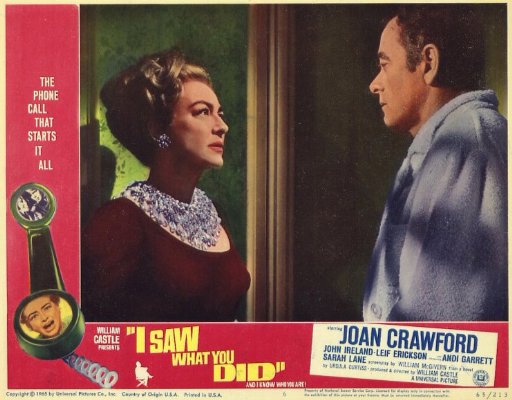
I Saw What You Did (1965)


It's common for film critics to bemoan the lack of originality in today's cinema, consistently grumbling over the latest horror remake or sequel that is due for release. Why things can't things be like the good old days? The problem with this attitude is two fold:

1) It completely romanticizes old Hollywood. Sure, a lot of great movies were made during the studio system, but for every great movie Hollywood churned out there were just as many clunkers. So, for every Gone With the Winds there were just as many Return of Dr. Xs.

2) It ignores the fact that the Hollywood of today is EXACTLY like the Hollywood of yesterday. Hollywood has always been about the profit. If one film is extremely successful, then it's only a matter of time before the other studios release a film exactly like it. When Easy Rider became an unexpected hit in 1969, the studios followed suit by making movies in a similar vain. In the 40s, two of Universals biggest money makers were the Monster films and Abbott and Costello series. MGM made a lot of great films in the 30s, but made countless Andy Hardy films as well. To quote Billy Joel, "the good old days weren't always good and tomorrow is not as bad as it seems."

In 1960 Alfred Hitchcock's Psycho hit the cinemas and proved to be a huge commercial hit. Hitchcock took a relatively obscure horror novel (by Robert Bloch) and, with a fairly low budget, turned it into a gold mine. It was only a matter of time before other filmmakers jumped on the bandwagon and produced their own Psycho, complete with relatively predictable twist endings. It is staggering just how many derivatives of Psycho were made throughout the 60s; Hammer studios would produce films like Paranoiac, Nightmare, and Scream of Fear, a young Francis Ford Coppola would direct Dementia 13 for his mentor Roger Corman, and William Castle got in the act by making THREE Psycho-like films.

William Castle is probably best known for the outrageous gimmicks he used to promote his horror films. His best known gimmick is probably Percepto-vision used for the movie The Tingler. Percepto consisted of attaching buzzers underneath select seats in the theater and setting them off during the film's climax (in which Vincent Price implores the audience to scream for their lives). Another gimmick was Emergo, which essentially was a plastic skeleton attached to a wire that floated over the heads of the audience during the climax of House on Haunted Hill. 

I Saw What You Did was William Castle's third attempt at mimicking Hitchcock, his two previous attempts were Homicidal and Strait Jacket, both of which hinge on a twist ending regarding the killer's REAL identity. Castle tries to pull a sleight of hand like Hitchcock did with Psycho, but ultimately fails, because the twist is fairly predictable in both films. I Saw What You Did is probably the most successful out of the three films, because it's the least gimmicky. The film follows two mischievous teenage girls, Libby and Kit, who amuse themselves by prank calling random numbers and whispering the phrase, "I know who you are and I saw what you did."  Unfortunately, one of their recipients, Steve Marak, has just murdered his wife. Libby mistakenly thinks that Steve is playing along with the prank and starts to grow curious as to what he actually looks like. The girls decide to drive by his home to have a look. Their plan is thwarted by Steve's next door neighbor (and would be lover), Amy, who thinks that Steve is having an affair with Libby. The girls beg Amy not to say anything, fearing that they will get in trouble with Libby's parents (who are at party) for leaving the house. Amy, out of spite, takes Libby's ID. The girls drive home dejected. Amy is aware that Steve has murdered his wife and plans to use this information to blackmail him into marrying her. Fat chance! Steve, not one to be caged, offs Amy and discovers Libby's ID. He then drives to Libby's house to confront her. Uh-oh!


I Saw What You Did "borrows" two distinct elements from Alfred Hitchcock's Psycho:

1. The killing of a star name fairly early in the proceedings: In Psycho, it was a genuinely shocking to see Janet Leigh killed off in the middle of the film. It was simply unheard of at the time to kill off a star name so early in the proceedings and naturally the audience had no idea how to react. William Castle takes a page from Hitchcock's book and bumps off Joan Crawford's character, Amy Nelson, with nearly a half hour remaining in the film. However, Crawford's death isn't nearly as shocking and disorienting as Janet Leigh's, because Amy is a supporting character and a fairly unsympathetic one at that. When she thinks Steve is having an affair with Libby, she becomes extremely jealous and possessive, to the point of blackmailing Steve into marrying her.

2. The shower scene: The shower scene is the most famous set piece in Psycho, so it's not surprising that Castle would ape it in his own movie, but with a twist. Steve is taking a shower when his wife starts to yell at him, he has had enough, pulls her in and stabs her to death. It is the Psycho shower scene done in reverse. The stabbing is shot in a similar fashion to the one in Psycho; shots of blood going down the drain, close ups of the woman's face, etc.

After Steve has murdered his wife, he attempts to cover up the crime by burying her in the woods. This is very similar to how Norman Bates tried to cover up Marion's murder, by dumping her car (with her body in the trunk) in the swamp. Castle milks these scenes to great effect, Steve is constantly on the verge of being discovered. At one point Steve hears a rustle in the woods and realizes a dog is coming his way. The gig is up, or so Steve thinks, but at the last possible second the dog's owner calls it back to the car.

I Saw What You Did is pretty jarring at times due to how tonally inconsistent it is. The scenes with the girls are done in a fairly light hearted manner with upbeat music playing on the soundtrack. These scenes would be more at home in a TV sitcom like Gidget than in a horror film. The scenes with Steve and Amy are extremely intense with your typical "spooky" horror/suspense music playing in the background. The fatal flaw of the film (other than plagiarizing Hitchcock) is that it hinges on characters behaving in the stupidest manner possible. Libby MUST know what Steve looks like, so she drives down to his house, gets caught snooping on his lawn by Amy, and in the process gives Steve the information he needs (her ID that Amy has taken) to track her down. Amy, out of fear of losing to Steve to much a younger woman, tries to blackmail him into marrying her, which, given the fact that he has just murdered his wife for her constant nagging, isn't exactly a bright idea. If Steve wasn't going to allow himself to be tied down to a constant nagger, then why would he allow himself to be held prisoner to a potential blackmailer. It's enough to make you smack your forehead in complete disbelief. On the other hand, at least the girls are played by actual teenagers (instead of the twenty something that often populate high school horror films) and behave as such. John Ireland makes for a compelling villain as well, he's absolutely cold and frigid to the world around him, and shows no remorse for the crimes he has committed. However, he only lashes out at the world when he feels he is being boxed in; his first murder was one of passion, the second was for self preservation. The confrontation between Steve and Libby (and Libby's younger sister Tess) at the end is extremely well done; at one point he tosses a knife as Tess when she screams out a warning to Libby. Castle really pumps up the atmospherics; the outside of the Mannering house is shrouded in fog, while Tess hides in the woods from her pursuer.
I Saw What You Did certainly pales in comparison to Psycho, but it's fairly entertaining in its own silly way.

Credits
Cast: Joan Crawford (Amy Nelson), John Ireland (Steve Marak), Andi Garrett (Libby Mannering), Sara Lane (Kit Austin), Sharyl Locke (Tess Mannering), Leif Erickson (Dave Mannering), Patricia Breslin (Ellie Mannering), John Archer (John Austin).

Director: William Castle
Screenplay: William P. McGivern
Running Time: 82 min.

Wednesday, April 3, 2013

Batman (TV Series): Why It's Friggin' Awesome, despite what comic book purists would have you believe.


I think for most people from my generation (and my parents) their first exposure to Batman was the campy 1960s television show starring Adam West. It was a show that I watched religiously when I was a kid, to the point that when it was taken off syndication I was absolutely devastated. I sat in my room for days and sulked about it. How could I live without my daily dose of The Dynamic Duo? It also meant that I would deprived of the greatest TV theme song in history.

The highlight of each episode was the fight scenes, whenever Batman and Robin would punch villain, words like, POW, BAM, BOOF, would appear on the screen. It was away to emphasize the very comic book nature of the television show.
The Batman in the TV show was an upstanding citizen who apparently had no vices, he didn't drink, didn't smoke and was able to keep his sexual urges in check, despite the fact that beautiful women were constantly throwing themselves at him. He was a goody two shoes who packed a mean wallop.

As a kid, Adam West was the DEFINITIVE Batman, until 1989, when the Tim Burton/Michael Keaton movie was released. The Tim Burton film went back to Batman's roots and made him a dark, brooding character haunted by the death of his parents, as opposed to the rather whimsical, benevolent authority figure of the old Adam West series. It was the DEFINITIVE Batman movie, until 2005 when Batman Begins was released to the cinemas.  Christopher Nolan's version was more grittier and less stylized than Burton's interpretation, and more importantly, Bruce Wayne was the central figure in the story, rather than a supporting player. Tim Burton's films, Batman and Batman Returns, were more interested in the plight of the villains and often pushed Batman/Bruce Wayne to the sidelines. Last year, Nolan finally completed his trilogy with The Dark Knight Rises, so it's only inevitable that in a few years time another reboot of the Batman franchise will be commissioned. Whether or not it will replace Nolan's Dark Knight trilogy as the DEFINITIVE Batman remains to be see.

I have done a complete 360 on the 1960s television series: I loved it as a kid, was embarrassed by it as a teen (especially after seeing the "serious" Burton films), and now love it as an adult. The television series may be a complete bastardization the original character, but it makes for some rather enjoyable (and funny) television. Of course, it's often overlooked that throughout the 1950s and most of the 1960s (the Silver Age) the Batman comic books themselves had devolved into rather silly children's stories. The villains weren't so much evil geniuses as they were merry pranksters with too much time on their hands. A typical story line from this era might involve the Joker trying to rob a pie factory in Gotham so he could stage the biggest pie fight in history. These comic books were aimed solely at kids and the TV show, for the most part, followed suit. It was also the campy TV show that brought Batman back into the spotlight after years of dwindling comic book sales.

What makes the TV show entertaining is Adam West's ability to deliver his lines in a straight manner, regardless as to how ridiculous they might sound. Oddly enough, when I was a kid, the campy humor went above my head, and I took the show absolutely seriously. When I watch the 1966 feature length film, I couldn't comprehend why my dad was laughing hysterically during the scene where Batman is punching a rubber shark that latched on his leg. This scene features the immortal line, "Hand me down the shark repellent bat spray." It is a moment that makes serious comic book fans cringe, but it is absolutely hilarious, especially with West's dry delivery.

I never liked character of Robin, even in the comic books and cartoons, and Burt Ward's take on the character can be extremely grating at times; to the point where one wishes Batman would give the Boy Wonder a nice crack in the jaw after his latest outburst of "HOLY______, Batman!"  Robin in the TV series main function was to get caught so Batman would have an excuse to fight the villains. Every once in a blue moon the writers would give him something useful to do, but otherwise he was a complete hindrance to the Caped Crusader's war on crime.  Robin in the TV series was essentially a boy scout in tights. 

Then there was the rogues gallery of villains, some of the most colorful characters in television (and comic book) history:
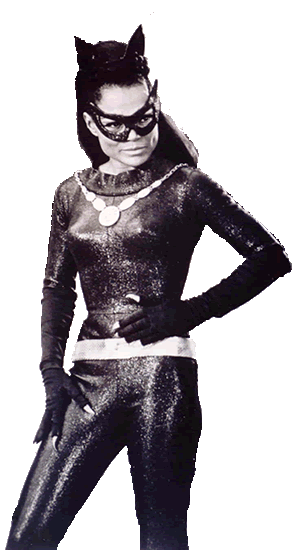
Catwoman: Three actresses played Catwoman during the show's run (well, two played the role on the television, one played the character in the movie), Julie Newmar, Eartha Kitt, and Lee Meriwether. 
Julie Newmar's interpretation is probably the most famous and best loved out of three, partly due to the fact that she had a wonderful chemistry with Adam West, but mostly because she was.....extremely... hot. 


Newmar's Catwoman was flirtatious with Batman and had a soft spot for him, to the point where she even contemplated giving up crime to be with him. In one of my favorite exchanges from the TV series, Catwoman offers turn a new leaf:

Batman: I'll do everything I can to rehabilitate you.
Catwoman:  Marry me!
Batman: Everything, except that! A wife, no matter how beauteous or affectionate, would severely impair my crime fighting.
Catwoman: But I can help you with your work. As a former criminal, I would be invaluable. I can reform. Honestly I can! 
Batman: What about Robin?
Catwoman: Robin?! Oh, I've got it. We'll kill him!

As a kid (and still as an adult) I was absolutely irate that Batman turned down her offer. Sure, killing Robin is excessive, but Catwoman would certainly be a more apt crime fighting partner than Robin, the Boy Blunder. She even tells him as much, but Batman turns her down. IDIOT! For my money, Newmar's portrayal is still the best (and yes that includes Michelle Pfeiffer and Anne Hathaway). 

Lee Meriwether (Miss America 1955) take on the character was much different, she had an icy cold exterior and didn't get all starry eyed when she encountered Batman. She took her role as a criminal very seriously and used her pretty looks (and sexuality) to lure Bruce Wayne into a trap. 

Catwoman and her cohorts (The Joker, Penguin, The Riddler), came up with an elaborate scheme to kidnap Bruce Wayne, so they could trap Batman when he came to rescue the famous millionaire. They wanted to lure Batman into a giant spring that would send him soaring into the arms of the Joker's exploding octopus. Needless to say, it didn't go according to plan. 


Meriwether was the first Catwoman I ever saw, so I will always I have a soft spot for her portrayal. 

When Earth Kitt inherited the role in the show's final season, the sexual tension between Batman and Catwoman was nonexistent, instead she purred her way through the scenery. Earth Kitt was by no means a bad Catwoman, but the dynamic between the two characters was far less interesting; she lacked Newmar's sex appeal and didn't quite possess Meriwether's cold hearted villainy, either. Though, Kitt's distinctive voice was a lot of fun to listen to.  

The Joker (Cesar Romero): It's common to disparage Caesar Romero's portrayal of the Joker, especially when compared to the much darker interpretations that Jack Nicholson (an multiple Oscar Winner) and Heath Ledger (the role he won the Oscar for) gave to the character.  Romero's Joker is a jovial prankster whose main goal in life is to embarrass Batman on a national stage. His schemes are completely impractical and, as a result, there is often no collateral damage involved when his plan is inevitably foiled. The Joker doesn't wish anyone (except for Batman) harm, he's mainly a criminal for his own amusement. 


While the Nicholson/Ledger incarnations are more truer to the comics, they would be completely out of place in the television series. The TV show was meant to be fun for the family, so the sight of the Joker smashing a guy's skull into a pencil would probably not go over well with parents.  Nor would him hand buzzing a gangster to death. Romero brought a lot of energy to the role, so even though his Joker may not be remotely like the one in the comics, he was still a lot of fun to watch. 

The Riddler (Frank Gorshin): Frank Gorshin's manic portrayal of the Riddler is vastly superior to any of the actors that followed in his footsteps; Jim Carrey's take on the character in Batman Forever is a piss poor imitation of Gorshin. The Riddler absolutely enjoyed toying with the Caped Crusader, his main down fall was his over confidence. He was so certain that he would succeed that he would give Batman and Robin clues to those crimes in the form of riddles, thinking that they wouldn't be able to figure them out, or that he and his cronies would be ready for the dynamic duo when they showed their faces. He always failed, but it never dissuaded him (then again, that applies to all the Batman villains).  The less I say about John Astin's brief stint as the Riddler, the better. 


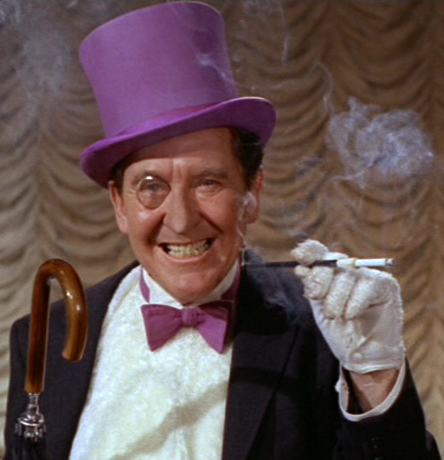
The Penguin (Burgess Meredith): The Penguin was always a silly character, not even a gritty reboot would be able to disguise just what a ridiculous villain he truly was. He walked like a penguin, had an extremely long nose, wore a monocle, and always had a cigarette holder protruding from his mouth. While he is extremely out of place in the dark, gritty Batman comics, he is a perfect fit for the campy TV show. 
The Penguin's crimes were always bird related and always chose extremely transparent bird themed aliases to throw the law off his track. In Batman: The Movie, he buys a pre-atomic submarine under the pseudonym P. N. Guin.  He labeled himself as being a SUPER GENIUS criminal mastermind, but was always bested by Batman. Whenever the Penguin disapproved of something he would let out a "Quack" sound. 


There were other colorful villains in the shows run as well: Egghead, King Tut, The Book Worm, False Face,The Minstrel, Mr. Freeze, but it's the four highlighted above that were, and still are, the most popular.

In the show's final season the character of Barbara Gordon/Batgirl was introduced. She was portrayed by beach movie regular (and frequent Elvis co-star) Yvonne Craig. Her character served dual purposes, it offered the girls a positive role model and it gave the boys more eye candy to look at. 
Batgirl's identity was a completely mystery to Batman and Robin, and she would often slip away before the Dynamic Duo had a chance to ask her any questions. She was a certainly more competent hero than Robin (and all the Gotham police force, but that goes without saying). Her alter ego, Barbara Gordon, was an extremely intelligent woman and could often figure out the criminals schemes/ where abouts before Batman and without the aid of a computer. She was also fairly adept at handling herself in fights, often holding her own with Batman and Robin (well, maybe not Batman, but she often bested Robin in terms of knock outs). Unfortunately, for all her toughness, she also had a tendency to get herself captured by the villains, then Batman would come along to save the day. Still, she was infinitely better than Robin. Yvonne Craig is leagues better than Alicia Silverstone, who stuttered her way through the role in 1997's Batman & Robin


As I mentioned before, Batman purists absolutely loathe the 60s TV show, because in their minds it makes a complete mockery out of the character. It wouldn't be until the 1989 Tim Burton film that the character would be a given a more serious minded treatment and since then the dark, troubled Batman of the Burton/Nolan films have supplanted the warm, whimsical Batman of the 60s. When Joel Schumacher went back to the camp format in Batman & Robin the movie going public rejected it, to the point where it's regarded as one of the worst movies ever made. In all fairness, it is a fairly dreadful film. It successfully killed the first Batman movie series but made way for the Christopher Nolan reboot. It's easy to rag on the Batman show for its camp aesthetics, but let's not forget that the comic book itself was extremely silly at the time. The 1960s Batman TV show is just one of the many faces the Caped Crusader has donned over the last eighty plus years, rather than being disgusted by it, Batman fans should embrace it. There's more than enough for room for two different interpretations of the same character (and in the comic book's case there's been 
more than that), so LIGHTEN UP PEOPLE! 
Besides, nothing in the Nolan films can top the sight of Batman running through this streets with a bomb over his head, looking for a place to dispose of it. (NOTE: This clip has been replaced with music from Benny Hill, as I could't find a decent clip with the original score.) 


Monday, March 25, 2013

Abbott and Costello Meet Frankenstein (1948)


Depending on who you talk to, Abbott and Costello Meet Frankenstein is either one of the best horror comedy films ever made, or the absolute the nadir in Universal's monster series of the 40s. To many horror aficionados it is a depressing sight to see three great horror icons (Dracula, The Wolf Man, The Frankenstein Monster) playing second fiddle to the comedy stylings of Abbott and Costello. In their mind, it's on par with shouting "HAIL SATAN!" in the middle of a Sunday church service, ABSOLUTE BLASPHEMY! I am part of the former camp that claim it at as one of the best, if not the best, horror comedy ever made.
 Of course, I'm absolutely biased as I first saw it when I was nine and watched it obsessively throughout the course of my youth. Abbott and Costello Meet Frankenstein was also my first exposure to both Dracula and the Frankenstein Monster (I saw The Wolf Man before hand). I own it in two different formats (VHS and DVD). I remember seeing the VHS on the shelf at Suncoast video, beckoning me to buy it for the low price of $19.99 and I obeyed, spending two weeks worth of allowance money on it in the process. A few months ago I spotted it on the DVD rack at Wal-Mart for $7.50 and needless to say bought it (especially after learning that it had a Greg Mank commentary on it).
The films of Abbott and Costello are fairly hit or miss, their best films include: Pardon My Sarong, Hold That Ghost, Who Done It, The Time of Their Lives, Buck Privates, Buck Privates Come Home, Africa Screams, and, of course, Abbott and Costello Meet Frankenstein. Their other films range from being tolerable, but mediocre to downright painful; the 50s, in particular, was not a kind decade for the comedy duo. Though, I have a soft spot from the absolute dreadful Abbott and Costello Go Mars, mainly because it borders on the surreal at times (the boys bump into a civilization of attractive warrior women that inhabit Venus). Costello's childish antics can be funny, especially when paired with the supernatural, but can be irritating as well. Bud Abbott was the perfect straight man and brought balance to the proceedings, often to the point of being able to offset Costello's mugging.
Abbott and Costello Meet Frankenstein would be the swan song for Universal's classic monsters, they would be replaced in the following decade by giant insects, alien invaders, dinosaurs, and most famously, the Gill Man from The Creature From the Black Lagoon. The plot is fairly simple: Dracula (Bela Lugosi) wants to put the brain of the dimwitted Wilbur (Costello) in the body of the Frankenstein Monster (Glenn Strange) so it will be obedient to his commands. Enter Larry Talbot (Lon Chaney, Jr.) whose top priority is stop Dracula, when he isn't turning into a werewolf and tearing up hotel rooms. While many horror fans complain about the monsters being relegated to supporting roles to a "second rate" comedy team, the truth is that Abbott and Costello Meet Frankenstein is far more respectful to the classic horror icons than the two previous films in the Universal series, House of Frankenstein and House of Dracula. The Wolf Man comes off rather well in these two pictures, but that's largely because he's central to the plot of both films. Dracula, wonderfully played by John Carradine, gets killed off midway through both films and the Frankenstein Monster is essentially a walking prop. In House of Dracula, the Frankenstein Monster spends most of the film strapped to an operating table, then in the finally closing minutes (the last two to be exact) he stumbles around inside a burning castle, only to have the roof come crashing down on him. To add insult to injury, the shot of the roof caving in on the Monster is lifted from The Ghost of Frankenstein. 
The reason Abbott and Costello Meet Frankenstein is a success is that it takes the horror elements seriously; never once are the monsters made to look silly. There's no scene in which Dracula's trousers fall down, or the Wolf Man taking a pie in the face. Dracula poses a very serious threat to our protagonists and Lugosi gives a very commanding performance (in the role he made famous seventeen years earlier). The humor comes from the characters reactions to the supernatural elements, or them being completely oblivious to them. In one funny/scary scene, Larry Talbot begs the boys to lock him in his hotel room and they reluctantly comply. However, Wilbur notices that Talbot left his suitcase in the hallway and brings it in, unaware that Talbot has just changed into the Wolf Man. The scene is filled with near misses and in one particularly moment Wilbur sits down to write Talbot a note, letting him know where the suitcase is, ignorant to the fact that the Wolf Man is lurking right behind him. Modern days audiences will probably find the scene more amusing than scary, but I'm sure it was an absolute scream fest in 1948.

The film is loaded with horror film iconography:
1) A creepy wax museum. The owner of the wax museum, Mr. McDougal, has purchased what he thinks are the "remains" of Dracula and the Frankenstein Monster, unaware both are fully intact and very much alive. This is where Wilbur first encounters Dracula and the Frankenstein Monster.
2) The shot of the full moon. In the opening sequence, Larry Talbot is on the phone in his London hotel room, trying to convince Wilbur, a baggage clerk at a railway station, not to deliver the crates that contain Dracula and the Frankenstein Monster to McDougal's House of Horrors. However, before he can finish his sentence, he notices the full moon and transforms into a werewolf and proceeds to tear apart his room.
3) A dilapidated, old castle. Dracula lives inside the castle under the pseudonym Dr. Leighos. It's also where he keeps his laboratory is located.
4) Secret passages. Chick and Wilbur, while searching the castle, stumble upon a underground passageway. Wilbur leans against a brick wall, which turns out to be a revolving panel that leads to a secret room where the Frankenstein Monster is being kept. Wilbur experiences a few close calls with both Dracula and the Monster. When Wilbur goes to get Chick, they have both seemingly vanished into thin air.
5) Hypnotism. Dracula is able to hypnotize Sandra (Lenore Aubert) and Wilbur into obeying his will.
6) The bat on the string effect. We get plenty of shots of Dracula, in bat form, flapping about the countryside.   It's also one of the few horror films of the decade in which the audience gets to see Dracula transform into a bat and vice versa. This is achieved through animation and, while not entirely convincing, is a rather neat effect to watch.
7) The laboratory scene. At the end of the film, Dracula has both Wilbur and the Frankenstein monster strapped to operating tables inside his laboratory. However, before he can begin his operation Chick and Larry come bursting into the save the day. Just when it seems Wilbur is finally safe from all harm, Larry turns into the Wolf Man.

The only real flaw of the film is the character of Dr. Stevens (Charles Bradstreet), whose main function is to serve as a love interest to Joan Raymond (Jane Randolph), an insurance investigator working for McDougal.
He is a rather uninvolving character and nearly drains the fun out of every scene he is in, which, thankfully, isn't too many. He does destroy the Frankenstein Monster at the film's end (by setting it on fire), but even that is a bit anti-climatic, considering Chick and Wilbur are rowing to safety in a row boat, while the Wolf Man and the Dracula have plummeted to their supposed deaths.

However, this is an extremely minor flaw in an otherwise great film. Abbott and Costello would bump into other monsters (The Invisible Man, Dr. Jekyll and Mr. Hyde, the Mummy) in the next decade, but none of those films come close to capturing the magic of Abbott and Costello Meet Frankenstein. It was lightning in a bottle that would also signal the end for the classic Universal Monsters.

Credits:
Cast: Bud Abbott (Chick Young), Lou Costello (Wilbur Grey), Bela Lugosi (Dracula), Lon Chaney,Jr. (Larry Talbot/The Wolf Man), Glenn Strange (Frankenstein Monster), Lenore Aubert (Sandra Morney), Jane Randolph (Joan Raymond), Frank Ferguson (Mr. McDougal), Charles Bradstreet (Dr. Stevens).

Director: Charles Barton
Screenplay: Robert Lees, Frederic I. Rinaldo, John Grant.
Running Time: 83 min.

Thursday, March 21, 2013

The Hobbit: The Unexpected Journey, Or, The Bad Assification of J.R.R. Tolkien


In the past few months we have bombarded with cinematic re-imaginings of children's stories: Hansel and Gretel: Witch Hunters, Jack the Giant Slayer, Oz: The Great and Powerful, and The Hobbit: An Unexpected Journey. The thing these films have in common (other than being adaptations of children's stories) is that they focus more on action and spectacle (to the 3D format) than telling an actual story. Hence, the bad ass factor is ratcheted up several notches, while characters and narrative get lost in the mix. It is only a matter of time before we are treated to a re-imagining of The Tortoise and the Hare (in 3D), which will end in a huge slug fest between the two characters and the tortoise coming out triumphant after he beheads the evil hare. 
Everything in today’s commercial cinema must be cool and bad ass otherwise, in the mind of Hollywood execs, the audience might have no interest in seeing it. So, not only do modern fight scenes defy the laws of physics, but they are now tailored to fit the needs of 3D as well. Therefore, when some bad ass warrior gets into a long elaborate duel with a baddie, there’s got to be a few shots in which he lunges directly at the camera.
Unfortunately, once the gimmick begins to wear thin, the easier it becomes to spot the flaws in the storytelling. Directors are sold on the idea that the audience will be in complete awe of the 3D effects that they will overlook the film’s many shortcomings. Consequently, the best 3D films tend to be the ones that are rather conservative with the 3D gimmick, while focusing more on the actual story line  They don’t “WOW” audiences in the movie theaters,  but they hold up a lot better after multiple viewings than their more flamboyant counterparts. 
Which brings me to The Hobbit: An Unexpected Journey, or as I like to call Lord of the Rings, Episode I: The Unexpected Journey. When it was announced that Peter Jackson was going to adapt J.R.R. Tolkien’s classic CHILDREN’s story into a three part movie, it left a good many people (Internet message boards) dumbfounded.  “How in the hell is Peter Jackson going to adapt a 300 page novel into a nine hour epic?” they asked.  After viewing the film, the answer become obvious: by adding as many subplots as humanly possible and shoehorning as many Lord of the Rings references in as possible…ALL IN GLORIOUS 3D. 
 Normally, I don’t have anything objections to when a filmmaker makes changes to the novel; after all, these changes are often necessary, ideas and characters that read well on the printed page don’t necessarily translate well onto the big screen.  When Jackson adapted The Fellowship of the Ring, I, for one, did not miss the character of Tom Bombadil. He would have been absolutely insufferable to watch (“Hey dol! merry dol! ring a dong dillo! Ring a dong! hop along! fal lal the willow! Tom Bom, jolly Tom, Tom Bombadillo!").  He was also fairly extraneous to the plot. He’s main function is to add a little color to the narrative.


However, Peter Jackson’s adaptation of The Hobbit maybe the rare example where it will take more time to watch the movies (all three of them) than read the actual novel. Whereas most adaptations omit characters/subplots from the novels to make them more streamlined for the cinema, Jackson actually adds characters/subplots to his cinematic rendering of the The Hobbit.  Fans may argue that it adds to depth to the overall proceedings and nicely ties it in with the Lord of the Rings trilogy, but it also has the unfortunate effect of making Bilbo (Martin Freeman) a supporting character in his own story. 

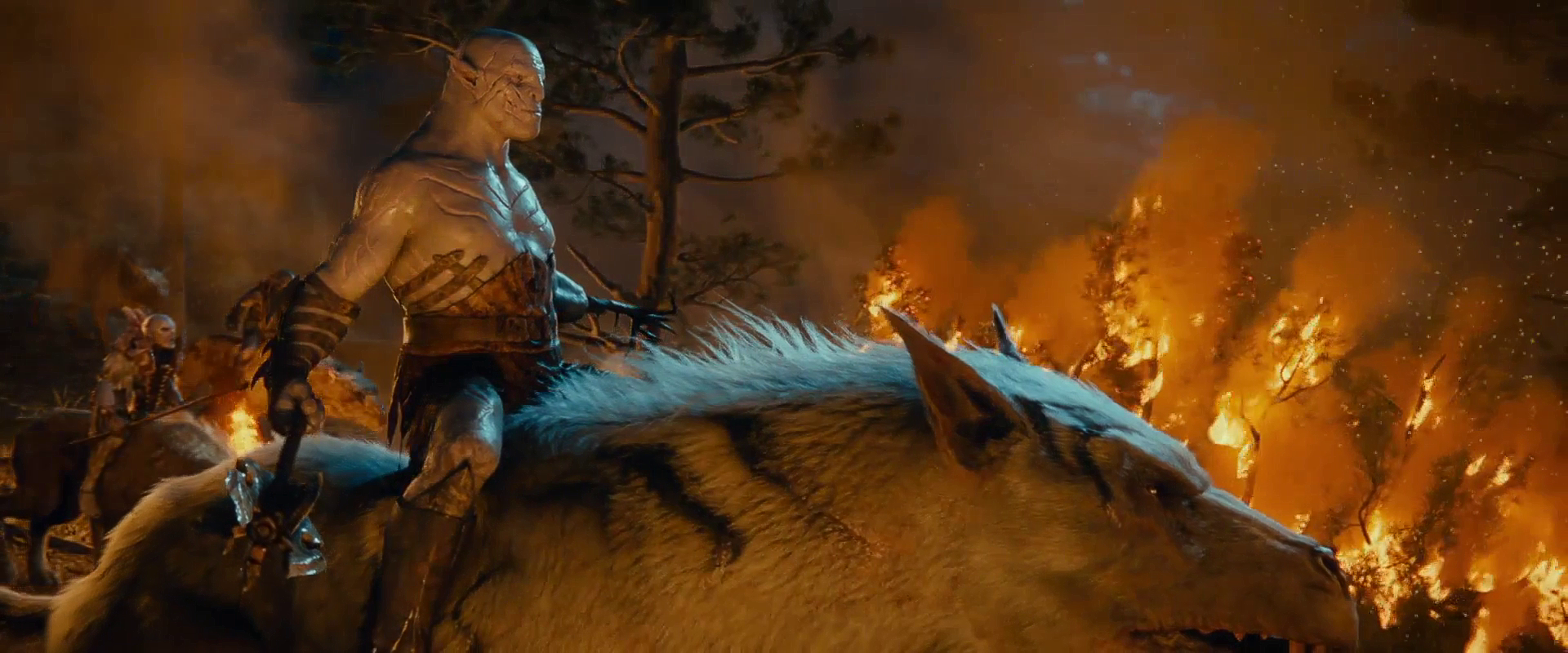
Peter Jackson’s often seems more invested in the character of Thorin Oakenshield than he is in Bilbo Baggins, the titular character.  Thorin is given not one, BUT TWO BACK STORIES. The first tells about how the dwarves were driven from Lonely Mountain by the dragon Smaug, the other is a lengthy flashback that details Thorin’s epic battle with the White Orc, Azog, (a character that is only mentioned in passing in the book).  Thorin mistakenly believes that he killed the White Orc a long time ago, but the bugger is still alive and seeks vengeance.  This, of course, leads to a show down at the film’s climax where Thorin and the White Orc duke it out. Thorin is thoroughly beaten, but Bilbo saves the day. Yup! Jackson finally remembers that Bilbo is the actual protagonist of the story and has him dabble in an act of heroism that wasn't in the book. In the novel, the dwarves are being chased by the Orcs and take refuge in the trees. The Orcs set the trees on fire and it looks like the Dwarves are cooked, when all of a sudden eagles swoop down and fly them to safety.
However, this resolution is not nearly bad ass enough for today’s audience, not to mention it wouldn't make for exciting 3D. So Jackson adds a small battle to the proceedings, after a horribly drawn out scene in which the trees tumble over like dominoes, forcing the Dwarves to hop from tree to tree until finally there is only one left and it’s hanging over the edge of a cliff. The tree slowly begins to uproot and leans at such an angle that Thorin is able to walk straight off it and face his tormentor face to face. The two duke it out, then Bilbo comes to save the day. The other Dwarves join in (the ones not hanging for their dear lives on the branches of the hanging tree) and it becomes a big free for all. When everything seems lost, the eagles come and save the day. BAD ASS! Go easy on the high fives, dude, you might spill the Mountain Dew.
The problem with this sequence, other then being horribly long, is that it resolves Bilbo's character arc much too early in the story; there's no reason to doubt his heroism after this scene, because he bravely risked his life to save Thorin's. In the book, the turning point for Bilbo is when the dwarves are captured by the giant spiders, he is on his own (Gandalf has left) and is essentially forced into an act of heroism. Up until this point in the book, Bilbo is a fairly timid character who is often more of a hindrance than actual help. After he slews the spiders and saves the Dwarves, Bilbo grows increasingly more confident in himself to the point that doesn't hesitate in facing Smaug. Of course, because Jackson decided to stretch the story out over the course of three movies, there needs to be some resolution at the end of the first film, hence, Bilbo's heroism and Thorin's new found respect for him.
It's also for this reason that the White Orc is such a prominent character throughout the film; without him there would be no clear antagonist. Smaug isn't set to make his appearance until the next film, the Necromancer is still in the shadows, and all the other baddies they encounter (Trolls, Goblin King) are stumbling blocks at best. Had Jackson just adapted The Hobbit into one film, there would absolutely  be no need for the White Orc, as Smaug would be more than enough to suffice. It's ironic that the 1977 Rankin/Bass version, despite being only 80 minutes in length, is far more faithful in tone to the novel than Peter Jackson's EPIC film. Of course, the Rankin/Bass was more in tune with their intended audience (children) than Jackson, who seemingly doesn't know who this movie is for; it seems like he's aiming for a children's movie that is frat boy approved. It ranges from being fairly whimsical at times (Bilbo's first encounter with Gandalf, the scenes with the wizard Radagast) to down right violent at others (practically all the fight scenes). It doesn't help that many of the scenes (especially the escape from Goblin Town) have the feel of Playstation video game. Like video games, their fun for the person that's playing it, but get fairly boring to the person who has to watch.


The Hobbit: An Unexpected Journey often seems less like an adaptation of Tolkien's novel and more of a rehash Jackson's version of The Fellowship of the Ring. In fact, The Hobbit follows The Fellowship of the Ring almost beat for beat.

1. In The Fellowship of the Ring we are shown a prelude that involves the War of the Ring. In The Hobbit we are shown a prelude of Smaug attacking Lonely Mountain and driving the Dwarves away from their homeland.

2. After the prelude, we go back to aged Bilbo (Ian Holm) writing his memories down in a journal. Frodo makes a brief appearance by getting the mail, while looking completely confused.

3. Thorin is essentially the stand in for Aragorn; a king without a kingdom. Of course, the difference is that Aragorn dodged his responsibility because of his inner doubts, Thorin has been waiting for the right moment to return. However, both are exceptional warriors and have an air of mystery about them that slowly gets revealed as the film progresses.

4. In The Fellowship of the Ring, Frodo and company are being stalked by the Black Riders. In The Hobbit, Bilbo and friends are being stalked by the Orcs, led by the extremely evil Azog.

5. The Fellowship of the Ring has the Council of Elrond, while The Hobbit has the White Council (NOT IN THE BOOK).  Both occur in Rivendell. Like Gimli, Thorin has an extreme dislike for Elves.

6. Goblin Town scene in The Hobbit occurs at about the same time as the Mines of Moria sequence from Fellowship of the Ring. The escape from Goblin Town isn't very detailed in the book, because as Gandalf and Dwarves are running away, Bilbo is knocked off the back of the Dwarf that is carrying him and falls down a chasm. It's then he meets Gollum. In the film, Bilbo falls down the chasm while the Dwarves are being captured by the Goblins. The Riddles in the Dark scene happens during the encounter with the Goblin King as opposed to after. This allows for Jackson to show the Dwarves escape in full detail and to take advantage of the 3D effects, hence, lots of shots of collapsing bridges and characters running towards the camera.

You shall not pass!


The pity is that somewhere in the rubble is a potentially great movie. Peter Jackson has assembled one hell of a cast; Martin Freeman is ideally cast as Bilbo and it's always a joy to see Ian McKellan as Gandalf. The Riddles in the Dark scene with Gollum is as good as I could have hoped for and the Goblin King is well realized. Had Jackson been more interested in adapting the story the Tolkien wrote as opposed ladling out subplots and ties in, he could have had a genuine classic on his hands. The Hobbit: An Unexpected Journey is not bad movie, but it's a disappointment nonetheless.

Credits:

Cast: Ian McKellan (Gandalf), Richard Armitage (Thorin), Martin Freeman (Bilbo Baggins), Andy Serkis (Gollum), Sylvester McCoy (Radagast),  Hugo Weaving (Elrond),Christopher Lee (Sauron), Cate Blanchett (Galadriel), Ken Stott (Balin), Graham McTavish (Dwalin), William Kircher (Bifus/Tom Troll), James Nesbitt (Bofur), Stephen Hunter (Bombur), Dean O' Gorman (Fili), Aidan Turner (Kili), John Callen (Oin), Peter Hambleton (Gloin/William Troll), Jed Brophy (Nori), Mark Hadlow (Dori/Bert Troll), Adam Brown (Ori), Barry Humphreys (The Great Goblin), Ian Holm (Old Bilbo), Elijah Wood (Frodo).

Director: Peter Jackson
Screenplay: Peter Jackson, Philippa Boyens, Fran Walsh, Guillermo del Toro.

Running Time: 166 min.


Sunday, February 17, 2013

Atom Man Vs. Superman (1950)


There have been many Lex Luthor's in cinema/television history, but for my money Lyle Talbot was the absolute best! Gene Hackman was great, but tended to overdo the wisecracks. Ditto Kevin Spacey. Whereas the other actors who portrayed the role never really left much an impression on me. Of course, Lyle Talbot has a distinct advantage over the others, in that he was the first actor to portray Lex Luthor on the big screen. Interestingly, he was also the first actor to portray Commissioner Gordon (another DC character) on the big screen in the 1949 serial Batman and Robin, made by the same team. Talbot is probably best known for his association with the the infamous movie director Edward D. Wood, Jr. Talbot co-starred in three of Woods films: Glen or Glenda?, Jail Bait, and Plan Nine From Outer Space. 
Talbot's Luthor is downright sinister, yet has an air of dignity about him. Clark Kent sums up best when he proclaims, "Luthor has a strange evil genius. Far above any scientist I've ever known."

 In Atom Man vs. Superman, Luthor is released from prison and vows to change his ways; he does so by becoming a respected television producer. This, not surprisingly, turns out to be a front for his criminal deeds. He has television trucks stationed all across the cities and each truck has a secret compartment in which his thugs can hide out after having robbed a jewelry store or some other establishment. He even manages to get the lovely Lois Lane (Noel Neill) to work for him, so she can can do puff pieces about the city. This is just one of many phases in Lex Luthor's agenda; the other is to rid the world of Superman by transporting the Man of Steel into a parallel dimension (The Empty Doom as he calls it) via his teleportation machine. To get Superman into the machine, Luthor creates a synthetic form of Kryponite, which weakens the Superman while he is at a public ceremony. Luthor's henchmen (disguised as ambulance drivers) steal away the Man of Steel to his apparent doom. Will Luthor succeed? Of course not!


Atom Man Vs. Superman was one of the few times (if not the only time) that a movie serial actually used a villain from the comic book it was adapted from. It was common for serial adaptations to invent their own villain. The villains in  serials tended to be masked scientists/criminals out for world conquest; in the first Superman serial, the Man of Steel faced a masked villainess called the Spider Lady. In Batman and  Robin, the villain was a masked scientist called the Wizard. Even Atom Man Vs. Superman follows the masked villain format by having Lex Luthor don the disguise of Atom Man to throw the law and Superman off his scent. Granted, Superman from the get go is convinced that the Atom Man is really Lex Luthor, but everyone else is convinced that Luthor has gone straight.
Despite a few changes the Superman serials remained fairly faithful to the comic book, which was fairly rare for a movie serial. The most famous case of a serial being drastically different from it's comic book source was 1944's Captain America, starring Dick Purcell in the title role. In the comic books, U.S. Army Private Steve Rogers became Captain American after being injected with a super serum that gave him great strength. Most of this adventures happened overseas as he fought Nazis and, most famously, the Red Skull. In the serial adaptation, Captain America's secret identity is Grant Gardner, who is not an army soldier, but a district attorney. His nemesis is a masked villain known as the Scarab, who turns out to museum curator Dr. Cyrus Maldor.  Most adaptations didn't take as many liberties with the source material like Captain America, but often, due to budgetary problems, a lot of compromises had to be made. In Batman and Robin there is no Batmobile, instead the dynamic duo drive around in a 1949 Mercury.
Atom Man Vs. Superman is a fairly ambitious serial, but the problem is that it doesn't have the budget nor the resources to match its scope. In chapter one, Luthor builds a sound ray and threatens to destroy the Metropolis River Bridge if his demands are not met. The authorities scoff at Luthor's demand, so he turns his ray towards the bridge and it begins to sway back and forth. This is achieved through the use of stock footage.....well known stock footage I might add; the collapse of the Tacoma Narrows Bridge (or the Galloping Gertie as it was called). Much to the horror of the Daily Planet Staff and police there is a woman on the bridge passed out in her car. Just when everything seems lost, Superman flies into frame to save the damsel in distress. Initially, I thought Superman would grab the woman and fly her to safety.......NOPE! Instead he stops the bridge from swaying by grabbing hold of its suspension cable and then calls for the cops to rescue the woman. The cops run in, grab the lady, and then run to safety. Superman lets go of the suspension cable and we then cut to footage of the Galloping Gertie collapsing. After the woman is taken to safety, Lois Lane coos, "Superman saved her! I knew he would do it!"


Chapter seven is a re-cap of Superman's origin, narrated by Luthor, with footage lifted from the first Superman serial. Jor-El (Superman's Krypton father) managed to send out radio waves in his Kryton language and Luthor was some how able to translate them, thus making him an expert on everything Superman - with the exception of Superman's secret identity.
When Superman flies he turns into an animated figure and then will land behind a landmark, where Kirk Alyn will then emerge from. This was done because the wire work on Kirk Alyn was so bad that the footage had to be scrapped and the producers, rather hastily, decided to settle on animation. Of course, the problem with the animation is that not only is it jarring at times, but it often kills the urgency that is required in the scene. Superman will often land behind a huge boulder, or some other landmark, and then run the rest of the way to his destination, hence wasting precious time.


It is these lapses in budget and plotting that prevent Atom Man Vs. Superman from being a classic.  Too often the plot is set up by complete coincidence; Lois and Jimmy have a knack for running into Luthor's henchmen, who then proceed to kidnap them just so Superman can save them at the last second. The perils tend to be a bit redundant as well; twice Jimmy is saved from an exploding car. Granted, these flaws are more apparent to the modern day viewer with a DVD player than a movie goer of the 50s, especially little children.
Yet, there are a couple of genuinely clever ideas scattered throughout the serial, the most compelling being "The Empty Doom." Lex Luthor builds a machine that transports Superman to another dimension  that he christened "The Empty Doom." The ghostly image of Superman often pops into frame and attempts to stop a crime from happening, but is forced into the role of a spectator, helpless to do anything about it. He, through sheer will power, is able to communicate with Lois Lane through her electronic typewriter and sets up a plan that will set him free. It also finally dawns on the Daily Planet staff that Clark Kent and Superman just might be the same person.  Perry White orders Lois Lane to write an article that asks the question, "Is Clark Kent Superman?" Lois is hesitant to do so, but obeys White's orders. However, she conspires with Jimmy Olsen to keep the story from every being printed by having him call White and pretending to be Clark Kent. The fairly convincing imitation fools White and he orders the story to be scrapped. However, once Superman is released from "The Empty Doom" the "Is Clark Kent Superman" subplot is completely discarded; Lois and Jimmy never seem interested in finding out the answer for themselves. Luthor becoming a successful TV producer in many way anticipates DC reboot of Superman in the 80s, in which Lex Luthor went from being mad scientist to a respected multi-millionaire with a sinister side.
Kirk Alyn's Superman is appropriately bland; he's pretty much a boy scout with super hero strength. This was essentially how Superman was depicted in the comics at the time and Alyn plays it to perfection. His Clark Kent is way more interesting character, in that he's not nearly as wimpy and bumbling as Clark was in the comic books. Alyn's Clark Kent is slightly clumsy (or pretending to be clumsy), but he's an excellent reporter and is fairly handy in a fight as well. Lois Lane thinks him a coward for always disappearing when danger is near, but we know better.  In TV Show The Adventures of Superman, starring George Reeves, there were very little difference between the Clark Kent and Superman personas, the only thing that really separated them was that Clark wore glasses and suit, while Superman wore a leotard costume. In the two Superman serials starring Kirk Alyn, there is just enough of difference between the two personas that makes it plausible (if not entirely believable) that no one would suspect Clark Kent of being Superman.
My favorite part of the serial is how it doesn't shy away from showing off Superman's strength; in one of the early chapters Luthor's henchmen fire bullets at Superman and they bounce off him, while he grins off the entire thing like it's nothing. This is done with animation, but it's a neat moment nonetheless  At another point, Superman effortlessly lifts up two henchmen, raises them above his head, and bangs their heads together, knocking them out cold.
I've never been a fan of Noel Neill's "Golly Gee Whiz" approach to the role of Lois Lane, granted, it's not nearly as bad in the movie serials as it was in the television show. In season one of The Adventures of Superman, Lois Lane was played by Phyllis Coates, who's interpretation of the role was far and a way my favorite. Coate's Lois Lane was a no nonsense reporter who took her job seriously and often put it ahead of her own safety. Secondly, she didn't have a school girl crush on Superman, like all the other Lois Lanes, but rather admired him and was grateful for his help. In the first season, there was a sense that Lois and Clark were beginning to bond as friends; initially Lois resented him for joining the Daily Planet, but by season's end she grew to appreciate him. However, when season two began filming Coates was no longer available and was replaced by Noel Neill, because of her appearance in the serials. Lois Lane went from being a professional trying to create her own breaks to being a fairly clueless reporter more interested in swooning over Superman than doing her actual job. In the serial, there's is very little sense of growth between Clark Kent and Lois Lane, even when he keeps constantly bailing her out; she constantly talks about him in a very condescending manner and is fairly resentful of his success. When it is suggested that Clark Kent might be Superman, Lois Lane has this to say, "If Clark Kent is Superman, we have no right in revealing in his secret. If he isn't, then why give a dope such a big build up."  Half the time, I was almost hoping the villains would succeed in bumping off Lois Lane, just so it would finally shut her up. Neill certainly isn't aided by the writing, which often relegates  Lois Lane to a plot device  so Superman has an excuse to fight the villains. Lois gets capture, Superman saves her. Wash. Rinse. Repeat. Not to mention her dialogue is fairly cringe worthy as well, practically ever other sentence has her referencing Superman. "Not even Superman himself could do such a thing."
Tommy Bond as Jimmy Olsen main function is comic relief, but to his credit, he's not nearly as annoying as Jack Larson's portrayal on The Adventures of Superman. At least, Bond's Jimmy Olsen was occasionally useful in capturing the villains, whereas Larson stumbled through the scenery and practically killed every scene he was in.
Atom Man vs. Superman is fairly entertaining serial, despite it's many limitations. However, it's best to view it over the course of a few days (like the audiences of 1950) than in one sitting, otherwise you might go insane.


Cast: Lyle Talbot (Lex Luthor), Kirk Alyn (Clark Kent/Superman), Noel Neill (Lois Lane), Tommy Bond (Jimmy Olsen), Pierre Watkin (Perry White), Jack Ingram (Foster), Don C. Harvey (Albor), Rusty Wescoatt (Carl), Terry Frost (Baer).
Director: Spencer Bennett.
Screenplay: George H. Plympton, Joseph F. Poland, David Mathews.
Running Time: 252 minutes (15 episodes)

Monday, February 11, 2013

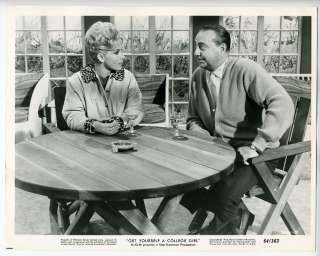
Get Yourself a College Girl (1964)


One of the disadvantages about having Turner Classic Movies is that they play so many movies I want to watch that I constantly find myself firing up the VCR, as a consequence I have a huge back log of movies that I have to watch. After nearly two years, I finally got around to watching Get Yourself a College Girl and thought it would serve as an interesting companion piece to my A Hard Day's Night/ Girl Happy review.

Get Yourself a College Girl was made in 1964 and as a result it often gets lumped in with the Beach Party genre that was popular during the period. While the similarities are there, the truth is, it has more in common with films like Rock Around the Clock (1956), and its semi-sequel Don't Knock the Rock (1956), than it does with the Frankie and Annette films that were popular at time. This isn't too surprising considering that not only does Get Yourself a College Girl have the same producer as those two films (Sam Katzman), but the same screenwriter as well (Robert E. Kent). Katzman was a legendary producer of low budget films and most famously brought not one, but two DC comic book heroes to the screen, Batman and Superman, in serial form. Rock Around the Clock and Don't Knock the Rock both would serve as templates for rock n' roll films of the future, including Get Yourself a College Girl.

Rock Around the Clock is officially the first Rock N' Roll film ever produced and it follows band manager, Steve Hollis (Johnny Johnston), as he attempts to bring Bill Haley and the Comets to the mainstream. One day, while driving across country with his musician friend, Steve stumbles upon Bill Haley and the Comets playing a dance in a small town located in the middle of nowhere. Steve his amazed at the amount of excitement Bill Haley and his band are generating among the locals; at point Steve's friend taps a dancing girl on the shoulder and asks, "What do you call that exercise you're getting?" She replies with, "It's rock n' roll, brother. And we're rocking tonight!"


Steve is convinced rock n' roll is the wave of the future and sets about getting Bill Haley national exposure. The only thing standing in his way is a manipulative, domineering music agent named Corinne Talbot (Alix Talton), who also has her heart set on marrying Steve, despite his lack of interest. When she finds Steve has become smitten with the female half of a brother/sister dancing act that accompanies the Comets, she sets about trying to sabotage Steve's chances. First, she books the Comets to play at a high school prom, thinking that the Comets "wild music" will get them booed offstage, but is utterly shocked when the youth respond in a wildly enthusiastic manner. After her first plan has failed, she attempts to have Steve and the Comets blackballed from the music industry by calling up her friends at other agencies. Steve circumvents her by calling upon popular DJ, Alan Freed, who owes Steve a favor. Finally, Corinne concedes defeat and offers the Comets are huge three year contract. A few other contrivances follow, but it ends on a happy note, with the Comets and other rock n' roll acts getting national exposure on a televised musical jamboree.

Two thoughts about Rock Around the Clock:
1) As a movie it is relatively worthless; the characters and acting (with the exception of Talton) are fairly bland. Bill Haley, despite his top billing, is relegated to the sidelines for the most of the film. But as time capsule for the period (mid 1950s) it is absolutely invaluable; it gives modern day viewers an opportunity to see rock n' roll acts of that time in their absolute prime. (Bill Haley, The Platters, The Bellboys, etc). 


2) The character of Corinne; she's a highly successfully, intelligent career woman, yet the filmmakers imply that she can never be happy unless she's married to a man. Throughout the film, she tries hard to break down Steve's will, so he will come crawling back to her, begging her to marry him. At the end, when she has failed, she seems content on settling for the next best thing (her assistant, Mike Dobbs). This theme of the highly successfully but lonely woman gets revived in Get Yourself a College Girl. 

Don't Knock the Rock, the semi-sequel to Rock Around the Clock, takes a defensive stance towards rock n' roll music; in it a successfully rock singer, Arnie Haines, returns to his hometown to find that he has fallen out of the favor with the elders. Their concern is that rock n' roll leads to juvenile delinquency, so he takes it upon himself (with help from Bill Haley and the Comets and other music acts) to put their fears to rest. After a couple of mishaps, he eventually wins over the elders and everything is peachy keen at film's end.

Flash forward to 1964, and the focus gets shifted from successful male rock star to successful female songwriter, Terry Taylor, who is still attending college at Wyndham. It is revealed that Wyndham is a fairly conservative musical college that looks down upon rock n' roll; to keep herself from being expelled, Terry has her songs published under a pseudonym. However, the cat is let out of the bag when her publisher, Gary Underwood, calls the college in regard to ideas he has for promoting her album. This naturally infuriates the Board of Directors, which consists mostly of old men, who demand that Terry be expelled. The student body marches in on the proceedings and objects to Terry's possible suspension, stating that she's been like a "Joan of Arc" to them with her progressive attitude towards women. However, the Dean, being a woman, is sympathetic towards Terry and asks that the Board wait until after Christmas Break to make their final decision.  One of the board members is Senator Hubert Morrison, who is up for reelection and whose grandmother founded the college. He is, at first, appalled by Terry's music, but the Dean tells him he's old fashioned and should try to get to know the girl before he passes judgment on her. Morrison takes this advice to heart and, by sheer coincidence, happens to be vacationing at the same ski resort as Terry and her friends. All sorts of hilarity ensue!


As I mentioned before Robert E. Kent was a screenwriter on all three films and I suspect a good majority of his screenplays contained the phrase, "Insert musical number here." These films are a more or less an excuse to showcase the musical talent of the day while the "story" mainly functions to bridge the musical numbers together. The actual story for Get Yourself a College Girl doesn't begin until nearly twenty minutes into the movie; the beginning has a few bits of exposition (Terry being a songwriter), but the majority of it is musical acts (The Dave Clark Five, The Animals) accompanied with shots of various college students dancing. One of the musical acts is Terry singing her new song, "Get Yourself a College Girl."


What I find interesting about this sequence (and the end as well) is that the two headlining bands (The Animals, The Dave Clark Five) were part of the British invasion. Get Yourself a College Girl maybe the first American film to openly embrace the British invasion, whereas most Beach Party films were either condescending toward it (Bikini Beach, The Girls on the Beach), or didn't bother to acknowledge its existence. Like A Hard Day's Night, I'm sure getting these bands was an attempt by Sam Katzman to cash in on their fame before it waned, but nonetheless, it is interesting that Katzman willingly jumped on this trend, while Samuel Z. Arkoff and other producers thumbed their nose at it. In fact, despite being labeled a "Beach Party Movie," there is absolutely no surf rock to be found in Get Yourself a College Girl. It is also interesting to note that many of the rock n' roll scenes often take a Direct Cinema approach to film making; often there will be shots of college students dancing done with handheld cameras to give it a more immediate look. This was obviously influenced by shots of the screaming audience at the end of A Hard's Day Night. 


Mary Ann Mobley is a far more engaging lead than the two stiffs (Johnny Johnston, Alan Dale) who sleepwalked through Rock Around the Clock and Don't Knock the Rock. Her character, Terry Taylor, is a woman who is trying to get ahead on her terms and takes offense when a man, Gary Underwood (Chad Everett), tries to run her life for her.  When Gary shows up at the ski resort, she is infuriated and threatens to sue him for breaching her contract; it was stipulated that the music publisher would never telephone Terry at Wyndham College. Gary's idea for promoting her new single is a painting of her holding an acoustic guitar and wearing a revealing nightgown; he then plans to have it plastered on billboards across the country. He has brought an artist along with him, Armand, to capture her likeness. Terry naturally takes offense to this and kicks Gary out of her room. Gary isn't defeated yet, he connives to use the body of another woman while painting Terry's face on top. He approaches various shapely woman at the ski resort, tells them his idea, and is met with a slap in the face. However, before the face slapping commences the audience is treated to an "Insert musical number here" moment with Astrud Gilberto singing "Girl From Ipanema."


While Get Yourself a College Girl features a relatively strong, independent woman in the lead, it's feminism is shaky at best. In the beginning, Terry stresses that a woman should be able to chose her path in life, without the interference of men; be it a career or romance. In the Frankie/Annette Beach Party films of the sixties, the main tension between the two of them was in regards to matrimony; Annette wanted to settle down and have a family, while Frankie wanted to have fun and avoid responsibility at all costs. In Get Yourself a College Girl, Terry's education and singing career come first, while a steady relationship is the last thing on her mind; she plays the field (as the lyrics to her songs suggest), but she's not quite ready to fall for any man. Of course, that all changes when Terry meets Gary. It's true that Terry initially resents Gary, but the audience knows that it's only a matter of time before the two fall in love. The romance is handled in an incredibly clumsy and lazy manner; Terry and Gary happen to be skiing on the same slope and Terry gives him the cold shoulder. She skis down the slope with Gary following her, she looks back to see where he is, and crashes into a snowbank. Her arms are stuck inside the snowbank and Gary takes advantage of the situation to kiss Terry on the lips. Rather than protest the situation, Terry gives in and after they are done kissing she comments that his kiss has melted the snow. She then frees her arms from the snow bank and embraces him.

There is a similar moment in Rock Around the Clock in which the band manager Steve Hollis is met with initial resistance by Lisa Johns (Lisa Gaye), the female half of the brother/sister dance act that performs with Bill Haley and the Comets. When Steve offers to manage that band he proposes a 60/40 split, meaning he'll get 40% of the earning. Lisa, acting as the spokes person for the band, insists that he should be only given 10% and tells him to call back later when he's changed his mind. Steve decides he will seduce Lisa into seeing his way. Later, the two of them are on the beach in bathing suits and Steve is about to make his move, but Lisa completely takes him off guard by kissing him first. The two kiss for a few minutes; Lisa tries to use her womanly charms to persuade Steve into taking 10%, while Steve uses his manly swagger into keeping the entire 40%, eventually they settle on 25%.  By the scene's end, they are hopelessly in love with one another. With the whole romantic subplot settled, the film can now focus on Steve's attempt to land the Bill Haley and The Comets a gig.

The most inexplicable moment that happens in Get Yourself a College Girl is when the character of Sue Ann (Chris Noel), the sexpot out of the group, starts to dance around in the girl's hotel room, clad in a bikini. It's real a head scratching moment...hell even Teresa and their friend Madge (Joan O' Brien) are confused by what is going on. This is a moment that is ripped from the many Beach Party films of the decade, except that it takes place at a ski resort in the WINTER! Which leads me to believe that the screenwriter, after having watched a marathon of earlier Beach movies, decided there needed to be at least one scene in which a busty blonde shakes her booty for all the world to see, regardless as to whether or not it made any sense. Granted, Chris Noel looks great in a bikini.


The best thing about Get Yourself a College Girl is the subplot involving Senator Hubert Morrison (Willard Waterman). At the beginning of the film, the Senator is fairly prudish in regards to the younger generation and finds Terry's songs offensive but, after the Dean of Wyndham tells him he's "old fashioned" in his view points and needs to be more open minded, he actually soaks in what she has to say and takes her advice. When he arrives at the ski resort, he makes it a point to introduce himself to Terry, so he can get to know her better. As the film progresses, his attitude begins to soften towards Terry and the younger generation, and they, in turn, begin to warm up towards him, to the point that they are willing to back him in his upcoming election. It's even implied that the Senator and the girl's beautiful dance teacher, Madge (Joan O' Brien), develop romantic feelings toward one another.
The older vs. younger generation is the staple of most rock n' roll pictures, and usually it's resolved in a fairly unconvincing manner (or in the case of A Hard Day's Night, not at all). In most rock n' roll pictures, the older generation remain firm on their preconceived idea that rock n' roll music is bad for society, and then, through some absolute miracle, have a change of heart at the film's end.  Yet, in Get Yourself a College Girl, because the Senator discards his presuppositions about the younger generation, it makes his conversion at the end all the more believable. The Senator is quite possibly the most likable character in the film; this is largely due to Willard Waterman's funny and engaging performance. 

Finally! In an interesting bit of trivia, all four leading actresses (Mary Ann Mobley, Joan O' Brien, Nancy Sinatra, Chris Noel) all co-starred with Elvis Presley at some point in their career.  Mobley would co-star with Elvis in Girl Happy and Harum Scarum. Joan O' Brien was his leading lady in the fairly well done It Happened At the World's Fair. Sinatra wouldn't be so fortunate, as her leading lady gig was in Speedway. And Noel played one of Shelley Fabares spring break friends in Girl Happy. Joan O' Brien was easily the best actress out of the bunch and had a fairly interesting career, co-starring with Cary Grant in Operation Petticoat and John Wayne in The Alamo, but after this film her career came to a complete halt. 

Cast: Mary Ann Mobley (Teresa "Terry" Taylor), Joan O' Brien (Marge Endicott), Chad Everett (Gary Underwood), Willard Waterman (Senator Hubert Morrison), Nancy Sinatra (Lynne), Chris Noel (Sue Ann),
Fabrizio Mioni (Armand), Dorothy Neumann (Martha Stone, Dean of Wyndham College), Astrud Gilberto (Herself), The Dave Clark Five, The Animals, The Standells, The Bell Boys.

Director: Sidney Miller
Screenplay: Robert E. Kent, Robert G. Stone.
Running Time: 86 min.

Snow White's Revenge/Scandal (2024)

  It is difficult to write about Snow White’s Revenge without bringing up the ending, so readers beware, this review will contain spoilers...