Powered By Blogger

Friday, July 26, 2013

The Beach Girls and the Monster (AKA: Monster From the Surf) (1965)


The Beach Girls and the Monster is a horribly inept horror film and, more importantly, one of my all time favorite bad films. It attempts to crossbreed two genres - the horror and beach party movies and fails miserably at both. It plays like Creature From the Black Lagoon meets Beach Blanket Bingo. 

The film doesn't waste time in claiming it's first victim, a giggling blonde conveniently named Bunny. Bunny is being chased on the beach by her boyfriend and hides behind a couple of rocks, located near a dark cave. Just then the monster slowly emerges from the foreground and strangles her to death. This scene is a missed opportunity. It begins promisingly enough with the camera stationed inside the a cave; everything in the foreground is in shadows while Bunny is standing in the background, outside the cave, in sunlight. The monster emerges from the shadows and can only be seen in silhouette. It then slowly creeps upon Bunny and then ATTACKS! Unfortunately, the camera then cuts to an all too revealing close up of the monster and, needless to say, it is extremely laughable. The monster mask is cheap knock off of The Gill Man and looks like something you might find in the Halloween section of a department store. After Bunny's murder, there is a shot of a newspaper with the headline, "SURF BEAUTY CLAWED TO DEATH."


Bunny's murder is cruel in that it teases the audience into believing that they will be watching a much more exciting movie. Unfortunately, the next monster attack won't occur for another forty minutes. Instead, the audience is treated to endless surfing stock footage, rock n' roll numbers, and lots of family squabbling.

The Beach Girls and the Monster is noteworthy in that it has the one of the most inept (and apathetic) protagonists in cinema history, Richard Lindsay. After Bunny's murder, Richard goes on with his life as if nothing happened. When his girlfriend Jane begins to lament Bunny's death, he comforts her with, "Don't feel bad. Let's try to forget it." Richard has given up his career in oceanography to become a full time beach bum, much to the annoyance of his father, Otto. When Richard isn't getting any hanky panky from Jane, he's riding the waves with his buddies or watching surfing footage. He is a remarkably dull and ineffectual character. He doesn't do a damn thing in the entire film, other than argue with his father and sneer at his drunken (and two timing) step mother. Even in the film's climax, he is more of an observer than an actual participant.  Yet, he's the guy the audience is supposed to be rooting for!!!!  The low point of the film is when Richard brings out the acoustic guitar and serenades Jane with an original composition, "More Than Wanting You." This happens during a beach party and Jane, along with a few other girls, begin to swoon over Richard's, theoretical, musical talent.

His girlfriend Jane is pretty much a non-entity - she is extremely cute and looks good in a bikini, and that's about it. She is given center stage later in the film when she and a puppet Lion, named Kingsley, lead the merry band of surfers in a sing a long, "There's a Monster From the Surf."
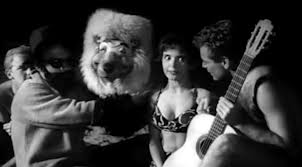


The beach party scene happens about 40 minute into the film and is tonally different from the rest of the film. Everything before and after has a fairly somber tone, but this scene is played entirely for laughs; to the point that even wacky sound effects are played on the soundtrack. It should be noted that the surfers are having the beach party on the exact spot that Bunny was murdered. Talk about sensitivity! Kingsley appears literally out of nowhere; there's some brief comic banter between him and Jane (who dons an annoying Betty Boop voice) and then they begin their painful sing a long. It goes on and on to the point that you wish the monster would show up and just off everyone in sight, just to put an end to this movie. Sadly, this does not happen. Finally, after this "comedic" interlude the monster  shows up and kills some random surfer dude who happens to be all alone. Despite everyone being a stone throw away, no one witnesses the murder except for Richard's friend Mark, who literally stumbles upon the scene. The surfer dude's girlfriend, Sue, accuses Mark of murdering her boyfriend and the police are called in. Mark has a gimpy leg, due to an auto accident he was in with Richard, yet some how manages to sneak away and steal a police car. Yet another scene that will make you slap your forehead in sheer frustration!

Beach Girls and the Monster is 66 minutes long and about ten minutes of that is devoted to surfing stock footage. Despite its short length, there apparently wasn't enough of a story to fill up an entire feature length movie, hence the filmmakers padded it's running time by adding endless surfing stock footage. It's also done in the least subtle way possible; at one point in the film Richard and his gimpy friend, Mark, watch surfing footage on a film project, while generic surf music (by Frank Sinatra, Jr.) plays on the soundtrack. This scene last FIVE MINUTES. It has absolutely no narrative value, it's just there to waste precious screen time. In another uproarious scene, Mark comes upon three attractive women dancing on the beach, while commenting on what good surfers their boyfriends are. The scenes plays like this:

Attractive Brunette: Look at my Billy go!

Cut to surfing stock footage.

Then other two women comment on their boyfriends surfing skills and we are shown more surfing shots. These three women have no purpose in the entire movie; this is the first and last time they appear. Though, oddly enough, the print floating around on the Internet uses an alternative take for this scene -  instead of the three girls cooing over their boyfriends surfing abilities, we are shown a medium long shot of four bikini clad girls dancing to music emanating from a nearby radio.


The horror, and even the beach movie shenanigans, often are shoved to the sideline to make room for the subplot involving Dr. Otto Lindsay. Dr. Lindsay completely disapproves of Richard's lifestyle and blames his son's seemingly downward spiral on his beach bum friends. At one point Dr. Lindsay tries to pinpoint the murders on those "no good " surfers.  The sheriff counters that most surfers are just young people trying to find themselves. Dr. Lindsay retorts, "They'll find themselves....in your jail one day!" The sheriff backs down, realizing he can't argue with such sound logic.

When Dr. Otto isn't bemoaning his son's fall from grace, Dr. Lindsay spends most of his time trying to please his bitchy, alcoholic wife Vicky.  She is completely bored with Otto and tries to seduce Richard at one point, who flat out rejects her. She then spends most of waking hours tormenting Mark, who is overwhelmed with his lust for her. Mark is a sculptor that lives in the Lindsay household; he  has been free loading off of Dr. Otto's good will for over a year. He has been making a sculpture of Vicky for some time and has her pose for him, so he can spend time with her. She is the ultimate cock tease, often tantalizing Mark with hints of sexual goodies, only to pour a bucket of cold water over him every time. This enrages Mark so much that he smashes the clay sculpture of her, screaming, "I'LL KILL YOU!" Of course, this only serves to make Mark a, rather unconvincing, red herring.


In a not surprising twist ending (SPOILERS) the monster turns out to be Dr. Otto Lindsay dressed up in a ridiculous costume. His plan of murdering surfers to help snap Richard out of his funk proves to be a bust. Oh, both Vicky and Mark meet untimely ends as well. Vicky gets hers after coming home from a date and Mark bites it after discovering the monster's true identity. However, before Mark kicks the bucket, he manages to stab Dr. Lindsay with a knife. While fleeing from the police in Jane's car, Dr. Lindsay loses consciousness and goes careening off a cliff, meeting a firey end. Richard with Jane in his arms just stares at the wreckage. THE END!

The most irritating thing about the movie, aside from the personality free Richard, is it's overuse of the zoom lens. Practically every other scene begins with a close up of an object or person, only to zoom out to a long shot of a room or location. One scene begins with a close up of Vicky's legs and then zooms out to reveal that she is sitting on a bar counter, while Richard looks on disapprovingly.  The beach party scene is filled with endless zooms; when Richard is serenading Jane on the acoustic guitar, the camera constantly zooms in on Jane's face. 

The Beach Girls and the Monster wasn't the only film to combine the horror and the beach party genre, a year before Del Tenney made The Horror of Party Beach, which, while terrible, is a lot more entertaining movie, due to it's more excessive nature. The body count in The Horror of Party Beach is much higher; there is a memorable scene in which the mutations crash a slumber party, abruptly putting an end to an acoustic guitar sing a long. Plus, the protagonist in that film actually does something as opposed to just sitting around. It's wonderfully awful movie filled with unintentionally surreal moments.

The Beach Girls and the Monster was directed by Jon Hall, who also stars as Dr. Otto Lindsay (and was the film's director of photography as well).  Hall was a matinee idol in the 40s, best known for the six technicolor adventures movies he made with screen goddess Maria Montez; the most entertaining one being the wonderful silly Cobra Woman. He also starred in not one, but two Invisible Man movies, The Invisible Agent and The Invisible Man's Revenge.  Unfortunately, by the 50s his career (and his good looks) had faded and he was reduced to making films like The Beach Girls and the Monster. 

The Beach Girls and the Monster is largely enjoyable, due to the stupidity (and inactivity) of the characters. It lacks the excesses of The Horror of Party Beach, but it makes up for that with its "What the hell were they thinking?" moments. Whose idea was it to make Richard so apathetic? Why is Mark constantly at the wrong place at the wrong time? This guy has knack for getting into trouble. Laugh at the non-existent chemistry between Arnold Lessing (Richard) and Elaine DuPont (Jane). Practically every ten minutes there is either a shot of a random bikini clad woman shaking her booty, or of Mark sulking over his impotence. The less said about the soundtrack by Frank Sinatra, Jr. the better.


Credits

Cast: Jon Hall (Otto Lindsay), Sue Casey (Vicky Lindsay), Walker Edmiston (Mark), Arnold Lessing (Richard Lindsay), Elaine DuPont (Jane), Read Morgan (Sheriff Michaels), Gloria Neil (Bunny), Caroyln Williamson (Sue), Kal Roberts (Brad), Clyde Adler (Deputy Scott).
Director: Jon Hall
Screenplay: Joan Gardner
Running Time: 66 min.

Tuesday, July 23, 2013

The Son of Kong (1933)


King Kong is one of my all time favorite movies and is, probably, the best monster movie ever made. It's just as exciting to watch now as it was when I was a twelve year-old kid. However, it's also one of the most written about movies in cinema history, meaning there's really nothing more I can say that hasn't been said already. The Son of Kong, however, has been fairly neglected by more film historians; if it is mentioned, it's usually in passing, and very rarely do they have anything positive to say about it. In his book "Movie Magic," John Brosnan has this to say about The Son of Kong:

Unfortunately the film had none of the grandeur of it's predecessor, and the script, by Ruth Rose was abysmal. Robert Armstrong, who played the hero in King Kong, returns to the island looking for a comparable attraction, apparently not having learned anything from his previous experience, and discovers 'Little Kong.' This baby Kong would have made his illustrious father roll over in his presumably giant grave - a mere twenty feet tall, he has the instincts of amiable puppy. The effects were impressive, but the overall result was disappointing. 

There's no doubt that The Son of Kong is an inferior film to it's famous predecessor, but Brosnan's summary makes me wonder if he's actually ever seen it. For instance, Carl Denham (Armstrong) doesn't return to Skull Island looking for a "comparable attraction," but rather goes there hoping to find an ancient treasure that Helstrom, a down on his luck Norwegian skipper and the film's main antagonist, has told him about. .  Kong Junior is, indeed, a much more friendlier creature than his chest pounding, bad tempered old man, but if the filmmakers would have made him a ferocious beast, then the film would merely be a rehash of the first film. Finally, Junior isn't twenty feet tall, but twelve feet. In his movie guide book, Leonard Maltin gives the film two and a half stars, which is about right. It's not a remarkable movie, but it is entertaining.


As for the script being "abysmal," I'd say that given the circumstances, Ruth Rose churned out a fairly adequate screenplay. After the success of King Kong, the sequel was rushed into production and made for less than half the budget of the first film. These budgetary lapses are fairly noticeable; Junior doesn't appear until the 42 minute mark (it's a 69 minute movie), and the Skull Island scenes are isolated to a small section of the island.  In King Kong, we were treated to many exciting scenes of Denham and company trekking through the dense jungle and bumping into all sorts of prehistoric life. In The Son of Kong, the prehistoric life has a knack for wandering into Junior's territory. The Son of Kong is a mini-adventure, completely lacking the epic scope of the first film.

However, there are two things are I find extremely interesting about The Son of Kong that most film historians tend to overlook:

1) Carl Denham's character arc.


The Son of Kong takes place a month after the events in the first film and Carl Denham is up to his neck in lawsuits. This experience has made him a more humbler person. In the first film, he was an extremely reckless filmmaker, who often regarded Ann Darrow as prop, rather than an actual human being. He didn't have a single, compassionate bone in his body; all he could think about was how swell everything would look on film. He's so single minded in his obsession to bring entertainment to the masses that he doesn't even harbor any sort of romantic feelings towards Ann Darrow (despite her being an attractive blonde) and is fairly indifferent when she and Jack Driscoll fall in love. In The Son of Kong, Denham has learned from his mistakes and when he finds Hilda alone in Bakang, mourning the death of her father, he does everything he can to cheer her up.  When he finds Junior trapped in quicksand, his initial reaction is not one of fear, but of saving the clumsy gorilla from certain death.  He knocks over a tree and Junior uses it to pull himself out. After Junior has injured his finger battling a giant bear, Denham (at Hilda's urging) bandages up the finger, such an act of kindness would have been foreign to the old Carl Denham.

2) Helen Mack.


I'm going to say it, The Son of Kong has a better leading lady than it's predecessor. I understand that Fay Wray's performance as Ann Darrow (or rather her screaming) is fairly iconic, but Helen Mack is much better actress. In the first film, Ann Darrow's character development essentially ends at the midway point, she falls in love with Jack and that's about it. It can be argued that Ann Darrow is more of a plot device than an actual character, as she's the reason Kong rampages through New York at the end. Ann's role in the second half of the film is that of a nonstop screamer (which is understandable given that the she is being carried around by a giaint ape), while Hilda remains brave throughout, often urging Denham to help Kong Junior.
 Hilda is a much more interesting heroine; she's first introduced as the star attraction of a rundown circus managed by her alcoholic father. She plays a guitar and sings a song called the "Runaway Blues," which is greeted with complete indifference by the small audience. Helen Mack specialized in playing feisty females (she's absolutely wonderful as Harold Lloyd's tough as nails sister in The Milky Way) and The Son of Kong is no exception. When Denham and Englehorn leave Dakang, Hilda stows away on board, partly because she has "nowhere else to go," but mainly to be around Denham. Robert Armstrong is old enough to be Helen Mack's father, but the romance in The Son of Kong is fairly believable; Denham is quite possibly the first person to offer any words of kindness (and encouragement) to Hilda in a long, long time, therefore it makes sense that she would take a liking to him. They are kindred spirits,  both of them have essentially lost everything; Denham is in complete debt at the beginning of the film and is facing being indicted by the grand jury, Hilda loses her father and the rundown circus she's called home for many years (it goes up in a fire). Yet, despite these obstacles both characters keep fighting on, never looking back. Though, the romance itself is fairly chaste, they don't even share an onscreen kiss. Then again, romance (and women) aren't exactly Denham's forte, he slowly learns the ropes as the movie progresses.

Because it was decided to make Kong Junior a good guy, the film is fairly lacking in the villain department; the closest thing we get is Captain Helstrom and he's fairly inept. It is revealed that Helstrom is the Norwegian skipper that sold Denham the map to Kong's island and since then his life has taken a turn for the absolute worse; he has lost his ship, is penniless, and is stranded in the Dutch Port in Bakang. He accidentally kills Hilda's father in a drunken brawl, which in the process burns down the circus tent (and Hilda's home).  Hilda threatens to report him to the Dutch magistrate, which only fuels his desire to get away. He stumbles upon Denham and Englehorn at a bar, and then makes up a story of a lost treasure (unaware that there really is a treasure on Skull Island) as a way to get off the island. However, Helstrom has no desire to go to Skull Island, once aboard Englehorn's ship (The Venture), he starts talking to the crew and leads them in a mutiny against Englehorn. Denham, Hilda, Englehorn, and Charlie are set adrift in a lifeboat, while Helstrom and the crew look on. However, Helstrom's reign as captain is short lived, after the crew refuses to  obey his orders, he pulls a gun on them, but is overpowered and thrown overboard. Denham and company pick him up, albeit reluctantly, and row their way to Skull Island. Once on Skull Island, Helstrom really is given nothing to do. He also has a fairly anti-climatic death; the sight of Junior frightens him and he runs towards the lifeboat, however, as he is ready to shove off, a giant serpent emerges from the water and devours him.


What The Son of Kong lacks, and what it's predecessor did so well, is the grand build up. The original King Kong effectively builds up to Kong's first appearance; he's first brought up in a conversation between Denham and Captain Englehorn. We first get a hint at his physicality, when we view the great wall for the first time. Why is the wall so big? What is it shielding the natives' from? The natives are holding a ceremony, where they sacrifice one of their virginal girls to be Kong's "bride." Then there's Kong's first appearance; we first sense his presence when we hear footsteps on the soundtrack, then the sound of trees being pushed over, and, finally, a load roar. After all this build up, Kong finally emerges from behind the trees and we (along with poor Ann Darrow) overwhelmed by the sheer size of this gorilla. There's a practically no build up in The Son of Kong, the closest thing we have is when Charlie, the Chinese cook, says to Denham early in the film, "I guess next time you leave big monkey alone, huh." Junior's introduction is fairly unremarkable; Denham and Hilda literally stumble upon him as he struggles to get out of a quicksand. Going by Denham's reaction, he doesn't seem a bit surprised that there is miniature Kong running amuk. It's also extremely odd how the filmmaker choose to introduce Junior from a stylistic stand point; there is a long shot of Denham and Hilda as they climb up an ancient stairwell, then the film cuts to a three way shot of Helstrom, Charlie, and Englehorn as they converse with each other. Helstrom tries to apologizes for leading a mutiny against Englehorn, but Englehorn will have none of it. Then it cuts back to a long shot of the top of the stairwell, with Junior's heading bobbing up and down in the background, the rest of his body obscured by the stairwell.  Denham and Hilda walk into frame and after a few seconds, they finally notice Junior. It's curious how very little build up there is to Denham's discovery of Kong Junior. A more effective way would have had the camera follow Denham and Hilda up the stairs and then have Junior's head pop into frame once they reached the top of the staircase (it's what Ishiro Honda did twenty years later in Godzilla).


The specials effects by Willis O' Brien are, just the like the first film, dated, but incredibly fun and often effective. Practically all of the movie's action is crammed into the film's last half hour; Junior fights not one, but two monsters, a giant bear and a dinosaur-like creature. The interaction between Junior and the actors is extremely well done, and often seamless, in it's execution. When Junior  is battling the giant bear, Denham and Hilda look on from the background. The eye line of the actors perfectly matches the action that is unfolding in the foreground. Of course, the audience is not paying attention to either of the actors in this scene, their eyes are entirely focused on the fight, but it does show that at least the filmmakers put an actual effort into making the film, as opposed to being lazy and coasting on the goodwill of  the predecessor.
While Hilda and Denham have front row tickets to one of the greatest wrestling matches of all time, Englehorn and company get trapped in a cave fissure by a nasty Styracosaurus. Helstrom is extremely cowardly in this scene, trembling in absolute fear while hiding behind Charlie.

The ending is rather abrupt, Denham finds the treasure, Helstrom gets devoured, and all of a sudden an earthquake happens, sinking Skull Island in the process. Englehorn, Charlie, and Hilda row away to safety in a lifeboat, but Denham gets caught, along with Kong, inside a cave. They both scale a cliff to a higher height as the island slowly sinks beneath them. Finally, they have reached the highest peak. Hilda and company spot  Denham and row in his direction. Junior grabs Denham and holds him above the ocean, while he slowly sinks underneath. The row boat arrives just in the nick of time to save Denham, but it's too late for Junior. This scene is almost the inverse of the Empire State Building scene in Kong Kong, in that film Kong sense his death, picks up Ann for one last look and then puts her down, resigning himself to his grizzly fate; he loses his footing and falls to his death. In Son of Kong, grabs Denham and holds him above the ocean until the rowboat comes to his rescue. One death is tragic, the other  is heroic. All of the action I mentioned takes place over the course of FIVE MINUTES! There's nothing earlier  in the film that foreshadows the earthquake, it just unexpectedly happens.

Monster fans tend to whine about the decision to make Junior a friendly ape and are aghast at his comedy routines. It's never bothered me one bit, largely because I went into Son of Kong with relatively low expectations; the only reviews I ever read were negative, so when I saw for the first time in 1993 (age 14) I was pleasantly surprised. Is it a vastly inferior film to it's predecessor? Most definitely! Is it a bad movie? Most definitely NOT! If you catch it in the right frame of mind, it's rather enjoyable (and rather sweet) 70 minutes. Of course, I'm biased as I believe that Helen Mack is one of the most underrated actresses of all time and tend to enjoy practically everything I have seen her in. Not to mention, the sight of Kong Jr. beating the crap out of a giant bear still manages to bring out the child in me.

Credits

Cast: Robert Armstrong (Carl Denham), Helen Mack (Hilda Peterson), Frank Reicher (Captain Englehorn), John Marston (Captain Helstrom), Victor Wong (Charlie), Ed Brady (Bo'sun Red), Lee Kohlmar (Mickey), Noble Johnson (Native Chief), Gertrude Short (Reporter), Kathrin Clare Ward (Mrs. Hudson).

Director: Ernest B. Schoedsack
Screenplay: Ruth Rose
Running Time: 69 min.

Wednesday, July 10, 2013

Friday the 13th, Part 2 (1981)


A few months ago I composed  a list of my top 25 horror films and had Friday the 13th, Part 2 ranked at number 25. I was initially going to leave it at that, but after having watched the movie again, I realized that there was much more that needed to be said.
Friday the 13th, Part 2 is my favorite entry in the critically maligned series. Part 2, in particular, felt the wrath of the critics; Roger Ebert gave it half a star, while Leonard Maltin in his movie guide book rates it a BOMB. This isn't too surprising as there is nothing remotely original about Friday the 13th, Part 2, it slavishly follows the formula of the first film:

1) Friday the 13th begins with a pre-credits scare sequence. In 1958, two horny camp counselors gets offed by an unseen assailant. In Friday the 13th, Part 2, Alice, the survivor of the first film, gets killed off by an unseen assailant.

2) The introduction of the secondary characters. In Friday the 13th, the first character we are introduced to (after the credits) is Annie, who is hitchhiking her way to Camp Crystal Lake, she is to be the cook. She wanders into a small town and stops in a local diner to get directions to the summer camp. At first she is given the shifty eyed treatment by the locals, but eventually a kindly truck driver offers to give her a partial lift.  While driving his truck, he warns her about all the wrong doings that have occurred there and advises her to quit. She laughs him off as being superstitious. In Part 2, the first characters we meet (after the credits) are the busty Sandra and her boyfriend Jeffrey. Like Annie, they arrive in a small town. Unlike Annie, they have a means of transportation, Jeffrey's black pick up truck. Jeffrey gets inside a phone booth and dials the number of his friend, Ted, to get directions to the camp. As Jeffrey is talking on the phone, his pick up truck is getting towed away. Sandra alerts him to this and they chase after it, imploring the driver of the two truck to stop. This, however, turns out to be a prank arranged by Ted. The three of them have a good laugh and drive up to the summer camp.

3) The heroine in both films is one of the last characters to be introduced. In Friday the 13th, Alice's introduction doesn't come until fifteen minutes into the movie. In Part 2, Ginny makes her entrance around the twenty minute mark. There's a lot of bait and switch going on in both films; in Friday the 13th, the audience is tricked into believing that Annie is the main protagonist, only for her be killed off in the early going. Annie is your ideal American Girl, apple cheeked with a sunny disposition. She has the ability to brighten up her surroundings, which makes her death even more shocking. The makers of Part 2, try to the same tactic with Sandra and Jeffrey. They are two fairly likable, and attractive, teenagers that most of us in the audience wouldn't mind having a beer with. However, once the character of Ginny enters the scene, we know they are doomed to suffer the same grizzly fate as Annie.

However, Alice and Ginny are radically different heroines. Alice is a fairly passive character for the first hour of the movie, to the point of being a non-entity. It's only when she's left to her own devices that she's able to assert herself as being the film's protagonist. Ginny, on the other hand, is fairly proactive from the get go. The other camp counselors, especially Paul, are fairly dismissive when it comes to the topic of Jason. They view him as being a legend cooked up the locals to scare away outsiders.  However, Ginny takes Jason very seriously; she is studying child psychiatry and tries to understand Jason from a psychological view point. She is the first to recognize the threat of Jason, while the others are off screwing around.


4. Crazy Ralph. Ralph is a local drunk and doomsayer. In the first two installments of The Friday the 13th series he warns the counselors that they are all doomed if they go to Camp Crystal Lake. In the first one, he approaches Annie in the street and screams, "YOU'RE DOOMED!" In Part II, while Jeffrey is in the phone booth, Crazy Ralph pops out of nowhere and preaches his prophecy of doom, much to Jeffrey's bemusement. Sadly, Crazy Ralph doesn't take his own advice to heart, for he bicycles down to the camp and gets garrotted by Jason.

"If Friday the 13th, Part 2 is such a carbon copy of the first film, then how can it be your favorite of the series?" you might be asking. How can something so completely unoriginal be better than the film that preceded it? While there is nothing innovative about Part 2, there are a few things that it manages to do better than the original, like........

1) The Villain.
 I always thought that the "twist" ending to Friday the 13th (Pamela Voorhees, Jason's mother, is the killer) undermined the horror that came before it. Pamela Voorhees is a middle aged woman and not in particularly good shape, yet is some how capable of performing some extraordinary physical feats. How could a woman of her stature, for instance, toss the body of recently murdered Brenda through a raised window? How could she overpower a much younger and stronger Bill and impale his body so that it's hanging a few feet off the ground? This would require super strength, something that Mrs. Voorhees doesn't possess; she can't even hold her own against the rather ineffectual Alice. Plus, Betsy Palmer's performance is so ridiculously over the top, that it is often more comical than scary. She possesses super speed as well, seconds after tossing Brenda's corpse through the window she manages to pull up in a jeep.  The film tries to overlook this fact by giving a Mrs. Voorhees a more "mannish" appearance - she has short hair and they bulk up her frame by having her wear a thick sweater.  Still, I don't know anyone who is remotely scared by Pamela Voorhees.

Jason, on the other hand, is much more formidable foe than his crazy mother. It easy to believe that a man of his physique would pose a serious threat to Ginny and the other camp counselors. Jason is sheer brute force. However, one of the main reasons I like Part 2 the best is that Jason is a rather clumsy, and therefore, a more believable serial killer. With each progressing sequel Jason became more and more of a Super Human to the point that he seemingly developed the ability to teleport; his victims would out distance him by a good mile or so, but then cut to close up and there would be Jason standing right in front of them, brandishing some implement of destruction. When Jason became a super natural being, it drained the reality out of the franchise (and suspense) out of the franchise. In Part 2, it's Jason determination and devotion to his deceased mother that makes him frightening. He doesn't teleport, or for that matter crush skulls with his bare hands, but he does have the element of surprise going for him.


2) Heroine. 
Amy Steel is my favorite leading lady in the entire Friday the 13th series and a genuinely good actress. For instance, take the scene at the end in which Ginny dons Mrs. Voorhees' nasty sweater and tricks Jason into believing that she is his deceased mother. It's a rather ridiculous moment, but Steel manages to sell the living hell out of it and somehow makes it work.
I mentioned how Alice (Adrienne King) is almost a non-entity in the first Friday the 13th film, but that basically applies to most of the leading ladies in the series, Amy Steel being the exception. She manages to bring a lot warmth, humor, and intelligence in to what could have easily been a thankless role. The other leading ladies tended be rather humorless and fairly stiff in their performances; Dana Kimmell in Part 3, for example. The only actress in the series that really comes close to matching Steel's performance is Jennifer Cooke in Friday the 13th, Part VI: Jason Lives. She gives a  fairly lively performance as Megan, but she is often shoved to the sidelines to make room for Zombie Jason and Tommy Jarvis (played in dour fashion by Thom Matthews.)   Hell, by the time Jason Takes Manhattan came along, the "lead actress" was more or less relegated to supporting player, while Jason was elevated to "hero" status.

The slasher films have often been accused of being misogynistic and moralistic - the sexually promiscuous woman is hacked to pieces, while the virginal woman is rewarded for her virtuous lifestyle by being allowed to survive the night. However, the first two Friday the 13th films throws a monkey wrench into that criticism, because not only are both heroines sexually active (Alice is sleeping with her boss Steve Christy, Ginny and Paul make love in her cabin), but they indulge in some worldly vices; Alice smokes pot and partakes in a game of strip Monopoly, while Ginny tells sick jokes and goes to the bar with other camp counselors. They may be nice girls, but they are certainly no angels.

3) Scarier Opening Sequence. 
Friday the 13th begins with two horny teenagers meeting their demise at the hands of an unknown assailant (later revealed to Pamela Voorhees). It's a fairly short scene and the deaths are fairly inconsequential to overall plot.  Part 2 begins with the murder of Alice, the sole survivor of the first film. It's a fairly divisive moment among Friday the 13th fans, many of whom feel that Alice should have been the protagonist in the second film as well. I rather like the scene as it sets the tone for the rest of the film, that essentially all bets are off. If Alice, the heroine of the first, isn't safe from Jason's wrath, then no one is.  Killing off the survivor of the first film would become cliche among horror sequels, but Friday the 13th, Part 2 was one of the first to do it. The only sequel, that I can think of off hand, to do it prior to Friday the 13th, Part 2 was the 1942 film The Mummy's Curse, in which Kharis (Lon Chaney, Jr.) offs Dick Foran midway through the film.


4. The prankster lives.
 In the Friday the 13th series, there's always one character that is an absolutely prankster; Ned in the first film, Shelley in Part 3, etc. Therefore, when Ted makes his first appearance in Part 2, we are  certain he's going to get it. When he scares the other counselors by jumping out at them with a monster mask and a spear, we are 100%  certain that he will suffer a gruesome demise. Yet, Ted is spared, because he opts to stay at the bar and get drunk. Paul, Ginny, and Ted go to a local bar for one last night of hardcore drinking, before the children arrive in the morning. When Ginny and Paul go back to the camp, Ted stays behind and asks a local if there are any "after hour" bars? It's actually a nice deviation from the norm; a character survives the night by indulging in the kind of "sinful" activity that would usually mean certain death in other horror films. There could always be a sequel in which Ted relates how alcohol saved his life.


The early Friday the 13th films (1-4) were often under harsh criticism for being extremely violent and gory, yet are absolutely tame when compared to recent horror films. What I like about the first four Friday the 13th movies is that they mix up the killings; some are more extreme than others. In Part 2, Mark takes a machete to the head, while Terry is killed off screen; we see her reaction to the unseen killer and then it cuts to the next scene. Rather than bombard the audience with nonstop gore, the filmmakers allow us a breather every once in awhile. Plus, it doesn't desensitize us to the killings later on the film - each one is shocking in their own right. Modern horror films have become so excessively gory, that it has the effect of numbing, often boring the audience. 

The first four Friday the 13th movies might come across as slow to modern audiences that are used to the rapid pacing of present day cinema; frantically edited to the point that they are incomprehensible.  Friday the  13th, Part 2, in particular, relies heavily on extended takes to build up suspense. The best example is when Paul is telling the rest of the camp counselors about Jason while they are all sitting around a camp fire. The scene begins as a long shot of the group huddled together and then it slowly zooms in on a close up  of Paul's face as he tells his story. It's a nice way of getting a piece of exposition out of the way by disguising it as a scary campfire story. When Paul gets to the end of his story, in which he warns "Jason's out there,"  Ted, donning a monster mask and spear, jumps into the camp fire circle and scares the living crap out of the counselors. It's a cheap scare, but effective.


It's interesting to note that a similar scene occurs in The Burning, made the same year, and complete with the same gag. It would be easy to accuse one film of ripping off the other, but that seems as unlikely as both were in production at the same time and released within one week of each other; Friday the 13th, Part 2 opened on May 1, 1981 and The Burning came out the following weekend, May 8. It's more likely that the screenwriters of both movies had very similar moments in their youth (campfire stories) and decided to include it in the script. The early slasher movies are the cinematic equivalent of a campfire story; they slowly build to a very grim ending and often end on a cheap scare.

Later, Jason enters a cabin to look for Ginny. The camera tracks Jason's feet as they pace about the room, eventually revealing that Ginny is hiding underneath a bed. Jason stands in front of the bed for a few seconds; the shot is framed so that Jason's feet are stationed in the foreground, while Ginny is lying underneath the bed in the background.The tension builds as the audience wonders whether or not Jason will look underneath the bed and discover Ginny. This scene plays out so long that it becomes almost unbearable (in a good, frightening way) to watch. Will Jason discover her? Will he walk away?  A modern horror film might not even bother to establish Jason and Ginny's spatial relationship to one another, instead you might get a close up of Ginny lying under the bed and  then a close up of Jason as he scans the room. Rapid editing would ruin a moment like this, because it wouldn't be able to properly convey the danger Ginny is in.


Another criticism leveled at the Friday the 13th franchise is the audience actively roots for the killer. This may be true of later entries in the series, when Jason was the star, but certainly not the case in early films. In the first two films the filmmakers do a good job of distancing the audience from the killer, who is off screen force for most of the film and completely devoid of an identity, hence making it extremely hard to root for her/him. The audience genuinely fears for the lives of the camp counselors and, in some cases, it actually saddened when one of them comes to a ghastly. In Part II, I am always saddened when the characters of Mark and Vickie get offed by Jason, because they seem like genuinely nice people. Mark has been dealt a hard hand in life, he was cripple in an accident and is stuck in wheel chair, but he has an extremely positive outlook. He doesn't sit around and sulk about his current state, but rather is determined to walk again. He also has a sex drive, which is a rarity in Hollywood, where people with physical disabilities are often depicted as being extremely child like.Vickie has a crush on Mark and the two of them are about to spend the night together, until Jason steps in.

While Friday the 13th, Part 2 is my favorite film in the series, it oddly enough, has the weakest ending. Ginny has seemingly killed Jason (in the dilapidated shack he lives in) with a machete and Paul carries her to a nearby cabin to look after her. Just then they hear a scratch coming from the front door, they expect the worst and Ginny arms herself with a pitch fork, while Paul stands by the door, waiting for her cue to open it. She gives Paul the nod and he opens to reveal...A DOG! The dog belongs to the now deceased Terry and went missing earlier in the film. They both breathe with a sigh of relief. Ginny is about to walk over to pet the dog, when Jason (unmasked) comes crashing through the window behind Ginny and attacks. WHITE OUT and fade in to Ginny on a stretcher being carried into an ambulance. She asks "Where's Paul?" over and over again, but doesn't receive an answer. The medics put her in the ambulance, close the back door, and drive off. THE END.  Jason lunging at Ginny is, of course, a repeat of the gag from the first film, in which Jason rises up the lake and attacks Alice in the canoe. It's a frustrating ending, because it's so abrupt. It comes off as being an after thought by the filmmakers, realizing they need at least one more scare and aping the ending of the first film. Paul's disappearance is never explained, so we are to assumed that he was killed while saving Ginny from the clutches of Jason. Or maybe, it was all a dream?!

In Part 3, the ending has been retconned so that after Ginny has taken Jason out with the machete, he pulls it out of his shoulder and walks away. When Jason crashes through the window at the end of Part 2, the machete is still lodged in his shoulder. The third film never references the attack of Ginny in the cabin, nor the mysterious disappearance of Paul. It does, however, have a TV news report that shows Ginny being taken aboard the ambulance, but that's it.

I would like to finish this review by talking about the muddled Friday the 13th time line. The first film tries to dance around this subject with the caption "PRESENT DAY!" However, in Friday the 13th: The Final Chapter, Pamela Voorhee's gravestone reveals that the year of her death was 1979. The second film takes place five years after her death, making it 1984. The events in Friday the 13th, Part 2 through Friday the 13th: The Final Chapter (Part 4) happen within the same week. This makes very little sense, because in The Final Chapter, Sandra's brother, Rob, has come to Crystal Lake to hunt down Jason and avenge her death. Given that her death was just a few days ago, Rob must have psychic abilities. Granted, he might have heard about her death, but how would he know Jason is still lurking about the woods? Considering that at the beginning of The Final Chapter, Jason has been pronounced dead. Friday the 13th: The New Beginning (the worst entry in the series) occurs four years after the events in the fourth film, making it 1988 (which is doable). In Friday the 13th, Part VI: Jason Lives, Tommy Jarvis is significantly older, which would place the setting of this movie in the 1990s (which isn't doable, given the style of clothing on display). Friday the 13th, Part VII: The New Blood, confounds things even further by taking place seven years after the events of Jason Lives, putting it near the millennium. It's all very confusing, but then again, I'm probably putting way too much thought into all this.

Credits

Amy Steel (Ginny), John Furey (Paul), Adrienne King (Alice), Marta Kober (Sandra), Bill Randolph (Jeffrey), Lauren-Marie Taylor (Vickie), Stuart Charno (Ted), Kirsten Baker (Terry), Tom McBride (Mark), Russell Todd (Scott), Betsy Palmer (Pamela Voorhees), Walt Gorney (Crazy Ralph), Warrington Gillette (Jason unmasked), Steve Dash (Jason).
Director: Steve Miner.
Screenplay: Ron Kurz
Running Time: 87 min.

Friday, June 21, 2013

Ghost of Dragstrip Hollow (1959)


A group of hot rodders need a new hangout and set their sights on a supposedly haunted house. Hilarity ensues! That is the skeletal outline for The Ghost of Dragstrip Hollow, but the film is essentially a plot less mess, often bordering on the surreal. Despite its title, the "ghost" doesn't appear until 45 minutes into the movie and is completely out matched by our young heroes. The Ghost of Dragstrip Hollow is a hot rod movie, a rock n roll picture, a comedy, and a horror film all rolled into one muddled package. The narrative unfolds in fits and starts, often to make way for either gratuitous rock n' roll numbers or eye rolling slap stick humor. In one extremely odd sequence the heroine, Lois, has a slumber party much to the chagrin of her father. Lois and her friends dance, play records and, in the movie's most inexplicable moment, start cracking up at a western that is playing on the television. In the spirit of the moment, the western starts to go haywire (the image gets flipped around, horses gallop in reverse, etc.), while all sorts of crazy sound effects blare from the television. The novelty eventually wears thin and the girls go back to their dancing.


The running gag in this sequence is that the father has to use the bathroom, but keeps getting thwarted by Lois and her friends. He spends the entire scene waiting in the hallway while the girls go about their business. Just when it looks like he is finally going to get his turn, one of the girls will emerge from out of nowhere and cut in front of him. He waits so long, that he eventually falls asleep, while leaning against the wall. This is a throwaway scene and yet it eats up nearly five minutes of  precious screen time (the movie is 65 minutes long). It ends with Lois's dad breaking the fourth wall. Lois sees her father sleeping and asks him what he is doing. He says he must have been sleep walking. Lois tells him to back to bed and then enters the bathroom.
Her father, in a state of absolute confusion, looks directly in the camera and asks, "What am I doing here?" Black Out.

I would genuinely like to believe that Ghost of Dragstrip Hollow is a misunderstood, subversive masterpiece. After all, there is a huge gender role reversal in the characters of Lois and Stan. Lois is the hell raiser out of the two, constantly getting into races with her rival, Nita, and running afoul of the law as well.

The movie opens with Lois and Nita drag racing across the dry river bed of the Los Angeles River. Nita eventually loses control of her car and crashes into a wall. Lois drives away, oblivious to the accident. However, a cop arrives on the scene and manages to catch her license's plate number. He eventually tracks her down and hauls her in. This, naturally, doesn't go to well with Lois's parents and her father suspends her driving privileges for two weeks.  Stan, on the other hand, avoids trouble at any costs and is upset with Lois when he learns about the drag race.


Other than the gender role reversal, there are a lot of other interesting things going on in The Ghost of Dragstrip Hollow. The Zenith Club (Lois and Stan's Hot Rod Club) befriend a reporter named Tom Hendry, who is writing an article about drag racing. He is at first neutral in his stance, as his article covers both sides of the issue, the parents and the dragsters. However, he eventually warms to Zenith Club and wants to help, often  taking a defensive stand towards the teenagers. He has this rather interesting exchange with Lois's father:

Dad: There seems to be such a difference between their adolescence and mine.

Hendry: It's a difference of a degree only. You didn't have jets to cope with of 375 horse powered automobiles. Or even more significant, a world on the verge of self destruction. All these things want to make kids grow up in a hurry.

Dad: They're so sharp. They know so much....TOO MUCH!

Hendry: That proves my point. They feel they have to become adults quickly. They're not sure there will be a tomorrow.

It's a rather somber moment, in an otherwise silly movie. Ghost of Dragstrip Hollow maybe one of the few teen oriented films of the 1950s to explicitly reference the Cold War. Yet, this little exchange was eerily prophetic; less than a decade later the world seemed on the verge of self destruction with the Vietnam War waging on and the brewing tensions on the American home front.  In 1959, everything still seemed peachy keen. Lois's drag racing is merely a whim, she will eventually move onto better things. The Zenith Club are a bunch of straight laced kids; they listen to authority and don't indulge in any self destructive behavior. Lois is the exception, rather than the rule, but she eventually learns her lesson.


What is also amazing about the Ghost of Dragstrip Hollow is how anti-climatic it is. There are three major conflicts presented throughout out the movie and all them are resolved rather easily.

1) The Zenith Club gets evicted from their hangout, because they don't have money to pay the bills. Their future looks bleak, when Anastasia Abernathy (a client of Lois's father) remembers the old house she and her husband used to live in. She offers to let them use it, but warns that it is haunted. The gang accepts her offer and, after spending the night in the house, deem it suitable for their needs. They have a few run ins with the paranormal, but nothing really serious. They kids decide to kick things off by throwing a Halloween costume party.

2) The "ghost" is not really much of a threat to the kids and, is in fact, merely a prankster. He plays a few tricks on the kids, like pretending to be the sleeping Dave's girlfriend, or levitating a candle, but never means them any real harm. Hell,  at one point, he even dances with Lois at the Halloween costume party. In what might have been an inspiration for Scooby Doo, the ghost is unmasked and revealed to be a  bitter washed up horror actor (Paul Blaisdell), who is still upset that he didn't get cast in Horrors of the Black Museum. 


Horror aficionados will recognize the "ghost" suit as being the same one Blaisdell donned in The She Creature, a 1956 horror film that was a knock off of The Creature From the Black Lagoon. The She Creature suit has been considerable stripped down for this movie; the feet have been replaced by sneakers.  The She Creature is not the only Blaisdell creation that makes a return appearance, a man wearing a Saucer Man mask is briefly seen dancing to the music.

3. The main antagonists in the movie are Tony and his girlfriend Nita, members of a rival gang (that seemingly consists of four people, including themselves). Yet, even they are not a much of a threat. Tony will have a few choice words with Stan, while leering at Lois, and then walk away. Nita, however, keeps hounding Lois for a rematch. She demands satisfaction and Lois, inevitably, acquiesces. The two of them have one final drag race....OFF SCREEN! That's right! The movie slowly builds to this confrontation and the audience doesn't get to see any of it. Instead, Lois tells Stan and Tom all about it. Stan is naturally upset, but Lois promises him she'll pay the club fine and tell her dad about it, knowing full well that it means a further suspension of her driving privileges. Stan conjectures that this isn't too much of a bad thing, because now he can drive her around.

I said before that I would like to believe that Ghost of Dragstrip Hollow is misunderstood, subversive masterpiece, but this is, of course, a lot of nonsense. It's wishful thinking on my part; a pathetic attempt to rationalize my genuine love for a really bad movie. Whatever quirks exist in the film is largely due to lazy film making, rather than clever screen writing. Ghost of Dragstrip Hollow is very much a product of it's time, often loaded with bogus 1950's lingo. My favorite being, "He's got static in his attic, completely zonk!"
It often seems like the sole reason for this movie's existence was so A.I.P. (American International Pictures) could promote their new record label. It would explain why there is a rock n' roll number practically every ten minutes.


I would just like to add that I proudly own this movie on DVD! It was packaged as double feature, along with the equally ridiculous The Ghost in the Invisible Bikini. What is about this movie that I find so appealing?

Two reasons:
1) It is very much  a product of its time (1959) that is makes for an interesting time capsule. You can learn a lot about an older generation from the movies that were made during their youth. Films like Ghost of Dragstrip Hollow visualize what it was like to be a teenager growing up in the late 50s (albeit in an exaggerated manner). It's a cinematic time machine, it allows us to see the 1950s up close and be completely flabbergasted by the trends of the time (bogus lingo, drag racing, rock n' roll, etc.) For this reason alone, the movie is invaluable.

2) I said it before and I will again, it is an insane piece of film making. It may not be a good movie, but it is never boring. The first time I saw it, I had no idea what was going to happen next. I expected to see a movie about an evil spirit tormenting a group of hot rodders, instead I got a film about a rabble rousing woman and her many misadventures. Just when I thought I had the movie figured out, it would blindside me with a new, and extremely ridiculous, plot twist. It runs the gamut from being a drag race movie to being a Scooby Doo like mystery.

Credits
Cast: Jody Fair (Lois Cavendish), Russ Bender (Tom Hendry), Martin Braddock (Stan), Henry McCann (Dave), Leon Tyler (Bonzo the Clown), Elaine DuPont (Rhoda), Dorothy Neumann (Anastasia Abernathy), Kirby Smith (Wesley Cavendish), Jeanne Tatum (Alice Cavendish), Jack Ging (Tony), Nancy Anderson (Nita), Sanita Pelkey (Amelia), Judy Howard (Sandra), Tommy Ivo (Himself), Beverly Scott (Hazel),Paul Blaisdell (Man in Suit), Jimmie Madden (Himself).

Director: William Hole, Jr.
Screenplay: Lou Rusoff
Running Time: 65 min.

Friday, June 7, 2013

Ironfinger (1965)/ Golden Eyes (1968)


The 1962 - Dr. No has been released in cinemas worldwide and is a huge hit. The following year comes From Russia, With Love (my favorite James Bond film) and that is followed by Goldfinger, James Bond has become an international sensation and it is only a matter of time before other studios jump on the bandwagon by producing 007 knock offs, such as Matt Helm, Derek Flint, Fathom Harvill, Modesty Blaise, and Andrew Hoshino.  Wait.....Andrew...who? Sadly, the adventures of Andrew Hoshino are hard to find in the United States (though they can be seen on Huluplus), they are so obscure that both films, Ironfinger and Golden Eyes, have less than 20 votes each. It's rather a shame, because both films are extremely entertaining.


Ironfinger follows Andrew Hoshino as he tracks down an arms dealer, Mr. Le Bois. Standing in his way are warring Japanese gangs, the Akatsuki family and the Aonuma, and a cool hitman, Komori, who uses acid to dispose of his victims. He forms an alliance with bumbling Detective Tezuka and sexy hit woman Yumi, who specializes in explosives.


The films is rather ambiguous as to what Hoshino's profession really is.... an INTERPOL agent or a hit man? Hoshino is a rather compelling character, he often puts on a cowardly demeanor so his enemies will completely underestimate his abilities. He is also somewhat of a bumbler; he constantly gets caught by the villains and is extremely clumsy at times: there's one scene in which he attempts to roundhouse kick a group of thugs, only to miss them and fall completely on his ass. What saves his neck is his ability to improvise under high pressure situations. This comes in handy as Hoshino is constantly being captured by the villains.

Early in the movie he is tied up in a taxi cab, that is stationed in an underground parking structure, and is being watched over by a dim witted henchman.  Hoshino notices a can of shaving cream resting on the passenger seat and evolves a plan. The villains have confiscated his suitcase and brought it up to their office to rummage through it. Hoshino tricks the henchman into believing that the suitcase has a radio transmitter hidden in it and that it's sending out signals to other INTERPOL agents, who should arrive very shortly. While he is telling the henchman this story, Hoshino uses a blade hidden in his wrist watch to cut through the ropes binding his hands together.  He then starts screaming that he is fellow INTERPOL agents have arrived. The henchman gets out of the car to check and is relieved to find the parking structure is still empty. He walks back inside of the cab and gets sprayed in the face with shaving cream. Hoshino ties up the henchman and then goes on his merry way. Later on in the film, Hoshino incapacitates another henchman (who uses a hearing aid) with a toilet plunger.


Akira Takarada is extremely charismatic as the hit man Hoshino. It's interesting to contrast Takarada's portrayal of Hoshino with Sean Connery's take on James Bond. Bond always has a cool demeanor and always seems to be in control, even when he was in the villain clutches, he is a professional and it shows, not to mention he is quite the lady's man. Hoshino is almost none of these things, he's extremely confident, but is quite inept at times. It's to Takarada's credit as an actor that despite his bumbling ways, the audience still takes Hoshino seriously as a hero. Takarada has wonderful comic timing, but he also can be serious when the scene calls for it. In fact, it's amazing just how effortlessly Takarada goes from being a bumbler to a cold hearted assassin, often in the same scene.

The most interesting aspect of Ironfinger (at least to me) is the character Yumi, played by Mie Hama. Shortly after the release of Ironfinger, Hama would portray agent Kissi Suzuki in the Connery-Bond film You Only Live Twice. However, despite brandishing a gun, Kissi Suzuki is more of a decoration (Hama spends most of her screen time clad in a white bikini) than an actual character. She doesn't appear until the film is nearly two thirds over, so there really isn't much time for character development. Hama is much better served in Ironfinger, where her character is often a driving force in the narrative.

Towards the end of the film Komori abducts Hoshino and has him taken aboard a plane, that is being piloted by gun smuggler (and Le Bris lackey), Mr. Huang. Yumi witnesses the kidnapping and follows them to the airport. She runs back to the hotel to inform Detective Tezuka of the abduction and the two of them form a rescue plan. Yumi has chartered an airplane and the two of them fly after Huang and Hoshino (who is tied up). Yumi sends a message to Komori (via one of of Le Bris goons posing as a bellboy) that she planted a bomb on the plane and it will explode any minute. Komori radios this information to Mr. Huang and he promptly bails out, leaving Hoshino to his fate. Yumi then pilots the chartered plane, while Tezuka uses a rope ladder to climb onto the plane Hoshino is trapped in. It is a success! Tezuka safely lands the plane. Meanwhile,  Yumi  goes back for Huang, who is still parachuting down, and takes him out with the propeller of the airplane. Yumi parachutes to safety and watches as the plane explodes in mid air. It's at this juncture in the narrative that Yumi loses clothes and spends the rest of the film in red bra.

Hoshino and Tezuka have been captured and are imprisoned in a concrete cell, Yumi blows them out with plastic explosives that she uses as bra padding. Yumi, despite her professionalism, has a few quirks of her own; she sets off small explosions to startle people and finds their reactions amusing. And despite her unflappable nature, the sight of a dead rat causes her to faint.

In You Only Live Twice, Japanese woman are depicted as being second class citizens, totally dependent on men. In Ironfinger, it's the quite the opposite as Yumi is just as good as Hoshino (if not better) in their shared professions. Their birds of a feather, which makes easy to believe that they would begin to harbor romantic feelings towards one another by movie's end. Though, their romance is fairly chaste; they kiss and embrace a few times, but never quite make it to the bedroom. Bond always found time in his busy schedule to bed whatever scantily clad hottie that crossed his path.

 Hoshino and Yumi are fairly amoral characters, they could easily go either way. In the beginning, Yumi is working for the Akatsuki family at first, but switches sides when it's no longer in her best interest. Hoshino is a hit man who has been hired by a European arms dealer to take out Mr. Le Bois, he is hardly a boy scout.
Hoshino is a good guy by default; this particular assignment calls for him to wipe out gangsters and other undesirable characters. In this one instance, he and the law have the same goal, to take down Le Bois, and they enjoy a rather cordial partnership.

Golden Eyes follows Hoshino as he attempts to find a rare gold coin and the man that assassinated a little girl's father. Like the first film, Hoshino aligns himself with a sexy female assassin, Ruby, who's specialty is knives.


Also in the mix is a flaky (and sexy) woman pop singer, whose main hobby is car racing. She has entered an auto rally in Japan and unknowingly has the rare coin in her possession. On top of that, there are hit men hot on her trail. Can Hoshino save her in time?


Golden Eyes is a lot of fun, but Ruby is a less interesting character than Yumi, in that we never see her skills put to use. Early in the film, the audience is shown her ability with the knife and then movie forgets all about this until the very end, and even then it's fairly anti-climatic, as Hoshino and Tuzeka (played by a different actor) already have things under wraps. However, Takarada is always a joy to watch and it's his spirited performance that really keeps that film afloat. Plus, any film that has assassins dressed up as nuns (pushing baby carriages) is automatically good in my book.

Both films were produced by Toho, which was also cranking out Godzilla films at the same time. Naturally, there is a huge overlap between the two series. Jun Fukuda, the director of both Hoshino films, would go on to direct Godzilla vs. the Sea Monster, Son of Godzilla, Godzilla vs. Gigan, Godzilla vs. Megalon, and Godzilla vs. Mechagodzilla.  Mie Hama and Ichiro Arishima (Tezuka in Ironfinger) both appeared in King Kong vs Godzilla. Arishima played the head of a pharmaceutical company, Mr. Tako, the man responsible for bringing Kong to Japan, and Hama played Fumiko, the young woman Kong carries around in his paw.  Akira Takarada and Akhiko Hirata (Komori) were regulars in the Godzilla franchise; Takarada appeared in six films total, while Hirata co-starred in seven. Bibari Maeda (Ruby) played the island girl, Riko, in Son of Godzilla. 
Finally, Takarada would be reunited with Hama  in the 1967 film King Kong Escapes. Hama played the memorable femme fatale, Madame Piranha.

Credits:
Ironfinger (aka 100 Shot, 100 Killed) (1965)
Cast: Akira Takarada (Andrew Hoshino), Mie Hama (Yumi Sawada), Ichiro Arishima (Detective Tezuka),
Akihiko Hirata (Komori), Toru Ibuki (Matsuki).
Screenplay: Michio Tsuzuki, Kihachi Okamoto
Director: Jun Fukuda
Running Time: 101 min.

Golden Eyes (aka Booted Babe, Busted Boss) (1968)
Cast: Akira Takarada (Andrew Hoshino), Bibari Maeda (Ruby), Tomomi Sawa (Mitsuko Saito), Andrew Hughes (Stonefeller), Makato Sato (Detective Tezuka), Yoshio Tsuchiya (Kurokawa), Nadao Kirino (Hassan).
Screenplay: Jun Fukuda, Ei Ogawa, Michio Tsuzuki.
Running Time: 79 min.

Wednesday, June 5, 2013

Indiana Jones and the Temple of Doom (1984)


 Indiana Jones and the Temple of Doom is my favorite entry in the "Indiana Jones" saga. "How is this possible?" you might ask. After all, Raiders of the Lost Ark is an all time adventure classic with a strong love interest (Karen Allen as Marion) and a memorable finale with awesomely gruesome face melting action.  And how can I even suggest that Temple of Doom is better film than Indiana Jones and the Last Crusade? That film has Sean Connery as Indy's dad, while Temple of Doom has Kate Capshaw as the extremely annoying night club singer, Willie Scott, and, even worse, a kid sidekick named Short Round. Hell, it could be argued that Indiana Jones and the Kingdom of the Crystal Skull is a superior movie than Temple of Doom. Sure, it features Indy's annoying illegitimate son Mutt, but at least it doesn't have a hysterical female in it. Well, calm down for a second and I will explain to you why The Temple of Doom is my favorite film in the series.Hell, I even concur that Raiders of the Last Ark and The Last Crusade are superior movies, but I personally find Temple of Doom to be the most entertaining film out of the bunch, warts and all.

Willie Scott-


Most fans absolutely loathe the character of Willie; she's extremely petty, superficial, and cowardly; it seems every two minutes she's screaming about something. She's particularly loathsome in the first half of the film, constantly shouting at Indy and extremely insensitive to the customs of the Indian villagers. Yet, Willie is probably the only female in the entire Indiana Jones saga that actually has a character arc. At first glimpse, Willie is step down from Marion Ravenwood, the female protagonist from Raiders of the Lost Ark. Marion was the complete opposite of Willie, plucky, intelligent, and able to hold her own in a male oriented world.  Willie is used to the life of luxury, being a famous night club singer and all, whereas Marion is  more worldly and street savvy, she is the daughter of an archaeologist and has spent most of her life in complete shitholes; the bar she owns at the beginning of the film is a complete dive, filled with all sorts of reprobates. Yet, despite her strong and feisty demeanor, Marion is constantly in need of being rescued. Even her most heroic scene, she knocks out a German that's about to shoot Indiana, ends with her needing to be rescued. She maybe a stronger female lead, but she is still a nuisance. On other hand, Willie's cowardly ways in completely consistent with the character we are introduced it the beginning of the film. Her forte is the ritzy night life of Shanghai, she has lived a pampered existence, therefore it makes perfect sense that this character would complain almost nonstop when forced to endure the hardships of the jungle, or would be spooked by practically every animal she encounters, she is completely out of her element. Hell, if I had to walk through a tunnel populated with BIG BUGS, I would probably be in hysterics as well. However, Willie's adventures with Indiana transforms her into a more compassionate person, one who is able to empathize with the suffering of others, instead of turning her back on them. She may be a screamer, but she does work up enough courage to walk through the bug infested underground tunnels of Pankot palace, and does save Indiana and Short Round from certain death.

Short Round -


I've always liked the character of Short Round, which is odd given that I usually cringe whenever a child sidekick is introduced in any action series, for instance I absolutely detest the character of Robin, the Boy Wonder. Yet, Short Round is actually a pretty wise kid and is able to hold his own in fight scenes. There iss also a nice dynamic between Harrison Ford and Jonathan Ke Quan, the two of them seem to genuinely enjoy one another's company, and it's easy to believe that Indiana Jones would take this kid underneath his wing. He also allows us a glimpse into Indiana's softer side; he is like a big brother/surrogate father to Short Round. It greatly humanizes the character of Indiana Jones and helps separate him from the one dimensional indestructible bad asses that have dominated the action film genre in the past twenty years.

Mola Ram -


As great as Raiders of the Lost Ark is, it's lacking in the villain department. Belloq, a French archaeologist and Indiana's rival, is too spineless to be a real threat. Whereas Toth, a bald headed, bespectacled Nazi, is relegated to the role of henchmen. Mola Ram, the bug eyed high priest of the Thuggee cult, is genuinely frightening. He is the kind of villain that will give you nightmares; he wears a ceremonial headdress that has horns protruding from its sides and a shrunken human head on top. Of course, his most famous feat is the ability to rip the hearts out of still breathing humans. Mola Ram even successfully (if only briefly) converts Indiana Jones to the dark side, by turning him into a mindless slave. Amrish Puri has a great screen presence and lends a real sense of menace to the proceedings.

Indiana Jones Gets to Be the Hero-

It's been argued, rather successfully, that Indiana Jones is a pretty ineffectual hero in Raiders of the Lost Ark, almost everything that happens in that film would have occurred whether Indiana Jones was there or not. Indiana doesn't defeat the villains at the end,  the Ark of the Covenant does the job for him. It is actually a nice, unexpected twist that deviates from the norm, but in terms of character development it is fairly unsatisfactory. The term Deus ex machina often gets thrown around while discussing the ending of Raiders of the Lost Ark, but that's not entirely true, the Ark from the very beginning is set up as being a dangerous relic of God that isn't to be taken lightly, Marcus Brody even warns Indiana about this very point. The ending of Raiders of the Lost Ark is the pay off to everything we have been told from the get go.
In The Temple of Doom, Indiana Jones is unquestionable the hero, he defeats Mola Ram and frees the child slaves from the clutches of the Thuggee. It's more traditional ending, but it's satisfying just the same. If the audience spends two hours rooting for a character, they sure as hell want to see him come out on top by movie's end.

Steven Spielberg and George Lucas Take Chances.

What I appreciate most about Indiana Jones and the Temple of Doom is that it's not a simple rehash of the first film. The opening credits clue the audience that Temple of Doom is going to be a completely different movie than Raiders of the Lost Ark. Instead of opening on a dangerous trek through the jungle, Temple of Doom begins with a musical number (modeled after Busby Berkeley), a Mandarin version of "Anything Goes" sung by Willie. The opening scene from Raiders of the Last Ark is a mini movie in it's own right and is fairly extraneous to the main narrative. It's main function is to introduce the antagonist, Belloq, but it's not a necessary scene overall. If Spielberg would have opted to cut it out of the film, the audience wouldn't have been any the wiser.


 In Temple of Doom, the night club scene sets the narrative in motion. He meets up with Chinese gangster Lao Che and Willie just happens to get in the way. Indiana Jones escapes the Lao Che's clutches by jumping out a window; he takes Willie with him, because she's holding an antidote to a poison that Lao Che has tricked him into drinking. The land in the back of a car, which is being driven by Indiana's kid sidekick Short Round. They manage to elude Lao Che and make it to the airport, where Indiana has chartered an airplane.  However, after Indiana closes the airplane door, it is revealed  the plane is one of Lao's and that the pilots are working for him. They parachute out of the airplane, while Indiana and company are asleep, and drain the fuel tank. Through a set on contrivances, Indiana Jones and companions use a rubber raft to parachute out of the plane, they end up in a poor Indian village.

Instead of pitting Indiana Jones against Nazis, he is up against the Thuggee cult of India. Granted, the Nazis were more of worldwide threat, but the Thuggee (as depicted in this film) are absolutely ruthless to the point that even children aren't exempt from their wrath, this makes them a far more frightening adversary.
Indiana Jones and the Temple of Doom is a much darker film than Raiders of the Lost Ark, Spielberg tries to balance this out with more scenes of comedy relief (provided by Willie), but the middle section is something out of H.P. Lovecraft. We are shown a poor man's heart getting ripped out of his body by Mola Ram, and, through some ancient magic, he survives the ordeal only to be lowered into a pit of lava as sacrifice to the god Kali.


Indiana briefly loses his soul to Mola Ram's magic, only to be awakened from his trance like state after Short Round burns him with a torch. Mola Ram is searching for the  two missing Sankara stone s(there are five total) that supposedly will bring him great power. To achieve this goal, he enslaves children from nearby villages and has them mine for the stones. Willie comes fairly close to being the next sacrificial victim, until Indiana and Short Round intervene. These are fairly grim moments, but then again, it's never really in doubt that Indiana is going to triumph in the end. Still, it's amazing to see such graphic violence in a PG movie. It was the heart ripping scene in this movie and the microwave scene in Gremlins that lead to the creation of the PG-13 rating.

Best Action Set Pieces.

In my opinion, Indiana Jones and the Temple of Doom has the best action set pieces in the entire series. There are wonderful moments in Raiders of the Lost Ark, Last Crusade, (and yes even) Kingdom of the Crystal Skull, but for my moment none of them can top the mine cart chase in Temple of Doom. The mine cart chase is Spielberg at his best; he seamlessly combines miniature work with footage of the actors. Even more impressively is that the audience is able to follow the action with relative ease; we know where characters are in relation to one another.  A lot of action scenes today tended by a bit muddled and hard to follow, images fly by in rapid succession (shots often last less than a second) and the filmmakers often do a piss poor job of establishing the spatial relations between the characters.
There's other great moments as well:
Indiana standing in the middle of a rope bridge (with the Sankar stones in a sack), while Mola Ram's henchmen close in on him from both sides. He tries to bluff his way out of it by threatening to drop the stones into the river below, but Mola Ram only laughs, saying they will eventually find them. The only option Indiana has left is to cut the rope bridge in half with a sword he has lifted from one of the Thuggee. Indiana secures himself to the bridge by wrapping his leg around a rope suspender and then cuts it in half, sending Mola Ram's men plunging to their doom in the crocodile-infested river.

Indiana and Short Round have finished their trek through the bug infested underground tunnels of Pankot and come upon a chamber. Short Round accidentally sets off a trigger mechanisms that causes the roof of the chamber to slowly closely in on our protagonists. If that weren't enough, spikes begin to emerge from the floor, either they will be crushed to death, or impaled.   Their only hope of escape is to have the hysterical Willie pull a lever that will reset the trap. However, the lever is located in a hole that is infested with huge bugs.

Indiana Jones and the Temple of Doom is loaded with wonderful cinematic moments and this why is my favorite film out the series. Once seen, they are absolutely hard to forget.

Credits:
Cast: Harrison Ford (Indiana Jones), Kate Capshaw (Willie Scott), Jonathan Ke Quan (Short Round), Amrish Puri (Mola Rum), Roshan Seth (Chattar Lal), Philip Stone (Captain Blumburtt), Roy Chiao (Lao Che), Raj Singh (Little Maharaja), Dan Aykroyd (Weber).

Director: Steven Spielberg
Screenplay: Gloria Katz, William Huyck. George Lucas (story)

Running Time: 118 min.

Snow White's Revenge/Scandal (2024)

  It is difficult to write about Snow White’s Revenge without bringing up the ending, so readers beware, this review will contain spoilers...