Powered By Blogger

Friday, January 10, 2014

Mesa of Lost Women (1953)


Mesa of Lost Women is regarded as one of the worst movies ever made and with a good reason; it's an extremely incompetent piece of cinema. It is so inept that the "Lost Women" of the title are fairly incidental to the actual plot of the movie. This is the IMDB synopsis of movie:

A mad scientist named Aranya is creating giant spiders and dwarfs in his lab on Zarpa Mesa in Mexico. He wants to create a master race of superwomen by injecting his female subjects with spider venom.

This isn't entirely incorrect, except that Aranya has probably less than ten minutes of actual screen time, despite Jackie Coogan's top billing.  When we first meet Aranya, he is showing off his experiment to fellow scientist, Leland Masterson. He hopes to make a race of superwomen by injecting them with a venom taken from a giant spider. This venom has made these women almost indestructible, yet unfortunately, it has transformed Aranya's male test subjects into dwarves.  Dr. Aranya hopes that Masterson will join him in his quest to make a species of super women, but Masterson denounces him. Disappointed, Aranya has his mute, sexy assistant Tarantella inject Masterson with a serum that transforms him into a raving lunatic. After this brief scene, Aranya completely vanishes and doesn't reappear until the film's climax.

The film is told in the flashback from the point of view of pilot Grant Philips...or is it? Just as soon as Grant begins tell his story, an omniscient narrator (Lyle Talbot) hijacks his account and begins to fill the audience in on how it all really began. The narrator is extremely condescending towards the characters in the movie, often mocking their bravery and intelligence. Other times, the film will cut to a close up of a character and the narrator will tells us their thoughts. When Grant starts talking about the Spider Women, there is a close up of the character of Pepe (who is has heard tales of such monstrosities), and the narrator starts chiding him for keeping his mouth shut.

The movie opens on a medium close up of man, just then a pair of hands (with claw like finger tips) crawl into frame and grab the guy's face. The camera pans over to reveal an attractive brunette. She pulls the man in for a kiss and he (understandably) doesn't offer up any sort of resistance. However, his immense joy is short lived as her kiss proves to be lethal and he falls down dead. Just then an off screen voice asks,"Have you ever been kissed by a girl like this?" Then the opening credits roll. Initially, I thought that this was a flash forward into the story, considering that man being kissed reappears a few minuter later. I was wrong.


This opening scene is disconnected from the rest of the story; it only serves to set up how dangerous the Spider Women really are. It leads you to believe that the plot will revolve around Spider Women luring unsuspecting (and extreme dense) men to their dooms. However, the Spider Women prove to a complete non-threat to our protagonists; their role consists mainly of close ups as they stare on, from afar, at our hapless heroes. Even Tarantella, the main Spider Woman, turns out to be a rather inadequate villain. She shows up long enough to do a "seductive" dance at a complete dive of a bar, only to be shot for her effort.  Earlier in the film, Dr. Aranya says that Tarantella is virtually indestructible and could live for hundreds of years, yet the film never properly explores this idea; we get a brief glimpse of it when Tarantella literally walks off her bullet wound. After her apparent "resurrection," she disappears from the proceedings (she briefly reappears at the movie's climax). This is rather a wasted opportunity as Tandra Quinn actually has great screen presence and could have made for one memorable vamp, instead she is absolutely wasted in relatively small role (even though she graces all the movie posters).

Tarantella's dance reminds me greatly of Salma Hayek's seductive snake dance in Robert Rodriguez's From Dusk Til Dawn. Tandra Quinn and Hayek play fairly similar characters; there's an aura of mystery surrounding both women due to their silent nature (though Hayek has a few lines in From Dusk Til Dawn), and both of them strut their stuff at a sleazy bar while the male protagonists leer on, much to the disgust of the sole female in the group. Of course, Hayek is much more scantily clad than Quinn and her character has an actual function to the story, while Tarantella vanishes from sight. Tarantella's dance is the highlight of the film and, once seen, is extremely hard to forget.


The real "heart" of the film are the characters Grant Phillips and Doreen Culbertson, who develop a budding romance as the film progresses. Grant is a handsome, individualistic pilot, while Doreen is an insecure, gold digger. She is set to marry the nebbish (and significantly older) businessman Jan van Croft, however, fate, taking the form of insane scientist Dr. Leland Masterson and a downed airplane, intervenes. Masterson, after having shot Tarantella, abducts Jan and his soon to be trophy wife and forces Phillips to fly him to safety. However, the plane crash lands on the very same mesa where Aranya is performing his experiments. It turns out that this crash landing is no accident as it is revealed that Jan's servant, Wu, is really Dr. Aranya's lackey. His sole mission was to bring Masterson back to Aranya. How Wu was able to track Masterson's whereabouts is never revealed; he just happened to be at right place at the right time. Character development is fairly slim in this movie and even that doesn't occur until that last fifteen minutes of the movie; Grant and Doreen have a heart to heart while everyone else is asleep. The two share a passionate kiss, but Grant pulls away and apologizes to Doreen for taking advantage of the moment. Then the film jump cuts to a long shot of the two star crossed lovers as Doreen tries to persuade Grant that she has heard a noise coming from the woods. This is an extremely jarring edit; the audience never hear the noise Doreen is shouting about and it happens in mid sentence. I don't if it's just a poor print of the movie or complete incompetence on the part of the filmmaker, though I suspect the latter. The brief interlude between Grant and Doreen was probably shot later on in production (as a pick up) and the editor haphazardly spliced it into the film, hoping the audience wouldn't notice the jarring edit.


Other than Tandra Quinn, the most memorable thing about Mesa of Lost Women is its extremely repetitive score by Hoyt S. Curtin; which consists mainly of a flamenco guitar and a piano. Legendary schlockmeister, Edward D. Wood Jr., like it so much that he later recycled it in his crime film Jail Bait. However, this is not the Mesa's  only ties to Wood, it is narrated by his frequent collaborator, Lyle Talbot, and his (then) girlfriend, Dolores Fuller, can be briefly glimpsed as one of the Spider Women. Great minds think a like!

It's often hard to explain the appeal of bad movies like Mesa of Lost Women, after all, they are the absolute nadir when it comes to the cinema, but their disjointed nature often gives them a surreal quality that is often lacking in movies that are intentionally campy. Mesa of Lost Women often plays like a nightmare; the juxtaposition of beautiful women and dwarves (not to mention a giant spider) gazing directly at the camera is very unnerving at times.


Credits

Cast: Jackie Coogan (Dr. Aranya), Tandra Quinn (Tarantella), Harmon Stevens (Dr. Leland Materson), Robert Knapp (Grant Phillips), Paula (Mary) Hill (Doreen Culbertson), Nico Lek (Jan van Croft), George Burrows (George), Chris-Pin Martin (Pepe), John Martin (Frank), Allan Nixon (Doc Tucker), Richard Travis (Dan Mulcahey), Samuel Wu (Wu), Dolores Fuller (Blonde Watcher In Woods), Katherine Victor (Car Driver Spider Woman).
Narrated by Lyle Talbot.

Director: Ron Ormond, Herbert Tevos.
Screenplay: Herbert Tevos, Orville H. Hampton.
Running Time: 70 min.

Monday, December 16, 2013

Sherlock Holmes and the Secret Weapon (1942)


Sherlock Holmes and the Secret Weapon was my first introduction to the world famous sleuth; I was in 8th grade at the time and out of sheer boredom (it was 2 AM on a Friday night) I popped in my dad’s video copy (COLORIZED) in the VCR, and I have been hooked ever since. Whenever there was a Sherlock Holmes movie on television, I had to watch it.  However, the Rathbone-Bruce films weren't enough to quench my thirst, so I eventually turned to the Arthur Conan Doyle short stories; I bought "The Classic Illustrated Sherlock Holmes" and absolutely ate it up. What’s amazing about Doyle’s character is how he has transcended time; Sherlock Holmes is just as relevant now as he was in Victorian London. The TV show Sherlock was not the first adaptation to transpose Doyle’s creation to a modern day setting; the Universal series did the same thing in the 1940s by setting it against the backdrop of World War II. In the early films, Holmes was often pitted against Nazi agents. In The Secret Weapon,  a Swiss scientist, Dr. Tobel, has invented a bombsight that the Nazi’s desperately want and it is up to Holmes to see that it does not fall into their hands.


The plot is secondary in a movie like this; the real joy of the Universal Sherlock Holmes series was seeing Basil Rathbone’s definitive take on the Doyle character (sorry, Jeremy Brett fans). Indeed, part of the fun is watching Holmes don various disguises to either evade or locate his enemy. In the Secret Weapon he disguises himself as:  an elderly, German book dealer, a Lascar sailor named  Rum Sangh, and Frederic Hoffner, a scientist. It's amazing how Rathbone completely loses himself in these characterizations; often to the point that you forget it's Sherlock Holmes in disguise. There was never any sense that Rathbone was phoning in his performance, despite starring in 14 Sherlock Holmes movies from 1939 to 1946. Rathbone is extremely energetic in the role of Sherlock Holmes and is always fun to watch; check out his musical number in The Adventures of Sherlock Holmes. It's a fairly gratuitous moment, but an absolute delight as well. Holmes dons the disguise of a music hall performer and sings "I Do Like to be Beside the Seaside" at a garden party.


Rathbone is well matched by Lionel Atwill's ratlike portrayal of Professor Moriarty. In the Rathbone series, Moriarty was played by three distinct actors: George Zucco, Lionel Atwill, and Henry Daniell. Each of them gave a fairly distinct performance, but Atwill was my favorite. His Moriarty was a complete slime bag and gave off a foul odor.  Zucco and Daniell were fairly dignified in their roles, but Atwill's Moriarty is absolutely shameless, as Holmes often points out. Zucco and Daniell's Moriarty lived in lavish settings, Atwill's lives in a complete dive. Yet, there is a mutual respect between him and Holmes; Moriarty even regrets having to kill Holmes, because he is the only worthy adversary out there. The battle of wits between Holmes and the "Napoleon of Crime" are among the best scenes in the movie, as well as in the entire series. Rathbone and Atwill had a wonderful dynamic that it's no wonder they were often cast opposite one another; their most famous pairing was in Son of Frankenstein, in which Atwill gave a commanding performance as the wooden armed Inspector Krogh, while Rathbone hammed it up in the role of the title character.


Nigel Bruce has often been a source of controversy among die hard Sherlock Holmes fans, there are many who resent his bumbling portrayal of Dr. Watson. I, personally, rather enjoy Bruce's comedic take on the character.  Of course, this is largely due to the fact that the Rathbone/Bruce films were my first exposure to Sherlock Holmes. In the Arthur Conan Doyle stories, Watson isn't really much of a character, his main function is that of a narrator, hence he often gets lost in the shuffle (the two exceptions being Hound of the Baskervilles and The Sign of Four). The literary stories are told from the first person point of view, but when adapted into film, Watson's narration is unnecessary, not to mention redundant. Watson is essentially Holmes sidekick, therefore the logical solution would make him the comedy relief. This change boils the blood of many purists, but Bruce is a good enough actor that Watson's bumbling antics never become a stumbling block. It also helps that Rathbone and him have excellent chemistry; the two of them effortlessly work off one another. Watson maybe a bit clueless at times, but he's extremely loyal to his temperamental friend, and is often brave when the moment calls for it.

It's interesting to note that in The Secret Weapon, Watson and the equally inept Inspector Lestrade (Dennis Hoey) save Holmes not once, but twice from certain death. The first time, Holmes is tied up and placed in the false bottom of a trunk; Moriarty instructs his two lackeys to take the truck and dump it into the ocean. The two men are on their way, when they run into Lestrade and Watson. Lestrade demands to see the contents of the trunk, the men open it up, revealing tools on top. At first, Lestrade is taken in by the ruse and send the men on their way, but Watson notices that the trunk is unusually heavy for something containing a few tools. A light bulb goes off in Lestrade's head and he calls out after the two men; they panic and drop the trunk, thus saving our hero from certain peril.  Later on, just when it seems Moriarty is going to put a bullet in Holmes head, the dimwitted duo arrive just in the nick of time, once again prolonging the life of the famous sleuth.


The was the first entry directed by Roy William Neill, who would go on the direct the remaining films in the series. Neill's greatest accomplishment is how he managed to keep things moving at a brisk pace; there is  almost no let up in Sherlock Holmes and the Secret Weapon. Holmes is almost always on the move, be it walking through the desolated streets of London (this film takes place during the German air raids), or frequenting the many swill holes in London in an effort to locate Professor Moriarty. Neill's efficient direction becomes even apparent when you compare the Rathbone films to the Arthur Wortner adaptations of the 30s. Wortner made for an excellent Holmes; he was much more subdued in his portrayal than Rathbone. However, his Sherlock Holmes films are quite a chore to sit through due to the pedestrian direction; they are sluggish in spots, to the point where they make Kubrick's 2001: A Space Odyssey seem like a Michael Bay film. Also, the editing is extremely choppy that it's often hard to tell where one character is in relation to another. Wortner gives it his all, but sadly, even his performance can't redeem these stale films. The Rathbone/Bruce films may not be most faithful of adaptations, but they are a lot of fun. Even the worst film in the series, Pursuit to Algiers, is still worth a look.

Credits.
Cast: Basil Rathbone (Sherlock Holmes), Nigel Bruce (Dr. Watson), Lionel Atwill (Moriarty), Dennis Hoey (Inspector Lestrade), Kaaren Verne (Charlotte Eberli), William Post, Jr. (Dr. Franz Tobel), Holmes Herbert (Sir Reginald Dailey), Mary Gordon (Mrs. Hudson).
Director: Roy William Neill
Screenplay: Edward T. Lowe Jr., Scott Darling, Edmund L. Hartmann. Based on “The Dancing Men” by Arthur Conan Doyle.
Running Time: 68 min.

Monday, November 18, 2013

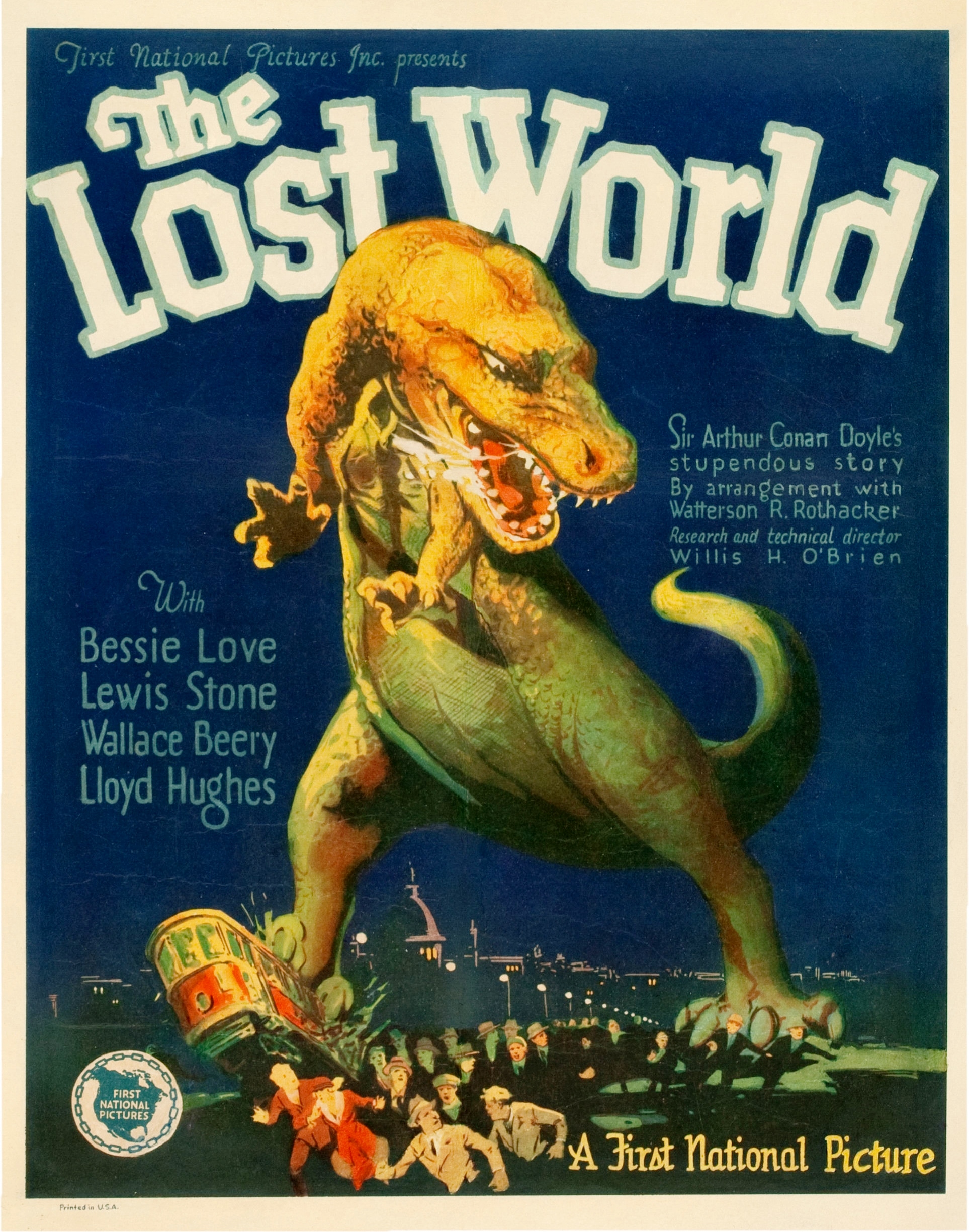
The Lost World (1925)


The Lost World was the pre-cursor to King Kong and the grandfather of the modern day blockbuster; many of today’s special effects extravaganzas follow its template, a slim framework to hang its special effects on.  The special effects in The Lost World are dated, but they are charming in their crudity, and are certainly the best parts in the film. The non effects scenes are rather unremarkable, but passable. The Lost World suffers from two major flaws:

1)      The Love Triangle. The character of Paula White (the appealing Bessie Love) was not in Arthur Conan Doyle’s novel and was created specifically to provide the character of Edward Malone (Lloyd Hughes) with a love interest.  This in itself isn’t necessarily a bad thing, but it takes an awkward turn for the worst with the introduction of famed hunter Sir John Roxton (Lewis Stone), who also vies for Paula’s affection.  The problem is that this love triangle is a complete mismatch in Edward’s favor, Paula doesn’t return Roxton’s affections, she just shrugs them off. Often, the relationship between Paula and Sir John comes off as being more father/daughter than potential lovers, because it’s so tame. If one were to edit out the title cards in The Lost World, Sir John would come across as a concerned father wanting the best for daughter. It doesn’t help that Lewis Stone was old enough to be Bessie Love’s father. The Love Triangle, for all its build up, is much ado about nothing; Sir John takes Paula’s rejection of him in relatively good humor and remains friends with Edward.  There is never any moment where it threatens to tear apart the expedition, instead everyone remains agreeable throughout. It might have helped had there been a least once scene in which Sir John contemplates letting Edward get mauled by a dinosaur, or setting his gun sights on Edward, instead of the Ape Man that is tormenting him throughout the movie.  Instead, it’s a rather dull subplot that could have easily been discarded.


2)      Harry O. Hoyt’s pedestrian direction.  A common occurrence throughout the film is how Hoyt will constantly undercut the tension in a by cutting back and forth between two different locations. Early in the film, the expedition party has downed a tree to get across a chasm. When the tree falls, the films cuts to a Brontosaur (or to be correct, an Apatosaurus) grazing in the jungle. It is startled by the sound of the tree falling. Cut back to the expedition walking across the tree on a time. Cut back to the Brontosaur. Cut back to the party. Whatever tension Hoyt was trying to get out of the party crossing the chasm is completely deflated by the comical Brontosaur munching away on the greens. It is an extremely odd directorial decision that only baffles the viewers; a few cut a ways last for merely a split second.
The reveal of the dinosaurs is rather unremarkable as well. Professor Challenger and company finally come upon the plateau, the sight of Challenger’s previous expedition and the disappearance of Maple White (Paula’s father), when the film abruptly cuts to a long shot of a Pterodactyl gliding into frame.  There is no build up to its appearance, it just randomly appears. It takes Challenger and friends a couple of seconds to notice its existence and when they finally see it, they are absolutely amazed.  In King Kong, the film heightens its suspense by slowly revealing Kong to the audience; first all we hear is a roar, then a couple of footsteps, then the sound of trees being knocked over, and finally, after nearly a minute of screen time has passed, Kong emerges into frame, and we in the audience can’t believe what we are seeing. The Pterodactyl scene doesn’t have quite the effect, because there is nothing to clue us in to its appearance. I’m sure in 1925, audiences must have been blown away by what they were seeing, but to the modern viewer it’s just as an awkward moment, “Oh, look! A Pterodactyl! MEH!” When we first saw Kong, we immediately feared for Ann Darrow’s (Fay Wray safety), but the Pterodactyl is never a threat to our protagonists; it munches on an animal in its talons and then promptly flies away, never to be seen again.


For many years the only available copy of The Lost World was a heavily mutilated print that ran a little over an hour, consequently giving the film a very disjointed feel about it. In 1998, a 93 minute print was located and it helped fill in a few narrative gaps, though even this print is missing important scenes (the original print ran 108 minutes).  One of the crucial scenes the 1998 print added back in was Edward’s relationship with his fickle girlfriend, Gladys. Edward desperately wants to marry her, but she rebukes his proposal saying she will “only marry a man of great deeds and strange experiences – a man who can look death in the face without flinching!” This is Edward’s main motivation for going on the expedition in the first place (as it is in the novel), yet this scene was surprisingly deleted from most prints, making you wonder why Edward would willingly risk life and limb for an expedition he doesn’t really believe in; he, at first, thinks Challenger’s claims of dinosaurs in the Amazon are complete nonsense.  It also essentially deletes Edward’s character arc, he goes from thinking the world of Gladys to finding true love in the arms of Paula. At the end of the film Edward bumps into Paula again, only to find that she has married a nebbish clerk named Percy Potts, and he couldn’t be more delighted. He has a few laughs with Gladys and her husband, wishes them luck, and then goes running into the arms of the awaiting Paula. It’s great to see these two scenes restored, because it gives the character of Edward some depth, instead of just being a handsome face that stumbles through the scenery. I personally would love to see Percy Potts get his own spin off; his story of how he landed a complete babe like Gladys would be an inspiration to geeks everywhere, especially me.  He has never left London his entire life and is afraid of his own shadow, yet he somehow manages to win the hand of the lovely Gladys ----truly inspirational!


However, the best thing about The Lost World, other than its special effects, is Wallace Beery’s portrayal of Professor Challenger, which is spot on from the book. Challenger has the mind of Einstein, but the body of a Neanderthal, and often gives into his more primitive instincts; it is revealed that he has attacked three reporters that tried to interview him. When Edward reveals that he is a reporter, Challenger lunges at him, but Edward is able to hide amongst the crowd. Later on, Edward sneaks into Challenger’s house and tries to plead his case, but Challenger won’t hear any of it, and the two of them tumble and tussle out the front door. It’s only after that Edward reveals he is a friend of Sir John Roxton that Challenger backs down and is willing to listen.  Challenger has all the intelligence in the world, but distances people with his boorish behavior. It takes the intervention of Edward to get the expedition funded; he is able to sell it to his newspaper as a rescue mission to save Maple White (which makes for a great human interest story).  It is a great performance from Beery, sadly, he gets lost in the shuffle once the special effects and the love triangle take front and center.  Professor Challenger has little to do in the second half, except antagonize fellow scientist, Professor Summerlee (Arthur Hoyt).


There is also a misguided attempt by the filmmakers to turn Sir John Roxton into a tragic figure; for all of his world renown, he is a lonely man. This might have worked if Sir John was a compelling figure, but he’s a complete bore.  It also doesn’t help that Edward is the audience surrogate; we see the world through his eyes, so naturally he’s the character we empathize with most.  He desperately seeks the love of Gladys, something that most of us can relate to and foolish jumps into dangerous because he wrongly thinks it will impress her. He’s a fallible character, hence relatable. Sir John is a rather distant character and his interest in Paula is a foolish pipe dream.  When the movie ends with him standing alone on the streets of London, we are totally indifferent to his plight. Lewis Stone is a fine enough actor, but he’s given very little to work with here. He played a very similar role in the camp classic The Mask of Fu Manchu and is much more effective, largely because he is a perfect foil for Karloff’s depraved madman. Plus, he’s so single minded in his goal to stop Fu Manchu that he doesn’t have time to pursue much younger women. PHEW!
 

Bessie Love has a great appeal as Paula White, largely due to her very expressive face. Indeed, Love’s likability is able to gloss over the fact that Paula is kind of a flake.  She could easily avoid the awkward moments with Sir John, if she just stated that she wasn’t interested in him, instead she laughs off his advances. She could easily throw out the word that most men dread to hear, “FRIENDS,” but she doesn’t even do that.  She avoids confrontation; because she doesn’t want to hurt Sir John’s feelings. However, inevitably the truth comes out and Sir John is heartbroken. It is even more infuriating that it is Edward that tells Sir John that Paula and him are going to get married. It is the ultimate cock punch!  Sir John is able to muster a smile, despite having his heart stomped on. When it looks like the expedition will make it back to civilization, after all, Paula calls off the engagement with Edward, because of his obligation to Gladys (which is kind of moot point, given that Gladys doesn’t love Edward and never agreed to marry him).  Once it is revealed that Gladys is married to the awesome Percy Potts, Paula, once again, kicks Sir John to the curb and embraces Edward. UGH!   Love would later go onto to star in The Broadway Melody, which was the first sound feature to win the Oscar for Best Picture. Alas, it has not aged particularly well, but she manages to liven up the proceedings with her likable personality.  This time around, her character is on the fuzzy end of a love triangle; her bland boring boyfriend falls in love with her younger sister.


When The Lost World is mentioned, no one ever thinks of the cast and the director, but rather the stop motion special effects by Willis O’ Brien. As mentioned in the introduction, the special effects are extremely dated and fairly jerky at times, but there are some genuinely effective moments.  The most famous scene is the Brontosaur rampaging through London at the film’s climax, but to me, the most nightmarish sequence is the Allosaur attack on the expedition party. It’s a rare moment where the filmmakers are able to build up some tension; the Allosaur is first seen in the shadows, obscured by a couple of trees. The only thing visible is its eyes, which come across as two glowing orbs floating in the night sky. It finally emerges from the trees and attacks the party. They are able to repel it by throwing a torch in its mouth. It’s a brief scene, but highly effective.  It’s one of the few scenes in the movie where the actors actually interact with a dinosaur; usually the effects scenes are fairly unrelated to the actual storyline. It is common to have a scene with the cast doing a bit of business, then the film will cut to two dinosaurs duking it out, then cut back to the cast, who are completely oblivious to the prehistoric wrestling match that just occurred.  The Lost World is relevant, because in many ways, it proved to be a test run for the much superior King Kong, which still inspires filmmakers to this very day.  Also, it gave us the memorable character of Percy Potts…a truly original creation. Hopefully, a young filmmaker will realize the potential of this awesome character and give him his own movie. It is long overdue!


Credits:

Cast:  Wallace Beery (Professor Challenger), Bessie Love (Paula White), Lloyd Hughes (Edward Malone), Lewis Stone (Sir John Roxton), Alma Bennett (Gladys Hungerford), Arthur Hoyt (Professor Summerlee), Bull Montana (Ape Man), Margaret McWade (Mrs. Challenger), Finch Smiles (Austin), Jules Cowles (Zambo).

Screenplay: Marion Fairfax.
Based on the novel by Sir Arthur Conan Doyle.
Director: Harry O. Hoyt
Running Time: 93 min.

Thursday, October 31, 2013

House of Wax (1953)/ Mystery of the Wax Museum (1933)


Vincent Price is one of the few screen actors that was able to make a completely loathsome character likable.  Take House of Wax, for instance. Price stars as Henry Jarrod, a mad sculptor who murders people (who resemble historical figures), covers their bodies with wax, and then puts them on display at his wax museum.  He is the kind of character that audiences love to hate! Yet, we don’t hate Henry Jarrod, rather we find him sympathetic; he maybe the kindest villain ever to grace the silver screen.  When the meddlesome Sue Allen is taken aback by how much his Joan of Arc sculpture resembles her recently deceased friend, Cathy, Jarrod tries to put her mind ease by telling her he modeled his Joan of Arc after a picture of Cathy  he saw in the newspaper. Does she buy the explanation? NO! Her nonstop snooping (((SPOILERS))) eventually leads to poor Jarrod’s untimely demise. I remember watching House of Wax for the first time with my friend Joe and we kept getting annoyed at how Sue Allen kept sticking her nose where it wasn't wanted. Whenever she would touch the Joan of Arc wax figure, we would scream at the television, “He just told you not to touch the damn sculpture!”  The audience wants Jarrod to succeed, despite his homicidal tendencies.  This is entirely due to Vincent Price’s charismatic performance; Henry Jarrod is the most likable character in the entire film. It certainly doesn't help that Phyllis Kirk gives a rather stiff performance as Sue Allen.  If it was different actor portraying Jarrod, then chances are the audiences would cheer when he plunges head first into a vat of ((((AGAIN SPOILERS))) boiling wax.


House of Wax was a remake of the 1933 film, Mystery of the Wax Museum, and is one of the few remakes that is superior to its predecessor.  Mystery of the Wax Museum is fun horror film, highlighted by a wonderfully sinister performance by Lionel Atwill as the mad sculptor, Ivan Igor. However, it’s littered with too much comedy relief, provided by Glenda Farrell (as wisecracking reporter, Florence Dempsey), to be considered a true classic of the horror genre. I actually like Farrell’s performance, she is a lot of fun and energetic, and is certainly more interesting than Charlotte, the damsel in distress portrayed to perfection by Fay Wray. It is also interesting to note that it is Florence who drives the narrative of the story; she is investigating the disappearance of a body from the city morgue, and her fact finding leads her directly to Igor’s wax museum.  She’s a tough as nails reporter and is able to hold her own in a man’s world.  

The problem is that Farrell’s character seems more at home in a film like His Girl Friday than in a gruesome horror film.  The comedy is so prevalent that the horror is almost secondary; Farrell probably has more screen time than Atwill and Wray combined, and I am not exaggerating.  The comedy has the effect of defusing any tension that the filmmakers were hoping to build up, because Farrell is too busy trading barbs with her editor (Frank McHugh), or flirting with a murder suspect (Gavin Gordon), that there’s never a sense of urgency. It’s not until the movie’s last fifteen minutes (Charlotte finds herself in the clutches of the mad Igor) that the audience is given a time element. Will Florence and company save Charlotte? Or will she be turned into a permanent resident of Igor’s wax museum?

Fay Wray is given second billing in the credits, but probably has less than twenty minutes of actual screen time. The character of Charlotte doesn't first appear until the half hour mark, roughly the middle of the film. She isn't given much to do except scream at the top of her lungs. This, unfortunately, is what Miss Wray is best remembered for. Yet, Charlotte is an infinitely more appealing heroine than Sue Allen in the remake.  While Fay Wray’s acting was limited, she did have a genuine screen presence that usually made up for her short comings. She radiated warmth and sincerity when she was onscreen, which explains why she has become a film legend.  That and the fact that she starred opposite a giant ape the same year Wax Museum was released. She is the kind of woman that most men in the audience (excuse the sexism, ladies) would want to protect from all harm. We genuinely fear for her life, because she comes off as being so vulnerable. Sue Allen is a fairly distant character that we find ourselves less engaged in her peril.  Also, Charlotte unwittingly stumbles into Igor's web by happening to be at the wrong place at the wrong time, she is dating one of his assistants. Sue Allen, on the other hand, practically is asking for trouble by constantly sticking her nose where it isn't wanted. Sue Allen is a stronger heroine than Charlotte, but even she is relegated to being the damsel in distress at the film's climax.

Mystery of the Wax Museum takes many of it's cues from the previous year's Doctor X, made by the same cast and crew. Like Wax Museum, Doctor X's central character is reporter investigating a string of murders that happen on the night of a full moon.  Unlike Wax Museum, the reporter is a bumbling male, who not only serves as the film's comic relief, but as a love interest for Fay Wray as well. Poor Miss Wray! The comedy in  Doctor X is completely jarring given how gruesome the subject matter truly is: a murderer who dabbles in cannibalism. Doctor X has essentially the same strengths and flaws as Mystery of the Wax Museum; they both are wonderfully atmospheric and have exciting endings, but can be fairly tedious at times. Florence, however, is infinitely more likable than Lee Taylor, the male reporter who stumbles into the role of hero.


House of Wax improves on the original by writing out the reporter character and focusing more on the Henry Jarrod/ Sue Allen storyline.  There is a greater sense of danger in the remake then there was in the original film. The first victim in Mystery of the Wax Museum is Joan Gale, a young woman who apparently committed suicide, but it is later revealed to have been murdered. The problem is that Gale’s murder happens off screen and the only connection we have with her is a photograph printed in the newspapers obituary column. In House of Wax, the murder of Cathy Gray, close friend of Sue Allen, is genuinely shocking, because the audience empathizes with her.  Cathy, despite her brief screen time, is a fully developed character, wonderfully played by Carolyn Jones.  When we first meet Cathy, we assume that she is a dumb blonde, given her tendency to giggle at just about anything. However, her ditzy demeanor is just an act; a ruse into attracting potentially wealthy suitors.  House of Wax’s setting is in the 1890s, which was not a particularly kind time for single women.  Cathy does whatever she can to survive, even if means playing dumb and using her body to win the favor of Mathew Burke, Jarrod’s former partner, who hopes to be collecting insurance money really soon.   However, in span of five minutes, Cathy is dealt two blows:

1) Matthew Burke is murdered. He is hung by a horribly disfigured man dressed in black. Cathy dreams of being in a stable relationship are shattered.
2) Cathy suffers the same fate as Burke. She is murdered in her bedroom.


The murder of Cathy is genuinely surprising, because there is absolutely no build up to the moment. Sue Ellen returns to her apartment building from a job interview, only to find her landlord demanding her rent. Sue Allen is penniless at the moment, but Cathy has offered to lend her some money. Sue Ellen enters Cathy’s apartment and finds her asleep in the bedroom. She calls out Cathy’s name a few time, but gets no answer. She walks closer to the bed, only to find, much to her horror, that Cathy has been strangled.  Just when things couldn’t get any worse, a black figure emerges from behind the bed and chases after Sue Ellen.  It is a surprising turn of events, given that a few minutes earlier the two of them were enjoying each other’s company and having a few laughs.  It is very much the anti-thesis of the slasher films, which slowly builds to a victim’s inevitable death; the unseen killer has his target in sights and does them in any extremely protracted manner.  In the House of Wax, there is nothing to tip us off that Cathy is going to come to such a gruesome end; no POV shot of the killer looking outside apartment, etc.
House of Wax is remembered for two reasons, it jump started Vincent Price’s horror film career and it was made in 3D. I had the privilege of seeing House of Wax in 3D a few years ago at the Times Cinema in Milwaukee and it was a lot of fun. I think part of the fun is that director Andre de Toth is absolutely shameless with his use of the gimmick; there’s a scene in which Sue Ellen and Scott Andrews (her boyfriend) are at a Can Can and all the dancers stick their butts right out at the screen. Probably, the most famous scene is the paddle ball man; Jarrod hires a barker to drum up business for his wax museum, the guy’s specialty is doing tricks with a paddle ball. It’s a gratuitous scene, but extremely effective, at least in the 3D version, especially when the ball keeps bouncing at your eyes. 

Vincent Price would continue to make horror films throughout his career with varying success, but in House of Wax he is frightening, yet simultaneously sympathetic.  Henry Jarrod is slightly crazy at the film’s beginning; he talks to his sculptures and thinks of them as his children. When Burke sets fire to Jarrod’s wax museum (to collect insurance money), it not only scars Jarrod physically, but mentally as well. He completely losses any sense of reality; in his mind he is doing his victims are great service by immortalizing them in wax.  There is a lot pathos in Price’s performance that was lacking in Lionel Atwill’s no nonsense portrayal in the original film. Lionel Atwill was a terrific actor and his Igor is truly menacing, but his straightforward performance is at odds with the nonstop humor in the film. It is shame that Atwill constantly has to play second fiddle to wisecracking Glenda Farrell, when he should have been given his own starring vehicle to shine in. On the other hand, the comedy relief in the remake is not nearly as jarring, because Price allows for humor to creep into his performance; at point a woman becomes overwhelmed by the horrific waxworks and faints, Jarrod interrupts his tour of the wax museum and offers her friends some smelling salts.

 
Credits:
Mystery of the Wax Museum (1933)
Cast: Glenda Farrell (Florence Dempsey), Lionel Atwill (Ivan Igor), Fay Wray (Charlotte Duncan), Frank McHugh (Jim), Allen Vincent (Ralph Burton), Gavin Gordon (George Winton), Edwin Maxwell (Joe Worth), Arthur Edmund Carewe (Sparrow – Professor Darcy), Holmes Herbert (Dr. Rasmussen), Claude King (Mr. Galatalin), Thomas E. Jackson (Detective), DeWitt Jennings (Police Captain), Matthew Betz (Hugo), Monica Bannister (Joan Gale).
Director: Michael Curtiz
Screenplay: Don Mullaly, Carl Erickson.  Charles Belden (story).
Running Time: 77 min.

House of Wax (1953)
Cast: Vincent Price (Prof. Henry Jarrod), Frank Lovejoy (Lt. Tom Brennan), Phyllis Kirk (Sue Allen), Carolyn Jones (Cathy Gray), Paul Picerni (Scott Andrews), Roy Roberts (Matthew Burke), Dabbs Greer (Sgt. Jim Shane), Paul Cavanagh (Sidney Wallace), Angela Clarke (Mrs. Andrews), Charles Bronson (Igor), Nedrick Young (Leon Averill), Reggie Rymal (The Barker), Philip Tonge (Bruce Allison), Frank Ferguson (Medical Examiner). 
Director: Andre de Toth
Screenplay: Crane Wilbur.  Charles Belden (story)
Running Time: 88 min.

Thursday, October 17, 2013

10 Worst Horror Films I Have Ever Seen.

There have been so many dreadful horrors that it was almost impossible for to just settle on ten. However, after thinking about it for a few days (I have no life), I narrowed my list down to these ten titles. There are many of bad horror films I have yet to see, so this list could easily change in the future.

10) Halloween II (2009)


Dir: Rob Zombie.
Cast: Scout Taylor-Compton, Taylor Mane, Malcolm McDowell, Brad Dourif, Danielle Harris, Sheri Moon Zombie, Margot Kidder, Mary Birdsong, Bea Grant.
Running Time:  105 min.
I absolutely loathed Rob Zombie's remake of Hallween, the only reason it isn't on my top 10 list is because Halloween II is infinitely worse. Slasher films aren't exactly high works of art, but even the bottom feeders tend to have at least one character you an empathize with...... not so with Halloween II. For instance, I enjoy the first four entries in Friday the 13th series, largely because the characters are at least fun too watch. Sure, their main function is to meet grisly ends, but at least they are pleasant company. They are the kind people you would want to be on a weekend get away with. In Halloween II, everyone is miserable. 
I like Rob Zombie, his music is entertaining for the most part and he comes off as being highly intelligent in interviews, therefore it's complete shame that this film is mind numbingly awful. Zombie is more of a "shock" director than an actual "horror" director. Meaning, he'll lull you into a hypnagogic state, only to jump out and scream "BOO" at you! Take for instance the death of Laurie's friend, Harley. She is at a costume party, dressed up as Dr. Frank-N- Furter (from The Rocky Horror Picture Show) and is fixing to fornicate in the back of a van with a guy wearing a werewolf mask! UH-OH! The guy, however, ask to take a leak first and is dispatched by Michael, while he is urinating on a tree. Then Michael crashes through the back window of the van and snaps poor Harley's spine. It's an extremely violent moment, yet it's not in the least bit scary, and eventually the shock value wears off on the viewer.  The original Halloween slowly builds to it's inevitable climax, the audience is constantly in a state of unease, wondering when Michael Meyers is going to strike. In Halloween II, we don't really care, we just want the damn movie to end. 

9) Hell of the Living Dead (1980)

Dir: Bruno Mattei, Claudio Fragasso.
Cast: Margit Evelyn Newton, Franco Garofolo, Selan Karay.
Running Time:  101 min.
My summary of Hell of the Living Dead: Endless bickering among the characters, endless nature stock footage, and lots of cheap looking gore. Rinse. Wash. Repeat. The zombie make up looks like play dough, and is often on the verge of falling off the faces of the poor extras. It's a third rate Dawn of the Dead, which is probably giving it too much credit.  The hilariously awful dubbing is amusing for a little bit, but gets old after awhile. 
  
8) Maniac (1934)

Dir: Dwain Esper
Cast: William Woods, Horace B. Carpenter, Ted Edwards, Phyllis Diller (not the comedienne), Theo Ramsey.
Running Time: 51 min.
Maniac is about a hammy ex-vaudeville actor Don Maxwell that finds himself an assistant to Dr. Meirschultz, a mad scientist experimenting on resurrecting the dead. Maxwell kills Meirschultz and covers up his crime by impersonating the mad doctor, driving himself insane in the process. Maniac is noteworthy in that in tries to pass itself of as an educational film about mental illness; there are inter titles scattered throughout explaining what the main character is experiencing. To visualize Maxwell's descent into madness, director Esper superimposes footage from the Benjamin Christensen classic Haxan: Witchcraft Through the Ages over his face. By posing as an educational film it gave Esper leeway to show woman in the nude, as well as get away with extreme violence; at one point Maxwell plucks out a cat's eyeball and eats it. It's a horrible film to be sure, but probably the only film on this list that is remotely fascinating, given the era that it was made. 

7) Jaws:The Revenge (1987)

Dir: Joseph Sargent.
Cast: Lorraine Gary, Lance Guest, Mario Van Peebles, Karen Young, Michael Caine, Judith Barsi.
Running Time: 90 min.
Jaws is one of my favorite movies. Jaws: The Revenge, on the other hand, is pure schlock, only good for a few unintended laughs. Whereas Jaws kept the shark off screen for the majority of the movie, The Revenge makes the mistake of showing too much.In one laughable bit, the shark jumps out of the water and devours a  woman that is sitting on top of a banana boat.


Lorraine Gary returns as Ellen Brody, who constantly has flashbacks to the first film. In fact, she some how able to remember events that she wasn't apart of, like Martin Brody disposing of the shark in the first film. Gary tries her hardest, but the material lets her down. Apparently, some genius decided that if the Great White Shark roared like King Kong, it would be much more scary. Thankfully, we were spared a Jaws 5: In Space. 

6) The Snow Creature (1954)

Dir: W. Lee Wilder.
Cast: Paul Langton, Leslie Denison, Teru Shimada, Rollin Moriyana, Darlene Fields.
Running Time: 70 min.
A real snoozer! W. Lee Wilder is name that completely gets overlooked in the “Worst Director of All Time” conversation, possibly because his films are so boring that they are easy to forget. He sneezed out three non classics in the 1950s: Killers From Space (with Peter Graves), Phantom From Space, and The Snow Creature. Amazingly, he was the older brother of Billy Wilder, quite possibly the greatest director in Hollywood history. The Snow Creature is not only hampered by a low budget, the same shot of Yeti walking towards the camera is recycled throughout the film, but by an incredibly dull cast.


It’s an incredibly uninvolving and joyless film; when a Himalayan village is attacked by a Yeti, the main character shrugs with complete indifference.  It also blatantly steals the plot from King Kong; the Yeti is captured and brought to Los Angeles, where it escapes and runs amok. There are better ways to spend 70 minutes.

5) Zombie Lake (1981)

Dir: Jean Rollin.
Cast: Howard Vernon, Pierre-Maris Escourrou, Anouchka, Antonio Mayans, Nadine Pascal, Youri Radionow.
Running Time:  90 min.
A squad of green skinned, bugged eyed Nazi zombies arise from the bottom lake and terrorize a French village that murdered them years ago. Their main victim of choice: curvaceous, female skinny dippers. There's also a "heart warming" subplot in which one of the zombies is reunited with his daughter, the product of an affair he had with a local woman. The fact that he is able to recognize his daughter is, in itself, a mystery, considering he was killed before her birth. This subplot also highlights just how incompetent of a film Zombie Lake truly is; his daughter is roughly ten years old, which would put the setting of this movie some time in the mid 1950s, yet the fashions, hair styles, and technology place it in the late 70s/early 80s. The filmmakers were to lazy to replicate a 1950s setting, which makes everything more confusing. Not to mention, director Jean Rollin seems to have confused zombies for vampires; the undead Nazis bite the necks of their victims and suck their blood.


4) Monster a-Go Go (1965)

Dir: Bill Rebane, Herschell Gordon Lewis.
Cast: Philip Morton, June Travis, George Perry.
Running Time:  70 min.
Monster a-Go Go is about an astronaut that crash lands on Earth and has been transformed into a deformed, radioactive monster. This idea was done before in The First Man In Space (1959) and The Quatermass Xperiment (1955), but while those films were actually interesting, Monster a Go-Go is 70 minutes of pure boredom. There's lot of narration and very little characterization. It's also extremely disjointed; characters often disappear without explanation. It also is extremely anti-climatic; the military follows the monster into the sewer, only to find that is has disappeared.  We are then treated to this mind blowing piece of narration:

As if a switch had been turned, as if an eye had been blinked, as if some phantom force in the universe had made a move eons beyond our comprehension, suddenly, there was no trail! There was no giant, no monster, no thing called "Douglas" to be followed. There was nothing in the tunnel but the puzzled men of courage, who suddenly found themselves alone with shadows and darkness! With the telegram, one cloud lifts, and another descends. Astronaut Frank Douglas, rescued, alive, well, and of normal size, some eight thousand miles away in a lifeboat, with no memory of where he has been, or how he was separated from his capsule! Then who, or what, has landed here? Is it here yet? Or has the cosmic switch been pulled? Case in point: The line between science fiction and science fact is microscopically thin! You have witnessed the line being shaved even thinner! But is the menace with us? Or is the monster gone?

Brilliant!

3)The Creeping Terror (1964)

Dir: Vic Savage.
Cast: Vic Savage, Shannon O’ Neill, William Thourlby, John Careisio.
Running Time:  75min.
The soundtrack to The Creeping Terror was supposedly erase during post-production, so instead of dubbing over lines, the filmmakers opted to go with an omniscient narrator that never shuts up. The narrator constantly reaffirms things that are being shown onscreen, "The military was called in....," etc. The terror is essentially a walking carpet with a tip shaped like a piece of asparagus that meanders across the countryside and devours people that get in its path. The deaths in this film could easily be avoided if the monster's victims, instead of just lying perfectly still waiting to be devoured, got up and walked a way at a leisurely pace. Every horrific moment consists of the monsters very slowly crawling towards its next meal, while the person just lies there helpless, never once thinking to get up. The camera also lingers on the behinds of the monster's young, female victims as it gobbles them up.

2) Curse of Bigfoot (1976)

Dir: Dave Flocker.
Cast: Bob Clymire, Bill Simonsen, Jan Swihart.
Running Time: 88 min.
Here's a typical moment in Curse of Bigfoot:
Two lumberjacks are driving through the woods in a pick up truck, when all of a sudden Bigfoot runs across the road. One of them (wearing a wool hat) goes into the woods to investigate, while the other one waits at the truck. Wool Hat Man walks through the woods and then is attacked. Sounds exciting, right? Well, the scene in question goes on for nearly seven minutes and the attack in question happens off screen and is signified by a scream. It's a film that builds up to nothing! There's never any real sense of danger,because we're never shown an actual murders.  It doesn't help that the Monster suit looks like it came from a kindergarten pageant.
It's a tedious film that desperately apes the Howard Hawks film The Thing From Another World, but fail miserable. A nice cure for those who suffer from insomnia. 

1) Manos: The Hands of Fate (1966)

Dir: Harold P. Warren.
Cast: Tom Neyman, John Reynolds, Diane Mahree, Harold P. Warren, Jackey Neyman.
Running Time: 74 min.
It's only 74 minutes long, but it's the longest 74 minutes you'll ever experience. Manos: The Hands of Fate is quite possibly the most inept movie ever made. Supposedly, it was made on a bet between director Harold P. Warren and screenwriter Stirling Silliphant, in which the former bet the latter he could make a movie for $19,000. It was never stated that the movie actually had to be good, so Warren won the bet. It's obvious that Warren is not familiar with the concept of editing, as there are scenes where characters stand around awkwardly staring blankly into thin air, as if awaiting their cue from the director. In another scene, the hillbilly satyr Torgo gets a bit touchy feely with the lead actress, who responds by staring in abject horror, then after enduring this abuse for about two minutes finally yells at him to stop.

In another famous moment, two cops hear a gun shot in this distance and decide to investigate. They get out of their squad car, take a few steps into the desert, scan the area for a few seconds, and then call it a day. Exciting! 

Tuesday, September 24, 2013

The Bat (1959)


Is there a cooler actor in the history of cinema than Vincent Price? The answer is no! Vincent Price had the magical ability to transform the most putrid of scripts into something watchable; his presence alone often elevated many of the films he starred in.  He was a fun actor to watch and one never got the impression that he simply phoned in his performance, regardless of the material. The Bat is not a Vincent Price vehicle, despite his top billing. He is relegated to the thankless red herring role of Dr. Malcolm Wells; a character that we are constantly lead to believe is the villain of the title. There's a lot of damning evidence against him, which means that he cannot possibly be The Bat.


The Bat was the third adaptation of the 1920 Broadway play by Mary Roberts Rinehart and Avery Hopwood, and it is by far the weakest out of the three. The play was adapted twice by Roland West in 1926 (as The Bat) and 1930 (as The Bat Whispers).  The first version is probably the best of the three, largely because the story is so old fashioned that it is best suited as a silent film. It's main flaw is that it lacks a strong lead. Emily Fitzroy gives a poker faced performance as Cornelia van Gorder, while Louise Fazenda mugs it up as Cornelia's cowardly maid, Lizzie Allen. The rest of the cast is adequate, if unremarkable.
 The Bat Whispers is notable in that it was one of the earliest attempts at widescreen and stars Chester Morris as the strong jawed Detective Anderson. Morris has great screen presence and livens up the proceedings with his no nonsense performance. The film greatly suffers during the stretch he is off screen, because, other than Una Merkel (as Dale Van Gorder), none of the other cast is nearly as interesting. The Bat Whispers has some truly eye popping visuals; in one scene the camera glides up the side of a building, goes through an opened window, and stops on a man sitting at a desk. It's an extremely cinematic movie, unfortunately it creaks along at a very slow pace. It's a film that cries for a soundtrack, as there are many long stretches of absolute silence. It's not nearly as bad as Tod Browning's Dracula, but it is a chore to sit through at times, though it gets back on track towards the end. It also has an amusing afterword in which Chester Morris breaks the fourth wall and implores the audience not to give away the true identity of The Bat to potential future audience members.


By 1959, The Bat was extremely old fashioned and Crane Wilbur didn't do anything to "modernize" it. The 1959 version is the weakest of three, because it is, cinematically, a very bland movie. Sure, the earlier versions may be creaky at times, but both are visually stunning movies with great sets and eye popping camera movements. The 1959 version often resembles a television play that was popular during that time; characters deliver their lines while facing the camera, and scenes end in a traditional fashion, with characters exiting the frame. This could be overlooked if The Bat was remotely menacing, but unfortunately he is a rather dull villain. He wears a fedora hat, a black mask, and plods around the scenery in a business suit - not exactly the type of uniform you would expect a notorious jewel thief (and murderer) to wear. However, despite wearing a mask, the audience knows The Bat's identity from the get go, because we get a good look at his body shape, and let's just say that it's too short to be Vincent Price and too pudgy to be the red herring in the film, Warner, Cornelia's chauffeur/ butler.  The earlier Roland West films obscure The Bat's identity by never giving the audience a good look at him; in The Bat Whispers the audience only sees his shadow for the majority of the film. He also avoids detection not only donning a mask, but a fake limp as well. In the silent film, he dons a bat mask. Granted, modern audiences will probably figure out the Bat's identity fairly early on, but to audiences of the late 20s/early 30s, his unmasking must have come as a complete surprise.


The earlier versions also have a prologue that gives the audience a good look at just how cunning and devious The Bat truly is. In both films, The Bat writes a note to the police bragging about how he is going to steal a jewel necklace from it's owner, Gideon Bell, at midnight and they won't be able to stop him. This boast seems practically impossible; Bell's apartment is located on one of the building's upper floors (no fire escape in sight) and the place is swarming with police officers. Yet, despite all of the precautions, the Bat not only steals the necklace, but strangles Bell as well. The 1959 film drops this prologue altogether, hence the audience is never given a sense at just how dangerous The Bat truly is. We are told about his past exploits; the characters ponder his past crimes for a second and move onto more cheerful things. The movie is extremely lacking in urgency. The majority of the previous films take place over one night, while the action in the 1959 film unfolds over the course of a few days. It follows this pattern:

1. The Bat strikes, but is eventually scared off.
2. The characters sit around a table and have a conversation. Despite having a killer lurking about, they are rather cheerful.
3. Bat strikes again. Gets scared off again.
4. More cheerful banter by the cast.
Wash. Rinse. Repeat.

Even after the murder of Judy (Darla Hood), the film flash forwards to a scene of Cornelia van Gorder dictating her memoirs to her new secretary, Dale. Dale hangs onto Cornelia's every word and then writes it down. This goes on for a nearly a full MINUTE of screen time, effectively diffusing all tension in the process.

It's really a questionable decision by director (and screen writer) Crane Wilbur. You can definitely find fault with the Roland West films, but at least he keeps ratcheting up the suspense to the point that it becomes almost unbearable. Wilbur's approach will make you shrug with complete indifference, "Eh! So what?"
The death of Judy illustrates this point; she is such a peripheral character that her death fails to resonate with the audience. Hell, even the characters in the film don't seem too bothered by her untimely demise. Sure, Dale screams, "NOT JUDY!" But less than two minutes later the audience sees her in the flash forward with Cornelia and she is all shits and giggles. What the hell was Crane Wilbur thinking?!


The Bat gets a lot of mileage out of Agnes Moorehead's performance as Cornelia van Gorder. The one of the few improvements Crane Wilbur made from the source material was making Cornelia a murder-mystery author, instead of the humorless spinster she was in the earlier films. Cornelia in the film knows her business, she's not timid when it comes to using a gun for her protection, and she figures out that there must be a hidden room somewhere in the Oaks, the mansion that she is renting for the summer. Moorehead brings a lot of humor and (more importantly) warmth to the role that was lacking in the earlier incarnations. It's also a complete joy to see two pros like her and Vincent Price banter with one another on screen; it's too bad they weren't given better material to work with, because there's a great dynamic between them.


All three versions basically share the same plot: Cornelia van Gorder has rented out a mansion for the summer that is owned by banker Courleigh Fleming (John Fleming in the 1959 film). Fleming has embezzled a million dollars from his bank and has stashed it in a hidden roomed located in the mansion.  The Bat has learned about the stolen fund and stalks the mansion hoping to find the loot for himself. However, he is not the only interested party. The earlier versions slowly dole out this information to the audience, while Crane Wilbur spoon feeds us everything from the get go. In the original version, Fleming has faked his death and is in cahoots with Dr. Wells. They try to frighten Cornelia van Gorder and her associates from the mansion, so they can claim the loot for themselves without any hassle. In the 1959 version, after Fleming has confided in Dr. Wells that he has embezzled the funds, Dr. Wells murders Fleming so he claim the stolen loot for himself. Granted, he's extremely lackadaisical when it comes claiming the money and getting rid of Cornelia and company; he makes a few asides to her about the potential danger of the mansion and then goes about his merry way. At times, it seems Dr. Wells has completely forgotten about the money, especially when he is seen drinking tea and shooting the breeze with Cornelia and her lovely, much younger female guests (Dale and Judy). As I mentioned before, this film is completely lacking in urgency, even the villains are in no hurry to get anything done. Price, for his part, brings a lot of charm to the role, which is about all he can do with a completely underwritten and thankless character. His main function is act suspicious, so the audience can shout out from their seats, "HE'S THE BAT!!!" Or at least, that's what the filmmakers had in mind.


Crane Wilbur added the characters of Judy and Warner, the suspicious butler, to the screenplay, while limiting the roles of Fleming and the character Victor Bailey, Fleming's clerk who is wrongfully accused of embezzling the money. Bailey has much more significant screen time in the earlier films; Dale and him (his fiancee) are in cahoots and are trying to locate the stolen money to clear his name. In the 1959 film, Dale and  Victor are already married, and he is given a brief scene at the beginning of the film, only to be never seen again; his arrest and subsequent release happen off screen. This is another instance in which Wilbur vastly improves on the source material, because, in both of the Roland West films, Bailey brings nothing but dead weight to the proceedings. He is really has nothing to do, except provide Dale a romantic interest. Dale is Cornelia's niece in the earlier films as well. Here, she is just Victor's long suffering wife and Cornelia's future secretary.  On the other hand, killing off Fleming was a mistake, because the alliance between him and Dr.Wells brings more tension to the proceedings. At one point, Wells attempts to kill Detective Anderson, because he knows too much. Dr. Wells and Fleming do everything in their power to scare people off, which in turns, bring a sense of urgency that the 1959 remake completely lacks.

The Bat was a common fixture on local television in the 80s and 90s, probably because it plays a lot better on small screen than its more cinematic counterparts. The only way one could fully appreciate The Bat Whispers is seeing it on the big screen. Ditto 1926 silent version! On the other hand, the 1959 film is so cinematically dull that almost nothing is lost when it is viewed on television.  There's no startling compositions! There's nothing that jumps out at you! It plays like a television drama, so not surprisingly it fares a lot better on the boob tube (preferably on an analog set with a 13 inch screen).

Credits

Cast: Vincent Price (Dr. Malcolm Wells), Agnes Moorehead (Cornelia van Gorder), Elaine Edwards (Dale Bailey), Gavin Gordon (Lt. Andy Anderson), John Sutton (Warner), Lenita Lane (Lizzie Allen), Darla Hood (Judy Hollander), John Bryant (Mark Fleming), Harvey Stephens (John Fleming), Mike Steele (Victor Bailey), Riza Royce (Jane Patterson), Robert Williams (Detective Davenport).

Director: Crane Wilbur
Screenplay: Crane Wilbur. Based off the Broadway play by Mary Roberts Rinehart and Avery Hopwood.
Running Time: 80 min.

Snow White's Revenge/Scandal (2024)

  It is difficult to write about Snow White’s Revenge without bringing up the ending, so readers beware, this review will contain spoilers...