Powered By Blogger

Tuesday, October 23, 2012

Halloween 4: The Return of Michael Myers (1988)


Halloween 4?! Surely, this is a mistake. Why would you want to devote an entire review to an unnecessary sequel to a classic horror film? Why not just review the original one instead?  I tell you why, my incredulous readers, because Halloween has been written about so many times that there is really nothing more I can say to it.  Halloween 4, on the other hand, is essentially up for grabs, because despite a strong cult following, it has essentially been overlooked by the critics.  It’s also the best of all the Halloween sequels; its gore is kept to a minimum and the characters are fairly likable. It’s definitely a mixed bag, but compared to the awful horror sequels that saturated the market in the 80s, it comes off rather well. 
Despite the 4 in the title, it is actually the third film in the Michael Myers saga; Halloween III: Season of the Witch had nothing what so ever to do with the character (except for a brief clip of the first Halloween playing on the television), instead it revolved around a plot by a Druid cult to take over the world through the use of Halloween masks and a television signal, or something to that effect. As you can imagine this didn’t go over so well with the Halloween fan base and when Halloween 4 rolled along, Michael Myers was back, giving free reign to once again terrorize the small town of Haddonfield. However, the filmmakers couldn’t get Jamie Lee Curtis to return, so instead they introduced the character of Jamie Lloyd (Danielle Harris), the daughter of Laurie Strode (Curtis’ character from the first two Halloween films).  The filmmakers did manage to Donald Pleasence to reprise his role as the slightly crazy Dr. Sam Loomis. It must be said that Dr. Loomis is one of the most resilient heroes in cinema history; not only does he survive a stab wound, but a fiery explosion as well. At the end of Halloween II, Dr. Loomis sacrifices himself by blowing up the hospital room him and Michael Myers are trapped in. Or so it seemed, because he’s very much alive in Halloween 4. 

The film does reference the explosion by having burn scars on Loomis’ face and hands, he also walks with a limp, but otherwise he’s doing fine. As is Michael Myers, who apparently has the ability to regenerate his eyes; at the end of Halloween II his eyes were shot out by Laurie. Continuity has never been the strong suit of any horror franchise, especially if it gets in the way of making a profit. We clearly saw Michael Myers blinded and burnt to a crisp at the end of Halloween II, but thanks to the magic of the movies (and ticket sales) he is alive and in the best shape he’s ever been; some how he’s managed to bulk up, despite being in a coma for ten years.

I mentioned before that Halloween 4 is the best of all the sequels and that is largely due to two things:

1)      The silliness is kept down to a bare minimum; it exists, but it’s not nearly as prevalent as it is in other horror sequels. The characters don’t wander down dark alleys, asking, “Who’s there?” At one point, the heroine Rachel is looking for Jamie and wanders into a junkyard. She’s sees a shape heading her way and rather than asking useless questions, she instead runs away. It turns out to be a false alarm as the shape is a prankster dressed up like Michael Myers.  The only head slapping moment is when Rachel and Jamie are running up a flight of stairs and Rachel turns around and screams, “Why don’t you leave us alone?”  As if somehow Michael will realize the error of his ways, apologize for being mean, and then go straight on home. On top of that, Rachel gives away their location.  Other than this blooper, the characters behave in a pretty consistent manner. There’s (thankfully) no scene in which two random characters decide to have sex in the least likely of places;   Halloween II has a scene in which a curvaceous nurse and an ambulance driver decide to get it on in a hot tub inside the hospital. And not surprisingly, they both meet a rather untimely and fairly grisly end. The nurse gets her face scalded off. There is a mild sex scene between two characters, but it occurs inside a well furnished house, and is promptly interrupted by the arrival of the town sheriff (who is the woman’s father). It’s played for laughs and only lasts for a few seconds.

2)      An attempt at character development. 
      The characters of Rachel and Jamie are far more complex than the genre dictates, but more importantly they are likable. You genuinely feel for Jamie when she is getting picked on by school mates, because her uncle is the town Boogeyman. Rachel genuinely loves her adopted sister Jamie, but kind of resents having to watch her all the time.  Her social life is constantly put on hold, because the burden of watching Jamie usually falls on her shoulders. However, as the film progresses it is pretty clear that Rachel would die for Jamie.  She constantly puts her life at risk to protect Jamie from Michael Myers.   Both are relatable characters and the actresses do a fine job of bringing them to life. The actress who plays Rachel (Ellie Cornell) has a natural look to her which gives the film an air of credibility. She’s attractive, but not overwhelming pretty, unlike the supermodels that tend to dominate most horror films today. Danielle Harris is extremely good as Jamie, odd considering that she was a child actress at the time and this was her first major film.  The Jamie/Rachel dynamic is the heart of the story; the film is at its best when it focuses on them.

The character of Sam Loomis is what gives the Halloween films a slight edge over the other horror franchises made during the same period; he is obsessed with destroying Michael Myers, but also adopts a very gentle approach when the two meet face to face.  When he meets up with Michael in a gas station he implores him not to go to Haddonfield and to leave those people in peace. He also adds, “If you want another victim, take me!”  Of course, his pleas fall on deaf ears and Michael heads to Haddonfield any ways. It’s interesting to note that Michael never goes after Dr. Loomis directly. The scene in the gas station is a great example, Loomis is ripe for the picking, but Michael never approaches him. The only time Loomis gets attacked is when he stands in Michael’s way. This is where having a veteran actor like Donald Pleasence pays off, because despite how silly the story might get, he brings a lot of dramatic weight and dignity to the role.  If a serious actor like Pleasence thinks the situation is dangerous, then chances are the audience will too.
In the first film, Pleasence sells the film’s premise with a memorable monologue:

I met him, fifteen years ago. I was told there was nothing left. No reason, no conscience, no understanding; even the most rudimentary sense of life or death, good or evil, right or wrong. I met this six-year-old child, with this blank, pale, emotionless face and, the blackest eyes... the devil’s eyes. I spent eight years trying to reach him, and then another seven trying to keep him locked up because I realized what was living behind that boy's eyes was purely and simply... evil. 

While Loomis is slightly batty, he is wise enough to know he can’t take on Michael by himself and alerts the Haddonfield police.  Thankfully, the police take his warnings seriously and send squad cars out to the patrol the area. In most horror films from that period the law was either incompetent or nonexistent. In the Friday the 13th series, the law (with the exception of Friday the 13th Part VI: Jason Lives) was usually nowhere to be seen, except in small patches. In the first two films, there is a brief scene in which a patrolman shows up and serves up a warning to the teenagers, which gets promptly ignored.  Other than that, the teenagers are by themselves and picked off one by one. In Halloween 4, the town sheriff is fairly competent and does the right things, but even that is not enough to stop Michael Myers.  Loomis is essentially the Dr. Van Helsing of the series - a thorough expert on Michael Myers and is completely obsessed at stopping him, no matter the costs.

There are other nice touches in Halloween 4 that would I like to comment on, before I get to its biggest flaw:

1)      The specter of Michael Myers still haunts Haddonfield. In most horror film sequels, the characters develop a sense of amnesia and seem to forget all the horrible things that happened to their community years ago. In Friday the 13th-The Final Chapter, the heroine’s family has lived near Camp Crystal Lake all their lives, but yet has never heard of Jason Voorhees.  In Halloween 4, Michael Myers is still very much a part of Haddonfield, especially around Halloween. As a prank, teenagers dress up as Mike Myers to scare one another and random citizens. The house Michael grew up in still stands and is thought to be haunted by the locals.  Jamie is teased by her classmates, because her uncle is the town Boogeyman. Even though the Haddonfield murders happened a decade ago, the town is still very much haunted by them.    

2)      The vigilantes.
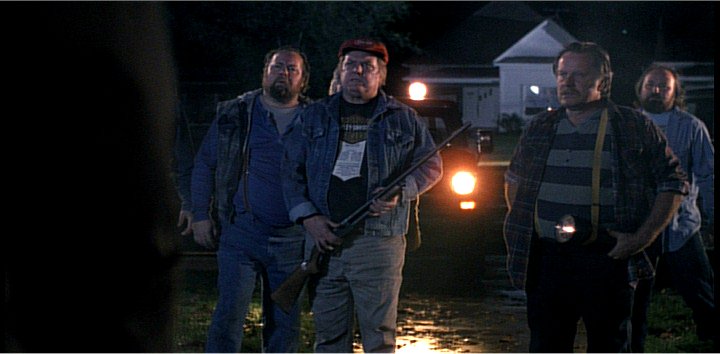
      Chances are if there was an escaped killer lurking about your hometown, most people would opt to stay indoors and lock their doors and windows. However, there would probably be a small crowd who would arm themselves, take the law into their own hands, and hunt down the killer. In Halloween 4, local bar owner Earl gathers up all his redneck buddies and they proceed to hunt down Michael, hoping to get to him before he can take another life. However, as is the case with most vigilantes, they cause more trouble than good.  Earl and his men are bit on edge, and at one point their hear rustling come from the bushes and fire away, adopting the whole “shoot first-ask questions” later mentality. Unfortunately, the man they gun down is the local town drunk, Ted Hollister, who was urinating behind the bushes. Earl tries to deflect blame by yelling at one of his men, “You dumb son of a bitch. You said you saw Myers.”  Earl and his lackeys prove to be rather ineffectual against Michael as well; he sneaks up behind them (while they are standing on the pack of moving pickup truck) and proceeds to kill them one by one.  

The biggest flaw of Halloween 4 is, unfortunately, Michael Myers himself. In the first Halloween, Michael Myers was a fairly average sized male who was very slow and methodically in the way he stalked his victims. In fact, the main reason the first Halloween is so effective is that is slowly builds to the violence at the film’s end.  You know the characters are going to get it, but you don’t know when.  The body count is relatively low (five total) and the gore is kept to an absolute minimum. The interesting thing about Michael is that he is, in fact, very much a kid trapped inside a man’s body.  In his excellent book Cult Movies, Danny Peary writes:

               I think Michael is an incredibly interesting character, not the typical vengeful movie psycho. Carpenter defines him as Evil itself (the real boogeyman), but I don’t believe he goes around killing people because he is evil. Insane, yes; evil, no. There is still a little boy inside the man’s body, and everything he does is part of a game. In fact, his activities are less suited for Halloween than “Mischief Night” (the night after Halloween “celebrated” in many American towns when kids play dirty tricks on their neighbors). He has fun scaring characters before he kills them, or teasing them by making noises, or jumping out of closets. The scariest moment is when Michael drives past Laurie, Annie, and Lynda and stops for a moment. He could kill any of these people any time he wants to, but he prefers to hide behind bushes and in closets, peer into windows, or, as in the case with Annie, play tricks with her car door.

One of the more memorable moments in the first Halloween is after Michael stabs Bob, the camera lingers on him in a long shot as he stares at Bob in a most curious manner and slowly tilts his head to the side.  By the time of Halloween 4, such nuances got thrown out the window in favor of a more one dimensional, lumbering giant. The irony is that while most slasher films took their cue from Halloween, the Halloween sequels took their cue from the many rip offs that dominated the 80s.  The Michael Myers in Halloween 4 has more in common with Jason Voorhees than he does with the Michael Myers seen in the original film.  Between Halloween II and Halloween 4 Michael has somehow bulked up and increased in height, and completely lacks the grace that defined his characters movements in the first film. No longer is he a shadow in the background, but rather a super human brute who dominates the proceedings.

In the original film the bloodshed and the violence was implied, whereas the sequels the gore factor increased greatly and the violence started to get ridiculously over the top. For instance, there is a scene in Halloween 4 in which Michael impales a curvaceous blonde girl with a rifle with very little effort.
In another scene, his hand comes crashing through a pick up truck window and proceeds to rip off Earl’s head. Granted, the gore in Halloween 4 isn’t as gruesome as it is in present horror films, but it’s still there. While many horror fans applaud the gore scenes, I find them rather redundant and boring; to me gore diffuses the tension, rather than adds to it.  When Michael rips off Earl’s head, it makes me cry out, “Oh! Come on,” rather than, “OH MY GOD!”  If the execution is poor, gore scenes can be incredibly laughable. In the Lucio Fulci film The Beyond there is a scene in which an idiot is attacked by tarantulas that proceed to rip his face apart. This sounds disgusting, but because of Fulci’s inept direction it becomes a laugh riot. For one, despite walking on a wooden floor, it sounds like the Tarantula’s are walking on potato chips, and secondly, despite having his face torn apart, the guy doesn’t seem to be in any pain. At one point he gets his eye ripped off and mere says, “OH NO!” It’s a scene that lingers on and on, and doesn’t necessarily add to the overall narrative, though Fulci films rarely make any sense.

The other aspect I can’t stand about the Halloween sequels (not just part 4) is the idea that Michael Myers hunts down his next blood relative. In Halloween II, it was revealed that Laurie Strode is Michael Myers’ sister.  This storyline was added to give Michael motivation for going after Laurie, but otherwise it added nothing to the overall narrative.  When Halloween 4 rolled along, the filmmakers couldn’t get Jamie Lee Curtis to reprise her role as Laurie, so they changed the premise from Michael Myers stalks his sister to Michael Myers stalks his niece.  I absolutely hate both story lines, because they take the idea of chance out of the equation.  In Halloween, Laurie was a random person Michael encountered and proceeded to stalk her and her friends; it was a chance encounter that leads to the death of three teenagers.  What makes the film so frightening is the idea that this could happen to anyone in any town. Laurie just happened to be at the wrong place at the wrong time and as a result she finds herself fighting for her life at the film’s end. It is also through chance that Loomis spots the car Michael stolen, sees children fleeing from a house, and arrives in the nick of time to save Laurie.  However, by making Michael and Laurie siblings this idea of chance goes tossed out of the window in favor of the idea that fate is what brought the two together.  In Halloween 4, Michael has waited patiently for ten years, so he can escape and stalk his poor niece.  This also presents the problem of “How does Michael know he has a niece?” and Halloween 4 never really answers that question; in Halloween 5 it is revealed that the two share a psychic link (when it is convenient for the plot). 

*Spoiler*

I especially loathe the twist ending in which Jamie turns evil and attacks her stepmother with a knife, thus implying that she will take Michael Myers place. There are many fans that like this ending, because how it parallels the first Halloween, but it’s absolutely needless and unoriginal. For one, Friday the 13th: The Final Chapter sports a similar twist ending, in which it is implied that Tommy Jarvis (Corey Feldman) might have not survived the ordeal of killing Jason with his sanity intact. In Friday the 13th: The New Beginning this isn’t so much as implied as  it is explicit; we see Tommy wearing Jason’s mask and clutching a knife as the film’s heroine is oblivious to her soon to be demise. In Halloween 5 this idea of Jamie being Michael’s heir apparent is completely dropped and instead she spends a good deal of the film mute and recovering in a hospital. Secondly, it’s seemed to a common theme amongst horror films of the 80s to end on a rather downbeat note, just when you thought the killer was defeated, he would come back for one more scare. It’s a cliché that got rather tiresome as the decade wore on and seeing a cute girl turn evil is just a bit too much. And Pleasence shouting, “NOOOO!” in slow motion doesn’t really help matters.

I have love/hate relationship with Halloween 4. I like the characters of Jamie and Rachel, as well a few other touches by the filmmakers. It’s still a step above the majority of the slasher films of that decade, and certainly a masterpiece compared to the dreadful sequels that followed, but unfortunately I find the character of Michael to be rather lifeless and uninteresting. He’s no longer the Michael Myers of the first film, but rather a Jason rip off.  

Cast: Donald Pleasence (Dr. Loomis), Danielle Harris (Jamie), Ellie Cornell (Rachel), George P. Wilbur (Michael Myers), Beau Starr (Sheriff Meeker), Sasha Jensen (Brady), Kathleen Kinmont (Kelly Meeker), Michael Pataki (Dr. Hoffman), Gene Ross (Earl), Carmen Filpi (Rev. Jackson P. Sayer).
Director: Dwight H. Little

Thursday, October 4, 2012

Freaks and Geeks (1999 – 2000)


I remember when I first saw Freaks and Geeks; it was, in fact, six months ago. I caught the end of the pilot episode on the Sundance Channel and was instantly drawn in. I then found out that my co-worker Paul had the entire series on DVD, so I asked if I could borrow it and he agreed. I then spent my day off watching the entire series from beginning to end, I was addicted.  So addicted, that I spent the next few days watching it over again and listening to the commentaries by the cast and crew.  What was the appeal? It was the most accurate depiction of high school that I had ever seen on television.  Freak and Geeks is the kind of show that you can watch and say, “Hey, something similar happened to me in high school,” or, “Hey! I know someone like that!”
There’s an episode in particular, Girlfriends and Boyfriends, which has a special place in my heart, because it has a moment that is taken directly from my high school experience. In it, our protagonist Sam Weir has a crush on the pretty, popular cheerleader Cindy Saunders. At the advice of a fellow geek, Gordon Crisp, Sam decides to join an extracurricular activity that she’s a part of (the year book club) so he can get to know her better. It appears to pay off, when after having bonded over going store to store to sell ad space in the year book, Cindy asks Sam if he would like to go with her to Stackies, a fast food restaurant, after school. Sam, naturally, says yes and it appears that their first date is well on its way.  Everything appears to be going smoothly at Stackies, until star basketball player Todd walks by and Cindy starts to blush. She then asks Sam, “Do you know Todd Schellinger?” And then Sam, knowing where this is headed, hesitantly replies, “Yeah…well, not personally. But, why?”
And then this following exchange occurs:
Cindy: I don’t know! He’s kind of cute. Don’t you think?
Sam: I guess.
Cindy: Okay, I’ve never told anyone this before, but I have like the hugest crush on him. At last week’s game he asked my friend Jo for my phone number. Do you think that means he likes me?
Sam: He asked for your phone number?
Cindy: Well yeah, but he never called. And every time I see him he acts like he doesn’t even know I exist.
Sam: Well maybe, he’s just shy.
Cindy: Do you think? (pauses) I don’t know. It’s like I’m always so nervous around him, I never know what to say. It’s not like with you. You’re so easy to talk to. (And to add insult to injury) You’re just like my sister!
Sam: Thanks!
Yes! This very scene actually did happen to me. I was once having lunch with this extremely attractive girl (who shall remain nameless) and then she proceeded to talk all about this guy she had a crush. Thankfully, she did not compare me to being like her sister. This is the appealing aspect of Freaks and Geeks, is that it often takes very painful moments from our high school years and makes us laugh at them. This scene at Stackies is painful, but Sam’s reactions to Cindy’s questions are often hilarious. He’s completely flabbergasted and at one points does a spit take when Cindy says, “It’s not like with you.”
Freaks and Geeks often subverts high school stereotypes as well, take Todd for example. In most high school shows, he would probably be a dumb meathead who bullies everyone smaller than him. In the next episode, We’ve Got Spirit, Cindy and Todd start to date and this infuriates Sam. When Cindy tells Sam her and Todd are dating, he replies by telling her that Todd is a jerk, she chalks it up to Sam being nervous about the  game (he’s signed up to be the school mascot, after the old one got injured) and proceeds to walk away. Sam’s suspicions about Todd are proven false when it is revealed that Todd is actually a NICE GUY!  Sam sees Todd barfing in the men’s locker room and naturally thinks the worst; however, Todd confides in Sam that he gets nervous before each basketball game. The two then have a nice, small exchange and Todd is on his way. Sam realizes that he completely misjudged Todd and after the game apologizes to Cindy.
Another moment that I can relate to is the opening scene of the pilot, when Sam and his Geek friends are quoting Caddyshack, when the local bully Alan White starts to pick on Sam. His friends (Bill and Neal) bail on Sam, leaving to feel the wrath of Alan. But before Alan can act, Sam’s sister Lindsay appears and scares off Alan and his cronies by acting all drugged out. This again is a moment straight out of my freshman year at high school. A certain jock kept picking on me in Study Hall, when my sister found out; she confronted him and essentially scared him into leaving me alone. Like Sam, I was slightly embarrassed that my petite sister fought my battle for me.  
The dynamic of Sam and Lindsay is probably my favorite part of the show; it’s the kind of relationship you find amongst most siblings, they tend to get on one another’s nerves, but underneath the constant squabbling there is genuine affection.  At the end of Girlfriends and Boyfriends, there is a nice scene in which the two of them cheer one another up after the rough day they had (Lindsay’s awkward first date with Nick, Sam’s disastrous “date” with Cindy). It’s a nicely understated scene, there’s not much dialogue between the two of them, but a few small gestures:  Lindsay asks Sam for one of his Ding Dongs and he pushes her way.  When Cindy calls Sam to talk about Todd, he wraps the telephone cord around his neck and pretends to strangle himself, which gets a laugh from Lindsay. Lindsay then stands next to Sam, listens in on the conversation and makes a few funny faces, which in turns gets a laugh out of Sam.  It’s a rather moving scene and certainly far more genuine than most heart to heart moments you get in sitcoms.
  The most interesting thing about Sam and Lindsay is that it is implied that the two of them could easily fit in with the popular crowd if they chose to do so. In fact, on the commentary, creator Paul Feig said that had there been a season two, one of the main storyline would have been whether or not Sam remained a Geek. He's picked on heavily in the first half of the season, but as the show progresses, Sam seems to grow weary of being a geek, and manages to befriend a few people in the popular crowd. In The Little Things, Sam is sitting on the popular table with Cindy, when Todd says something rather discouraging about her. She in turn, tries to bait Sam into picking a fight with Todd, but Todd calls her out. He says he doesn't want to fight Sam and that he likes Sam.  In Looks and Books, Lindsay gets fed up with the Freaks and tries to reconnect with her older friends, rejoining the Mathletes in the process.
Freaks and Geeks has developed a cult following through the years, but only lasted one season due to poor ratings. It’s often baffled critics how such a well written and genuinely touching show could only last one season, while half assed sitcoms (Full House, Family Matters) can run for nearly a decade. I have developed a few theories as to why the show never really caught on with the public.
1)      Minor Victories
The characters in Freaks and Geeks have minor victories, meaning whatever victory they achieve is usually short lived and another problem rears its ugly head. In the pilot episode the Geeks are getting bombarded in a game of dodge ball, until Sam is the only one left standing. Alan picks up a ball and relishes the thought of being able to knock Sam out of the game, but in a surprise turn of events, Sam catches the ball and forces Alan out of the game. The rest of the Geeks give out a huge cheer, until the other jocks gang up on Sam and bombard him with rubber balls.

In The Diary, Bill finally persuades the gym teacher to let him and the geeks choose the softball teams, because he’s tired of not being able to play. The coach agrees and the Geeks get to choose the teams this one time. Later In the game, one of the jocks pops the ball up and Bill catches it. Sam, Bill, and Neal are extremely ecstatic over Bill’s moment of triumph, but their celebration is a bit premature as the other team’s players tag up and proceed to run home.

 In Tricks and Treats, Lindsay goes cruising with the Freaks (Daniel, Kim, Nick, and Ken) and is initially awkward around them, despite Nick’s best attempts to make her feel welcomed. But as the days wears on, she begins to loosen up, to the point where she even commits acts of vandalism (smashing jack o lanterns, batting mailboxes.)  The Freaks then persuade her to throw eggs at some random bystanders; Lindsay grabs an egg from the cartoon and throws it…only to find to her utter horror that she just egged her own brother. She then demands that Daniel back up so she can apologize to Sam and at least give him a ride home. Daniel is reluctant after first, but eventually gives in, much to dismay of his girlfriend, Kim Kelly. Lindsay tries to apologizes, but Sam won’t listen and runs off. Lindsay then demands that Daniel take her home. Nick tries to talk her out of it, but Kim Kelly interjects, “Just take her home I told you she would be a drag.”


I always found this overall scene fairly interesting, because if this was a typical sitcom, when Lindsay says, “We just egged my little brother,” it would probably have been accompanied by a laugh track.  The idea of a sister accidentally egging her brother is kind of funny and most sitcoms would probably have played it for full comedy. Then by episodes end there would be an apology, followed by a huge hugging session. In Freaks and Geeks, this scene goes from comedic to tragic in the blink of an eye. When Lindsay learns she just egged Sam, her reaction is pretty funny as is her delivery of the line, “We just egged my little brother.” But the absolute shock on Sam’s face, when he learns that his own sister just egged him is genuinely heart breaking.  He is in a complete state of disbelief and almost on the verge of tears.  The only closure we get is when Sam and Lindsay’s parents ask him who egged him, he responds, “Some freaks.” He is still angry at Lindsay, but he doesn’t rat her out.
 There is no hugging session at the episode’s end, a few minutes later Lindsay once again tries to apologize to Sam and he coldly responds with, “Nobody thinks you’re cool, you know.”

In one of the more bittersweet episodes Carded and Discarded, the Geeks befriend a beautiful transfer student, Maureen, and know that it’s only a matter of time before they lose her to the popular crowd, especially after seeing her in the hallway talking to the head cheerleader. At first, the geeks try to delay the inevitable, but eventually they come to accept it and decide to make the most of the time they have left with Maureen. On their last night together, they take her to an all you can eat buffet. At the episode’s end, she asks them if it’s okay if she sits at the cheerleader’s lunch table, the Geeks reluctantly agree and then give her a few parting words of advice, knowing she probably won’t ever speak to them again. Though, Maureen does pop up two more times in the series, so she hasn’t completely forgotten about the Geeks.

2)      Awkward Teenage Romances
Freaks and Geeks has one of the most awkward teenage romances in this history of television; the coupling of Nick and Linsday. This is a story arc that spanned four episodes and ended in the most bitter of ways.  It’s not even so much as a romance, as it is an act of charity on Lindsay’s part.  It begins in I’m With the Band, Nick is adamant about starting a rock band, but the rest of the freaks are more interesting in clowning around than being serious musicians. This infuriates Nick who demands they practice harder, the Freaks tire of this and walk out on Nick, leaving him in a state of absolute depression. Lindsay cheers him up by telling him that the local band, Dimension, is having auditions for a new drummer. Nick is overjoyed and proceeds to hug Lindsay, however his happiness is short lived when he shows up for the audition and completely bombs. The drums are Nick’s passion (he often drums along to Rush albums), but he is absolutely dreadful.

  He again enters a state of depression and begins to rave about how is dad is going to make him join the army. Nick and his dad have a deal that if he can’t keep a C+ average in school, he’ll have to join the army.  Nick isn’t very bright and is for the most part a slacker, hence making his stint in the army a foregone conclusion. Lindsay, in act of impulse, kisses Nick on the lips in an effort to cheer him up and, needless to say, it works. It works so well that he is unable to get the kiss out of his mind and proceeds to tell the rest of the freaks all about it.  Lindsay regrets it right off the bat, but rather than hurt Nick, she eventually agrees to go on a date with him. In Girlfriends and Boyfriends, they finally go on their first date. Prior to their first date, Nick sends Lindsay a rose and letter which reads, “CAN’T WATE  TILL TOMORROW NITE    NICK.”
 Lindsay makes a face which seems to say, “What am I getting myself into?” The next night Lindsay meets Nick in his basement and he tells her no words can truly express his feelings towards her, so instead, he plays the song “Lady” by STYX and proceeds to sing along with it.  At first Lindsay, is charmed and laughs at the gesture, but it proceeds to go and on, until her smile fades into confusion, then into discomfort, and finally into look of complete disturbance.

Finally, just to shut Nick up, she asks, “Do you want to make out or something?” But Nick tells her he just wants to lie down next to her. By the next episode, We’ve Got Spirit, Lindsay has already tired of Nick and wants to break up with him, but to dismay of the other Freaks, who fear what Nick might do after hearing the news. Lindsay confides in her mom about Nick and her mom tells her to break up with Nick the next time she sees him. She doesn’t, as Nick explains to her what happened in his last relationship and why he acts essentially the way he does.  Lindsay can’t bring herself to break up with Nick, quite yet.  However, Nick runs into Lindsay’s mom at a high school basketball game and she proceeds to tell Nick how sorry she is that things couldn’t work out between her and Lindsay, in essence she just broke up Lindsay’s relationship with Nick. Nick, is bitter at first, but the two of them remain friends by the series end, though Nick never really quite gets over Lindsay.

Let’s compare this romance with another popular 1990s show, Saved By the Bell. Whereas Freaks and Geeks is set in Michigan in the early 1980s, Saved By the Bell seems to take place in another universe altogether. The show, like most sitcoms of the time, utilized a laugh track, so whenever a character did something “funny” it would be greeted with laughter from the “audience.” Another thing that was common was to utilize catcalls as well, so when two characters would kiss, we would hear the following from the fake audience, “WOOOOOOOOOOOOO!”  
The romance that dominated Saved By the Bell and Saved By the Bell: The College Years was between Zack and Kelly.  The major bump that the couple encountered was when Kelly fell for a college student and broke up with Zack. This was short lived as it was later revealed that the college student was a complete tool. The two inevitably got back together and  married (Hawaiian style).  Their romance has also inspired a lot of fan made Youtube videos, like this one:
There’s a lot of differences between the Zack/Kelly and the Nick/Lindsay storylines.
·        Zack was the main character in Saved By the Bell and essentially ran the school, to the point where he  had the principal Mr. Belding wrapped around his finger.  Nick is an outsider that is content with being an underachiever.  He also looks like an average high school student, while Zack looked like someone you might find in the Sears catalog.  Kelly is a popular, well liked student at Bayside high school, while Lindsay is trying to find her place in the world, not necessarily caring about what people think about her.
·        In Saved By the Bell, Zack and Kelly were destined to be together from the get go. The first few series revolved around Zack’s attempts at trying to land a date with her and finally getting rewarded for his hard work. The two of them were completely compatible with one another and were able to overcome any hardships that came their way.  Nick and Lindsay were brought together by mere happenstance and their relationship didn’t stand a chance, as they had very little in common. Lindsay liked Nick, but only as a friend.
·        In Saved by the Bell, you rarely saw the characters home lives, every once in a while there might be an episode in which Zack’s dad made an appearance, but for the most part the show revolved around the characters time at the school. There were no episodes (that I recall) where Zack had to meet the approval of Kelly’s father, or Kelly’s mother nosing into her affairs. The closest thing to family intervention came when Kelly’s younger sister developed a crush on Zack and he had to let her down easily. Of course, in Saved by the Bell, nothing is ever simple, so rather than just tell Kelly’s younger sister that he’s not interested, he tried to repulse her away by dressing and acting like a complete slob, which had the opposite effect. Finally, Zack breaks down and tells the younger sister that he is only interested in Kelly. And she replies, “Why didn’t you just say so in the first place?”  In Freaks and Geeks, the family plays a huge role in the series and when Lindsay’s dad finds out she is dating Nick, he naturally disapproves, afraid that he might get her pregnant, or catch some venereal disease. He then tells her the disturbing story about how he lost his virginity (to a prostitute in Korea, “the worst five dollars I’ve ever spent.”) And then her mother chimes in, “Your virginity is a gift.”  Sex never seemed to on the mind of the Saved By the Bell kids, just innocent puppy dog love.

At the end of the series (when the producers knew it was going to be cancelled) Sam got his wish and was given a chance to date Cindy. In Smooching and Mooching,  Sam finds out that Cindy has broken up with Todd and then, much to his surprise, she asks him if he would like to come to a party. It turns out to be a Spin the Bottle party and Neal is adamant that Sam bring him and Bill along. Sam acquiesces and the three of them go to the party, not knowing what to expect. The only one who doesn’t see any action is Neal. Cindy takes Sam into a bedroom and the two of them stare at each other for a while, Sam is not certain what he is supposed to do, and then he finally asks Cindy if he can kiss her. She then forces herself on Sam, to the point of near molestation. The two of them start to date, but the happiness is short lived, when Sam realizes that him and Cindy have little in common, and on top of that she is pretty boring. When Sam takes her to see The Jerk at the movie theater, she doesn’t laugh once and finds it to be stupid. There are only two things she’s interested in: talking about high school and making out. Sam now has to face the hardest challenge of his life, breaking up with the girl of his dreams.  Cindy doesn't take it very well, screams at Sam, and throws the ring he gave her at him.  It’s a stark contrast from the seemingly sweet girl we saw in the series pilot episode. It’s certainly no Saved By the Bell romance. Had Freaks and Geeks gone down that path, more than likely Sam and Cindy would have gotten married.
3)      Not Malleable (Or Too Real For Its Own Good)
Freaks and Geeks is set in a specific place and time (Michigan, 1980) and everything about it looks authentic right down to the smallest detail; the sets, the music, and even the look of the actors seem genuine. It’s on par with looking at a time capsule from that period. The jokes and gags are often driven by the narrative and never exists for their own sake. This is Freaks and Geeks greatest strength, but it was, ultimately, the reason why it never lasted more than a season. By setting the show in a specific time and place, and giving it more realistic narratives, it is pretty limited in the type of stories it wants to tell.  For instance, there is no episode in which the gang takes an all expense trip to Hawaii, nor is there an episode in which they enter a talent show where the top cash prize is conveniently the same amount they need to save their favorite hang out from being torn down. A common trope of sitcoms is to have a day dream sequence; Saved By the Bell is filled with these, like the episode in which Screech is made the new hall monitor and then day dreams about himself being Robo-Screech.  Freaks and Geeks strays away from this trope; the closest we get to a daydream sequence is when Sam is dancing in front of and talking to a mirror, imagining what he's going to say after Cindy sees him in his new jump suit. 


Saved by the Bell is a truly awful show; filled with bad jokes, cheap sets, and horrible acting, but it managed to last four seasons (two spin off shows followed as well as a few rip offs) mainly because there was no attempt to ground the show in reality. In fact, the humor and characters in Saved By the Bell are so over the top, that if there was an episode in which Screech invented a rocket and flew the gang to the Moon, the audience wouldn’t bat an eye. After all, there was actually a story in which the Feds thought Screech was a Martian. However, a similar story in Freaks and Geeks universe would have the audience scratching its head. The only problems the characters in Saved By the Bell face is “What should I wear to prom?” or “What should I get Kelly for Christmas?” It’s usually a really trivial matter that gets resolved by the episode’s end.  The characters never seem to worry about money or getting in trouble with their parents. If one of Zack’s plans backfires, it usually ends with him getting a detention, but he is no worse for wear, and comes out of it smiling. The only time Saved By the Bell is interested in the “real world” is when there is a mandatory episode dealing with the dangers of drugs and alcohol. In one of the most famous Saved by the Bell episodes, famous actor Johnny Dakota chooses Bayside to film an anti-drug commercial. The gang is ecstatic, even more so when Johnny agrees to let them appear in the PSA.  He later invites him to a party, where Zack and Kelly discover much to their horror that their idol smokes marijuana on a regular basis. The next day, they refuse to shoot the PSA and Johnny storms off the set. All is not lost, however, as it is revealed that their principal, Mr.Belding, CONVENIENTLY knows the president of NBC, who agrees to let them shoot their own anti-drug PSA. Of course, only Zack and his pals are allowed to represent Bayside, because all the other students are unimportant to the proceedings.


And who could ever forget this Saved By the Bell moment:

Freaks and Geeks strays away from this kind of sermonizing, and in fact pokes fun at it, like in Beers and Weirs, when the students are forced to attend an anti-alcohol assembly and have to watch as a group of students perform a skit all about the dangers of alcohol. Naturally, the students laugh at its overall ridiculousness.


Saved By the Bell often has characters inexplicably picking up skills that they never seem display beforehand; in the last season Zack took the SAT and was revealed to be A GENIUS! How much of genius? Well, he scored higher than straight A student and absolute perfectionist Jessie Spano.  Up until then Zack was a huge underachiever (academically) who put girls before grades, but because he’s the equivalent of Jesus in the Saved By Bell universe, it’s only natural that he would be a genius as well.
In Freaks and Geeks there is an episode Breasts and Tests that is set up in almost similar fashion; Daniel, essentially the leader of the Freaks, is struggling in algebra and Lindsay offers to tutor him. Daniel, however, can’t quite grasp it. The next day, Daniel asks Lindsay to help him cheat on the test. Lindsay is reluctant at first, but after hearing Daniel’s teacher say awful things about him, she whole heartedly agrees. Daniel steals a copy of the test and then has Lindsay do all the work. He then copies the work on the actual test and gets a good grade. However, the algebra teacher is suspicious and knows that Lindsay helped Daniel cheat on the test. He can’t prove it, but he is determined to have Daniel suspended. At the episode’s climax, Daniel and Lindsay talk to the guidance counselor, Mr. Rosso, and swear that they didn’t cheat it; he, in his naiveté, believes them. Lindsays parents show up to back her up, but the algebra teacher is still not swayed and says the only way he’ll believe Daniel is if Daniel retakes the test right there in front of all them to see. Daniel is reluctant, but after a few urgings from Mr.Rosso agrees to take the test. In the Saved by the Bell universe, Daniel would discover, much to his surprise, that he knows everything on the test and would proceed to ace it. Of course, there’s no way Saved By the Bell would allow Daniel to get away with cheating, so he would naturally confess his crime and everyone in the room would forgive him in a teary eyed finale. In Freaks and Geeks, Daniel screws over himself and Lindsay, when instead of filling out the test, he writes "ZEPPELIN ROCKS!" He doesn’t even attempt to solve any of the problems. He is about to get yelled at, when he gives a teary eyed story about how in the sixth grade he was told he would never amount to anything, and this in turn silences everyone in the room, except Lindsay, who bursts out laughing, because this is the same cock and bull story he told her earlier on in the episode. She starts laughing so hard that tears start streaming out of her eyes. Daniel looks at her and whispers for her to be cool. 

The characters in Saved By the Bell genuinely enjoy highschool, where as the characters in Freaks and Geeks are trying to survive it. Saved By the Bell is about the joys of youth (with an occasional bump in the road), while Freaks and Geeks is about the pains of youth (with an occasional ray of light to brighten up the day).  That maybe the "problem" with Freaks and Geeks, when people go home and watch television they want to watch something that will help them forget their problems, rather than something that will open old wounds.  Hence, shows like Saved By the Bell are allowed to have a long shelf life, they're mindlessly stupid, but no one will ever mistake them for reality. However, Paul Feig and company got the last laugh, the cast  and crew of Freaks and Geeks are still enjoying rather successful careers, while the people associated with Saved By the Bell have faded into obscurity. Well, except Mario Lopez, someone's got to host Access Hollywood! Or whatever gossip show he does.
Series cast: Linda Cardellini (Lindsay Weir), John Francis Daley (Sam Weir), James Franco (Daniel Desario), Jason Segal (Nick Andopolis), Samm Levine (Neal Schweiber), Martin Starr (Bill Haverchuck), Busy Phillips (Kim Kelly), Seth Roger (Ken Miller), Joe Flaherty (Harold Weir), Becky Ann Baker (Jean Weir).
Series creator: Paul Feig


Friday, September 14, 2012

Night of the Creeps (1986)


{Warning: The review contains spoilers.}

1989. I’m sitting in my living room, watching a reruns of the TV show Batman (my favorite show at the time), and angered that I have suffer through a whole slew of commercials before I get to see how the episode is going to end. Suddenly a promo for tonight’s movie pops up; at first I’m not interested, as it looks like a lame ass zombie film, but that all changes when I hear the following exchange:
Detective Cameron: I got good news and bad news, girls. The good news is your dates are here.
Sorority Sister: What’s the bad news?
Detective Cameron: They’re dead!
After that, I feel that I MUST watch this movie, it is my duty, nay my destiny to do so. The movie, needless to say, is Night of the Creeps and I, being ten years old at the time, am absolutely mesmerized by everything that I have just seen. This film has EVERYTHING: Zombies, leeches (creeps) that shoot into people’s mouths, a hardboiled detective, a teenage love story, and space aliens. I was so enamored by the movie that when the station re-aired it a few days I popped in a blank video cassette and  pressed the record button on the VCR (our remote was broke), convinced that I would have it for all eternity, or until the cassette wore out. That didn’t happen, as my dad taped it over for an episode of Columbo.  In his defense, it was an exciting episode in which Columbo goes to a movie studio to solve a mystery.  However, it would be well over a decade until I saw the film again and that was when it aired on the Sci-Fi channel.  This time I made damn sure no one would tape over it and I’ve been true to my word, I still have it in my “tape off TV” video library. 

What surprised me upon seeing it as an adult was how funny the film was in parts, I completely missed this as a ten year-old kid. By this time I had taken a few film studies course at UWM and was pretty well versed in cinema history, so I found it absolutely humorous that the characters shared the same last names with famous horror directors: Chris “Romero”, Cynthia “Cronenberg,” J.C. “Carpenter,” and Detective Ray “Cameron.” And the topper was that the characters go to Corman University. As a kid, I didn’t really pay much attention to interactions between the characters, but rather spend the minutes counting down when the zombies were going to attack. As an adult, I tend to find the character scenes for more interesting than any of the horror scenes.  Night of the Creeps strongest asset is that it has fairly interesting and likable characters, rather than the standard personality free super models that often populate many horror films of today:
1.       Chris Romero (Jason Lively) – Chris is probably the least interesting of the main characters, but that’s mainly because he essentially serves as the film’s straight man. He is a fairly average looking college student and lacks self confidence, he still recovering from a bad break up from his high school sweetheart and moans about it all the time, much to the chagrin of J.C.  He is extremely self conscious and is a complete wet blanket at social gatherings.  He is also a hopeless romantic, when he sees Cynthia for the first time he is completely starry eyed and is convinced, despite not knowing her, that he is in love. However, he’s too nervous to introduce himself to Cynthia at frat party, so his best friend J.C. does the talking for him. When J.C. (lies) and tells Chris that Cynthia doesn’t have a boyfriend, Chris thinks the only chance he has with her  is by joining a fraternity, rather than being himself.  This in turn leads to the creeps being unleashed upon the college; in order for Chris to get into a fraternity he must pull a prank on one of the sororities, which involves stealing a cadaver and putting it on the lawn of sorority house. Chris and J.C. then go to the medical lab, where they stumbled upon a cryogenically frozen corpse.  Chris wants to get the hell out of there, but J.C. presses a button which opens the cryogenic chamber.  Chris tries to lift the corpse (while the disabled J.C. keeps asking him annoying questions), when suddenly it grabs his arm, this freaks out both him and J.C. and they run out of the lab, “screaming like banshees.” A lab assistant walks in and is promptly “creeped” by the thawed cadaver.  After this incident, Chris is not only depressed, but a little paranoid as well. However, as his world comes crashing down, Chris is essentially forced into action and proves himself fairly adept at handling high pressure situations; by the end of the film he becomes a fairly commanding presence, ordering the sorority sisters to leave the house, while him and Cynthia head down to the basement to take care of the creeps.  

2.       J.C. Carpenter (Steve Marshall)- J.C. is the exact opposite of Chris, extremely confident and a fairly funny loving guy, despite having a physical ailment that makes him use crutches to get around. It’s to Dekker’s credit that he never uses J.C.’s handicap as a cheap ploy for sympathy; there is no sad back story about to explain his ailment, nor are there violins heard on the soundtrack when he is first introduced, instead J.C. is presented as a wiseass that just happens to be handicapped.  His is constantly cracking jokes to make light of bad, often ridiculous situations. When he comes back from talking to Cynthia, Chris wants to know all about her, J.C. replies, “Well, she knows her name, which is impressive for a sorority girl.” Most importantly, he is a true friend to Chris and his not afraid to call him out on his bullshit; after having been scared by the corpse, the two go running back to their dorm room. Chris asks what they should do and J.C. cracks a joke that involves bolting the windows and shouting, “You’ll never take us alive coppers!”  This irritates Chris and he shouts, “Everything’s a joke to you tonight.” This sends J.C. off a huge, long rant:

Fuck you, Chris! Look, every single day I put up with your moaning about what’s her name and how you wish could fall in love again, but you’re too chickenshit to do anything about it. And then this Cynthia girl comes along, dream girl 2001, and I say to myself, “What the hell? I’m sure as hell never gonna get laid, so I might as well help my best friend, right?” Then you say, “J.C., help, we got to join a fraternity so she’ll give me the time of day. I say, “What the hell? You got to do it, you got to do it. And what do I do? I bust my ass off to help you and you get chickenshit again. And I push and I push and I don’t give up, and why? Why? You don’t even know. You don’t even care, because it’s important to me that you’re happy. Is that so crazy? And if we got to act like jerks and get into trouble to do that, then what the hell! It’s better than acting like jerks for no reason, right? So yeah, everything is a joke. It’s hilarious! Because if you take it seriously, you just get depressed all the time like you are. So fuck you!

Night of the Creeps boldest stroke is that it kills J.C. (an extremely likable character) midway through the film, thus setting up that no one is safe in this film. J.C.’s death is handled offscreen, but he still plays a vital role in the film’s denouement, after he gets “creeped” he records a message for Chris and explains that fire will kill the creeps.

3.       Cynthia Cronenberg (Jill Whitlow)- Cynthia is fairly sweet and somewhat naïve sorority girl, who inexplicably is dating the biggest dipshit on campus, Brad or “the Bradster” as he calls himself. However, despite her seemingly sweet exterior, she isn’t a complete pushover and often refuses to put up with Brad’s nonsense. Twice she stands up to Brad, calling him out on his arrogant behavior.
-The first time occurs after Brad confronts Chris and J.C. about the cadaver prank. Brad put the two up to it, but it upset that it wound up on the lawn of the sorority Cynthia goes to. Of course, the two guys know nothing about it, as they chickened out when the corpse seem to come to life. They are complete unaware that they corpse walked to Cynthia’s sorority, where its head burst open and shot creeps anywhere. J.C. tells Brad to back off and to “practice goose stepping.”  Brad kicks the back of J.C.’s crutch, which sends J.C. falling to the ground. Brad then asks Cynthia if she’s coming with him and she replies by flipping him the bird.  Then she helps J.C. up and gets introduced to Chris for the first time in the film.
-Brad calls Cynthia on the phone and then starts berating her for sticking up Chris and J.C. He then criticizes her for being a psych major and she, not wanting to hear any more of his drivel, hangs up the phone.
Her role of heroine is accidentally, in fact you could say that she is recruited by Chris, when the zombies converge on the sorority house, Chris gives her the flame thrower and briefs her on how to use it.  At first, she is completely shocked by all that is happening around and is incapable of doing anything, but eventually she snaps herself out of it and proceeds to set ablaze all the zombies (and the creeps that burst out of their heads) that come into her path.


4.       Detective Ray Cameron (Tom Atkins)- Cameron is the most complex character in the film, on the surface he is your average cinematic hardboiled detective, he doesn’t suffer fools gladly and often makes off color jokes, but deep inside he is a complete emotional  wreck. Cameron is haunted by the murder of his high school sweetheart 27 years earlier at the hands of an axe wielding maniac, as he confides to Chris, “Your high school sweetheart went on with her life. Mine got hacked up by some nutcase with an axe.” Cameron later on hunted down the killer, murdered him and buried the body it in an empty lot. However, despite having his revenge, he is still incapable of moving on with his life; at one point his superior asks, “Do you get off on living in the past?”  When the creeps are unleashed upon the campus, Cameron is convinced that it somehow ties together with his past, and is later proven correct when the corpse of the axe wielding maniac is resurrected by the creeps.  Cameron once again confronts his sweetheart’s killer, who is literally a pile of walking bones and blows his heads off, which in turn unleashes a whole bunch of creeps on civilization. After this confrontation, Cameron has a complete breakdown and is on the verge of suicide, when Chris comes knocking at his door to inform him that J.C.  has been taken by the creeps.  Cameron is hell bent on stopping the Creeps and doesn’t care  whether or not he comes back alive. In fact all Chris really manage to do was delay Cameron’s suicide, as Cameron sacrifices himself by dousing the basement of the sorority house with gasoline and blowing up the place. The presence of Detective Cameron is what really makes Night of the Creeps unique to the 80s horror cycle; in most horror films from that period (and even today for that matter) the law is either largely absent or completely inept, here Cameron dominates every scene he is in and is completely competent at his job. He’s also slightly insane and by the film’s end the role of action hero has been passed from him to Chris. 

There’s always been a divide amongst horror fans as to whether or not humor belongs in a horror film; some fans absolutely detest it, while other fans completely embrace it. I really think it depends on the film’s subject matter.  In Night of the Creeps the humor is needed to help the audience digest it’s rather ridiculous premise:  Experimental leeches (creeps) are shot from a spaceship in a canister, crash land on earth, and proceed to turn random people into zombies by flying into their mouth.
By adding humor into the mix director Fred Dekker lets the audience know that the film is not to be taken seriously and should sit back and enjoy themselves, plus it helps to masks many of the films flaws. If this film was played completely straight, chances are audiences would laugh at the film, as opposed to laughing with it. Night of the Creeps benefits greatly from the humor, whereas a horror film like Night of the Living Dead power lies in its straightforward, documentary like approach to the subject matter. For instance, if the character of Ben was to shout a stupid catchphrase after killing a zombie, it would be completely out of the place and destroy the overall tone of the movie. In Night of the Creeps, when Detective Cameron shouts, “It’s Miller Time!” before blasting off the head of a zombie, it fits perfectly into the overall tone of the film and usually gets a huge response from the audience.  

However, it’s also important that the humor respects the horror aspect of the film; the threat genuinely needs to be real in order for the audience to buy the premise.  If, for example, there was a scene in which one of the creeped out zombies slipped on a banana peel or did an elaborate pratfall, it would diffuse any tension that the filmmaker might be going for.  The humor often comes from the characters reactions to the zombies, or their being completely oblivious to the matter; when Cynthia is trying to comfort a creeped out Brad, she has her backed turn towards him and is unaware of the creeps shooting out of this mouth. It’s a moment that gets two reactions: 
1)      You’re laughing at how blissfully ignorant she is to the situation.
2)      You’re shouting at the screen, pleading for her to turn around.
The threat is genuine, but you can’t help but to laugh at how oblivious Cynthia is to the danger that is standing right behind her.  Thankfully, Chris arrives just in time to dispose of zombie Brad.
The other thing I couldn’t help to notice is that Night of the Creeps (especially in the first half) often plays like an 80s teen comedy. The archetypes are there:
Chris - the insecure lead who is infatuated with Cynthia.
J.C.- the wise cracking, off beat sidekick who dominates the first half of the film, but vanishes at the film’s climax, though in J.C.’s case he is killed off.
Cynthia - The girl of Chris’ dreams, who is coincidentally dating the biggest asshole on campus.
Brad – The campus bully that makes Chris’ life a living hell.
Teenagers often populate horror films, but they tend to belong in groups and there really is no pecking order. They are either camp counselors hoping to relax before the kids arrive, or they are party animals whose goals are to get wasted and/ or laid over the weekend; which makes it even more interesting that Chris’ main goal is to be in a genuine relationship with Cynthia, as opposed to just wanting to sleep with her. He even confides in J.C. that Cynthia could be the one and that he is in love. That was often the driving narrative in most teen comedies of that period; the lead male’s desire is not to have sex with his dream girl, but to be in a fully committed relationship with her. In Teen Wolf, after Scott and Pamela have just had sex, he is absolutely heartbroken to learn that it meant nothing to her. In Chris’ case, he gets his wish and at the film’s end is embracing Cynthia in his arms while her sorority burns down.
Whether or not this is intentional by Dekker is a matter of speculation, but it plays nicely into the era that he is stylizing onscreen. One of Dekker’s wisest decisions is to have a title card the reads “Pledge Week – 1986,” after the films black and white introduction. This may not seem like a big deal, but it allows for present day audiences to accept the film’s more dated aspects.  It was often common for other horror films of that decade to begin with a prelude set in the past and when it cut to the present a title card would flash onscreen that read, “Present Day” as opposed to giving you the exact year. This was often done to give the film a timeless feel, by not giving an exact date the filmmaker was trying to imply that it could take place in any era. The problem is that these films look nothing like the present day. In the original Friday the 13th, the characters lifeline is stripped away when the land phone gets disabled; now a day practically everyone would be carrying a cell phone and would have the cops there in a matter of minutes.  
As I mentioned before, I first saw Night of the Creeps on television, I bring this up because the TV version’s ending was significantly different that the ending that was on the theatrical and video release of the film.  In the theatrical/video cut Cynthia notices a dog, crouches down to pet it and gets creeped for her effort. The final shot is of a creep flying towards the camera, thus screwing Cynthia and Chris out of a happy ending. In interviews Dekker has stated he regretted this ending and only used it because the studio didn’t approve of his original ending.  Obviously they had a change of heart, because when the film premiered on television, they substituted the “Cynthia gets creeped” ending for Dekker’s original, far more elaborate ending.  The television version gives Cynthia and Chris their happy ending, but then cuts to an ambulance driving down the road, just then the charred corpse of Detective Cameron walks into frame with a cigar in his mouth. The charred corpses takes a few more steps and then collapses, once his body hits the ground, creeps burst from his head and scurry under a gate; the camera tracks back to reveal that the gate belongs to a cemetery. The camera then proceeds to track over the gate and into the cemetery, when all of a sudden a light shines onto a headstone.  The camera then tilts up to reveal an alien spaceship flying into frame, slowly searching the cemetery for the creeps.  This was the ending I grew up with and naturally it’s the ending I prefer. What I like about the cemetery ending is that it puts the audience through an awry of emotions: When the creeps burst from Cameron’s head and slither into the cemetery, the audience’s naturally reaction is, “You have got to be kidding me!” The problem has seemingly gone from bad to worse, it’s only a matter of time before Cormon University is swarming with zombies; but then confusion sets in when the spotlight shines on the headstone. When the spaceship flies into frame, the audience doesn’t know what to expect or even how to react; it’s a prelude to a movie that we never see.  It’s a far more ambitious and ambiguous ending that the audience can interpret it anyway they want.  I always feel a sense of relief when  I see the spaceship flying, because (in my mind) the aliens have come to save the day. They are here to reclaim their experiment and to offer the Earth some assistance; it’s on par like in the westerns when the cavalry arrives at the last minute to save the heroes from certain doom.  The way I figure is if the aliens can fly across the galaxy and locate the creeps to this exact cemetery, then it is a cinch that they will be able to have this problem cleaned up in no time.  I also like this ending, because I like the character of Cynthia and seeing her getting creeped is a complete bummer, especially after everything she has been through. The movie has already killed off two likable characters in J.C. and Cameron, does really need to off a third?  It’s also served as a nice bookend; the film begins with the aliens and ends with them, tying everything up rather neatly. When the movie was finally released to DVD in 2009 the cemetery ending was “restored” to the film, while the alternate ending with Cynthia was relegated to special features.

In my previous entry for Better off Dead, I mentioned how it was a shame that director Savage Steve Holland was given very few opportunities to unleash his imagination on the movie going public and the same applies to director Fred Dekker.   In his short lived career Fred Dekker directed three movies: Night of the Creeps, The Monster Squad, and Robo Cop III.  While it’s probably best that no one remembers Robo Cop III, both Night of the Creeps and The Monster Squad are highly entertaining films filled with interesting ideas, and surprisingly both have developed a cult following over the years.

Night of the Creeps is a whole grab bag of ideas: a teen comedy, zombie film, and alien invasion film all rolled into one.  Dekker begins the film a board an alien spaceship where an alien that has been creeped steals a canister and shoots it off into space, then the film segues way into a black and white sequence modeled after the science fiction films of the 50s. The looks is wonderfully authentic, if you were to compare this sequence to the many science fiction films of the 50s, it would be hard to tell them apart; the cinematography and the acting are spot on. 
Fred Dekker is extremely creative in the way he reveals information to the audience;  towards the end of the film we get a shot of Cameron lying on a couch in his apartment, holding a lighter in his hand and hesitating on whether or not he should light it. Just then a knock comes from his apartment door; he ignores it for a few seconds, but eventually gets annoyed by the nonstop pounding and gets up to answer the door.  The film cuts to high angle shot of Cameron ripping duct tape off the door cracks and he violently opens the door to find Chris waiting on the other side with tears streaming down his cheeks. Chris informs Cameron that the creeps got J.C.  (Alfalfa as Cameron calls him) and then explains to Cameron their life cycle and how they can be destroyed. We then got to a long shot of an opened oven, the camera slowly zooms in on it as Cameron walks in and out of frame gathering his gear, the camera finally settles on a close up of the oven’s dials, then Cameron’s hand pops into frame and turns off the gas.

It’s a wonderfully visual moment; it tells you everything you need to know about the character without a single line of dialogue. Fred Dekker’s direction is choppy at times, but for a first time filmmaker it's still pretty impressive and a real shame he wasn’t give more opportunities.


Cast: Chris Romero (Jason Lively), Detective Cameron (Tom Atkins), J.C. Carpenter (Steve Marshall), Cynthia (Jill Whitlow), Brad (Allan Kayser), Detective Landis (Wally Taylor), Sgt. Raimi (Bruce Solomon), Young Scientist (David Paymer), Johnny (Ken Heron), Pam (Alice Cadogan), Lisa (Suzanne Snyder). 

Writer & Director; Fred Dekker

Running Time: 90 minutes.  

Snow White's Revenge/Scandal (2024)

  It is difficult to write about Snow White’s Revenge without bringing up the ending, so readers beware, this review will contain spoilers...