Powered By Blogger

Wednesday, March 22, 2017

Some Kind of Wonderful (1987)


John Hughes is the rare example of the screenwriter being the auteur (this distinction is usually held for movie directors); the movies that he wrote/produced throughout the 80s have a unique vision to them despite being helmed by different directors.  While most teenage comedies of the 80s were “cash ins,” one senses that Hughes had a genuine sympathy for teenagers. His movies tend to be more realistic (well, except Weird Science and Ferris Bueller’s Day Off) depictions of high school life and the dilemmas most teenagers face in during that crucial time.  

I can’t write about Some Kind of Wondeful without bring up Pretty in Pink, as the former is a largely a reworking of the latter movie (with the gender roles swapped). In Pretty in Pink, the love triangle consists of Andie – Blain – Duckie, while in Some Kind of Wonderful it is Keith – Amanda – Watts. In John Hughes original script (and original cut) of Pretty in Pink, the female protagonist, Andie (Molly Ringwald) wound up with the eccentric Duckie (Jon Cryer) at the movie’s conclusion. However, test audiences disapproved of this ending, so it was reshot with Andie hooking up with the more conventional leading man, Blain (Andrew McCarthy).  This changed irked Hughes so much – whose heart was with Duckie- that he decided to rework Pretty in Pink as Some Kind of Wonderful, in which it is the misfit who is given the happy ending.  In Wonderful, the effeminate Duckie is transformed into the tom boy, Watts, while Keith is Andy’s counterpart, and Amanda is the Blain surrogate.  

While it is a case of Hughes plagiarizing himself, I prefer Some Kind of Wonderful, if only because Watts is a far more believable love interest for Keith than Duckie was for Andie.  There’s an argument to be made that test audiences often ruin potentially great movies, but in the case of Pretty in Pink they had a point – the Duckie/Andie relationship is a classic case of unrequited love. Duckie places her high on a pedestal, while she barely tolerates him. If there was a single instance where Duckie made Andie smile, then maybe the ending would seem plausible, instead she seems to find him bothersome.  In the Pretty in Pink making of featurettes, Molly Ringwald states that she wanted Robert Downey, Jr. to play Duckie and she has a valid point – Jon Cryer is fine in the role, but he lacks the charisma of Downey.  I also prefer to the structure to Wonderful, which slowly builds to the date between Keith and Amanda. Pretty in Pink has the more conventional “Boy meets Girl – Boy loses Girl – Boy wins Girl back” structure that is prevalent in most teen comedies.  In Some Kind of Wonderful, Keith finds out that Amanda agreeing to go on a date with him is a “joke,” but goes along anyways so he can make a stand. 

It is a credit to John Hughes that the movie doesn’t demonize Amanda, the most popular girl in the school. She is a fairly sympathetic character – she initially agrees to go out with Keith to get back at her boyfriend, Hardy, but she isn’t a malicious person.  She also isn’t your stereotypical “rich bitch” as she lives in the same neighborhood as Keith and tolerates Hardy’s asshole behavior because being his girlfriend has lead to her being accepted by the popular crowd. She is also given a nice character arc; she confesses to Keith that she would rather be in a relationship for the wrong reasons, instead of being “right” and alone.  Later, when Keith realizes that his heart belongs to Watts, it is Amanda that encourages him to go after her.  Amanda would rather be “right,” than cling to a one sided relationship. While the movie is on Keith’s side, it does actually take him to task for his actions. When he berates Amanda for using him, she counters that he is also using her for his revenge. They are both guilty of being assholes. Keith realizes that she is right and apologizes.  Lea Thompson has such a sweet natured persona about her that makes it easy empathize with Amanda. 


Watts is the third leg in the love triangle and she is much more interesting than the “pretty best friend” that you usually find in these movies. She comes from a broken home and is actually envious of Keith’s home life – she tells him that he should feel lucky to have a dad that cares. She is walking contradiction; tough as nails on the outside and extremely vulnerable on the inside. She agrees to help Keith in his plan (by acting as his chauffeur) but can’t contain her jealously towards Amanda.  The interesting thing about Some Kind of Wonderful is how it constantly shifts our sympathies in the last half hour – you are simultaneously rooting for Keith, Watts, and Amanda.  It’s easy to cheer for Amanda when she finally stands up to Hardy, yet sympathize with Watts who feels that she is losing Keith.  Watts keeps her feelings so well guarded that it never occurs to Keith that she has a romantic interest in him, until the very end. The movie could have easily ended with Keith ending up with Amanda, and Watts being the self sacrificing one, and the audience probably would have been equally satisfied. Mary Stuart Masterson is very good in the role and manages to show Watts’ vulnerable side without making her seem pathetic. The movie greatly deglamorizes Masterson – she has short hair and wears men’s clothing. She’s still pretty, but at least the movie makers put a genuine effort into making her look and act like an outcast, instead of just slapping glasses on her face. 


John Hughes (and director Howard Deutch) has a great eye for family life. Some Kind of Wonderful does a great job of depicting the love/hate relationship siblings have for each other. Keith and his younger sister, Laura, are constantly bickering with each other, but when Laura finds out Hardy’s plans for her older brother, she instantly becomes Keith’s ally.  The Keith/Laura relationship is also responsible for the most contrived moment in Wonderful – Laura is at the mall with her friends and just happens to overhear Hardy’s plan to jump Keith at his party. This is too convenient (even Howard Deutch takes issue with it in the commentary), but it is a minor flaw in an otherwise strong film.
The other main conflict is between Keith and his father. Keith’s father keeps riding him to pick a college, but Keith is reluctant to do so. It never occurs to his father that maybe Keith doesn’t want to attend college; he just assumes it to be the case. Again, the nice thing about this relationship is that it easy to sympathize with both sides of the argument: Keith wants to be an artist, while his father wants what is best for him. Granted, this is a fairly clichéd storyline, but Eric Stolz and John Ashton absolutely sell it with their sincere performances.  

Stolz was initially cast as Marty McFly in Back to the Future, but was fired weeks into the production and replaced by Michael J. Fox.  Stolz in a fine actor, but his intense style of acting wouldn’t mesh with a blockbuster like Back to the Future, but it works perfectly well here. Keith has been marginalized his entire high school existence and finally decides to make a stand. He isn’t necessarily looking for trouble, but he is done with being treated like a doormat.  In the first half of the movie, his mind is set on getting a date with Amanda and fate seemingly intervenes on his behalf; Amanda breaks up with The Hardy right in front of Keith’s eyes.  In the final act, the date is less about winning Amanda’s heart and more about giving the ultimate middle finger to all his tormentors.  The fact that he finds an understanding with Amanda is just icing on the cake. 

There are few other touches I like:
1)      The montage that opens the movie. This is rather a unique way of beginning a movie, but it is extremely effective. In a matter of seconds the movie perfectly sets up the characters and where they in their lives (Keith is working at the gas station, Watts is banging on her drum kit, and Amanda and Hardy are making out).  The rapid editing and the heavy percussion score gives us a sense that these storylines are heading for a collision course (plus the not so subtle shot of Keith walking towards an oncoming train).

2)      Keith and the skinhead Duncan forming a bond over their artwork. Through a series of contrivances, Keith ends up in detention with Duncan and his gang of punk rockers.  Amanda is giving detention for being late to gym class, so Keith pulls the fire alarm and gives himself up so he can be with Amanda. Unbeknownst to him, Amanda manages to sweet talk her way out of detention – so it’s just Keith and the punk rockers. There are initial hostilities, but the two of them quickly become friends after viewing each other’s artwork – Duncan is etching something on the desktop, while Keith is drawing in his sketchpad.  The two of them nod approvingly and a friendship is born. 


3)      Keith becoming a folk a hero after landing a date with Amanda. After Amanda agrees to a date with Keith, the word quickly spreads throughout the high school. Amanda’s upper crust friends are embarrassed, but to all the outcasts in the school, Keith becomes a hero. Duncan congratulates Keith on his victory and then offers up his services to help the date go as smoothly as possible.  This is oddly reminiscent of a scene in Better Off Dead, when after Lane challenges the obnoxious Roy Stalin to a skiing race on top of the K-12 (the deadliest mountain in the state), the word immediately spreads and all the outcasts gather around Lane to wish him luck. 


Some Kind of Wonderful tends to be overlooked by fans of 80s cinema (it was the least profitable of the John Hughes teen comedies). The Breakfast Club, Ferris Bueller’s Day off, and Pretty in Pink enjoy greater popularity, but I would argue that Some Kind of Wonderful is John Hughes best movie. It’s the perfect culmination of all his tropes – his final say on the teenage genre that he helped create. It may have been conceived as a rebuttal to Pretty in Pink, but it is a movie that perfectly stands on its own.


Credits
Cast: Eric Stolz (Keith Nelson), Mary Stuart Masterson (Watts), Lea Thompson (Amanda Jones), Craig Sheffer (Hardy Jones), John Aston (Cliff Nelson), Elias Koteas (Duncan “Skinhead”), Maddie Corman (Laura Nelson), Molly Hagen (Shayne), Jane Elliott (Carol Nelson), Candace Cameron Bure (Cindy Nelson), Chynna Philips (Mia),  Scott Coffey (Ray), Lee Garlington (Gym Instructor).
Director: Howard Deutch
Screenplay: John Hughes
Running Time: 96 min.

Thursday, March 2, 2017

The Heavenly Kid (1985)


The Heavenly Kid had the huge misfortune of being released in 1985 – the golden year of the teen comedy.  The year that brought us teen comedies like: Better off Dead, The Breakfast Club, Teen Wolf, and Weird Science to name a few (it certainly didn’t help its box office that it was released two weeks after Back to the Future).  The Heavenly Kid isn’t held in same regard as the movies listed and with good reason, it is not a very good movie.  It also doesn’t help that it has many striking similarities to the two Michael J. Fox comedies that were released that year, Back to the Future and Teen Wolf.  

In Back to the Future, Marty McFly (via time machine) travels back in time to 1955 and must insure that his parents end up together, or else he will cease to exist. In The Heavenly Kid, Bobby Fontana (via heavenly intervention) travels forward to the 1980s and must help out the nerdy high schooler Lenny, or his soul will be damned to hell.  In Teen Wolf, Scott Howard is an “average” student who yearns for better things (he obsesses over the popular blonde, Pamela, while spurning his cute friend Boof) and through supernatural intervention (his lycanthropy) is given everything he ever desired, but nearly loses his soul in the process. In The Heavenly Kid, Lenny is an “average” student who yearns for better things (he obsesses over the popular blonde, Sharon, while spurning his cute friend Melissa) and through supernatural intervention (Bobby, his guardian angel) is given everything he ever desiredbut nearly loses his soul in the process.  

It would be ridiculous to accuse Cary Medoway and Martin Copeland of plagiarism, as The Heavenly Kid went into production the same time as both movies, but those movies have something that The Heavenly Kid complete lacks – a charismatic lead actor in the form of Michael J. Fox. Teen Wolf is not a great movie but Fox is able to carry it on his charisma alone.  Lewis Smith (Bobby) and Jason Gedrick (Lenny Barnes) are serviceable actors,but are only as good as the lines they are given.  In Teen Wolf, we like Scott Howard. We don’t, however, like Lenny Barnes.  


First impressions are important in real life, but even more so in the movies.  Our introduction to Lenny is not a favorable one; he is working a shift at a burger joint and proceeds to botch everything. When he isn’t making a complete mess in the kitchen, he is leering at the popular girl, Sharon.  When he waits on her table, he flashes her a creepy smile and awkwardly asks, “What would you like?”  When a group of teenagers taunt Lenny by shouting “WEINER,” multiple times, we are inclined to agree with them.  Of course, first appearances can be deceiving and maybe, just maybe we will eventually warm up to the Lenny – NOPE! It is particularly annoying how dismissive Lenny is of Melissa. 

When she tells Lenny that their English teacher thinks very highly of him, it leads to this exchange:

Lenny: C’mon Melissa! Nobody cares about that stuff.
Melissa: I do.
Lenny: Well, you’re different.

This is, oddly enough, the highlight of their relationship. Why does Melissa harbor a crush towards Lenny? Why would a “dweeb” like Lenny give a cold shoulder to a girl like Melissa? The movie does a rather poor job of defining their relationship. Are you they childhood friends? Have they recently met? It also makes the usual mistake of casting the more attractive girl (Nancy Valen) in the outsider role, while giving the role of the popular girl to a rather plain looking actress (Anne Sawyer as Sharon).  It is not that Sharon is unattractive, but it doesn’t make sense that Lenny would obsess over her, especially when a fairly attractive girl is trying to win his affection. In Anne Sawyer’s defense, the script doesn’t give her much to do. Sharon is an extremely bland character and comes across as more apathetic than bitchy. Who knows? Maybe that was director Cary Medoway’s intention but it makes Lenny come across as an even a bigger dunce.  


It also doesn’t help that the transition from “good” Lenny to “bad” Lenny is almost instantaneous – his transformation from geek to badass magically (literally) happens overnight.  Bobby uses his heavenly powers to give Lenny a new set of wheels and a complete makeover.  Lenny, through divine intervention, beats the school bully, Fred Gallo, in a fight and Sharon immediately runs into his arms. Given how unlikable “good” Lenny is, you would think that “bad” Lenny would be a cinch for Jason Gedrick. You would be horribly mistaken.  Gedrick’s way of portraying Lenny’s inner conflict is by donning a permanent scowl.  The scene where the new and improved Lenny struts down the school hallway while everyone gawks at him is a comedy gold, but not for the reason Medoway intended.  If this is “cool” Lenny, then “geeky” Lenny must have been a maladjusted troglodyte who lived under a rock. The only thing that  separates the two is Lenny’s greaser hair do and black pleather jacket.  Of course, this is supposed to symbolize that Lenny is turning into Bobby (to the point that he develops the same mannerisms and phrases).  Except that no one in 1985 would find this cool; Lenny should have been greeted with derisive laughter instead of absolute awe by his classmates.  


Lewis Smith fares much better as Bobby and that is largely due to the fact that he is supposed to be unlikable. It is Bobby’s arrogance that got him killed in the first place. He challenges Joe Barnes to a chicken race, because his honor has been insulted, and gets killed in the process. He is assigned by his guardian angel, Rafferty (Richard Mulligan), to help out Lenny and makes a complete mess out of it. Bobby is a terrible mentor – his tips for picking up women are antiquated and, in one case, leads to Lenny getting assaulted; he manages to get Lenny both high and drunk; and initially his main motivation for helping Lenny is a self serving one – a spot in Heaven.  After he saves Lenny from a fatal fall off a cliff, he informs Rafferty that he is ready to go and then expresses annoyance when he learns that his mission isn’t over. 


It is only after being reunited with his old flame (and Lenny’s mother) that he begins to see the error of his ways.  It must be said that scenes with Bobby and Emily nearly redeem the movie. Lewis Smith is particularly good in this section of the movie and Jane Kaczmarek does wonders with the material that she is given. It is easy to feel Bobby’s pain when he finally realizes what his arrogance ultimately cost him – a chance at having a family of his own. It is also in this section when we are given the “startling” revelation that Lenny is *gasp* Bobby’s son. 


I can’t talk about this revelation without discussing The Heavenly Kid’s biggest goof – its warped timeline.  The movie opens with the title card “The Ridge – the early 1960s.” This is confirmed by the style of clothing the characters are dressed and the fact that Jerry Lee Lewis song “Whole Lotta Shakin’ Goin’ On” is blaring on Bobby’s car radio. After Bobby is killed in “the chicken race” and has to spend time in purgatory (depicted as an endless subway train ride), the movie flash forwards to “the present,” which would make it 1985. Which means that Emily is either lying to Bobby, or Lenny is one extremely stupid high school student. If you go by the movie’s timeline, Lenny would be in his early twenties. Wikipedia’s summary of the movie has the opening set in 1968, but that is completely contradicted by the visual evidence on display. This is a huge over sight by Cary Medoway and it is amazing that this goof made its way into the final movie.

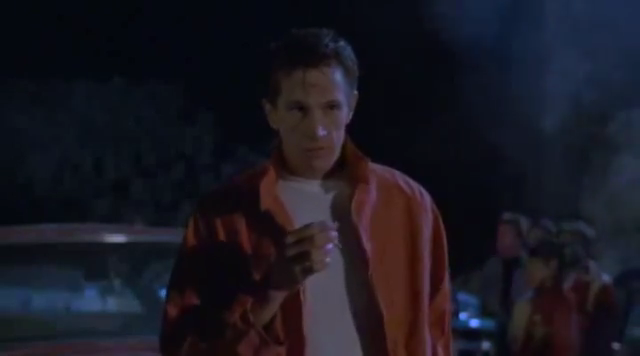
The Heavenly Kid makes the common mistake of most bad movies and that is referencing a much better film – the opening scene is a recreation of the “chicken race” scene in Rebel Without a Cause. This is extremely laughable most due to the fact that three principals are  too old to be playing teenagers.  This is normally the case in most teen comedies, but The Heavenly Kid takes it to ridiculous levels – Lewis Smith and Jane Kaczmarek were in their late twenties at the time, while Mark Metcalf (as Joe Barnes) was pushing forty. It is also odd to be seeing Mark Metcalf recreating the James Dean role (he sports the same red jacket and similar hair cut) considering his penchant for playing overbearing authoritarian figures (Neidermeyer in Animal House and the hard ass father in Twisted Sister’s “We’re Not Gonna Take it” music video).  He is not exactly convincing as a well meaning but deeply misunderstood teenager.   


There are a few clever/funny moments scattered throughout the movie: as mentioned before, the idea of purgatory being an endless subway train ride is funny – especially when Bobby sees a Viking sitting at the back of the compartment; Bobby, while trying to convince Lenny that he is ghost, steps in front of an oncoming semi-truck and then jumps out of the way at the least second, because “I may be dead, but I aint crazy"; and the montage of Lenny trying to impress various women and constantly falling on his ass. These scenes offer a brief glimpse of what The Heavenly Kid might have been had it been done more competently.  Its tone is completely scattershot – it ranges from high drama to stoner humor. 


Cary Medoway’s direction is pretty heavy handed at times.  The most egregious example of this is when Lenny is sulking at party while Sharon merrily dances with two men.  The visual works on its own, but Medoway can’t help himself and must have a 1980s pop song blaring on the soundtrack. The song (“Heartless”) literally serves as a Greek chorus (She’s heartless/colder than ice/ if you’re looking for love/you better think twice).  Then again, it could be that Medoway didn’t trust Gedrick’s performance (Lenny looks constipated for the entire second half of the movie) and needed some insurance just to get the point across. “It’s in the song, people. LISTEN! That’s how Lenny feels! Pay no attention to the actor!”

Credits
Cast: Lewis Smith (Bobby), Jason Gedrick (Lenny Barnes), Jane Kaczmarek (Emily Barnes), Richard Mulligan (Rafferty), Mark Metcalf (Joe Barnes), Nancy Valen (Melissa), Anne Sawyer (Sharon), Beau Dremann (Bill), Stephen Gregory (Fred), Will Knickerbocker (Max).
Director: Cary Medoway
Screenplay: Cary Medoway, Martin Copeland
Running Time: 90 min.

Thursday, December 29, 2016

Godzilla 1985/ Return of Godzilla (1984)


“Now he is back. And he’s more magnificent, more glamorous, more devastating than ever. Prepare yourself. The greatest star of all has returned,” proclaimed the television promo for Godzilla 1985. The last time movie audiences had seen the giant lizard in action was in Terror of Mechagodzilla.  In the original movie, Godzilla was a metaphor for the atomic bomb but, by the time Terror of Mechagodzilla has rolled around, he had become a defender of the Earth. His adventures became increasingly sillier throughout the decades. Return of Godzilla was Toho’s attempt to bring the monster backs to his roots; as a result, the movie is a direct sequel to the original movie and ignores that more kid friendly movies of the 1960s and 1970s.  New World Pictures acquired the rights and distributed it in the states as Godzilla 1985. In order to “Americanize” the movie over twenty minutes of footage was cut, and new scenes with Raymond Burr (reprising his role as reporter Steve Martin from Godzilla, King of the Monsters) were added.  Therefore, it is not surprising that many fans consider Godzilla 1985 to be a complete bastardization of Return of Godzilla. 

This assertion isn’t entirely false – in a fairly dubious piece of re-editing, the Soviet Colonel Kashirin pushes a red button and launches a nuclear missile, while in the original cut he dies trying to prevent it from being launched; it’s fascinating to find a piece of American Cold War propaganda in the middle of a Japanese monster movie. 

 The character arc of the Maki is completely discarded in the New World edit. He begins the movie as an opportunistic reporter looking for the big scoop; when brother and sister, Hiroshi and Naoko, have their tearful reunion, Maki crashes onto the scene with his photographer in tow. It makes for a great human interest story. This reunion has been arranged by Maki; he informs Naoko that her brother is alive and tells her which hospital he is staying at. She, naturally, assumes that Maki is doing this out of the goodness of his heart, rather than for his own ulterior motives.  She later takes him to task for his callous behavior. It clearly has an effect on him, because by movie’s end he is a more compassionate figure.  It is also interesting to note the difference between Japanese and American cinema - if Return of Godzilla was a traditional American blockbuster, the relationship between Maki and Naoko would blossom into a full fledged romance. The movie would end with them locked in a passionate kiss, completely oblivious to the massive destruction that surrounds them. However, the romance is merely hinted at and the only intimate moment the two characters share is a brief hug at the end.


The New World edit also jostles around a few of the scenes; the meeting between Prime Minister Mitamura and the American and Soviet ambassadors happens before Godzilla’s attack on the nuclear power plant, rather than after.  The Prime Minister initially wants to keep Godzilla’s reappearance a secret, but that plan gets shot down after a Soviet submarine is destroyed by Godzilla, and the Russians assume that the Americans are responsible for the act. After it is revealed that Godzilla is responsible for the attack, there is a long debate as whether or not nuclear weapons should be used to stop Godzilla.  This is a crucial plot point in Return of Godzilla, but is only briefly touched upon in Godzilla 1985. There is a scene where the Prime Minister debates this idea with his cabinet before giving his answer to the Russian and America ambassadors.  

However, with all that being said, Return of Godzilla is hardly the masterpiece that many of the fans would have you believe. Maki's character arc is fully realized by the middle of the movie; all attempts at characterizations are abandoned in the second half as Godzilla lays waste to Tokyo.
 
 In a few instances, the editing in Godzilla 1985 is actually better than the Japanese version – the attack of the giant sea louse is great example of this. In Return of Godzilla, the scene is longer and we are given a good look at the sea louse prop and it is pretty laughable. In the New World edit, this scene is fairly brief and we are only given a few  glimpses of the sea louse as it attacks our protagonist – it is a much scarier sequence.  The New World edit is quicker paced and direct to the point – in Godzilla 1985, after Maki reveals to Naoko that her brother is alive, the movie immediately cuts to her running into Hiroshi’s hospital room.  In Return of Godzilla, the conversation between Maki and Naoko is slightly longer, but is fairly redundant.


The added scenes with Steve Martin and the pentagon officials are pointless; Raymond Burr stands around and utters such banalities like, “Godzilla will win.” He is a complete wet blanket and there is really no reason for him to there other than name recognition. At least in Godzilla, King of the Monsters, Steve Martin had the function of narrator - he was an audience surrogate and we saw the events unfold through his eyes.  Still, it is slightly amusing to see Burr reprise a role he played thirty years earlier and under the exact same circumstances.  


As silly as the dubbing in Godzilla 1985 is, it is preferable to the International English version that is on the Return of Godzilla DVD. The dubbing in Godzilla 1985 maybe cartoonish at times, but at least the voice over actors give emotional performances, whereas voice over acting on the International English version is fairly monotonous and actually slows the pacing of the movie. Plus, Godzilla 1985 had some genuinely memorable lines; my favorite is when a wino shouts at Godzilla, “Don’t act like such a big shot, hick, you just got to town. If you want to hang with me, you better learn some manners.” 

It is great that Return of Godzilla is finally available in the United States, but I would like to see a decent print of Godzilla 1985 released on Blu-ray. It may be bastardization, but it is also an interesting relic from the Cold War era.

Credits (for Godzilla (1985)
Cast: Raymond Burr (Steve Martin), Ken Tanaka (Goro Maki), Yasuko Sawaguchi (Naoko Okumura), Yosuke Natsuki (Professor Hayashida), Keiju Kobayashi (Prime Minister Mitamura), Shin Takuma (Hiroshi “Kenny” Okumura), Hiroshi Koizumi (Professor Minami), Kenpachiro Satsuma (Godzilla), Warren J. Kemmerling (General Goodhoe), James Hess (Col. Raschen), Travis Swords (Major McDonough), Eitaro Ozawa (Minister of Finance Kanzaki).
Directors: Koji Hashimoto, R.J. Kizer.
Screenplay:  Shuichi Nagahara, Straw Weisman, Lisa Tomei. Tomoyuki Tanaka (story)
Running Time: 91 min. 103 min (Japanese version)

Friday, December 23, 2016

A Christmas Story (1983)


It has been a tradition in my family to kick off the Holiday season by watching A Christmas Story after finishing Thanksgiving dinner. It’s a movie I have seen countless times since my childhood and it still cracks me up, despite the overexposure. The majority of Christmas movies have a fantasy element to them – It’s a Wonderful Life, A Christmas Carol, White Christmas, and Miracle on 34th Street, to name a few – but A Christmas Story is the most relatable out of the bunch, because it has a fairly simple premise: a boy desperately wants a Red Ryder BB gun for Christmas. The only fantasy elements we get in A Christmas Story are Ralphie's day dreams.

A Christmas Story is one of the most accurate depictions of childhood ever put onto film. The children in Christmas movies tend to be wide eyed innocents that don’t possess a single selfish bone in their body; this is not the case with Ralphie Parker in A Christmas Story, who behaves like complete shithead at times. After Flick has stuck his tongue to a frozen pole, Ralphie leaves him to freeze in the cold. He doesn’t even bother to inform their teacher, Miss Shields, about Flick’s plight. Later, when Ralphie’s mother wants to know who he heard the f--- word from, instead of ratting out his father, he opts to throw his friend Schwartz under the bus. Yet, despite these acts of cowardice, Ralphie remains a completely sympathetic character – he’s just an awkward kid trying to survive childhood.

 A Christmas Story is a funny movie, but the movie is largely about Ralphie learning to cope with disappointment: He is constantly told, “You’ll shoot your eye out,” by the adults in his life when he reveals he wants a BB gun from Christmas; the Little Orphan Annie decoder ring he gets in the mail turns out to be an advertisement for Ovaltine; he gets a C+ on his Christmas theme, after imagining that it would get him a standing ovation from the class; his crazy aunt makes him a pink bunny costume for Christmas;  the Santa Claus at the department store turns out to be a complete maniac; and he nearly shoots his eye out with the Red Ryder BB gun. Ralphie’s most redeemable quality is his ability to shake off the disappointment and get on with his life. It’s fitting that the movie ends with him sleeping in bed with a smile on his face. 

The Parkers are a fairly interesting family because they are neither a perfect nor dysfunctional family unit that you often see on television. They are a fairly normal family, but like most normal families they have their quirks: the youngest son, Randy, refuses to eat; The Old Man is “one of the most feared furnace fighters in northern Indiana”; Ralphie constantly day dreams; and the mother holds the family together, but isn’t above getting into a petty argument with her husband.  The most famous image from A Christmas Story is the leg lamp that the Old Man wins in a contest. He is completely in awe of his “major award,” while the mother is embarrassed by it. When he suggest they put in by the front window (where all the neighbors can see it), the mother begins to freak out. The leg lamp subplot is not only hilarious, but its denouement shows just what an imaginative director Bob Clark could be; the mother leaves the frame to water the plants and then seconds later we hear an off screen crash. The Old Man emerges from the furnace, wondering what the noise was, only to discover that his precious leg lamp is in pieces. The mother claims it was an accident, but the father suspects foul play.  Was it really an accident? Did the mother do it on purpose? We are never given a clear answer, it is left ambiguous. If A Christmas Story were made today, there would, no doubt, be a shot of the mother knocking over the leg lamp and then giving the audience a wink. She would also be played by a “hot” actress, instead of the natural looking Melinda Dillon.

It is interesting to note that Darren McGavin was in his sixties and Melinda Dillon was in her forties when A Christmas Story was released, which makes them the oldest pair of parents in movie history. Yet, this works greatly in the movie’s favor – the movie is told from Ralphie’s point of view and children tend to view their parents as being old timers. When I was a kid, I thought anyone over the age of thirty was ancient. How times have changed! The great thing about the parents in A Christmas Story is that, despite their squabbles, they still enjoy each other's company – the movie ends with her sitting on his lap in the living room as they watch the snowfall.


This leads me to my final point: What happened to Bob Clark after A Christmas Story? It’s like there are two Bob Clarks; pre-Christmas Story and post-Christmas Story. The pre-Christmas Story Clark made a series of flawed, but interesting movies: Black Christmas is an unsettling precursor to Halloween; Murder by Decree is an eerie Sherlock Holmes thriller; and Porky’s is a better than average sex comedy. His filmography after A Christmas Story is absolutely horrendous; the nadir probably being Superbabies: Baby Geniuses 2.  His early movies showed a director with great promise, while his later projects make you wonder, “How does this guy keep getting work?” It is an absolute shame. Well, at least he will always have A Christmas Story.

Cast: Melinda Dillon (Mother Parker), Darren McGavin (The Old Man Parker), Peter Billingsley (Ralphie), Ian Petrella (Randy), Scott Schwartz (Flick), Tedde Moore (Miss Shields), R.D. Robb (Schwartz), Zack Ward (Scut Farkus), Yano Anaya (Grover Dill), Jean Shepherd (Ralphie as an adult – voice), Jeff Gillen (Santa Claus).
Director: Bob Clark
Screenplay: Jean Shepherd, Leigh Brown, Bob Clark
Running Time: 95 min.

Snow White's Revenge/Scandal (2024)

  It is difficult to write about Snow White’s Revenge without bringing up the ending, so readers beware, this review will contain spoilers...