Powered By Blogger

Thursday, June 13, 2019

Ed Wood (1994)


Edward D. Wood, Jr. is often regarded as the worst director in cinema history. He might have been destined for obscurity if it wasn’t for the 1980 book “The Golden Turkey Awards” by Harry and Michael Medved.  In their book, Wood was voted the “worst director of all time” and his magnum opus Plan 9 from Outer Space was voted “the worst movie of all time.” This brought Wood new found fame among bad movies aficionados, who eagerly sought out his body of work.  Wood was a fairly interesting character, not only was a bad movie auteur but also – a World War II vet (he survived one of the bloodiest battles in the South Pacific); a writer of lurid pulp novels; a pornographer (after his failed career in Hollywood he relegated himself into making hardcore porn); and a transvestite.  His pseudo-documentary Glen or Glenda is (rightfully) ridiculed for its sheer ineptitude, but it’s also one of the most personal movies ever committed to celluloid – it’s based on Wood’s own struggles to come to terms with his cross dressing.   His movies are genuinely unique, even if they are terrible. He was a true auteur!  It is no wonder that Tim Burton was compelled to tell Ed Wood’s story – he is the ultimate misfit. 


It is important to note that Ed Wood is not your typical Hollywood biopic. It only focuses on a small portion of Wood’s life (1953 – 1959) and completely plays around with the facts – it glosses over Wood’s alcoholism and omits his brief marriage to Norma McCarty. It recreates the behind the scenes of three Wood movies – Glen or Glenda, Bride of the Monster, and Plan 9 from Outer Space – but skips over the making of Jail Bait (which was shot on the same sets as Glen or Glenda).  While most of Wood’s stock company is portrayed in the movie, Lyle Talbot is noticeably absent (even though he appeared in three of Wood’s movies).  

There are also a lot of liberties taken in the storytelling (mostly for comedic effect); in the movie, while making Bride of the Monster, Ed talks Bela Lugosi into wrestling with a rubber octopus in a pond, when in reality it was a stunt double (this is even more obvious in the cleaned up DVD of Bride of the Monster).  There has been a dispute as to how Loretta King was cast in Bride of the Monster – in the movie, Ed mistakenly believes that Loretta has the money to finance the entire production (after she lends him two hundred dollars) and he cast her in the lead out of obligation, while Loretta King claims that she was contacted by Wood, via her agent, and that money was never a factor.  I tend to be believe King’s account of the story, because while filming Bride of the Monster Wood ran out of money and had to briefly shutdown production until he could get financing – so,  if King was cast under false pretenses, then wouldn’t Wood just recast the role once production started up again?  It should be noted that it was Dolores Fuller, Ed Wood’s ex-girlfriend and one time lead actress, who kept pushing this story about Loretta King. Initially, Fuller was supposed to play the heroine in Bride of Monster but Wood eventually cast King in the role.  There is a theory that Wood lied to Fuller about the circumstance of King’s casting in a desperate attempt to let his girlfriend down gently.  “I desperately wanted to cast you in the lead role, baby, but she has all the money.  I need to placate her whims.”  Either way, Fuller’s account of Loretta King is second hand, at best, and is fairly biased towards Ed Wood.   Also, despite what the movie claims, Loretta King was not allergic to water.  


The movie is less of a biography of Wood and more a retelling of his life through a fairy tale lens.  Wood, as played by Johnny Depp, is an enthusiastic, good natured young man who is looking for the big break. He desperately wants to make movies but just can’t seem to get his foot into the door.  He finally gets a chance when he learns that sleazy producer, George Weiss, is making a biography of Christine Jorgenson and Wood manages to convince Weiss he is the man for the job because of his cross dressing history.  Weiss grudgingly hands Wood the assignment and then is dismayed (albeit briefly) that Wood’s script has nothing to do with Christine Jorgenson, but he really doesn’t care too much about the content as long as Wood delivers the movie on time and it makes a profit.  The running gag throughout the movie is that Wood often has to swindle his way into making movies; he’ll do anything because the ends justify the means.  When his landlord tells him that his church is interested in making a series of movies on the apostles, Wood tells him that they should invest their money into a proven genre (science fiction) and then they can use the profits from that film to finance their apostle movies.  He then persuades the church to fund Plan 9 From Outer Space (they later regret the decision after seeing Wood’s absent minded approach to filmmaking).  When they point out all errors in a scene, Wood barks back, “movies are not about the small details, they are about the big picture.”  What is incredible about this scene is that, despite the legitimate criticism of his backers, we find ourselves siding with Wood. The movie does such an excellent job of portraying Wood as an underdog figure that we naturally root for him, despite his lack of talent. 

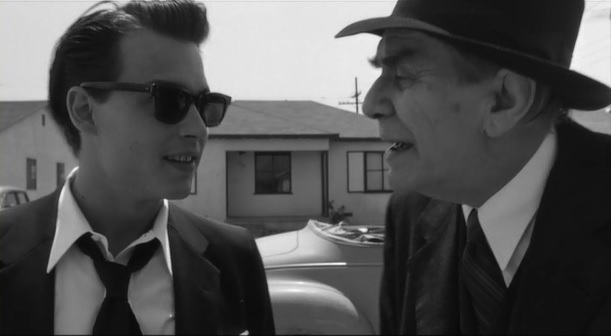
The heart of the movie is the relationship between Ed Wood and Bela Lugosi (wonderfully played by Martin Landau).  There is an interesting dynamic between the two men - Wood is a fairly young man struggling to get into the movie business while Lugosi is washed up movie star who has been forgotten by the industry.  The two of them are kindred spirits despite their age gap.  Wood’s relationship with women is pretty much secondary:  His girlfriend, Dolores Fuller, leaves him midway through the movie and his courtship of Kathy (his second wife) is extremely rushed.  The two of them meet while Bela is in rehab and then Ed Wood woos her at a carnival. 


 Burton really isn’t interesting in this aspect of Wood’s life (probably because it is too conventional for his sensibilities).  The most moving scene in the movie is not when Ed wins over Kathy, but rather when he persuades Bela, hopped up on pain killers, to check into rehab. Up until this scene, the movie was been fairly light hearted, but this scene is extremely nightmarish.  Everything is a state of disarray– Bela’s household is a complete mess and he his babbling incoherently. At one point he pulls out a gun and insists that Ed and him should kill themselves. Ed defuses the situation by calmly talking Bela down and then driving his friend to rehab.  Both of the actors are spot on in their performances – Landau is so good that  you can genuinely feel  Bela’s pain and confusion, and Depp rather effectively underplays the scene - instead of trying to compete with Landau, he basically stands back and gives Landau room to perform. It is a nice give and take between the two talented actors.  This is the rare instance where Ed is the voice of reason. He is clueless most of time, but when it comes to his friendship with Bela he is absolutely committed.  


There is the criticism that Wood exploited Bela Lugosi’s name to further his own career – this view is largely expressed by Bela Lugosi, Jr. in the documentary The Haunted World of Ed Wood.  Lugosi, Jr. views his father’s work with Wood as being the absolute “bottom of the barrel” and a total disgrace to his father’s memory.  In all fairness to Junior, he isn’t wrong – his father’s appearances in Glen or Glenda and Bride of the Monster are huge step down from Dracula, The Black Cat, and, hell, Abbott & Costello Meet Frankenstein. However, what Lugosi, Jr. conveniently overlooks is that his father’s career had already reached the bottom of the barrel long before his association with Ed Wood. The year before Lugosi appeared in Glen or Glenda he starred in a truly execrable comedy called Bela Lugosi Meets a Brooklyn Gorilla  (which featured the second rate comedy duo  Sammy Petrillo and Duke Mitchell – a Martin & Lewis knockoff).  Truth to be told, if you take the time to look at Lugosi’s filmography, you will find that the bad movies greatly outnumber the good ones. While it’s true the Wood movies are bottom of the barrel, it’s a bit disingenuous of Junior to blame Wood for his father’s downfall.

 Did Wood exploit the Lugosi name? Definitely.  Was it sole reason he cast Lugosi in his movies? Definitely not.   While a few curious filmmakers might have been drawn into by Lugosi’s billing on the movie poster, the fact is he wasn’t exactly a major star at this point in his career.  In the 1950s he was pretty much forgotten – it wouldn’t be until the sixties that he would become a cult figure. I believe Wood genuinely cared about Lugosi and did whatever he could to get his friend work – like writing a nonsensical role in the pseudo-documentary Glen or Glenda. I’ m sure having Lugosi as his “star” persuaded investors to fund his movie, but the fact is these roles seem tailor made for Bela (especially the made scientist in Bride of the Monster).  To be honest, other than the Wood pictures, the movies Lugosi made in the 1950s are pretty forgettable.  


There is an interesting parallel between Ed Woods friendship with Bela Lugosi and Tim Burton’s friendship with Vincent Price – they were both fairly young filmmakers who befriended aging horror icons.  Vincent Price did the narration for Burton’s animated short, Vincent, and then later appeared in Edward Scissorhands, while Lugosi spent his final years making movies for Ed Wood.  However, unlike Wood before him, Burton managed to find mainstream success fairly early in his career (his third feature length movie was Batman) and Price never quite reached the bottom of the barrel that Lugosi did.  Lugosi spent most of his career living in the shadow of Dracula, while Price managed to adapt with the times (most people from my generation know him for the rap he did on Michael Jackson’s “Thriller.”) 


Is Edward D. Wood, Jr. truly the worst director of all time? Is Plan 9 from Outer Space the worst movie of all time? My answer is a staunch…..NO!!!!  Granted, it’s this title that made Wood a posthumous celebrity but it’s simply not true.  Sure, Ed Wood’s movies are bad, but they are also fairly watchable.  There is also a nice sincerity about Wood’s movies – he genuinely loved the medium of filmmaking and wanted to tell compelling stories.  Unfortunately, his movies are interesting for all the wrong reasons but at least the passion there.  In all honesty, Wood often displayed some flashes of competence – the nightmare sequence in Glen or Glenda is genuinely creepy and disorienting;  Bela Lugosi is genuinely good in Bride of the Monster; and there a few atmospheric shots of Tor Johnson and Vampira wandering through the cemetery in Plan 9 From Outer Space.  I can think of a few filmmakers that are more deserving of the worst director of all time:  Coleman Francis, Larry Buchanan, Dwain Esper, to name a few.  These filmmakers were in the movie industry for monetary gain and would gladly have given up the craft if they could find an easier way to make money.  There also plenty of movies that are infinitely worse than Plan 9 from Outer Space, I will gladly name a few:  The Creeping Terror, The Beast of Yucca Flats, Manos: The Hands of Fate, Child Bride, Mesa of Lost Women, They Saved Hitler’s Brain, and Larry Buchanan’s entire filmography. Compared to these movies, Plan 9 from Outer Space is a veritable masterpiece.  

 While Ed Wood was a critical success, it was a complete dud at the box office. This isn't too surprising given that the vast majority of movie goers probably have never heard of Ed Wood - his movies appeal to a fairly niche audience. Ed Wood is not only Burton's most personal film, but it also signified the end of his "Golden Era."  Beginning with Pee-Wee's Big Adventure in 1985 and ending with Ed Wood in 1994, Tim Burton had nearly a decade of solid film making under his belt. He was truly a unique movie director - but after the financial failure of Ed Wood his movies became increasingly more inconsistent and, worst of all, forgettable.   He has basically relegated himself to big budget remakes of classic movies and TV shows- with the occasional "personal" film thrown in for good measure.  His newer movies feel less like a personal statement and more like a corporate product meant for mass consumption.  I'm not going to begrudge Tim Burton his success (he absolutely earned it) but it's shame to see a once unique and extremely original filmmaker get swallowed up by the Hollywood system.


Credits
Cast: Johnny Depp (Ed Wood), Martin Landau (Bela Lugosi), Sarah Jessica Parker (Dolores Fuller), Patricia Arquette (Kathy O’ Hara), Bill Murray (Bunny Breckinridge), Jeffrey Jones (Criswell), Lisa Marie (Vampira), George “The Animal” Steele (Tor Johnson), Juliet Landau (Loretta King), Mike Starr (George Weiss), Max Casella (Paul Marco), Brett Hinkley (Conrad Brooks), Clive Rosengren (Ed Reynolds), G.D. Spradlin (Reverend Lemon), Vincent D’ Onofrio (Orson Welles), Ned Bellamy (Dr. Tom Mason), Rance Howard (Old Man McCoy).
Director: Tim Burton
Writers: Scott Alexander, Larry Karaszewski.
Running  time: 126 min.

Thursday, April 11, 2019

Wayne's World (1992)


If you were to ask most people in my age group (I’m 39) what their favorite era of Saturday Night Live was, they would probably answer the early 1990s.  It was an era that, arguably, rivaled the original cast in terms of comedic talent (Phil Hartman, Mike Myers, Dana Carvey, Adam Sandler, Chris Farley, to name a few), many of whom went on the successful movie careers.   When Wayne’s World was released in 1992 it was not just a comedy – it was THE COMEDY! It was endlessly quoted in the classroom (“No way”) and practically everyone I knew owned a VHS copy of it.  A personal antidote:  My sister and I were once watching Wayne’s World on a Saturday, when she received a phone call from a friend ….who was also watching Wayne’s World and practically in sync with our viewing.  What can I say? I grew up in Port Washington, Wisconsin and there is very little to do there. 

There are only two SNL skits that have been successfully adapted into full length movies, The Blues Brothers and Wayne’s World.  The Blues Brothers successfully adapted the SNL skit into a fun musical – comedy, while Wayne’s World is one of the most offbeat movies ever released by a studio.  The premise of this skit revolved around two metal heads, Wayne and Garth, who have a public access show that is filmed in the basement of Wayne’s parents’ house.  The two of them would discuss random topics (“Babe of the week”) and occasionally have a guest star.  It was an incredibly popular skit and it was only inevitable that SNL would try to spin that into a movie.    


The reason Wayne’s World work so well (while SNL comedies have failed) is because it is completely unpredictable to a first time viewer.  Sure, the basic plot line isn’t anything new – Will Wayne and Garth sell out?  A TV producer, Benjamin, buys the rights to their TV show for ten thousand dollars and then proceeds to make it more commercial friendly. In their contract, it is stipulated that the boys must give their sponsor – Noah Vanderhoff, the owner of an arcade chain – a weekly spot on their television show.  Wayne is annoyed by this, even though he signed the contract, and rebels by making fun of Noah during the first televised show – he writes insults on the back of the question cards he read offs, while Noah remains oblivious to the whole thing.  This doesn’t sit well with Benjamin, who then fires Wayne for his insubordination.  To make matters even worse, Benjamin also has his sights set on Wayne’s girlfriend, Cassandra.  It’s now up to Wayne and Garth to save their show, and Cassandra, from Benjamin’s slimy grip.  

The opening to a movie is extremely important; it‘s when the audience decides whether or not they want to continue watching the story.  In my humble opinion Wayne’s World has one the strongest openings of all time, because it perfectly sets up the characters. The movie opens with Benjamin and an attractive woman in bed together, watching television.  The woman flips through the channels and then stumbles up “Wayne’s World.”  She tells Benjamin that this show is popular with the local youth and this gives Benjamin an idea. He calls up his assistant and arranges a meeting for Noah Vanderhoff.  This short scene not only sets up the plot, but it gives us a nice look into Benjamin’s character – while his girlfriend views “Wayne’s World” as light entertainment, Benjamin sees it as a potential property that he can exploit.  Even in the midst of love making, he still can’t shake off his business like attitude. Having gotten that little bit of exposition out of the way, the movie then cuts to Wayne and Garth, and we spend the next twenty minutes seeing the world through their eyes. Wayne and Garth, like most of the working class, absolutely live for the weekend.  After they have finished their Friday show, they then go about their usual Friday night ritual – they drive around town (while head banging to “Bohemian Rhapsody), stop by the local doughnut shop where they interact with the locals, and then finally hang out at their favorite club, Gasworks, where all the local heavy metal bands play.   


The reason why Wayne’s World resonated with a young audience is that it is completely relatable – this is essentially what most high school and college students do on the weekends.  Even more refreshingly, this way of life is portrayed in an affectionate, irony free manner. When Wayne and Garth are hanging out at Gasworks, there is never an instance where the filmmakers feel they are above this type of setting. The main reason, I believe, for this affectionate portrayal is that director Penelope Spheeris was no stranger to the heavy metal scene; in fact, she made a series of documentaries about the subject (The Decline of Western Civilization trilogy).  She was extremely familiar with the types of characters that are depicted onscreen during the Gasworks segments.   If someone like Tina Fey would have made Wayne’s World, it would have been  dripping with condescension – in Fey’s version Benjamin would be the eye rolling protagonists who is too sophisticated for places like Gasworks. Wayne’s World was made in an era when Hollywood still had an affinity for the working class instead of the contempt that has taken over the industry in modern times. 

There is an interesting dynamic between Wayne and Garth – by default, Wayne is the more “adult” of the two. Wayne is fairly immature but he can interact in social and even business settings.  Cassandra maybe out of Wayne’s league but that doesn’t dissuade him from asking her out. He still harbors some guilt over his obsessive  ex-girlfriend Stacy, who stalks him relentlessly but doesn’t allow it to derail his life.  When he does realize that Benjamin is exploiting his intellectual property, Wayne does take a stand (albeit in very juvenile way) and gets fired for his insubordination.  Garth has a childlike innocence about him and can hardly function whenever Wayne isn’t around; on the rare occasion when Benjamin attempts to talk to Garth alone it proves to be extremely awkward.  While Wayne has enough confidence to ask Cassandra out, Garth is crippled by his shyness – he has a crush on an attractive blonde woman but he can’t build up the courage to talk to her.  Garth views the world in a childish manner; at one point he asks Wayne if he ever was attracted to Bugs Bunny in drag. Wayne, naturally, laughs at the question, but it is clear that Garth is serious.  

Wayne is also fairly self centered in regards to Garth, when he gets fired/walks out on the show, it never occurs to him how it will affect Garth.  Even though the show is called “Wayne’s World,” Benjamin decides to carry on without the star and Garth is left all alone on set, and has a near meltdown on the air.  Garth calls Wayne out over his selfish behavior but Wayne doesn’t want to hear any of it and walks away.  However, like all solid friendships the two of them bury the hatchet and then come up with a plan that will not only get their show back but will help out Cassandra, as well.  Their plan is to do a show from their basement, have Cassandra perform a few numbers, and hope that it will get her band signed to a major record label.  They do have an ace in the hole – their going to use satellites to redirect the TV signal into the limo of a major record producer, Frankie Sharpe. Thankfully, Sharp’s bodyguard (whom they met at the Alice Cooper concert) gave them all the required information regarding his boss.  Other than the whole “plotting to get their show back” I think most people can relate to this friendship – we’ve all been there before.  


This plot is basically just a frame work for Mike Myers to hang some crazy ideas on.   It is a movie that sets up certain tropes (Wayne falling in love with a girl) and then turns them on their heard.  For instance, practically every romantic comedy has a scene where they two leads bond – it can either be charming or cringe worthy depending on the talent involved.  Myers gets passed this stumbling block by having Wayne and his love interest, rock goddess Cassandra, talking in Cantonese (her native language) while subtitles appear onscreen to translate what they are saying to each other.   This scene is not only funny, but it is also pretty convincing – Cassandra is charmed that Wayne took the time to learn her native language and instantly connects with him. Wayne’s first interaction with her was a bit awkward, so he makes an actual effort to impress her the second time around.   This is one of the aspects I like about Wayne’s World; he actually has to work to get the girl of his dreams.  In their first scene together, Wayne is completely transfixed by her but she kind of just brushes him off.  She recognizes him from his public access TV show but she is more concerned about getting money from her manager and doesn’t have time to chat. Yet, rather than be demoralized by this failed interaction, Wayne becomes more determined to win Cassandra over, so he takes the time to learn her native language.  Even though Wayne’s World is a silly comedy, these tiny detail gives it an air of credibility.  


 The funniest moment is when Wayne and Garth go backstage to meet Alice Cooper.  A lesser movie would have our heroes taking part in a wild party; instead the scene quickly turns into Alice Cooper giving a lecture on the history of Milwaukee. Wayne asks Alice Cooper if he comes to Milwaukee often and the rock legend goes on fact filled rant about the city.  Wayne and Garth can only stare on awkwardly; what else can they do in this situation? 

As teenager, it is easy to loathe the character of Benjamin. He is, after all, a yuppie prick who wants to ruin the “purity” of Wayne’s public access show.  His attempts to commercialize it are also a bit extreme - he gives it a more polished theme song (instead of Wayne and Garth rocking in the basement) and even gets an announcer; Wayne and Garth are completely taken aback by both of these additions.  It is also true that he insists that they give a weekly spot to their sponsor, but other than that they are still allowed to create the content they like.  In modern day terms it would be on par with a Youtuber deciding on whether or not they want to monetize their video by running ads.  As annoying as these ads might be, they permit the Youtuber to keep on creating the content they want (provided they are not flagged, or demonetized for political reasons).  As annoying as it is for Wayne and Garth to give Noah a spot on their show, it is his sponsorship that allows for them to create whatever content their heart desires (provided their show isn’t cancelled). Sure, it is kind of loathsome that Benjamin attempts to steal Cassandra for Wayne, but let’s not forget that it’s only because Wayne vouches for him in the first place that she gives Benjamin the time of day.  When Benjamin approaches Cassandra about producing a music video for her band, she is extremely skeptical. It’s only after her talk with Wayne, and Wayne giving Benjamin his seal of approval, that Cassandra goes through with the deal


It is not so much morality as it personal philosophies  that separate Wayne and Benjamin - Wayne views “Wayne’s World” as his baby, while Benjamin sees it only as a product to make money off of. When Wayne was producing the show from his parents basement he didn’t really have to worry about expenses or ratings (it was public access, after all) and even as the star of a local television show, he still doesn’t have to worry about these things. Benjamin, on the other hand, is the one that has to worry about the finances and keeping the sponsor happy. If Noah pulls his sponsorship, then everyone is out of a job.  Basically, Benjamin is the one that has to assure everything runs smoothly and if an employee fails at their job, well he has no choice but to let them go.  Again, this is something I have only recently considered.  

In his review of the film, Leonard Maltin described Rob Lowe’s performance as “dull.” However, I think that is the point. Benjamin isn’t really a villain; he is just an ambitious young man.  He is completely at home when it comes to boardroom meetings and other business settings, but is at a loss when it comes to dealing with the common man.  He sticks out like sore thumb at the local club Wayne and Garth hang out at. After Cassandra has finished performing her set, Benjamin tells her multiple that her music was great. This is a world that is completely foreign to him and he comes off as a total square.  In the more comfy settings of his lavish penthouse, he is able to impress Cassandra with his knowledge of China and other subjects; this entire exchange makes Wayne feel rather insecure.  

It also helps that Tia Carrere is absolutely credible as a rock goddess.  This may seem like a small thing, but there are many movie actress who, while they have a strong screen presence, are absolutely lacking when it comes to stage presence. In her rock n’ roll numbers, Carrere absolutely owns the stage (and screen).  She has an extremely lively presence and her renditions of classics like Jimi Hendrix’s “Let Me Stand Next to Your Fire” and Sweet’s “Ballroom Blitz” are fun and energetic.  Just compare Carrere’s stage presence to that of Justine Bateman and Julia Roberts in the bland rock comedy, Satisfaction, and you will notice a huge disparity. Their song numbers are completely stiff and awkward.  They wouldn’t even make it as karaoke singers, let alone a full fledged rock band.  Carrere has no such hangs up (probably because she is trained singer) and projects confidence whenever she is called to sing.  The nice thing about Cassandra is that  she doesn’t tolerate anyone’s bullshit – when Wayne hints that her video shoot is result her sleeping with Benjamin, she rightfully takes offense and kicks him out.  Later when it becomes abundantly clear to her that Benjamin is making a pass at her, she walks out on him and takes a roll of the dice with Wayne (even though Benjamin is the “sure thing.”)  While Wayne and Garth are the focus of the story, it is refreshing to see that Cassandra maintains her independent spirit.  She loves Wayne, but also has a life of her own.  It is also nice that Wayne realizes he’s done wrong by her and wants to make it up to her  – even if it comes in form of a convoluted plan that has a small chance of succeeding.


What has become of the mainstream comedy? The last time a full fledged, live action comedy cracked the yearly top 10 box office was in 2012 (Seth MacFarlane’s Ted).  Sadly, the current cinematic landscape has been littered with so many super hero movies and franchise reboots that original comedies have been pretty much sideline by the studios.  In 1992, four of the year's top ten grosser were live action comedies (Home Alone 2, Sister Act, Wayne’s World, and A League of Their Own), while the only super hero movie in the mix was Tim Burton’s underrated Batman Returns.  Boy, have the times changed!

Credits
Cast: Mike Myers (Wayne), Dana Carvey (Garth), Tia Carrere (Cassandra), Rob Lowe (Benjamin), Brian Doyle – Murray (Noah Vanderhoff), Kurt Fuller (Russell), Colleen Camp (Mrs. Vanderhoff), Lara Flynn Boyle (Stacy), Michael DeLuise (Alan), Dan Bell (Neil), Lee Tergesen (Terry), Sean Sullivan (Phil), Donna Dixon (Dream woman), Frederick Coffin (Officer Koharski), Meat Loaf (Tiny), Chris Farley (Security Guard), Alice Cooper (Himself), Mike Hagerty (Davy), Ione Skye (Elyse), Ed O’ Neill (Glen – Mikita’s Manager), Frank DiLeo (Frankie ‘Mr. Big’ Sharp), Robert Patrick (Bad Cop).
Director: Penelope Spheeris
Screenplay: Mike Myers, Bonnie Turner, Terry Turner.
Running Time:  95 min.

Tuesday, January 8, 2019

National Lampoon's Christmas Vacation (1989)


I initially planned on having this review up before Christmas but it was delayed a bit by computer problems, family get togethers, and my full time job. In case you were wondering why I'm reviewing a Christmas movie in early January, well...those are the reasons. I hope you enjoy.

It has been a long standing Christmas tradition in my family to sit down and watch the great Christmas movies: It’s a Wonderful Life, A Christmas Carol (1938 version), White Christmas, A Christmas Story, Miracle on 34th Street (the original, obviously), and last, but certainly not least, National Lampoon’s Christmas Vacation.  Of course, out of the movies I just listed Christmas Vacation is obviously the odd man out.  First, it is the third entry in the popular Vacation series, while the other movies listed are stand alone films. White Christmas is a semi-remake of Holiday Inn, but the story is significantly different than the earlier movie.  Second, it easily the crudest out of three (it is loaded with gross out and sexual humor). It maybe the only Christmas the features a woman (albeit imaginary) doing a slow striptease while “Mele Kalikimaka” is playing on the soundtrack.  It is also a bit cartoonish at times; especially when the Griswold family is attacked by a manic squirrel.  It is one of the most unusual Christmas movies ever made, yet it isn’t as far removed from your more “traditional” Christmas movie as it first seems. 

If you grew up in the 1980s, then there is a good chance that you were familiar with the Griswold family. They were featured in three movies (Vegas Vacation was released in 1997) with varying degrees of success; European Vacation is often regarded as the worst out of three. Though, I have a soft spot for it as it was the movie that introduced me to the Griswolds.  In each movie, the well meaning but bumbling patriarch Clark Griswold would obsess over planning the perfect vacation for his family and then watch helplessly as it turned disastrous.  Yet, despite the damage that Clark wreaked upon the world, Griswold family always survived the ordeal.  


It is impossible to imagine anyone else in the role of Clark Griswold other than Chevy Chase. It was a part that he was born to play (it’s no wonder that he kept returning to the role).  On his brief stint on Saturday Night Live, Chase was known for his physical comedy (and for being extremely difficult to work with it) and it serves him well in the Vacation series.  However, what makes Clark Griswold such an endearing character is the sincerity that Chase brings to the role. Sure, he is great when it comes to doing comedic pratfalls, but Chase does fairly well when the script veers more to the sentimental.  There is a nice moment in Christmas Vacation when Clark reassures Ruby Sue, the daughter of Eddie and Catherine (Ellen’s cousins), that she will be getting presents for Christmas this year.  He genuinely wants to give this little girl, and her brother, a memorable Christmas and even buys her gifts.  


Clark is a genuinely interesting character in his own right; one moment can be the most compassionate guy on the planet and then in the next he can be extremely rude and vulgar.  When his next door neighbor Todd asks where Clark is going to put his oversized Christmas tree.  Clark responds, “Bend over and I’ll show you.”  While Clark is a genuine family man that doesn’t stop him from flirting with the attractive sales girl, Mary, at the lingerie shop.  In fact, the whole exchange with Mary is so uncomfortable to watch because Clark acts like a total jackass.  He constantly stumbles over his words and makes all sorts of Freudian slips.  At one point he says, “There is a nipple in the air…” and then has to correct himself.  There is also a child like quality to Clark; he gleefully coats his sled with a kitchen lubricant (that his company has been working) to make the surface more slippy and then screams in terror as it flies down the hillside at a supersonic speed.  He is a man of many contradictions, but there’s no denying that he has a big heart. 

Because Chevy Chase dominates the movie with his comedic presence it is easy to overlook Beverly D’Angelo’s performance as Ellen Griswold – Clark’s devoted wife.  Of course, I’m stating the obvious when I say that Chevy Chase and Beverly D’ Angelo have remarkable onscreen chemistry; they are easily one of the most believable onscreen couples in movie history.  Therefore, it’s not surprising that there was a movie series centered on them.  Even though Clark is bumbling buffoon at times, it easy to understand why Ellen is attracted to him. His good natured persona and devotion to his family is an endearing quality.  It also speaks volumes about D’Angelo that she can hold her own against Chevy Chase.  Sure, Chase is given some of the more memorable lines, but D’Angelo is able to breathe life in what could have easily been an underwritten character.  In fact, there are some nice subtle bits of comedy provided by D’Angelo that you probably won’t catch in the first viewing; Ellen trying to hold back her laughter when her mother complains about her hemorrhoids; when the family is eating the Christmas dinner, Ellen lifts a fork of dried up turkey to her mouth, quickly flicks it off her the fork, and mimes like she is chewing on the turkey; when the police tell the family to freeze, Ellen places her hand directly on Clark’s crotch and keeps it there for most of the scene.   
She is also has one of the film’s funniest lines - when Audrey complains about having to share a bed with her brother (to accommodate the grandparents), Ellen replies, “Don’t be so dramatic.  I’m sleeping with your father.” 


If you are familiar with the Vacation series, then you know the Griswold children, Audrey and Rusty, are played by different actors in each individual movie.  For my money Vacation (the first movie in the series) has the best Audrey and Rusty (played by Dana Barron and Anthony Michael Hall). They are far more naturalistic than their successors and often behave like siblings.  There’s a scene in Vacation where Audrey and Rusty, while sitting in the backseat of the car, keep trying to wind each other up – there are simultaneous amused and disgusted by what the other sibling is doing.  It’s a very believable moment anyone who has been trapped in the back of the car with their sibling for a long period of time.  European Vacation easily has the worst Audrey and Rusty in the series; Dana Hill and Jason Lively are more annoying than they are funny.  Vegas Vacation has probably the second best Audrey and Rusty in the series.  Marisol Nichols and Ethan Embry are decent actors, and are given a few funny moments to shine. In Christmas Vacation Audrey and Rusty are played by Juliette Lewis and Johnny Galecki.  Both actors went on to have pretty significant careers and decent in the roles. The problem is that Audrey and Rusty are fairly insignificant to the actual plot.  Christmas Vacation has the biggest cast out of all the Vacation movies, which means Audrey and Rusty are pretty much pushed to sideline to make for the more eccentric characters.    


This leads me to my least favorite aspect of the Vacation series….

RANDY QUAID AS UNCLE EDDIE! I am not at all a fan of Uncle Eddie, as I find Randy Quaid’s performance to be extremely one note.  In the first movie, Uncle Eddie’s screen time is limited to a couple of minutes and, hence, he is much more tolerable.  Unfortunately, in Christmas Vacation his role is significantly increased and within ten minutes he already wears out his welcome (though, it does make Clark’s frustration even more relatable).  It’s not only Quaid’s performance that annoys me, it’s the fact that once Eddie arrives on the scene, the movie begins to resort to gross out humor; the most obvious example is when Eddie is draining the raw sewage from his RV into a storm drain. The only part I find Eddie amusing is when he’s wearing a black dickey underneath his white sweater.  


Thankfully, once Aunt Bethany and Uncle Lewis arrive on the scene, Uncle Eddy gets sideline for a little bit. Aunt Bethany is Clark’s old, senile aunt and Lewis is his crotchety old Uncle.  Granted, Mae Questel (as Aunt Bethany) and William Hickey (as Uncle Lewis) also give fairly one note performances but the filmmakers know when to use them; it isn’t until the start of the third act that they make their first appearance (though Uncle Lewis is briefly scene in Clark’s home movies).   Whether it’s Bethany reciting the Pledge of Allegiance at the dinner table (after Clark asks her to say grace), or Uncle Lewis accidentally burning down Clark’s Christmas tree, they are genuinely hilarious addition to the Griswold family.   I first saw Christmas Vacation in theatres when I was ten years old (winter of 1989) and I vividly recall my cousin Tom turning towards me every few minutes and trying to predict what would happen next.  He was wrong most of the time, but accurate predicted that Uncle Lewis would burn down the tree. What the moment did happen, we busted out laughing and I complimented him on his clairvoyance.  


Nicholas Guest and Julia Louis – Dreyfus also offer a couple laughs as Clark’s yuppie next door neighbors, Todd and Margo.  It’s interesting how these two characters work on two different levels;  on one hand it is extremely fun to see these two pretentious snobs get knocked down a few pegs (especially when Clark silences the condescending Todd with crude, sexual remark), while on the other hand it’s easy to sympathize with utter contempt they have towards Clark.  The biggest crime they commit in the movie is that they’re a bit snobbish; otherwise they are essentially minding their own business.  They want to enjoy a nice intimate dinner together; instead they become collateral damage in Clark’s obsession to have the perfect Christmas.  By the movie’s end their house has sustained significant damage, Margo is in tatters (after having being attacked by a demented squirrel and Eddie’s dog), and their marriage is in ruins (the extremely frustrated Margo punches the passive Todd square in the jaw). This is very much in the tradition of the Slobs vs. Snobs comedies that began with Animal House.  The snobs always dealt a pretty harsh punishment, even though the slobs (the underdogs) are really no better and are, in many ways, worse.  I recently watched Animal House and it occurred to me that Dean Wormer is one hundred percent correct about Delta House.  They are far more interested in partying than in academics and deserve to be expelled from the campus.  The only reason we despise Dean Wormer is because he is a crusty, middle aged man. Imagine how different the movie would be if he were more compassionate; we would despise the Deltas for taking advantage of kind man. Wormer is given a fairly harsh judgment that he doesn’t deserve.   The same applies to Todd and Margo; they don’t deserve the punishment that is meted out to them even if they are “snobs.”  


There are two themes that Christmas Vacation shares with most Christmas movies: family and redemption.  The Griswold’s are a tad bit dysfunctional at times and often get on each nerve, but are a strong enough unit that they can overcome what ever disaster is thrown their way.  Clark may go overboard at times, but Ellen, and his children, knows it is done with the best intentions. Even though the Christmas starts off disastrous, it ends on a positive note – everyone is together and enjoying themselves.  Clark has achieved his goal of creating a memorable Christmas.  Christmas Vacation knows when to sprinkle in the sentiment - not surprising, given that it was written by John Hughes.  After the night has been a complete disaster (ending when Uncle Eddie's dogs chasing a demented squirrel through the house) Clark lashes out at the family for wanting to leave and then storms into another room to brood for a little bit. He is then confronted by his father, who gives Clark a heart to heart chat; rather than berating his son for ruining Christmas, he encourages Clark to make things right by reading "The Night Before Christmas" to the family. It is an nice moment that is played to perfect by Chevy Chase and John Randolph, who has an extremely warm vibe about him.

The theme redemption comes in the form of Clark's miserly boss, Mr. Shirley. Clark has spent most of the movie waiting for his Christmas bonus to arrive in the mail;  he wants to put a swimming pool in the front yard and had to put on down payment on it even though there wasn't enough in his checking account to cover the amount.  His Christmas bonus will be able to cover the amount. After the Christmas dinner has been a complete disaster, Clark's luck seems to change for the better when a carrier arrives with his long awaited Christmas bonus. Clark shares his plans with the rest of the family and then opens the enveloped.....only to find that there is no Christmas bonus, instead he has been enrolled in "The Jelly of the Month Club." Clark naturally blows his caskets and goes on a profanity laden rant - Clark basically says that he could have his boss standing in front of him right, so he could give Mr. Shirley a piece of his mind.  Cousin Eddie takes this literally and abducts Mr. Shirley from his mansion and brings him back to Clark's house.  Clark tries to apologize, but Mr. Shirley fires him any and wants to call the police. However, Clark makes Mr. Shirley see the error of ways when he points out this wouldn't have happened Mr. Shirley not cut the Christmas bonuses. It's fine that Mr. Shirley doesn't want to give out bonuses, but he could have at least given his employee's a heads up and instead of blind siding them with an enrollment in a "Jelly of the Month Club." Mr. Shirley, after witnessing the consequences of his actions first hand, has a change of heart and reinstates the Christmas bonus.   


It can be argued that this scene is pretty contrived (and unrealistic) but it works extremely well in this narrative. It also gets a huge boast from Brian Doyle Murray who is able to convey so much emotions with just a simple glance.  The real point of this scene, however, is to show unity in the Griswold family - this is the first time in the entire movie that everyone in complete solidarity with Clark, including his abrasive father-in-law, Art. In fact, the movie specifically cuts to a shot of Art standing up to show his support for his son-in-law. We find similar endings in other Christmas classics:  the community rallying around George Bailey in It's a Wonderful Life; General Waverly's old Division showing up at the holiday inn to show their support, in White Christmas; and most famously, Tiny Tim wishing, "God Bless us, everyone" at the end of A Christmas Carol.  I'm sure there are many people out there they find this stuff "corny." I could just picture younger audiences rolling their eyes at Mr. Shirley's "little people" speech. That's they're opinion and they're entitle, but as for me -  I'll take a fun "corny: movie over a "bad ass" one any day of the week. 

Credits
Cast:  Chevy Chase (Clark Griswold), Beverly D’Angelo (Ellen Griswold), Juliette Lewis (Audrey Griswold), Johnny Galecki (Rusty Griswold), John Randolph (Clark, Sr.), Dianne Ladd (Nora), E.G. Marshall (Art), Doris Roberts (Francis), Randy Quaid (Cousin Eddie), Miriam Flynn (Cousin Catherine), Ellen Hamilton Latzen (Ruby Sue), Cody Burger (Rocky), William Hickey (Lewis), Mae Questel (Bethany), Brian Doyle Murray (Frank Shirley), Julia Louis – Dreyfus (Margo), Nicholas Guest (Todd), Sam McMurray (Bill), Nicolette Scorsese (Mary), Natajlia Nogulich (Mrs. Shirley).
Director:  Jeremiah S. Chechik
Writer: John Hughes
Running Time: 97 min.


Snow White's Revenge/Scandal (2024)

  It is difficult to write about Snow White’s Revenge without bringing up the ending, so readers beware, this review will contain spoilers...