Powered By Blogger

Thursday, August 14, 2014

Humanoids from the Deep (1980)


Humanoids from the Deep is absolute garbage. It is completely unapologetic for what it is that you will either find it absolutely repugnant, or be greatly amused by it. If you have a weak stomach, then this is definitely not the movie for you.  The plot centers around half man, half fish mutations that terrorize a small fishing community; their M.O. is to kill the men and rape the women. It is, essentially, a sleazier version of The Creature from the Black Lagoon; the humanoids act out what the Gill Man could only imagine. Logically speaking, the storyline makes absolutely no sense, but this is a Roger Corman production, therefore, he had to find a way to shoe horn in gratuitous sex and violence some how. The director, Barbara Peeters, and co-star, Ann Turkel, publicly disowned the movie after witnessing all the additions (nudity and violence) Corman had ordered.


In fact, it is fairly easy to differentiate between the footage shot by Peeters and the footage that was added during post production; in one truly bizarre scene, a couple are camping out on the beach in a tent. It turns out that the male is a ventriloquist and is speaking to his curvaceous girlfriend through his dummy, throwing all sorts of terrible puns her way ("Would you like to see my wood?")  The girlfriend is completely turned on by this and sheds all her clothes, but before they can engage in some sweet whoopee, a humanoid tears through the tent, kills the ventriloquist, and rapes the poor woman.  There are even a few odd cutaway shots of the dummy reacting to the all the mayhem.


What the hell? This was an obvious addition; these characters don't appear in any of the previous scenes, nor does the movie provide us with the follow up. There is no scene in which the main character, Jim Hill, and Dr. Susan Drake stumbles upon their remains, nor do any of the townsfolk inquire about their whereabouts. 

Here are a just a few observations I made about Humanoids from the Deep, both good and bad (SPOILERS):

1) The first death in the movie is a young boy, Jackie; who happens to fall into the water while trying to help his father reel in (what they believe to be) a fish. This directly recalls the death of  young boy, Alex Kinter, in Jaw. However, the difference between the two is that Alex's death in Jaws had a narrative function while Jackie's death is purely for shock value; it doesn't drive the story in any way and is quickly forgotten about.

2)  Humanoids from the Deep seems to take a lot of its cues from Halloween, especially in the use of the POV shot. There are a whole bunch of these scattered throughout the film. The POV shot is first utilized in the film to show that someone/something is spying on the vacuous blonde, Perry Larson (clad in a negligee). This leads to a false scare (one of many); Perry is startled by a noise from outside and goes to investigate (she grabs a two pronged fork for protection), JUST THEN....her boyfriend, Jerry, jumps into the frame. Jerry must have ninja training, because he is able to sneak up behind her without making a noise.  This gag gets repeated later on in the movie, when Perry and Jerry are playing around in the water, and Jerry disappears underneath the waves. Has he been pulled under by the humanoids? Perry begins to worry, but just then he springs up from the water.  Of course, anyone familiar with horror films knows that practical jokers, like Jerry, never make it to the end; after having his cheap laugh, Jerry is grabbed by a humanoid and has half his face torn off. It is a truly grisly end. Perry tries to run for help, but to no avail. However, she survives this traumatic ordeal and is later revealed to be pregnant.

3) The movie's main subplot concerns the building of a cannery in the town that will, supposedly, bring about more jobs to the community. This is greeted with enthusiasm by most of the locals, except Johnny Eagle (Anthony Pena), a Native American, who feels that the cannery is not only a violation of nature, but a treaty that was signed between his people and the white man years ago. He threatens to take legal action on the matter, which doesn't sit well with local fisherman, Hank Slattery (Vic Morrow), and his cronies. Hank tries to strong arm Johnny into changing his mind; even going so far as throwing a Molotov cocktail at Johnny's house. Naturally, it's only a matter of time before Hank meets his comeuppance at the claws of a humanoid. NOPE! In any interesting twist, Hank not only survives the blood fest, but actually redeems himself as well; he risks his life to save a little girl that is in peril. It looks like he's going to come to a bloody end, when a humanoid grabs his ankle and he is saved.....by Johnny Eagle.  In most movies, Hank would prove himself a coward and abandon the little girl, instead he behaves in a rather honorable manner. It's interesting that an exploitation film would actually take the time to give its main (human) villain a character arc.


4) I don't know what it is, but I find Doug McClure to be an extremely likable actor. He is rather credible as Jim Hill,  a local fisherman who is desperately trying to find a solution to the problem at hand. His sincere, straight forward performance gives this movie a huge boost; if Humanoids of the Deep were made today, it would be done in a tongue in cheek manner, with the cast constantly mugging it up for the cameras (see Sharknado). Sure, Humanoids from the Deep has an incredibly ridiculous premise, but having a pro like McClure brings an air of credibility to the proceedings.
McClure was a fixture in cheesy 1970s science fiction movies, appearing in such titles like The Land That Time Forgot, Warlords of Atlantis, and At The Earth's Core. Though, to people in my generation, he is probably best known for his portrayal as Kyle Applegate, the dimwitted mayor, in the TV show, Out of this World. 


5) The town is holding its annual carnival on the docks and prominently on display is the local beauty queen, Miss Salmon (clad in a bikini), who is accompanied by an annoying radio announcer. The movie constantly keeps cutting to Miss Salmon throughout all the chaos that ensues at the end (the humanoids bust out from under the docks and start attacking the townspeople) that we naturally assume she is a goner, especially when she loses her bikini top while being cornered by one of the monsters. Yet, once again, the movie defies our expectations by having Miss Salmon hurl bricks at the creature's head;  she not only inflicts significant damage on the monster, but escapes as well. It should also noted that Miss Salmon is played by Linda Shayne, who went on to write and co-star in 1983 sex comedy Screwballs. 


6) Humanoids from the Deep has often been labeled misogynistic by critics and its original director. This criticism is quite understandably given the nudity on display and the whole "raping the woman" subplot. While it's interesting to see Miss Salmon using her wits to escape the clutches of the title monster, the scene could still be construed as sexist given the fact that she is topless, which leads to a lot of bouncing while fighting off the creature. It's not exactly a ringing endorsement for feminism! Yet, the film's detractors (there are plenty) often overlook the scene that follows, for it completely subverts the horror conventions of the time.
Jim's wife, Carol, is all alone in the house with their baby, when one of the humanoids appears outside the living room window. Carol grabs the baby and hides it in a safe place; the closet. The only weapon she has at her disposal is a butcher's knife. The monster smashes through the front door and corners Carol in the kitchen.  This type of of scene has been played out many times, even in non-horror movies, and we naturally expect Jim to arrive just in the nick of time to save Carol. In John Carpenter's Halloween, Dr. Loomis arrives just in the nick of time to save Laurie from the death grip of Michael Myers, so it's only a given Jim will barge in the house and blast the monsters into a million pieces.  However, this doesn't happen!  It looks like it is curtains for Carol, when she grabs a bottle of dish soap and squirts it in the monster's eyes. This temporarily blinds the monster and Carol wastes no time hacking it to pieces with the knife. It's an interesting scene, because Carol is an average woman using her intelligence to take down a much stronger foe. Again, if Humanoids were made today, there would  be a scene that establishes Carol as being a complete bad ass, hence her taking down one of the monsters wouldn't be a surprise. Carol, on the other hand, is a house wife protecting her child from an outside menace; she uses whatever is at her disposal to take down the slimy intruder. This moment is even more surprising given the fact that Carol isn't even the main female in the story; that would be Dr. Susan Drake. 

7) My favorite moment in the movie is when townspeople realize that they greatly outnumber the humanoids and begin to turn the tables on their tormentors; in a long, high angle shot, we are shown a humanoid surrounded by group of burly men. After a moment hesitation, they gang up on the monster and kick the living crap out of it. It's a rather amusing moment. It must be said that, for a low budget movie, the make up effects, by Rob Bottin, are extremely well done. The humanoids are genuinely scary at times, especially when they are kept in the shadows.  Rob Bottin would go onto bigger and better things like The Howling and The Thing. 
.

The term "acquired taste" was invented for movies like Humanoids for the Deep. It's really hard to defend a movie like this, but then again, the movie never asks for a defense, it is what it is. It's a cheap piece of exploitation that exists solely to make a quick buck; it has absolutely zero artistic pretenses. It's the cinematic equivalent of junk food, particularly Doritos - it's not good for you and can often make you sick, but it's addictive nonetheless.


Credits
Cast: Doug McClure (Jim Hill), Ann Turkel (Dr. Susan Drake), Vic Morrow (Hank Slattery), Cindy Weintraub (Carol Hill), Anthony Pena (Johnny Eagle), Denise Galik  (Linda Beale), Lynn Theel (Peggy Larson), Meegan King (Jerry Potter), Breckin Costin (Deke Jensen), Linda Shayne (Susan - Miss Salmon), Greg Travis (Mike Michaels), Lisa Glaser (Becky), David Strassman (Billy), Don Maxwell (Dickie Moore), Bruce Monette (Jack Potter).

Director: Barbara Peeters
Screenplay: William Martin (Frederick James).  Story by Frank Arnold & Martin B. Cohen.
Running Time: 80 minutes.

Thursday, July 31, 2014

Head (1968)


It’s really hard to describe the movie Head, it’s the kind of film that you will either love or absolutely hate; there is practically no middle ground. I belong to the former category myself, as I find it to be an extremely amusing, if dated, piece of film making.  It’s definitely a product of its time; the late 1960’s. It is a movie that is about nothing, but says everything about its leading actors, The Monkees.  It was an attempt by the Monkees to shed their squeaky clean teen idol image in hopes of ingratiating themselves with the counterculture.  Head is the ultimate “college” movie, but sadly, college students at the time just yawned with indifference; they would have rather been dead than sit through a movie starring those “musical hacks,” The Monkees. The studio, of course, was oblivious to this fact and gave Rafelson the green light to make Head. The movie baffled the group's initial fan base, who went in expecting a goofy comedy, but instead were treated to a heady, and rather cynical, movie. To the fans (all three of them) that saw Head in  1968, it must have felt like the Monkees were flipping them the bird. I can only imagine the look of horror on their faces as Mickey Dolenz jumps off the Golden Gate Bridge in what is, essentially, an act of suicide.
Mind you, this happens at the very beginning of the film. The movie was a financial disaster and sent the Monkees in a nose dive that they never recovered from.  The studio (Columbia) didn't help matters with their piss poor promotional campaign; the TV spot  consisted of a thirty second close up of a man's face, then the word "HEAD" appeared on his forehead. The theatrical trailer to the movie was just as incomprehensible; it rapidly flashes images (in some case, outtakes) from the film, while playing random sound bites.


Rafelson was not content with just doing a full length episode of the Monkees and wanted to do something extremely different, nay extraordinarily insane, make a free form, stream of consciousness movie. There is no discernible plot to Head, nor, for that matter, is there a single character that the audience can relate to. Sure, we recognize The Monkees, but none of them are particularly sympathetic and are, at times,  down right unlikable; in one scene, Mike Nesmith and Micky Dolenz take wagers on whether or not a bikini clad woman will jump from the top of a building. The audience never really cares about the plight of the characters, because there is nothing to care about. 

Head often plays like an episode of Monty Python’s Flying Circus; like that show, it is a series of sketches that bleed into one another.  It is very self referential, rather than gloss over the fact that The Monkees were a manufactured product created to sell records, it fully embraces it (“a manufactured image with no philosophies.”) It constantly calls attention to the artifice by frequently breaking the fourth wall; Micky Dolenz gets frustrated and storms off the set of a western,  Peter Tork is worried about his image when the script calls for him to punch a woman, etc.
As a result, the audience never knows what is real (in the movie) and what is fake, thus creating a very surreal experience.  It is extremely fitting that at one point Peter starts whistling “Strawberry Fields Forever,” because, as the lyric in that song states, “nothing is real.”

In the movie, the Monkees are treated with absolute contempt by their co-workers; just their presence is enough to clear out the studio cafeteria. A few seconds later,  an overweight waitress sees them and quips, "Well, if it isn't God's gift to the eight-year-olds."  This is grounded in reality, as they were greeted with absolute disdain by the critics, who saw them as a cheap knock off of The Beatles (the pressed dubbed them the "Pre-Fab Four"). The Monkees TV show was greatly influenced by A Hard Day's Night, so this criticism has some merit. However, what really hurt The Monkees reputation was the revelation that they didn't play their own instruments on their albums. Of course, neither did the Beach Boys and many other, more respected bands from that era; The Monkees were singled out solely for the fact that they were a "manufactured" product. The result of this controversy is the common belief that The Monkees were no talent hacks that happened to be at the right place at the right time; they are no better than the Justin Biebers and Britney Spears of the world! Right?   What is largely ignored is that they could play their own instruments (they played live shows)  and actually did on the "Headquarters" album.  It needs to be mentioned that both Peter Tork and Michael Nesmith were fairly accomplished musicians in their own right, and wrote a few of the bands songs. Nesmith even manage to pen a hit song for Linda Ronstadt and The Stoney Poneys, "A Different Drum." The Beatles actually liked The Monkees and were big fans of the show.


I bring all this up, because it shows the mind set of the group as they prepared to make the movie Head. This was their chance to shed their prefabricated  TV image once and for all, and to prove their critics wrong. Of course, in 1968, it was a complete and utter disaster. However, like many other movies from that era, Head has developed a cult following. A part of this is due to Jack Nicholson's involvement with the film; he co-wrote the screenplay and has a "blink or you'll miss it" cameo in the middle of the movie. Head, in many ways, feels like a warm up for the following year's Easy Rider; they shared a lot of the same talent  and both have "loose narratives," and disillusioned protagonists.  Easy Rider resonated with the counterculture and was a box office smash; it was more grounded in reality, and visualized the hopes, and fears, of it's target audience. This is fairly surprising, considering that it is an extremely bleak film.

It's not too surprising that I find Head to be the superior out of the two movies; it definitely has similar flaws, like it's over reliance on psychedelic effects (a few scenes use the solarization process), but it is a much more energetic and creative film.  Easy Rider has a few wonderful moments scattered about, especially when Jack Nicholson enters the movie, but it is also incredibly boring at times. Head may have originally been a statement about The Monkees discontent with the system, but there are moments that still ring true today. There is a scene where the Monkees are onstage performing "Circle Sky," while shots of fans screaming are superimposed over their playing; one female fan looks like she's on the verge of having an orgasm. They scream the entire time, never once stopping to listen to the lyrics and trying to comprehend their meaning. It's not the music that excites them, but rather the product that is being presented onstage; the scenes end with rabid fans storming the stage and, literally, tearing the Monkees to bits. This is a phenomenon that is still alive in music today, fans (not necessarily teenagers) getting excited over a hyped up performer, regardless of the quality of his/her music. Head takes this idea a step further by juxtaposing images of the Vietnam War into the scene, thus hinting at how oblivious an obsessed fanbase can be to the world around them. It's a truly unnerving sequence and even a bit squeamish at times. How this movie got a G rating is a mystery to me?

My favorite moment is Micky Dolenz wandering through the desert, on the verge of dehydration. Just then he spots something in the corner of his eye; the film cuts to a long shot of Coca-Cola vending machine on top of a sand dune. Micky runs to the machine, inserts a few coins, and, much to his frustration, finds that the machine is empty. He starts banging on the machine, while the Coca-Cola jingle plays on the sound track. It's one of the funniest, and surreal, scenes from 1960's American Cinema.


Head is an underrated film that deserved a greater success; it only grossed a paltry $16,000 in its initial release. It's definitely worth a look, whether or not you are a fan of the Monkees. It may surprise you! Also, any film that has Frank Zappa giving Davy Jones pointers on how to improve his music can't be all bad.


Credits
Cast:  Micky Dolenz (Himself), Davy Jones (Himself), Michael Nesmith (Himself), Peter Tork (Himself),  Annette Funicello (Minnie), Timothy Carey (Lord High’ n Low), Teri Garr (Testy True),  Victor Mature (The Big Victor),  Logan Ramsey (Officer Lapid), Abraham Sofaer (Swami), Vito Scotti (I, Vitteloni), Frank Zappa (The Critic), Ray Nitschke (Private One), Carol Doda (Sally Sillcone), June Fairchild (The Jumper), I.J. Jefferson (Lady Pleasure), Sonny Liston (Extra) Toni Basil (Dancer).

Director: Bob Rafelson
Screenplay: Bob Rafelson, Jack Nicholson.
Running Time:  88 min. 

Monday, July 7, 2014

Josie and the Pussycats (2001)


Milwaukee, Wisconsin – April 2001.  My Basic Elements of Film making instructor comes into the classroom completely irate; the source of her anger – the Josie and the Pussycats movie. She can’t believe that Hollywood has adapted a second rate Hanna Barbara cartoon into a full length theatrical feature.  It is, in her words, “the death of cinema!” It should be noted that she has not seen the movie, but has already declared it an “irredeemable piece of garbage.”   How can an adaptation of little loved 70s cartoon possibly be good?  

She must have felt vindicated when Josie and the Pussycats opened not only to poor reviews, but poor box office as well. It was a financial failure; grossing a pathetic $14,886,015 (worldwide) on a $39 million budget.  The critics were especially harsh in their assessment of the film; Roger Ebert gave it half a star.  While it may not have been “the death of cinema,” it essentially ended the movie careers of directing/writing team of Deborah Kaplan and Harry Elfont.

It has baffled me why Josie and the Pussycats performed so poorly at the box office. After all, a movie doesn’t necessarily have to be good in order to be a huge success; just look at the Transformers movies. There a few reasons, I believe, why the movie did extremely poor business:

1)      The source material.  As I mentioned earlier, Josie and the Pussycats wasn’t exactly a beloved cartoon.  In fact, I’m willing to bet that the only exposure most people had to Josie and the Pussycats was their guest appearance on The New Scooby Doo Movies; the cartoon was rarely shown on syndication.  In the 1990s, the Cartoon Network did air a few episodes before replacing them with a better known cartoon.  I remember catching one or two episodes and thinking to myself, “This is a second rate Scooby Doo!” 

 On the flip side, devoted fans (all three of them) of the cartoon would probably hate the movie adaptation, because, other than the name of the band, it has almost nothing in common with the show.  Even the music is different; in the cartoon, Josie and her pals played pop rock, whereas in the movie they are more punkish.

2)      The Teen Cycle.  In 2001, the cycle of teen movies was beginning to wear thin.  Audiences were beginning to get sick of these movies and were moving on to better things; two huge fantasy movies would open later that year to great commercial and critical success, Harry Potter and the Sorceror’s Stone and Lord of the Rings: Fellowship of the Ring. Thus, beginning the rise of the nerd culture.  Hollywood rediscovered the teenage audience in 1996 with the release of Scream. It was a huge success, both financially and critically, and lead to countless imitations and sequels.  This would carry over to the music industry as well; in less than a year’s time the music charts would be dominated by boy bands and female pop singers (it’s important to remember this last point, because Josie and the Pussycats satires the whole teen music scene).  The problem with the teen audience is that it is in a constant state of flux; the same crowd that made Scream a hit in 1996 would probably have little desire to watch Josie and the Pussycats in 2001. Five years maybe a short time, but it’s a huge difference in the lives of teenagers. If Josie and the Pussycats would have been released a year or two earlier, then maybe, it would have done better at the box office. 

3)      Target audience. What audience was Josie and the Pussycats trying to reach? Universal tried to sell it as a teen comedy, but it really isn’t.  It lacks the tropes that are largely associated with the teen movie. For instance, it’s not set in a high school, nor is there a well choreographed dance scene at the movie’s climax.  Also, all teen comedies tend be small, self contained stories; they rarely leave their small town setting.  Josie and the Pussycats is a lot more epic in scope; the movie begins in the small town of Riverdale, but in flash the girls are flown to the big city to make their music dreams come true. There’s also a subplot involving the disappearance of a boy band, Du Jour.  It is a far more ambitious movie than She’s All That or Ten Things I hate About You, therefore, it probably wouldn’t resonate with a tween audience, who have grown accustomed to seeing  Freddie Prinze, Jr win the girl at the end.  It doesn’t work as nostalgia (like Scooby Doo did a year later), because the 1970s cartoon (and comic book) is too obscure. It surely didn’t appeal to the college crowd, largely because it was promoted as being yet another teen comedy.  It is certainly one of the oddest movies to ever come out of a major studio. 

I was working at North Shore Cinemas in 2001, which means I could see movies for free. So, on a whim, I decided to check out Josie and the Pussycats; I was curious to see just how bad it truly was. Maybe, it was due to my low expectations, but I walked out of the theatre completely surprised by the fact that I liked the movie. I was in denial over this fact for some time. I was a film student at UWM; I’m not supposed to like drivel like Josie and the Pussycats. After all, it signified the “Death of Cinema.” When people asked me about the movie, I would merely reply that “it wasn't as bad as I thought it would be.” However, I was reluctant to admit I liked it. When I watched it again on cable, I finally had to face the reality of the situation…I LIKED JOSIE AND THE PUSSYCATS!  I would even go as far to say that it is a genuinely good movie, despite Roger Ebert’s negative review. However, a few critics stepped forward (namely Nathan Rabin of the Onion) and bravely admitted to liking the movie. It made me feel good to know that I was not alone. 


Josie and the Pussycats certainly has its share of flaws; the biggest among them is Tara Reid as the air headed drummer, Mel. Granted, it’s a role that perfectly suits Reid limitations as an actress, but her one note performance gets a bit tiresome after awhile.  Also, the fight scene between her and former TRL host (and ultra tool) Carson Daly completely falls flat! The fight ends with Reid telling Daly that she would never go out with a guy like him. This is an injoke (at the time) as Reid and Daly were dating in real life. It is a groan inducing moment!  It makes even less sense now, considering the two of them broke up shortly after the movie. Thankfully, this joke proves to be the exception rather than the rule.  It is a shame that the filmmakers allowed Daly to appear in the movie, as it dulls the satire; instead of being a merciless attack on the music industry, it’s merely a friendly slap on the wrist. 

While Josie and the Pussycats may fail as a satire, it does make some rather valid points about the music industry; the girls are signed by the record label not because they have any musical talent, but rather they have the right look. Image is everything and the music exec, Wyatt, realizes that the three of them would make a great CD cover.  They happen to be at the right place at the right time; Wyatt has really no interest in their music.  I often wonder how different Britney Spears’ career might have been had the video for “Baby, One More Time” been a rather bland and forgettable affair.  Would teenagers have responded to video if it consisted of her dressed in a t-shirt and jeans singing to some dude across a room, instead of her prancing about in a skimpy school girl outfit? It was essentially the video that sold the song, which, in turn, led to Britney Spears becoming a pop culture phenomenon.  Britney Spears is a great example about how the look is more important than the actual music.  Ditto with the Backstreets Boys and all the other teen sensations that were big in the late 90s.  The movie even acknowledges the short shelf life of most teen pop stars; in the beginning the boy band, Du Jour, is supposedly killed in a plane accident. There is a brief tribute to them on MTV News, which ends with an in memory of "Du Jour 2000 – 2001." It also announces that their record label is going to release special editions of their albums to commemorate this loss.  Their music is not so much a work of artistic expression as it is product that is meant to be consumed and forgotten about. 


Commercialism has run amuk in the world of Josie and the Pussycats; Du Jour’s personal jet airplane has the Target logo painted on its walls. One shot is framed so that when can of Dr. Pepper is thrown into the foreground is aligned with a huge Dr. Pepper billboard in the background. The McDonald's logo lines the walls of Mel's hotel shower.


Even the popular music is just another ad space; the powers that be want to use the girls’ music into brainwashing the youth of America into accepting the newest trends, which they hope to achieve by implanting subliminal messages into their songs.  Josie and her friends are unknowing pawns in this scheme; in one scene, which follows a quick montage of the girls literally climbing up the charts, Josie asks Val and Mel if they find their meteoric rise to the fame odd. They ponder this for a second and then in unison shout, “NO!”  Wyatt momentarily breaks a sweat, afraid that he might have to replace the girls with a much more agreeable band.  It is a cyclical occurrence; when Du Jour starts to get wise to the tinkering that has been done with their music, Wyatt orders them to be killed, and the parachutes out of the plane, along with the pilots, abandoning the boys to a (seemingly) fiery end.

Deborah Kaplan and Harry Elfont are an extremely flawed but interesting writing/directing team; their best known movie is probably Can’t Hardly Wait, starring Jennifer Love Hewitt and Ethan Embry.  Their screenplays tend to be a bit muddled at times; this is especially true for Josie and the Pussycats, where supporting characters have a habit of disappearing for long stretches of the movie.  The character that suffers most is Alan M, Josie’s love interest, who fails to make an impression, because he is given very little to do. He comes off as kind of dense; it's not until Josie is given an elaborate make over that he notices that she's actually quite beautiful.  Who knows? Maybe Kaplan and Elfont were sending up She's All That, also starring Rachael Leigh Cook. The romance seems like an after thought; the filmmakers realized they had to appease some convention of the genre, so they shoe horned in Alan M.  It's amazing just how irrelevant he is to the entire story line.


A similar flaw can be found in Can’t Hardly Wait, when Denise (Lauren Ambrose) inexplicable ends up sleeping with Kenny (Seth Green), solely due to the fact that two of them share a pleasant moment (after endlessly bickering for most of the film). It feels absolutely forced and a complete betrayal of the Denise character; she's arguably the most interesting character in the movie, hence it's you feel cheated when she ends up with a loser like Kenny.

On the other hand, there are lot of creative visuals in the films of Kaplan and Elfont; the best example is the introduction of Josie and the Pussycats at the beginning of the film. The girls are seen in close ups, playing their instruments in an unspecified location. They perform a rousing rendition of the (catchy) song “Three Small Words,” then the camera pulls back to reveal that they are playing a gig at a bowling alley. The bowlers respond with complete indifference and carry on with their bowling; the girls are paid five dollars for their effort.  It’s an extremely effective introduction; through a single movement of the camera, we are told all we need to know about the girls and their current situation.  After the show, Josie comments that this may have been their best gig yet. Which makes you wonder what their other gigs must have been like. 

The funniest moment in the entire film is the reappearance of Du Jour at the end of the film. One of the members of the band, Les (Alexander Martin) emerges from the shadows and reveals that he successfully landed in the airplane, and now he, along with his band mates are going to stop Fiona from carrying out her nefarious scheme. The audience is lead to be that the cavalry has come to the rescue; then the camera pans over to reveal that other DuJour members are wrapped in body casts and and barely able to move. Les reveals that he landed the plane in the parking lot of a Metallica concert, and that their rowdy fans "kicked the crap" out of them.  It is an extremely funny pay off to the Du Jour story line.

It is also to Kaplan and Elfont's credit that the characters of Josie and Val never devolve into full fledged cartoon cartoons; they are the glue that holds everything together. If Rachael Leigh Cook and Rosario Dawson would have gone for a more broad, over the top approach, the movie would be overbearing and an absolute pain to watch.  It's easy to root for Josie and Val, because both are immensely likable characters. They also prove perfect foils Fiona (Parker Posey) and Wyatt (Alan Cumming). Posey is wonderfully over the top as the head of record company, Fiona, who despite her success suffers from an inferiority complex; the scene in which she tries to bond with the girls by holding a slumber party is both awkward and hilarious at the same time.  Cumming, however, steals the movie as the always scheming Wyatt. His icy cold demeanor is really a mask he wears, a way to distance himself from a painful childhood. He takes extreme delight in belittling those that he believes are his inferiors, and shows no signs of remorse when he orders Du Jour to be liquidated; murder is all in a day's work to him. 

Josie and the Pussycats is a from a perfect movie, but certainly wasn't deserving of the scorn that it received during its initial release in 2001. It is a fairly clever movie with genuinely fun and likable characters, and, most surprising of all, a fairly good soundtrack. There are certainly for worse ways you could spend your 99 minutes.

Cast: Rachael Leigh Cook (Josie), Rosario Dawson (Val), Tara Reid (Mel), Parker Posey (Fiona), Alan Cumming (Wyatt), Gabriel Mann (Alan M), Paulo Costanzo (Alexander), Missi Pyle (Alexandra), Alexander Martin (Les), Tom Butler (Agent Kelly) Seth Green (Travis), Breckin Meyer (Marco), Donald Faison (D.J.), Eugene Levy (himself), Carson Daly (himself),Aries Spears (the other Carson Daly). 

Directors: Deborah Kaplan & Harry Elfont.
Screenplay: Deborah Kaplan & Harry Elfont.
Running Time: 99 min.

Tuesday, May 27, 2014

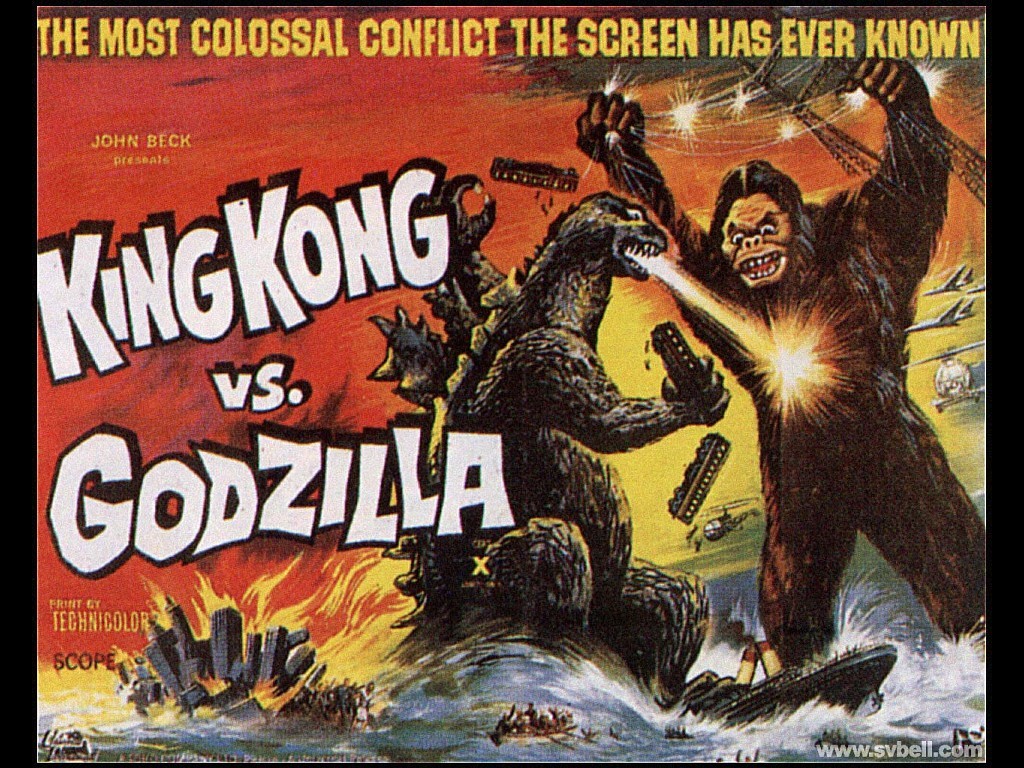
King Kong vs. Godzilla: The Remake


Gareth Edwards' Godzilla reboot has made a substantial amount at the box office and it has already been announced that there is going to be a sequel. The question is: What can they possibly do for a sequel? The answer is obvious - REMAKE King Kong Vs. Godzilla. I'm no talking about a gritty, bad ass remake, I'm talking a shot for shot, scene for scene remake of the 1963 Toho monster brawl.  I'm sure you are thinking, "That's blasphemy! King Kong Vs. Godzilla is a classic!" Okay, you probably were not thinking that! In fact, you were more than likely thing the exact opposite, and that's my point, King Kong Vs. Godzilla is ripe for a remake as it is one incredibly bad movie. Hell, it's bad even for a Godzilla movie! 

It's marred by one of the worst looking King Kong suits in cinema history; hell, it wouldn't cut mustard in a kindergarten pageant. It looks like director Ishiro Honda and Toho special effects crew dusted off whatever moth eaten ape suit they could find and figured that it was good enough. Not to mention, Kong's arms inexplicable change in length through the course of the movie; in one scene they are fairly stubby and in the next they are incredibly long. Kong looks more like a giant, furry mutation than an actual ape.


However, the only way to do this remake right would be to retain the silliness of the original film; a gritty reboot would look absolutely ridiculous. Part of the original's charm is it's wacky sense of humor; my favorite part being when Mr. Tako, the head of a pharmaceutical company, shouts, "King Kong can't make a monkey out of us." The last thing I want in a remake is a group of miserable people who look all sullen while two behemoths duke it out on the streets of Tokyo. King Kong vs.Godzilla is a silly premise, therefore it requires a campy approach to the material.  Therefore, I humbly suggest that Edward just xerox the script of the original film and upgrade its visual effects. Leave in the subplot about the magic berries that make Kong sleepy! The sight of a CG Kong getting stoned off of berry juice would be absolutely incredible! On the other hand, please change the end. It always irked me that Kong emerges triumphant in the end! I wanted Godzilla to vaporize that walking carpet!! C'mon Edwards, make it happen!

Sunday, May 25, 2014

Conan the Destroyer (1984)


I rather have a soft spot for Conan the Destroyer, which is, admittedly, due to my first seeing it on television as a kid; it’s a movie that my cousins and I watched on a repeated basis every time we hung out. It’s appealed laid in the fact that it was, essentially, a live action He-Man and The Masters of the Universe; with Conan filling in the role He-Man (sans the secret identity) and Queen Taramis (Sarah Douglas) as an Evil-Lyn surrogate. 


There are also loads of wizardry on display, battles, a giant monster, and, most memorable of all, a fight with a Man Ape (which resembles a Masters of the Universe reject). The writers even find to time to throw a virginal princess into the proceedings.  The difference between the two programs is that, as an adult, I find The Masters of the Universe absolutely unwatchable, while I am still greatly amused by Conan the Destroyer. I would never be as bold to proclaim it as being a good movie, that was greatly “misunderstood” by the critics, but it does make for an entertaining piece of 80s nostalgia; provided that you are in the right mind set. 

Conan the Destroyer was an attempt by Universal Studios to turn the Conan franchise into more “family friendly” fare by toning down the violence and amplifying the comedy relief. As a result, it is tonally inconsistent at times; it goes from goofy comedy to bloody violence, often in the same scene. The only thing that really makes it more palpable to children is the lack of sex. Though, there is a subplot devoted to Princess Jehnna's "sexual awakening." She has been sheltered her entire life and Conan is the first "real" man she has ever encountered, hence she is naturally attracted to him. There is even a scene in which the bumbling sidekick, Malak, attempts to talk to her about the birds and bees, but to no avail.


 The violence in the first film, Conan the Barbarian, had been a great concern for some critics, and the studio felt that its R rating kept it from being a bigger hit. I always found this criticism odd as Conan the Barbarian is a story that demands violence; after all, it’s not called Conan the Peace Maker. What most critics also ignore is that Conan does suffer the consequences of his actions; the most obvious being the death of his first, and only, love, Valeria. At the beginning of Conan the Destroyer, he is still mourning the loss of Valeria.  Conan is so lost in his grief that Queen Taramis is able to use this to her advantage; she promises to reunite him with Valeria if he agrees to partake in a quest that her niece, Princess Jehnna, is “destined” to make. It is prophesied that, on her quest, Jehnna will find a key that will awaken the Dreaming God, Dagoth.  Conan is so singled minded in his desire to be reunited with Valeria that it never occurs to him that Queen Taramis is lying. It also never crosses his mind that awakening a God might have dangerous consequences; when Akiro tries to warn him, Conan tells him to shut up. It’s only at the film’s climax, after having been betrayed by Bombaata, that Conan is able to get overcome his grief and just narrowly save the world.

If there is a fatal flaw to Conan the Destroyer is that it lacks a dynamic villain; Wilt Chamberlain, as the Captain of the Guards Bombaata, is a towering presence, but he is just a glorified henchman.  Taramis assigns him the important task of protecting Princess Jehnna’s virginity; this maybe one of the most ironic pieces of casting in movie history given Chamberlain’s claim that he slept with over 20,000 women. Whether this was intentional on the part of the filmmakers has yet to be seen.


Sarah Douglas is striking, and sexy, as Queen Taramis, with her statuesque figure and ice cold demeanor, but she is criminally under used; most of her screen time occurs in the first twenty minutes of the movie. She reappears at the climax, where she, rather abruptly, meets her comeuppance at the hands, or should I say horn, of Dagoth. It is a rather ridiculous end to a potentially great villain. We are misled into believing that Taramis is a worthy foe due to her hypnotic capabilities, but all that gets tossed out at the end.


Interestingly enough, it is also implied that she is also a warrior queen; at the beginning of the film she is suited up in armor and rides out with her men when they attempt to capture Conan. If there was ever a woman that could tempt Conan, it would be Queen Taramis as she is cut from the same cloth as Valeria. They are both extremely strong willed women and tall in stature; there is actually a moment where Taramis seems taller than Conan.  A better screenplay would have tossed out the whole Dagoth nonsense and focused primarily on Queen Taramis.  Sarah Douglas certainly has the acting chops to pull it off; she memorably played the evil Kryptonian, Ursa, in Superman II.

There is also a secondary villain in the form of Toth-Amon, a wizard who has in his possession a diamond Jehnna needs complete her quest.  He is merely a bump in the road and doesn't really have much purpose to the overall narrative. Though, his character is responsible for most memorable moment in the movie, Conan fighting an Man Ape monster in a room of mirrors. I admit the reveal of the monster scared me when I was a kid; it emerges from a mirror with its face obscured by a red hood. The audience is lead to believe this is the wizard Toth-Amon (who has a long, scraggly beard and one good eye), but then it pulls back the hood to reveal this ugly face:


AAAAAAAAAHHHHH! Well, that was my reaction when I was seven years-old.
My favorite bit is when the Man Ape grabs Conan by the ankles and swings him around in a circle. The look of bewilderment on Conan’s face never ceases to crack me up.  However, Conan’s discovery of Man Ape’s Achille’s Heel is fairly comical; he swings his sword backwards and accidentally smashes a mirror which, in turn, inflicts a huge injury on the monster’s body.


There are two heroines in Conan the Destroyer, Zula (Grace Jones ) and Princess Jehnna (Olivia d’Abo). It often feels like the writers took the character of Valeria and divided her into two different characters; Zula is a warrior, while Jehnna is the love interest, though it is more of a case of unrequited love. Jehnna develops a case of puppy dog love for Conan, but he never reciprocates her feelings.  This is done for two reasons:

1)      Valeria is the love of Conan’s life and no other woman could ever replace her.  When Jehnna asks if there could ever be another, Conan promptly replies, “Not on your life!”
2)      Olivia d’Abo was fifteen years-old while making this movie, hence it would feel downright sleazy to have Conan marry her in the end. They share a brief kiss at the end, but Conan is fairly indifferent to it.


However, it's also an example of how being politically correct can neuter a movie. Throughout the course of the movie so much is made of Jehnna's virginity; Queen Taramis sends Bombaata along on the quest to insure that Jehnna comes back as virgin, otherwise she won't make for a suitable sacrifice to Dagoth. The queen genuinely fears that Conan might have his way with Jehnna and when the princess develops a crush on him, it seems that her fears maybe well founded. It feels like the filmmakers are setting up a conflict for later in the movie; Will Conan give into his innermost temptations?  Jehnna constantly expresses her desire to be with Conan, however, this all proves to be a red herring.  Conan finds Jehnna to be rather petulant and is never tempted by her in the slightest. Jehnna, despite being smitten with Conan, never puts forth a real effort into seducing him. 

It doesn't help that Jehnna is completely devoid of a personality; she is solely defined by her relationship, or lack thereof, to Conan. Olivia d’Abo was awarded the Razzie for Worst New Star of 1984 (for her appearances in this film and the Bo Derek softcore porn, Bolero), but I find this to be a tad bit harsh. I think d’Abo does a fine job, given the circumstances; this was her first major role and she was given the assignment of bringing a completely underwritten character to life.  Hell, even a well respected actress would struggle with this character; just look at how bland Natalie Portman was in the Star Wars prequels. The fact that Jehnna isn't a totally unlikable character is a credit to d’Abo. 


Zula is another wasted opportunity.  Grace Jones with her androgynous features has a genuine screen presence, but too often her character fades into the background, while Conan and Bombaata are kicking some serious butt. Her main function is to be a sort of mentor to Jehnna; in the film’s funniest moment, Jehnna asks Zula how to get a man and Zula replies, “Grab him! And take him!”  Zula is a character who is driven by pure impulse and doesn’t have time for romantic nonsense. In another scene, Jehnna, hoping to impress Conan, asks Zula to teach her how to fight, but this gets interrupted by a drunken Conan, who rather, ineffectively, teaches Jehnna how to wield a sword. It’s a nice, humorous moment that successfully makes Conan more “human,” instead of the indestructible superman that often dominates the genre.  It must be said that Schwarzenegger, for all his limitations as an actor, is fairly adept at playing comedy.


The main problem with both of these female leads is that they fail to measure up to the character of Valeria from the previous film. Granted, this might have been intentional on the part of the writers, but because Zula and Jehnna are essentially the two sides of Valeria, they seem rather diluted at times;  Zula is a strong warrior, but she lacks Valeria’s warmth.  Jehnna is in love with Conan, but she is a rather weak willed character.  In Conan the Barbarian, Valeria was played by Sandahl Bergman, who with her piercing eyes and physical prowess made for a believable movie heroine.   For instance, compare Bergman’s fight scenes in Conan the Barbarian to Keira Knightley’s in the awful Pirates of the Caribbean sequels; despite all the fancy fight choreography, it is hard to believe that Knightly could ever hold her own in a sword fight, largely due to her twig-like figure.  On the other hand, it’s easy to believe that Bergman could stand her ground in a fight, because she has the physique of an athlete; she was a dancer in real life. In Conan the Barbarian, Valeria was Conan’s equal and even went so far as to fight the Gods for his life, on the other hand, in Conan the Destroyer, both Jehnna and Zula seem to be in constant awe of the man.  However, I will give the film this; there at least isn't a scene in which Jehnna inexplicably becomes an expert sword fighter, because the script demands it.  That’s what always irked me about the Pirates of the Caribbean sequels is how Elizabeth (Keira Knightley) goes from being the pampered daughter of a governor to a sword wielding badass without any transition. She just randomly picks up a sword and can hold her own against an expert.   

The two other members of Conan’s ragtag band of adventures are Malak (Tracey Walter) and Akiro (Mako). Malak is Conan’s bumbling sidekick who often complains about the lack of respect he is given.  In the first movie, Conan’s sidekick was Subotai, and while he was a source of humor, he was also a fairly competent warrior; the same cannot be said of Malak.  He is, in many ways, the audience surrogate in that he is often asking questions and expressing doubts about certain things, unfortunately, he is also pretty damn annoying at times. You often wish he would just shut his trap and let Conan go about his business. Though, there is a rather amusing scene, late in the film, where he keeps gabbing on about his "brother's sister's cousin."


Akiro serves multi-functions in the film; he is the minor comedy relief, a wizard, and, more importantly, the narrator of the story. Other than Conan, he is the only returning character from the first film. Mako's offbeat performance, in both films, is a lot of fun. It may not be the most complex characterization, but he manages to inject a lot of energy and humor into what could have been a rather thankless role.


Arnold Schwarzenegger is perfectly cast as Conan. It is a role that plays to his strengths as an actor; it highlights his muscular physique and gives him very little dialogue. I always felt that Schwarzenegger would have made a great silent actor, because not only does he have a magnificent physique, but a fairly expressive face as well. In Conan the Barbarian, the character becomes confident to the point arrogance, but that all changes when he loses Valeria. In Conan the Destroyer, he is a lost soul. At the beginning of the movie, he is wasting his potential on petty acts of thievery. At the movie's end, he is all alone; all of his companions stay behind to aide Jehnna in ruling her kingdom. He is not the cocksure protagonist of the first film, but rather an endless drifter. Conan keeps a stone face for most of the film, but his sad eyes tell the true story. Though, he is  not entirely dour, he does possess a sense of humor. I especially like this exchange between him and Jehnna:

Jehnna: I suppose nothing hurts you.
Conan: Only pain.

Conan is also far more cautious in the sequel; rather than blindly charging in and taking on Toth-Amon single handedly, Conan takes a short a detour to pick up Akiro, because he knows he'll need "magic to fight magic." In the first film, he tries to take on cult leader, Thulsa Doom, all by himself and is nearly killed for his efforts. He is stark contrast to Sylvester Stallone's John Rambo, who single handedly defeats the Vietnamese Army (and Russians) in Rambo: First Blood, Part II.  Though, it is a lot of fun to see Conan beat up on opponents twice his size.


The producers couldn't get John Milius to direct the sequel, so they turned to veteran director, Richard Fleischer. Fleischer had a rather long and interesting career in Hollywood;  he was at the helm of some genuinely good movies (20,000 Leagues Under the Sea, The Narrow Margin, Armored Car Robbery) and a few legendary turkeys (Che!, The Jazz Singer, Red Sonja). The best word to describe his direction is anonymous; he was a journeyman director who didn't have a distinct style, so he made a career aping other directors. In Conan the Destroyer, he seems content in doing his best John Milius impersonation, sans Milius' unapologetic approach to the material. Whether one likes or despises Milius, he was at least passionate about his film projects. Conan the Destroyer, on the other hand, was just another job for Richard Fleischer, and it often shows. Fleischer does have a knack for staging action scenes; the fight scenes in Conan the Destroyer are always comprehensible and exciting to watch. It's the non-action scenes that prove to be problematic.

The biggest asset to Conan the Destroyer is Jack Cardiff's beautiful cinematography, which gives the movie a lavish look; making it look far bigger than it actually is. The opening shot (of horses riding through the desert) is something you would expect to find in an epic like Lawrence of Arabia, not in a silly sword and sorcery film. It is almost enough to make you overlook the flaws in the script. 

Cast: Arnold Schwarzenegger (Conan), Olivia d’Abo (Princess Jehnna), Wilt Chamberlain (Bombaata), Grace Jones (Zula), Sarah Douglas (Queen Taramis), Tracey Walter (Malak), Mako (Akiro), Pat Roach (Man Ape/Toth-Amon), Jeff Corey (Grand Vizier), Ferdy Mayne (Leader), Sven-Ole Thorsen (Togra).
Director: Richard Fleischer
Screenplay: Stanley Mann.  Story by Roy Thomas and Gerry Conway.
Running Time: 101 min.


Snow White's Revenge/Scandal (2024)

  It is difficult to write about Snow White’s Revenge without bringing up the ending, so readers beware, this review will contain spoilers...